
Zanaga
Central Africa > Republic of the Congo > Zanaga
Français | Português | Español | Bahasa Indonesia | Melayu
Summary
- Central chimpanzees (Pan troglodytes troglodytes) and western lowland gorillas (Gorilla gorilla gorilla) are present in Zanaga.
- The population size is unknown.
- The population trend is unknown.
- The site has a total size of 25,570 km².
- Key threats to apes are illegal logging, hunting and mining activities.
- Conservation activities are not documented.
Site characteristics
The site is part of the Birougou-Batéké-Zanaga landscape, which has been identified as a priority landscape for western lowland gorilla and central chimpanzee conservation (IUCN 2014). The site overlaps with one of the largest iron ore deposits in Africa, located in a strip 47 kilometres long and three kilometres wide in the Republic of the Congo, bordering Gabon. A core section of the GuineoCongolian Forest is found over this vast mineral deposit, where endangered species like western lowland gorillas, chimpanzees, and forest elephants are found. Moreover, adjacent to the deposit lies the Ogooué River, one of Africa’s largest rivers by discharge (Stiles 2014).
Table 1. Basic site information for Zanaga
| Species | Pan troglodytes troglodytes, Gorilla gorilla gorilla |
| Area | 25,570 km² |
| Coordinates | Lat: -2.468761 , Lon: 13.627850 |
| Type of site | Logging concession |
| Habitat types | Subtropical/tropical moist lowland forest |
| Type of governance |
Types of sites Governance types Habitat types
Ape status
Table 2. Ape population estimates reported for Zanaga
| Species | Year | Occurrence | Encounter or vistation rate (nests/km; ind/day) | Density estimate [ind./ km²] (95% CI) | Abundance estimate (95% CI) | Survey area | Sampling method | Analytical framework | Source | Comments | A.P.E.S. database ID |
|---|---|---|---|---|---|---|---|---|---|---|---|
| Pan troglodytes troglodytes | Zanaga | ||||||||||
| Gorilla gorilla gorilla | Zanaga |
Sampling methods Analytical frameworks
Threats
Zanaga Iron Ore Company Limited is an iron ore exploration and development company, incorporated in the British Virgin Islands. The Company listed on AIM in November 2010 and trades under the symbol “ZIOC”. The logging companies operating in the area have already done a great deal of damage to the ecosystem diversity and composition of the forests surrounding the mine (Sitles 2014).
Table 3. Threats to apes reported for Zanaga
| Category | Specific threats | Threat level | Description | Year of threat |
|---|---|---|---|---|
| 3 Energy production & mining | 3.2 Mining & quarrying | High (more than 70% of population affected) | Presence of a large scale iron ore mine project (on.com/project/ Zanaga Iron Ore Project) . | Ongoing (2023) |
| 5 Biological resource use | 5.1 Hunting & collecting terrestrial animals | High (more than 70% of population affected) | Commercial hunting is the biggest threat to wildlife in the area (IUCN 2014). | Ongoing (2014) |
| 5 Biological resource use | 5.3 Logging & wood harvesting | High (more than 70% of population affected) | Three Asian logging companies operating in overlapping parts of the mine concession. Loggers are principally interested in exploiting and exporting Okoumé (Aucoumea klaineana), a hardwood used for plywood (Stiles 2014). | Ongoing (2014) |
Conservation activities
Challenges
Table 5. Challenges reported for Zanaga
| Challenges | Specific challenges | Source | Year(s) |
|---|---|---|---|
| Not reported |
Enablers
Table 6. Enablers reported for Zanaga
| Enablers | Specific enablers | Source | Year(s) |
|---|---|---|---|
| 1 Site management | |||
| 2 Resources and capacity | |||
| 3 Engaged community | |||
| 4 Institutional support | |||
| 5 Ecological context | |||
| 6 Safety and stability |
Research activities
Documented behaviours
Table 7. Behaviours documented for Zanaga
| Category | Behavior | Observation type | Prevalence | Observation dates | Source | Habituation | Species | Comment |
|---|---|---|---|---|---|---|---|---|
| Not reported |
Exposure to climate change impacts
As part of a study on the exposure of African great ape sites to climate change impacts, Kiribou et al. (2024) extracted climate data and data on projected extreme climate impact events for the site. Climatological characteristics were derived from observation-based climate data provided by the Inter-Sectoral Impact Model Intercomparison Project (ISIMIP, www.isimip.org). Parameters were calculated as the average across each 30-year period. For 1981-2010, the EWEMBI dataset from ISIMIP2a was used. For the two future periods (2021-2050 and 2071-2099) ISIMIP2b climate data based on four CMIP5 global climate models were used. For future projections, two Representative Concentration Pathways (RCP) were used. RCP 2.6 is a scenario with strong mitigation measures in which global temperatures would likely rise below 2C. RCP 6.0 is a scenario with medium emissions in which global temperatures would likely rise up to 3C by 2100. For the number of days with heavy precipitation events, the 98th percentile of all precipitation days (>1mm/d) was calculated for the 1979-2013 reference period as a threshold for a heavy precipitation event. Then, for each year, the number of days above that threshold was derived. The figures on temperature and precipitation anomaly show the deviation from the mean temperature and mean precipitation for the 1979-2013 reference period.
The estimated exposure to future extreme climate impact events (crop failure, drought, river flood, wildfire, tropical cyclone, and heatwave) is based on a published dataset by Lange et al. 2020 derived from ISIMIP2b data. The same global climate models and RCPs as described above were used. Within each 30-year period, the number of years with an extreme event and the average proportion of the site affected were calculated (Kiribou et al. 2024).
Table 8. Estimated past and projected climatological characteristics in Zanaga
| Value | 1981-2010 | 2021-2050, RCP 2.6 | 2021-2050, RCP 6.0 | 2071-2099, RCP 2.6 | 2071-2099, RCP 6.0 |
|---|---|---|---|---|---|
| Mean temperature [C] | 23.7 | 24.8 | 24.7 | 24.9 | 26 |
| Annual precipitation [mm] | 1973 | 1979 | 2010 | 2038 | 2001 |
| Max no. consecutive dry days (per year) | 37.5 | 28.8 | 26.3 | 33.9 | 27.2 |
| No. days with heavy precipitation (per year) | 6.1 | 9 | 8.9 | 8.8 | 9.2 |
Table 9. Projected exposure of apes to extreme climate impact events in Zanaga
| Type | No. of years with event (2021-2050, RCP 2.6) | % of site exposed (2021-2050, RCP 2.6) | No. of years with event (2021-2050, RCP 6.0) | % of site exposed (2021-2050, RCP 6.0) | No. of years with event (2070-2099, RCP 2.6) | % of site exposed (2070-2099, RCP 2.6) | No. of years with event (2070-2099, RCP 6.0) | % of site exposed (2070-2099, RCP 6.0) |
|---|---|---|---|---|---|---|---|---|
| Crop failure | 4.5 | 0.01 | 6.5 | 0.01 | 6 | 0 | 13 | 0 |
| Drought | 0 | 0 | 0 | 0 | 0 | 0 | 0 | 0 |
| Heatwave | 1 | 50 | 0.5 | 50 | 1 | 50 | 4 | 50 |
| River flood | 0 | 0 | 0 | 0 | 0.5 | 0 | 0 | 0 |
| Tropical cyclone | 0 | 0 | 0 | 0 | 0 | 0 | 0 | 0 |
| Wildfire | 30 | 0.6 | 30 | 0.59 | 29 | 0.62 | 29 | 0.58 |
-
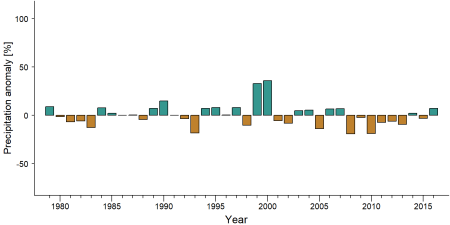
Precipitation anomaly in Zanaga -
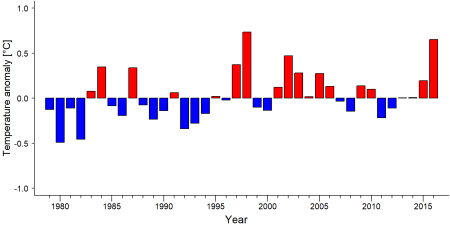
Temperature anomaly in Zanaga


External links
References
IUCN - International Union for Conservation of Nature (2014). Regional Action Plan for the Conservation of Western Lowland Gorillas and Central Chimpanzees 2015–2025. International Union for Conservation of Nature. doi:10.2305/iucn.ch.2005.ssc-rap.1.en
Stiles, D. (2014). The Zanaga iron ore mine – a test of best laid plans for preserving wildlife. Retrieved February 27, 2023 from Mongabay. https://news.mongabay.com/2014/10/the-zanaga-iron-ore-mine-a-testof-best-laid-plans-for-preserving-wildlife/
Kiribou, R., Tehoda, P., Chukwu, O., Bempah, G., Kühl, H. S., Ferreira, J., …, & Heinicke, S. (2024). Exposure of African ape sites to climate change impacts. PLOS Climate, 3(2), e0000345. doi:10.1371/journal.pclm.0000345
on.com/project/ Zanaga Iron Ore Project. https://www.zanagair
Page created by: APES Atlas Team Date: 2023-02-24