
Mwagna National Park
Central Africa > Gabon > Mwagna National Park
Français | Português | Español | Bahasa Indonesia | Melayu
Summary
- Central chimpanzees (Pan troglodytes troglodytes) & western lowland gorillas (Gorilla gorilla gorilla) are present in Mwagna National Park.
- The population sizes are unknown.
- The great ape population trend is unknown.
- The site has a total size of 1160 km².
- Key threats to great apes are hunting and disease outbreaks, and human wildlife conflict, logging and mining activities.
- The main conservation activities include awareness-raising and education, employing local people in conservation efforts, providing health and well-being services to local communities, restoring natural habitats, and conducting law enforcement and patrol operations.
- The site is part of the TRIDOM (Trinational Dja-Odzala-Minkébé) landscape.
Site characteristics
The site is located in the far east of Gabon, bordering the Republic of Congo. The park is home to forest elephants, hogs, western lowland gorillas, bongo antelopes, and rare endemic bird and plant species (Discover Gabon). The site is part of the TRIDOM (Trinational Dja-Odzala-Minkébé) landscape.
Table 1. Basic site information for Mwagna National Park
| Species | Pan troglodytes troglodytes, Gorilla gorilla gorilla |
| Area | 1,160 km² |
| Coordinates | Lat: 0.472048 , Lon: 13.778030 |
| Type of site | Protected area (National Park) |
| Habitat types | Subtropical/tropical moist lowland forest |
| Type of governance | Governance by government |
Types of sites Governance types Habitat types
Ape status
A study conducted in 2004 revealed that the park's gorilla population had been severely affected by Ebola epidemics, with all gorillas present in 2001 having disappeared. During this study, only five very old nests and a long-gnawed termite mound (at least one year old, possibly more) were recorded.
No signs of great ape feeding were observed (Maisels et al., 2004).
Between 2004 and 2012, the nest discovery rate increased (Maisels and Akou, 2013).
Between September 2019 and December 2023, during reconnaissance patrols by park surveillance teams, individuals (21) of Gorilla were observed in several locations in the park (See SMART sighting map).
Between September 2019 and December 2023, during reconnaissance patrols by surveillance teams, 170 Chimpanzees distributed in different groups and locations in the park were sighted (See SMART sighting map).
Table 2. Ape population estimates reported for Mwagna National Park
| Species | Year | Occurrence | Encounter or vistation rate (nests/km; ind/day) | Density estimate [ind./ km²] (95% CI) | Abundance estimate (95% CI) | Survey area | Sampling method | Analytical framework | Source | Comments | A.P.E.S. database ID |
|---|---|---|---|---|---|---|---|---|---|---|---|
| Pan troglodytes troglodytes and 'Gorilla gorilla gorilla | 2012 | 0.6 | Mwagna National Park | Line transects & recces | Maisels & Akou 2013 | ||||||
| Pan troglodytes troglodytes and 'Gorilla gorilla gorilla | 2004 | 0.0 | Mwagna National Park | Reconnaissance walk | Maisels et al. 2004 | No great apes recorded after the Ebola outbreak. | GAB0049 |
Sampling methods Analytical frameworks
Threats
A drastic reduction in ape numbers occurred between 2001 and 2004 almost certainly due to Ebola outbreaks (Maisels et al. 2004).
Table 3. Threats to apes reported for Mwagna National Park
| Category | Specific threats | Threat level | Description | Year of threat |
|---|---|---|---|---|
| 3 Energy production & mining | 3.2.3 Artisanal mining | Present (unknown severity) | Illegal mining activities including artisanal gold mining have been reported and are among the main causes of habitat loss (IBINGA SANA pers. comm. 2025). | Ongoing (2025) |
| 5 Biological resource use | 5.1 Hunting & collecting terrestrial animals | Present (unknown severity) | A survey in 2004 documented the presence of hunting trails (Maisels et al. 2004). One machete cut was recorded inside the park during a survey in 2012; outside the park, snares and shotgun shells were recorded (Maisels & Akou 2013). National and transboundary poaching has also been reported, with occasional intrusions by Congolese hunters and artisanal miners. This leads to population reduction, disruption of population dynamics, and disturbance of social behavior (IBINGA SANA pers. comm. 2025) | 2013-Ongoing (2025) |
| 5 Biological resource use | 5.1.5 Persecution/human wildlife conflict | Present (unknown severity) | The presence of human–great ape conflict, where local communities feel unsafe due to shared use of wild natural resources such as fruits with great apes, leads to encounters on forest paths and trails. These interactions can result in the killing of great apes for trade or cultural purposes (IBINGA SANA pers. comm. 2025). | Ongoing (2025) |
| 5 Biological resource use | 5.3.2 Commercial logging | Present (unknown severity) | The presence of the SUNNRY forest concession leased to Vision Wood Gabon has resulted in extensive logging activities, leading to habitat loss, population fragmentation, and increased access to hunting areas (IBINGA SANA pers. comm. 2025). | Ongoing (2025) |
| 8 Invasive & other problematic species, genes & diseases | 8.4 Pathogens | High (more than 70% of population affected) | Ebola outbreaks in the early 2000s decimated the gorilla population in the park (Maisels & Akou 2013, Bermejo et al. 2006). There remains a significant risk of disease transmission between humans and apes in both directions, as was reported again in 2025 (IBINGA SANA pers. comm. 2025) | 2002-Ongoing (2025) |
Conservation activities
Table 4. Conservation activities reported for Mwagna National Park
| Category | Specific activity | Description | Implementing organization(s) | Year of activity |
|---|---|---|---|---|
| 1 Development impact mitigation | 1.5 Install mechanical barriers or use natural hedges to deter apes | Activities related to building fences around farmers’ fields have been reported (IBINGA SANA pers. comm. 2025). | Ongoing (2025) | |
| 2 Counter-wildlife crime | 2.1 Implement road blocks to inspect cars for illegal ape bushmeat | Strengthening collaboration with law enforcement and customs authorities to intercept wildlife traffickers and combat illegal trade (IBINGA SANA pers. comm. 2025). | Ongoing (2025) | |
| 2 Counter-wildlife crime | 2.13 Provide sustainable alternative livelihoods; establish fish- or domestic meat farms | Local people are offered with sustainable economic alternative activities (IBINGA SANA pers. comm. 2025) | Ongoing (2025) | |
| 2 Counter-wildlife crime | 2.3 Conduct regular anti-poaching patrols | Ongoing anti-poaching patrols and enhanced surveillance activities have been reported in order to strengthen the management and protection of Mwagna National Park against poaching, illegal logging, and mining. (IBINGA SANA pers. comm. 2025). | Ongoing (2025) | |
| 4 Education & awareness | 4 Education & awareness | Awareness-raising and sensitization activities related to great apes were reported (IBINGA SANA pers. comm. 2025). | Ongoing (2025) | |
| 4 Education & awareness | 4.2 Involve local community in ape research and conservation management | Local people are involved in conservation efforts, informing them of the issues related to the great apes protection (IBINGA SANA pers. comm. 2025). | Ongoing (2025) | |
| 5 Protection & restoration | 5.2 Legally protect ape habitat | The site is a national park. | 2002-Ongoing (2026) | |
| 5 Protection & restoration | 5.6 Habitat restoration | Forest rehabilitation and protection activities have reported (IBINGA SANA pers. comm. 2025).
|
Ongoing (2025) | |
| 7 Economic & other incentives | 7.1 Provide monetary benefits to local communities for sustainably managing their forest and its wildlife (e.g., REDD, alternative income, employment) | Local people are employed to work in conservation programs/projects (IBINGA SANA pers. comm. 2025). | Ongoing (2025) | |
| 7 Economic & other incentives | 7.2 Provide non-monetary benefits to local communities for sustainably managing their forest and its wildlife (e.g., better education, infrastructure development) | Health and well-being services are delivered to local communities, while efforts are made to support and advance ecotourism development (IBINGA SANA pers. comm. 2025). | Ongoing (2025) |
Challenges
Table 5. Challenges reported for Mwagna National Park
| Challenges | Specific challenges | Source | Year(s) |
|---|---|---|---|
| 2 Resources and capacity | 2.2 Lack of staff | IBINGA SANA pers. comm. 2025 | 2025 |
| 2 Resources and capacity | 2.3 General lack of funding | IBINGA SANA pers. comm. 2025 | 2025 |
| 2 Resources and capacity | 2.4 Lack of continuous/long-term funding | IBINGA SANA pers. comm. 2025 | 2025 |
| 2 Resources and capacity | 2.6 Lack of biomonitoring/survey data | IBINGA SANA pers. comm. 2025 | 2025 |
Enablers
Table 6. Enablers reported for Mwagna National Park
| Enablers | Specific enablers | Source | Year(s) |
|---|---|---|---|
| 1 Site management | 1.1 Effective leadership | IBINGA SANA pers. comm. 2025 | 2025 |
| 1 Site management | 1.2 Effective coordination | IBINGA SANA pers. comm. 2025 | 2025 |
| 2 Resources and capacity | 2.1 Sufficient staff | IBINGA SANA pers. comm. 2025 | 2025 |
| 2 Resources and capacity | 2.6 External partnerships that add expertise or resources | IBINGA SANA pers. comm. 2025 | 2025 |
| 3 Engaged community | 3.1 Strong local environmental knowledge | IBINGA SANA pers. comm. 2025 | 2025 |
| 3 Engaged community | 3.6 Local community engagement and support | IBINGA SANA pers. comm. 2025 | 2025 |
| 4 Institutional support | |||
| 5 Ecological context | |||
| 6 Safety and stability |
Research activities
Mwagna National Park' serves as a dynamic research hub focused on wildlife ecology, botany, conservation, and sustainable development. Studies target species such as forest elephants, great apes, and diverse flora particularly those thriving in mineral-rich soils, while also assessing the environmental impacts of human activities like hunting and agriculture. Conservation efforts prioritize habitat protection and anti-poaching, supported by sustainable tourism initiatives that raise public awareness and generate funding. Crucially, research is participatory, involving local communities through knowledge sharing and mapping practices, making the park a vital space for crafting tailored, inclusive conservation strategies (IBINGA SANA pers. comm. 2025).
Documented behaviours
Table 7. Behaviours documented for Mwagna National Park
| Category | Behavior | Observation type | Prevalence | Observation dates | Source | Habituation | Species | Comment |
|---|---|---|---|---|---|---|---|---|
| Not reported |
Exposure to climate change impacts
As part of a study on the exposure of African great ape sites to climate change impacts, Kiribou et al. (2024) extracted climate data and data on projected extreme climate impact events for the site. Climatological characteristics were derived from observation-based climate data provided by the Inter-Sectoral Impact Model Intercomparison Project (ISIMIP, www.isimip.org). Parameters were calculated as the average across each 30-year period. For 1981-2010, the EWEMBI dataset from ISIMIP2a was used. For the two future periods (2021-2050 and 2071-2099) ISIMIP2b climate data based on four CMIP5 global climate models were used. For future projections, two Representative Concentration Pathways (RCP) were used. RCP 2.6 is a scenario with strong mitigation measures in which global temperatures would likely rise below 2C. RCP 6.0 is a scenario with medium emissions in which global temperatures would likely rise up to 3C by 2100. For the number of days with heavy precipitation events, the 98th percentile of all precipitation days (>1mm/d) was calculated for the 1979-2013 reference period as a threshold for a heavy precipitation event. Then, for each year, the number of days above that threshold was derived. The figures on temperature and precipitation anomaly show the deviation from the mean temperature and mean precipitation for the 1979-2013 reference period.
The estimated exposure to future extreme climate impact events (crop failure, drought, river flood, wildfire, tropical cyclone, and heatwave) is based on a published dataset by Lange et al. 2020 derived from ISIMIP2b data. The same global climate models and RCPs as described above were used. Within each 30-year period, the number of years with an extreme event and the average proportion of the site affected were calculated (Kiribou et al. 2024).
Table 8. Estimated past and projected climatological characteristics in Mwagna National Park
| Value | 1981-2010 | 2021-2050, RCP 2.6 | 2021-2050, RCP 6.0 | 2071-2099, RCP 2.6 | 2071-2099, RCP 6.0 |
|---|---|---|---|---|---|
| Mean temperature [C] | 23.8 | 25 | 24.9 | 25.3 | 26.2 |
| Annual precipitation [mm] | 3177 | 3207 | 3170 | 3226 | 3223 |
| Max no. consecutive dry days (per year) | 24.8 | 13.6 | 12.3 | 12.2 | 12.3 |
| No. days with heavy precipitation (per year) | 7.4 | 8.1 | 7.9 | 8 | 8.6 |
Table 9. Projected exposure of apes to extreme climate impact events in Mwagna National Park
| Type | No. of years with event (2021-2050, RCP 2.6) | % of site exposed (2021-2050, RCP 2.6) | No. of years with event (2021-2050, RCP 6.0) | % of site exposed (2021-2050, RCP 6.0) | No. of years with event (2070-2099, RCP 2.6) | % of site exposed (2070-2099, RCP 2.6) | No. of years with event (2070-2099, RCP 6.0) | % of site exposed (2070-2099, RCP 6.0) |
|---|---|---|---|---|---|---|---|---|
| Crop failure | 7.5 | 0 | 4 | 0 | 5 | 0 | 11 | 0 |
| Drought | 0 | 0 | 0 | 0 | 0 | 0 | 0 | 0 |
| Heatwave | 5.5 | 100 | 4 | 100 | 3.5 | 100 | 10 | 100 |
| River flood | 1 | 0.41 | 1.25 | 0.61 | 1.75 | 0.48 | 3.5 | 0.68 |
| Tropical cyclone | 0 | 0 | 0 | 0 | 0 | 0 | 0 | 0 |
| Wildfire | 30 | 0.29 | 30 | 0.25 | 29 | 0.27 | 29 | 0.25 |
-
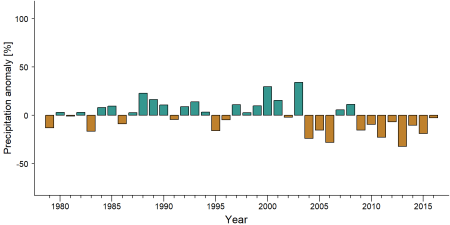
Precipitation anomaly in Mwagna National Park -
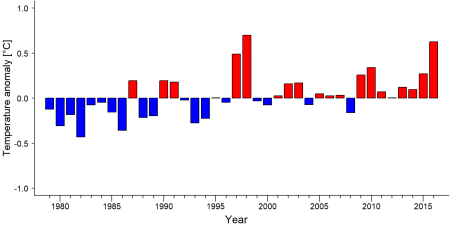
Temperature anomaly in Mwagna National Park


External links
References
Bermejo, M., Rodríguez-Teijeiro, J. D., Illera, G., Barroso, A., Vilà, C., & Walsh, P. D. (2006). Ebola Outbreak Killed 5000 Gorillas. Science, 314(5805), 1564-1564. doi:10.1126/science.1133105
Maisels, F. and Akou, M.E. (2013). Mwagne National Park: Report on survey transects 2012. WWF unpublished report.
Maisels, F., Akou, M.E., Douckaga, M. & Moundounga, A. (2004). Mwagne National Park Trip Report, Nov-Dec 2004 Large Mammals and Human Impact. WCS unpublished report.
Kiribou, R., Tehoda, P., Chukwu, O., Bempah, G., Kühl, H. S., Ferreira, J., …, & Heinicke, S. (2024). Exposure of African ape sites to climate change impacts. PLOS Climate, 3(2), e0000345. doi:10.1371/journal.pclm.0000345
Page created by: APES Atlas Team Date: 2023-07-11
Page updated by: Ibinga Sana Guy Ghislain Date: 2025-07-25