
East Nimba Nature Reserve
West Africa > Liberia > East Nimba Nature Reserve
Français | Português | Español | Bahasa Indonesia | Melayu
Summary
- Western chimpanzees (Pan troglodytes verus) are present in East Nimba Nature Reserve.
- It has been estimated that 28 individuals occur at the site.
- The chimpanzee population trend is stable.
- This site has a total size of 135 km².
- Key threats to chimpanzees are habitat loss due to iron ore mining and shifting agriculture, and poaching.
- Flora and Fauna International, and Conservation International support Liberia’s Forest Development Authority in the protection of the site and implementation of conservation activities, focused mainly on education and awareness.
- The site borders Mount Nimba Strict Nature Reserve in Guinea.
Site characteristics
East Nimba Nature Reserve is located in the north of Liberia, bordering Guinea and Cote d’Ivoire. East Nimba Nature Reserve was established in 2003 and covers part of the Mount Nimba Mountain range, which spans across Liberia, Guinea, and Cote d’Ivoire. The reserve borders Mount Nimba Strict Nature Reserve (UNEP-WCMC and IUCN 2019). In addition to the Western chimpanzee, other endangered and endemic (species) inhabit the site, including Jentink’s duiker (Cephalophus jentinki), Nimba otter shrew (Micropotamogale lamottei), Nimba flycatcher (Melaenornis annamarulae) and Nimba toad (Nimbaphrynoides occidentalis).
Table 1. Basic site information for East Nimba Nature Reserve
| Species | Pan troglodytes verus |
| Area | 135 km² |
| Coordinates | Lat: 7.51 , Lon: -8.53 |
| Type of site | Protected area (Strict Nature Reserve) |
| Habitat types | Subtropical/tropical moist montane forest |
| Type of governance |
Types of sites Governance types Habitat types
Ape status
The population in East Nimba Strict Nature Reserve has been estimated at 28 individuals (WCF unpubl. data). In addition, chimpanzee presence in the reserve has been recorded by the nationwide survey teams (Tweh et al. 2014). However, based on two unpublished datasets from 2010 (WCF unpubl. data) and 2014 (PANAF unpubl. data) Kühl et al. (2017) estimated a stable population size for this site.
Table 2. Ape population estimates reported for East Nimba Nature Reserve
| Species | Year | Occurrence | Encounter or vistation rate (nests/km; ind/day) | Density estimate [ind./ km²] (95% CI) | Abundance estimate (95% CI) | Survey area | Sampling method | Analytical framework | Source | Comments | A.P.E.S. database ID |
|---|---|---|---|---|---|---|---|---|---|---|---|
| Pan troglodytes verus | 2011-2012 | Present | East Nimba Nature Reserve | Line transects | Tweh et al. 2014 | LBR0026 | |||||
| Pan troglodytes verus | 2010-2011 | 0.17 | East Nimba Nature Reserve (area around Geipa, Camp 4, Cold Water) | Reconnaissance walk | CI 2012 | ‘reconnaissance walk’, survey effort: 41.32 km | |||||
| Pan troglodytes verus | 2010 | 28.0 | East Nimba Nature Reserve | Reconnaissance walk | WCF unpubl. data, in Kühl et al. 2017 | ‘reconnaissance walk’, survey effort: 178 km |
Sampling methods Analytical frameworks
Threats
Part of the nature reserve was severely degraded due to iron ore mining that occurred between 1962 and 1989 (CILSS 2016). The site has also been severely affected by deforestation; between 1974 and 2014, about half of its forest cover was lost (CILSS 2016). Bushmeat hunting in the area is also a key threat to chimpanzees (Bene et al. 2013).
Table 3. Threats to apes reported for East Nimba Nature Reserve
| Category | Specific threats | Threat level | Description | Year of threat |
|---|---|---|---|---|
| 2 Agriculture & aquaculture | 2.1 Annual & perennial non-timber crops | High (more than 70% of population affected) | Slash-and-burn agriculture around the park (CILSS 2016) and potential of encroachment (Zansi, G. K., pers. Comm. 2023). | 2016-Ongoing (2023) |
| 3 Energy production & mining | 3.2 Mining & quarrying | High (more than 70% of population affected) | Iron ore mining (CILSS 2016) | 1969-1989 |
| 4 Transportation & service corridors | 4.1 Roads & railroads | Low (up to 30% of population affected) | Mining activities lead to the construction of roads, further impacting the area (CILSS 2016). Two old roads are present, but with low traffic (Zansi, G. K., pers. Comm. 2023). | 2016-Ongoing (2023) |
| 5 Biological resource use | 5.1 Hunting & collecting terrestrial animals | High (more than 70% of population affected) | High hunting and poaching rates have been reported in the Nimba mountain range in Liberia (Bene et al. 2013) | Ongoing (2013) |
| 5 Biological resource use | 5.2 Gathering terrestrial plants | High (more than 70% of population affected) | Collection of NTFPs; especially fruit trees (Zansi, G. K., pers. Comm. 2023). | Ongoing (2023) |
| 5 Biological resource use | 5.3 Logging & wood harvesting | High (more than 70% of population affected) | The site lost half of its forest cover due to logging between 1974 and 2014 (CILSS 2016) | 1974-2014 |
| 6 Human intrusions & disturbance | 6.2 War, civil unrest & military exercises | High (more than 70% of population affected) | Influx of people fleeing areas of civil conflict during two civil wars, also resulting in a lack of law enforcement and increase in illegal logging and hunting (CILSS 2016) | 1989-1996, 1999-2003 |
| 7 Natural system modifications | 7.1 Fire & fire suppression | Low (up to 30% of population affected) | Fires sometimes started by farmers and hunters near the site (Zansi, G. K., pers. Comm. 2023). | Ongoing (2023) |
Conservation activities
Liberia’s Forestry Development Authority (FDA) is responsible for the protection and long-term management of East Nimba Nature Reserve. The site lies within the concession of an iron ore mining company, Arcelor Mittal Liberia (AML). In 2015, AML funded a (joint project) with Flora and Fauna International to ensure the effective management of the site and provide technical support and capacity building (FFI). Conservation International (CI) have also contributed to the protection of the site by providing environmental education and conservation awareness in nearby communities (FFI). As part of a livelihood improvement project, CI recruited Frontline Conservationists from local communities, who patrol and monitor the forests in exchange for a monthly stipend (CI 2016).
Table 4. Conservation activities reported for East Nimba Nature Reserve
| Category | Specific activity | Description | Implementing organization(s) | Year of activity |
|---|---|---|---|---|
| 2 Counter-wildlife crime | 2.3 Conduct regular anti-poaching patrols | FDA rangers and community eco guards conduct patrols (Zansi, G. K., pers. Comm. 2023). | Ongoing (2023) | |
| 4 Education & awareness | 4.1 Educate local communities about apes and sustainable use | FFI, UNOPS and PAPFor provide environmental education and raise conservation awareness around the reserve (CI 2016, FFI 2019). In the past, CI also conducted this activity (Zansi, G. K., pers. Comm. 2023). | 2016-Ongoing (2023) | |
| 4 Education & awareness | 4.2 Involve local community in ape research and conservation management | CI recruited Frontline Conservationists from local communities receive a stipend for patrolling, gathering data, and help raise awareness (CI 2016) | Ongoing (2016) | |
| 5 Protection & restoration | 5.2 Legally protect ape habitat | The site was designated as nature reserve in 2003 (UNEP-WCMC and IUCN 2019) | 2003-Ongoing (2026) |
Challenges
Table 5. Challenges reported for East Nimba Nature Reserve
| Challenges | Specific challenges | Source | Year(s) |
|---|---|---|---|
| Not reported |
Enablers
Table 6. Enablers reported for East Nimba Nature Reserve
| Enablers | Specific enablers | Source | Year(s) |
|---|---|---|---|
| 1 Site management | |||
| 2 Resources and capacity | |||
| 3 Engaged community | |||
| 4 Institutional support | |||
| 5 Ecological context | |||
| 6 Safety and stability |
Research activities
No information on research activities has been documented.
Documented behaviours
Table 7. Behaviours documented for East Nimba Nature Reserve
| Category | Behavior | Observation type | Prevalence | Observation dates | Source | Habituation | Species | Comment |
|---|---|---|---|---|---|---|---|---|
| Not reported |
Exposure to climate change impacts
As part of a study on the exposure of African great ape sites to climate change impacts, Kiribou et al. (2024) extracted climate data and data on projected extreme climate impact events for the site. Climatological characteristics were derived from observation-based climate data provided by the Inter-Sectoral Impact Model Intercomparison Project (ISIMIP, www.isimip.org). Parameters were calculated as the average across each 30-year period. For 1981-2010, the EWEMBI dataset from ISIMIP2a was used. For the two future periods (2021-2050 and 2071-2099) ISIMIP2b climate data based on four CMIP5 global climate models were used. For future projections, two Representative Concentration Pathways (RCP) were used. RCP 2.6 is a scenario with strong mitigation measures in which global temperatures would likely rise below 2C. RCP 6.0 is a scenario with medium emissions in which global temperatures would likely rise up to 3C by 2100. For the number of days with heavy precipitation events, the 98th percentile of all precipitation days (>1mm/d) was calculated for the 1979-2013 reference period as a threshold for a heavy precipitation event. Then, for each year, the number of days above that threshold was derived. The figures on temperature and precipitation anomaly show the deviation from the mean temperature and mean precipitation for the 1979-2013 reference period.
The estimated exposure to future extreme climate impact events (crop failure, drought, river flood, wildfire, tropical cyclone, and heatwave) is based on a published dataset by Lange et al. 2020 derived from ISIMIP2b data. The same global climate models and RCPs as described above were used. Within each 30-year period, the number of years with an extreme event and the average proportion of the site affected were calculated (Kiribou et al. 2024).
Table 8. Estimated past and projected climatological characteristics in East Nimba Nature Reserve
| Value | 1981-2010 | 2021-2050, RCP 2.6 | 2021-2050, RCP 6.0 | 2071-2099, RCP 2.6 | 2071-2099, RCP 6.0 |
|---|---|---|---|---|---|
| Mean temperature [C] | 25.4 | 26.6 | 26.5 | 26.7 | 27.8 |
| Annual precipitation [mm] | 1886 | 1933 | 1960 | 1956 | 2044 |
| Max no. consecutive dry days (per year) | 29.8 | 30.3 | 28.3 | 31.5 | 32.1 |
| No. days with heavy precipitation (per year) | 6.4 | 7.7 | 7.7 | 7.9 | 9.9 |
Table 9. Projected exposure of apes to extreme climate impact events in East Nimba Nature Reserve
| Type | No. of years with event (2021-2050, RCP 2.6) | % of site exposed (2021-2050, RCP 2.6) | No. of years with event (2021-2050, RCP 6.0) | % of site exposed (2021-2050, RCP 6.0) | No. of years with event (2070-2099, RCP 2.6) | % of site exposed (2070-2099, RCP 2.6) | No. of years with event (2070-2099, RCP 6.0) | % of site exposed (2070-2099, RCP 6.0) |
|---|---|---|---|---|---|---|---|---|
| Crop failure | 3 | 0.35 | 3.5 | 0.63 | 3.5 | 0.33 | 8.5 | 0.65 |
| Drought | 0 | 0 | 0 | 0 | 0 | 0 | 0 | 0 |
| Heatwave | 10 | 100 | 5.5 | 100 | 9.5 | 100 | 15 | 100 |
| River flood | 1.25 | 1.15 | 2.5 | 1.96 | 1.75 | 3.29 | 4.5 | 3.72 |
| Tropical cyclone | 0 | 0 | 0 | 0 | 0 | 0 | 0 | 0 |
| Wildfire | 30 | 0.37 | 30 | 0.36 | 29 | 0.37 | 29 | 0.36 |
-
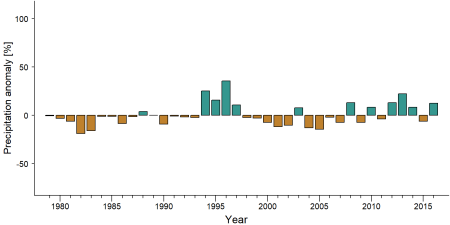
Precipitation anomaly in East Nimba Nature Reserve -
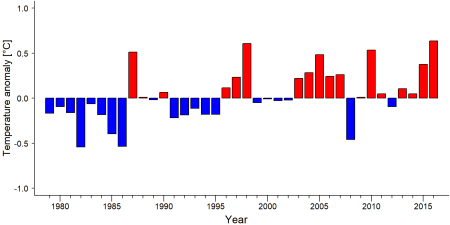
Temperature anomaly in East Nimba Nature Reserve


External links
References
Bene, J.K., Gamys, J. & Dufour, S. 2013. A wealth of wildlife endangered in northern Nimba county, Liberia. International Journal of Innovation and Applied Studies, 2, 314–323. link
CI. 2016. East Nimba Nature Reserve Forest Conservation Project. Online: https://www.daikin.com/csr/forests/project/pdf/report_liberia_e_201605.pdf
CILSS. 2016. Landscapes of West Africa- a window on a changing world. U. S. Geological Survey EROS, 47914 252nd St, Garretson, SD 57030, United States.
FFI. 2019. Implementing effective management of East Nimba Nature Reserve. Online: https://www.fauna-flora.org/projects/implementing-effective-management-east-nimba-nature-reserve
Kühl, H. S., Sop, T., Williamson, E. A., Mundry, R., Brugière, D., Campbell, G., …, & Boesch, C. (2017). The Critically Endangered western chimpanzee declines by 80%. American Journal of Primatology, 79(9), e22681. doi:10.1002/ajp.22681
Tweh, C. G., Lormie, M. M., Kouakou, C. Y., Hillers, A., Kühl, H. S., & Junker, J. (2015). Conservation status of chimpanzees Pan troglodytes verus and other large mammals in Liberia: a nationwide survey. Oryx, 49(4), 710-718. doi:10.1017/s0030605313001191
UNEP-WCMC and IUCN. 2019. Protected Planet: [East Nimba Nature Reserve in Liberia; The World Database on Protected Areas (WDPA)/The Global Database on Protected Areas Management Effectiveness (GD-PAME)] [On-line], [08/2019], Cambridge, UK: UNEP-WCMC and IUCN. Available at: www.protectedplanet.net. link
Kiribou, R., Tehoda, P., Chukwu, O., Bempah, G., Kühl, H. S., Ferreira, J., …, & Heinicke, S. (2024). Exposure of African ape sites to climate change impacts. PLOS Climate, 3(2), e0000345. doi:10.1371/journal.pclm.0000345
Page created by: APES Atlas Team Date: 2023-10-27