
Bumbuna Dam Catchment Area
West Africa > Sierra Leone > Bumbuna Dam Catchment Area
Français | Português | Español | Bahasa Indonesia | Melayu
Summary
- Western chimpanzees (Pan troglodytes verus) are present in Bumbuna Dam Catchment Area.
- It has been estimated that 388 individuals occur at the site.
- The chimpanzee population trend is decreasing.
- This site has a total size of 2,981 km².
- Key threats to chimpanzees include displacement due to a large hydroelectric project, hunting, slash-and-burn agriculture, logging, and mining.
- The Bumbuna Conservation Area was established within the catchment area to protect some of the biodiversity. In addition, Loma Mountains National Park was established to offset the environmental impacts of the Bumbuna dam.
- The area features Sierra Leone’s first hydroelectric power plant, which has been operational since 2009.
Site characteristics
Situated in the central part of the country, the site contains Sierra Leone’s first hydroelectric dam, supplied by the Seli river (Thompson 2010). The power plant has been in operation since 2009, and current plans of the project involve the construction of a second dam 30 km upstream from Bumbuna, at Yiben. The site is located at the base of the Sula Mountains and it is characterized by a forest savanna mosaic. In addition to the Western chimpanzee, the area hosts other endangered species, including pygmy hippopotamus (Choeropsis liberiensis), red colobus (Piliocolobus badius), and black-and-white colobus monkeys (Ganas-Sawaray et al. 2018).
Table 1. Basic site information for Bumbuna Dam Catchment Area
| Species | Pan troglodytes verus |
| Area | 2,981 km² |
| Coordinates | Lat: 9.07 , Lon: -11.72 |
| Type of site | Non-protected area |
| Habitat types | Subtropical/tropical swamp forest, Subtropical/tropical moist lowland forest, Savanna, Artificial aquatic (water storage) |
| Type of governance |
Types of sites Governance types Habitat types
Ape status
Local communities have reported that the chimpanzee population is decreasing in the area (Ganas-Swaray et al. 2018). Furthermore, surveys conducted between 2006 and 2018 indicate a population decline in the Bumbuna Conservation Area (Ganas-Swaray et al. 2018). Based on survey data collected in 2017-2018, it was predicted that the entire catchment area hosts approximately 388 chimpanzees (Ganas-Swaray et al. 2018). The 2017-2018 survey was complemented by recce surveys, camera trapping, and genetic analysis (Ganas-Swaray et al. 2018).
Table 2. Ape population estimates reported for Bumbuna Dam Catchment Area
| Species | Year | Occurrence | Encounter or vistation rate (nests/km; ind/day) | Density estimate [ind./ km²] (95% CI) | Abundance estimate (95% CI) | Survey area | Sampling method | Analytical framework | Source | Comments | A.P.E.S. database ID |
|---|---|---|---|---|---|---|---|---|---|---|---|
| Pan troglodytes verus | 2017-2018 | 0.13 (0.06-0.32) | 30 (12-72) | Bumbuna Conservation Unit, and areas surrounding Bumbuna power plant and Yiben reservoir | Line transects & recces | Ganas-Swaray et al. 2018 | Line transect survey effort: 79.5 km, reconnaissance survey, presence of 7 chimpanzee groups was confirmed | SLE0005 | |||
| Pan troglodytes verus | 2006 | 0.44-3.6 | 33-58 | Home range of 4 chimpanzee communities (i.e., not the entire catchment area) | Unknown | Nippon Koei UK 2007 as cited by Brncic et al. 2010 | At least four communities present in the area. | SLE0002, SLE0003 SLE0004, SLE0014, SLE0015, SLE0017, SLE0018, SLE0021, SLE0024, SLE0025, SLE0026, SLE0029, SLE0032, SLE0036, SLE0037
|
Sampling methods Analytical frameworks
Threats
The Bumbuna hydroelectric project represents a major threat to the chimpanzee population in the area. The planned flooding of the inundation area will completely, or almost completely, reduce the home ranges of three chimpanzee groups, and four other groups ranging close the boundaries of the inundation area are also likely to be adversely affected (Ganas-Swaray et al. 2018). The hydroelectric project also indirectly impacts chimpanzees. The displacement of some chimpanzee groups into the home ranges of other groups may lead to fatalities, due to the territorial nature of chimpanzees (Ganas-Swaray et al. 2018). Displaced chimpanzees may also come into conflict with humans due to competition for the same resources (Ganas-Swaray et al. 2018). Thus, in combination with the current rates of habitat loss and hunting, the development of the project puts an immense pressure on the chimpanzee population (Ganas-Swaray et al. 2018; Nippon Koei 2005).
Table 3. Threats to apes reported for Bumbuna Dam Catchment Area
| Category | Specific threats | Threat level | Description | Year of threat |
|---|---|---|---|---|
| 1 Residential & commercial development | 1.1 Residential areas | Present (unknown severity) | Villages are present in the area (Ganas-Swaray et al. 2018) | Ongoing (2018) |
| 2 Agriculture & aquaculture | 2.1 Annual & perennial non-timber crops | High (more than 70% of population affected) | Slash-and-burn agriculture (Ganas-Swaray et al. 2018, MoEWR 2010) | 2010-Ongoing (2018) |
| 2 Agriculture & aquaculture | 2.3 Livestock farming & ranching | High (more than 70% of population affected) | Presence of livestock in the area (Ganas-Swaray et al. 2018) | Ongoing (2018) |
| 3 Energy production & mining | 3.2 Mining & quarrying | Present (unknown severity) | Artisanal gold mining (Ganas-Swaray et al. 2018, Nippon Koei 2005) | 2005-Ongoing (2018) |
| 4 Transportation & service corridors | 4.1 Roads & railroads | High (more than 70% of population affected) | Footpaths, logging roads, and abandoned motor roads (Ganas-Swaray et al. 2018) | Ongoing (2018) |
| 5 Biological resource use | 5.1 Hunting & collecting terrestrial animals | High (more than 70% of population affected) | Hunting signs present (e.g., gun shells, snares, lookout platforms); in addition, interview data revealed that chimpanzees are hunted in the area (Ganas-Swaray et al. 2018) | Ongoing (2018) |
| 5 Biological resource use | 5.3 Logging & wood harvesting | Present (unknown severity) | Signs of logging, forest in the area is highly fragmented (Ganas-Swaray et al. 2018) | Ongoing (2018) |
| 5 Biological resource use | 5.3 Logging & wood harvesting | Present (unknown severity) | Fishing in the area (Ganas-Swaray et al. 2018) | Ongoing (2018) |
| 7 Natural system modifications | 7.2 Dams & water management/use | High (more than 70% of population affected) | Displacement of chimpanzees due to flooding of inundation area (Ganas-Swaray et al. 2018) | Ongoing (2018) |
Conservation activities
The Bumbuna Conservation Area (BCA) is a small protected area (3,532 ha) that was established in 2008 with the aim of conserving some of the biodiversity in the reservoir area (MoEWR 2010; Ganas-Swaray et al. 2018).
However, the BCA was deemed insufficient to compensate for the adverse environmental impacts, and as an additional offset, the Loma Mountain Non-Hunting Forest Reserve was upgraded to national park, which is now called the Loma Mountains National Park (MoEWR 2010). Furthermore, there is a lack of conservation activities in the area (Ganas-Swaray et al. 2018).
Table 4. Conservation activities reported for Bumbuna Dam Catchment Area
| Category | Specific activity | Description | Implementing organization(s) | Year of activity |
|---|---|---|---|---|
| 5 Protection & restoration | 5.2 Legally protect ape habitat | Bumbuna Conservation Area was established in 2008, however the number of chimpanzees has declined in the area due to habitat loss (Ganas-Swaray et al. 2018) | 2008-Ongoing (2018) |
Challenges
Table 5. Challenges reported for Bumbuna Dam Catchment Area
| Challenges | Specific challenges | Source | Year(s) |
|---|---|---|---|
| Not reported |
Enablers
Table 6. Enablers reported for Bumbuna Dam Catchment Area
| Enablers | Specific enablers | Source | Year(s) |
|---|---|---|---|
| 1 Site management | |||
| 2 Resources and capacity | |||
| 3 Engaged community | |||
| 4 Institutional support | |||
| 5 Ecological context | |||
| 6 Safety and stability |
Research activities
No information on research activities has been documented.
Documented behaviours
Table 7. Behaviours documented for Bumbuna Dam Catchment Area
| Category | Behavior | Observation type | Prevalence | Observation dates | Source | Habituation | Species | Comment |
|---|---|---|---|---|---|---|---|---|
| Not reported |
Exposure to climate change impacts
As part of a study on the exposure of African great ape sites to climate change impacts, Kiribou et al. (2024) extracted climate data and data on projected extreme climate impact events for the site. Climatological characteristics were derived from observation-based climate data provided by the Inter-Sectoral Impact Model Intercomparison Project (ISIMIP, www.isimip.org). Parameters were calculated as the average across each 30-year period. For 1981-2010, the EWEMBI dataset from ISIMIP2a was used. For the two future periods (2021-2050 and 2071-2099) ISIMIP2b climate data based on four CMIP5 global climate models were used. For future projections, two Representative Concentration Pathways (RCP) were used. RCP 2.6 is a scenario with strong mitigation measures in which global temperatures would likely rise below 2C. RCP 6.0 is a scenario with medium emissions in which global temperatures would likely rise up to 3C by 2100. For the number of days with heavy precipitation events, the 98th percentile of all precipitation days (>1mm/d) was calculated for the 1979-2013 reference period as a threshold for a heavy precipitation event. Then, for each year, the number of days above that threshold was derived. The figures on temperature and precipitation anomaly show the deviation from the mean temperature and mean precipitation for the 1979-2013 reference period.
The estimated exposure to future extreme climate impact events (crop failure, drought, river flood, wildfire, tropical cyclone, and heatwave) is based on a published dataset by Lange et al. 2020 derived from ISIMIP2b data. The same global climate models and RCPs as described above were used. Within each 30-year period, the number of years with an extreme event and the average proportion of the site affected were calculated (Kiribou et al. 2024).
Table 8. Estimated past and projected climatological characteristics in Bumbuna Dam Catchment Area
| Value | 1981-2010 | 2021-2050, RCP 2.6 | 2021-2050, RCP 6.0 | 2071-2099, RCP 2.6 | 2071-2099, RCP 6.0 |
|---|---|---|---|---|---|
| Mean temperature [C] | 26.2 | 27.3 | 27.2 | 27.4 | 28.5 |
| Annual precipitation [mm] | 2301 | 2278 | 2354 | 2365 | 2422 |
| Max no. consecutive dry days (per year) | 48.8 | 45.5 | 47.8 | 47.2 | 54.1 |
| No. days with heavy precipitation (per year) | 4.8 | 5.8 | 6 | 6.4 | 7.2 |
Table 9. Projected exposure of apes to extreme climate impact events in Bumbuna Dam Catchment Area
| Type | No. of years with event (2021-2050, RCP 2.6) | % of site exposed (2021-2050, RCP 2.6) | No. of years with event (2021-2050, RCP 6.0) | % of site exposed (2021-2050, RCP 6.0) | No. of years with event (2070-2099, RCP 2.6) | % of site exposed (2070-2099, RCP 2.6) | No. of years with event (2070-2099, RCP 6.0) | % of site exposed (2070-2099, RCP 6.0) |
|---|---|---|---|---|---|---|---|---|
| Crop failure | 5.5 | 0.17 | 3.5 | 0.17 | 4 | 0.17 | 6 | 0.17 |
| Drought | 0 | 0 | 0 | 0 | 0 | 0 | 0 | 0 |
| Heatwave | 5 | 100 | 5 | 100 | 7.5 | 100 | 7.5 | 100 |
| River flood | 0.5 | 0 | 1 | 1.65 | 1 | 1 | 2.75 | 2.63 |
| Tropical cyclone | 0 | 0 | 0.5 | 0.83 | 0.5 | 4.53 | 0 | 0 |
| Wildfire | 30 | 1.16 | 30 | 1.21 | 29 | 1.37 | 29 | 1.42 |
-
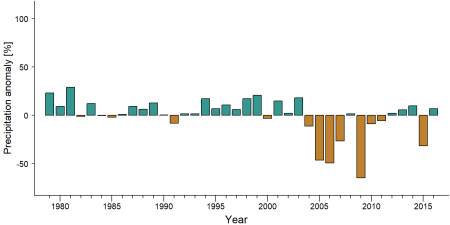
Precipitation anomaly in Bumbuna Dam Catchment Area -
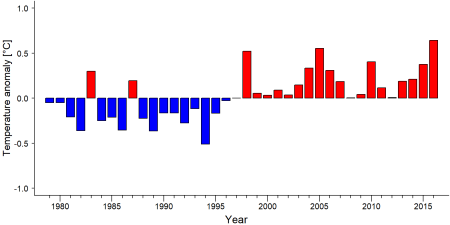
Temperature anomaly in Bumbuna Dam Catchment Area


External links
References
Brncic, T. M., Amarasekaran, B., & McKenna, A. (2010). Final report of the Sierra Leone national chimpanzee census project. Tacugama Chimpanzee Sanctuary, Freetown, Sierra Leone. link
Ganas-Swaray, J., Arandjelovic, M., Casado, N., Campbell, G., Garriga, R., & Serckx, A. (2018). Primate and large mammal targeted surveys, Phase II Bumbuna Hydroelectric Dam, Sierra Leone: Priority species. Final report.
Ministry of Energy and Water Resources (2010). Bumbuna Hydroelectric Environmental and Social Management Project (ESMP).
Nippon Koei UK, BMT Cordah, & Environmental Foundation for Africa. (2005). Bumbuna Hydroelectric Project environmental impact assessment (Vols. 1–3). link
Thompson, F. (2010). Sierra Leone's hydro-power dam lighting up Freetown. Voice of America. https://www.voanews.com/africa/sierra-leones-hydro-power-dam-lighting-freetown link
Kiribou, R., Tehoda, P., Chukwu, O., Bempah, G., Kühl, H. S., Ferreira, J., …, & Heinicke, S. (2024). Exposure of African ape sites to climate change impacts. PLOS Climate, 3(2), e0000345. doi:10.1371/journal.pclm.0000345
Page created by: APES Atlas Team Date: 2019-09-02