
Gombe National Park
East Africa > Tanzania > Gombe National Park
Français | Português | Español | Bahasa Indonesia | Melayu
Summary
- Eastern chimpanzees (Pan troglodytes schweinfurthii) are present in Gombe National Park.
- Approximately 90 individuals occur in the site.
- The chimpanzee population trend is stable.
- The site has a total size of 35 km².
- Key threats to chimpanzees are diseases, forest loss and loss of forest connectivity.
- Conservation activities have focused on long-term research, education and awareness raising.
- Jane Goodall began studying the chimpanzees at the site in 1960, when little was known about the behavior and social structure of wild chimpanzees
Site characteristics
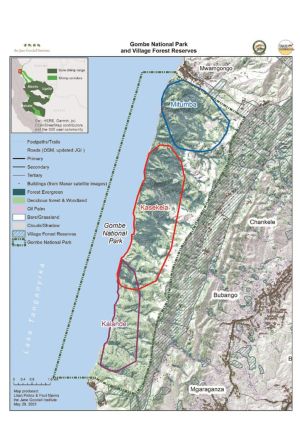
Located along the eastern edge of Lake Tanganyika in eastern Tanzania, Gombe National Park covers an area of 35 sq. km of mountainous terrain (Weiss et al. 2017). The site encompasses a mosaic of habitats and their transitions, from riverine forest to deciduous woodland and grassland (Weiss et al. 2017). Although the park covers a small area, it is rich in biodiversity. In addition to chimpanzees, several other primates inhabit the site, including olive baboons (Papio anubis), red colobus monkeys (Piliocolobus tephrosceles), red-tailed monkeys (Cercopithecus ascanius schmidti), blue monkeys (Cercopithecus mitis doggetti), and vervets (Chlorocebus pygerythrus) (Lonsdorf et al. 2021). The site was first established as the Gombe Stream Game Reserve in 1943, and upgraded to national park in 1968. As part of an effort to recognize that the national park is part of a larger ecosystem that needs to be integrated into conservation efforts, the geographical area known as the Greater Gombe Ecosystem was defined as part of the Conservation Action Planning process in 2005 (Wilson et al. 2020). Jane Goodall began studying the chimpanzees at the site in 1960, when little was known about the behavior and social structure of wild chimpanzees (Pusey et al. 2007). During her first year of study she made the key discoveries that chimpanzees make and use tools (Goodall 1964) and hunt and eat meat (Goodall 1963).
Table 1. Basic site information for Gombe National Park
| Species | Pan troglodytes schweinfurthii |
| Area | 35 km² |
| Coordinates | Lat: -4.698600 , Lon: 29.644148 |
| Type of site | Protected area (National Park) |
| Habitat types | Subtropical/tropical moist montane forest, Grassland |
| Type of governance |
Types of sites Governance types Habitat types
-
© JGI, TAWIRI, and TANAPA -

Gombe National Park © Stephano Lihedule, JGI


Ape status
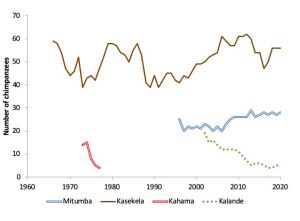
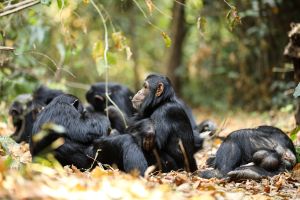
Gombe contains three communities of chimpanzees: Mitumba, Kasekela and Kalande. The chimpanzee population in the park decreased over time from an estimated 120–150 individuals in the 1960s to approximately 90 individuals in 2020 (Wilson et al. 2020). However, the consistent presence of approximately 90 chimpanzees since 2002 suggests that the population might be stable (Wilson et al. 2020).
Table 2. Ape population estimates reported for Gombe National Park
| Species | Year | Occurrence | Encounter or vistation rate (nests/km; ind/day) | Density estimate [ind./ km²] (95% CI) | Abundance estimate (95% CI) | Survey area | Sampling method | Analytical framework | Source | Comments | A.P.E.S. database ID |
|---|---|---|---|---|---|---|---|---|---|---|---|
| Pan troglodytes schweinfurthii | 2020 | 89-92 | Gombe National Park, entire area | Full count, Genetic (dung/hair) | Wilson et al. 2020 |
Sampling methods Analytical frameworks
-
Minimum population estimates for chimpanzee communities living within Gombe (Wilson et al. 2020) -
Chimpanzees from Gombe National Park © Stephano Lihedule, JGI 
Gaia and Gala © Stephano Lihedule, JGI -
© Stephano Lihedule, JGI


Threats
Due to the small size of the park and its small and relatively isolated chimpanzee population, chimpanzees at the site are particularly vulnerable to diseases and habitat encroachment (Wilson et al. 2020). Although diseases occur naturally, human activities can increase the risk of transmission to apes. Furthermore, respiratory disease appears to be the most common cause of death for Gombe chimpanzees, with 48% of chimpanzees inferred to have died from illness reported to exhibit respiratory symptoms (Wilson et al. 2020).
Table 3. Threats to apes reported for Gombe National Park
| Category | Specific threats | Threat level | Description | Year of threat |
|---|---|---|---|---|
| 2 Agriculture & aquaculture | 2.1 Annual & perennial non-timber crops | High (more than 70% of population affected) | Smallholder agriculture; increase in smallholder oil palm cultivation (Langat 2019, Stanley Shao pers. comm. 2025). | 2019-Ongoing (2025) |
| 5 Biological resource use | 5.1 Hunting & collecting terrestrial animals | Low (up to 30% of population affected) | Few cases of poaching (Wilson et al. 2020, Stanley Shao pers. comm. 2025). | 2020-Ongoing (2025) |
| 5 Biological resource use | 5.1.5 Persecution/human wildlife conflict | Low (up to 30% of population affected) | A few cases of chimpanzee killings by humans have been reported in the park as retaliation due to crop raiding (TAWIRI 2018). | 2018 |
| 5 Biological resource use | 5.3 Logging & wood harvesting | High (more than 70% of population affected) | As early as the 1940s, deforestation fueled by growing human populations threatened this area (Pusey et al. 2007). Charcoal production is an ongoing threat (Langat 2019, Stanley Shao pers. comm. 2025). | 1940-Ongoing (2025) |
| 8 Invasive & other problematic species, genes & diseases | 8.4 Pathogens | High (more than 70% of population affected) | Diseases occurring naturally in the chimpanzee population (Wilson et al. 2020). Also, high risk of acquiring diseases from humans (Wilson et al. 2020, Stanley Shao pers. comm. 2025). | 2020-Ongoing (2025) |
| 12 Other threat | Other | Present (unknown severity) | The connectivity between Gombe National Park and Masito Ugalla is under threat from forest conversion (TAWIRI 2018, Stanley Shao pers. comm. 2025). | 2018-Ongoing (2025) |
Conservation activities
The Jane Goodall Institute (JGI) has embarked on a number of conservation initiatives. For example, JGI worked with local communities to create a land use plan for their villages (Langat 2019). JGI created the Lake Tanganyika Catchment Reforestation and Education (TACARE) program in 1994, which aims to support sustainable livelihoods in the local communities while halting forest degradation. The program focuses on socio-economic development and sustainable natural resource management. Efforts to monitor health systematically at the site began in 2000. Observers conducting local follows every day take note of clinical signs (e.g., coughing, diarrhoea, wounds), both for the target of their follow, and for any individual observed ill (Wilson et al. 2020).
Table 4. Conservation activities reported for Gombe National Park
| Category | Specific activity | Description | Implementing organization(s) | Year of activity |
|---|---|---|---|---|
| 3 Species health | 3.1 Wear face-masks to avoid transmission of viral and bacterial diseases to primates | Since 2017 observers are required to wear face masks when with chimpanzees (Wilson et al. 2020, Stanley Shao pers. comm. 2025). | 2017-Ongoing (2025) | |
| 3 Species health | 3.11 Implement continuous health monitoring/permanent vet on site | JGI employs a full-time research team at Gombe, including a vet (Wilson et al. 2020, Stanley Shao pers. comm. 2025). | 2020-Ongoing (2025) | |
| 3 Species health | 3.13 Implement a health programme for local communities | The health monitoring project at the site has expanded to include a “One Health” approach, integrating diagnostic surveillance for chimpanzees and baboons, and examining links with people and domesticated animals (Wilson et al. 2020, Stanley Shao pers. comm. 2025). | 2020-Ongoing (2025) | |
| 3 Species health | 3.2 Keep safety distance to habituated apes | A minimum distance of 7.5 m is maintained for researchers, and 10 m for tourists, who are more likely to carry respiratory viruses due to recent travel (Wilson et al. 2020, Stanley Shao pers. comm. 2025). | 2020-Ongoing (2025) | |
| 3 Species health | 3.3 Limit time that researchers/tourists are allowed to spend with habituated apes | Tourist visits are restricted to no longer than one hour, and in groups no larger than six people (Wilson et al. 2020, Stanley Shao pers. comm. 2025). | 2020-Ongoing (2025) | |
| 3 Species health | 3.4 Implement quarantine for people arriving at, and leaving the site | Visiting researchers are asked to complete a 7-day quarantine before following chimpanzees (Wilson et al. 2020, Stanley Shao pers. comm. 2025). | 2020-Ongoing (2025) | |
| 4 Education & awareness | 4.1 Educate local communities about apes and sustainable use | Awareness raising among school children conducted by the Gombe Stream Research Centre. For example, students grow seedlings at school and transplant them back in their homes under the village reserve program (Langat 2019, Stanley Shao pers. comm. 2025). | 2019-Ongoing (2025) | |
| 5 Protection & restoration | 5.2 Legally protect ape habitat | The site is designated as a National Park. | 1968-Ongoing (2026) | |
| 8 Permanent presence | 8.1 Run research project and ensure permanent human presence at site | Long-term research at the site has provided benefits to wildlife conservation, for example, by understanding disease patterns and requirements for ecological monitoring, habitat use and connectivity, and engagement of local communities in research and conservation (TAWIRI 2018, Stanley Shao pers. comm. 2025). | 2018-Ongoing (2025) |
Challenges
Table 5. Challenges reported for Gombe National Park
| Challenges | Specific challenges | Source | Year(s) |
|---|---|---|---|
| Not reported |
Enablers
Table 6. Enablers reported for Gombe National Park
| Enablers | Specific enablers | Source | Year(s) |
|---|---|---|---|
| 1 Site management | |||
| 2 Resources and capacity | |||
| 3 Engaged community | |||
| 4 Institutional support | |||
| 5 Ecological context | |||
| 6 Safety and stability |
Research activities
Jane Goodall began habituating the Kasekela community in the 1960s, and demographic records have been continuously kept ever since (Weiss et al. 2017). From 1963 to 2000, chimpanzees were provisioned with bananas at an artificial feeding station, with daily records made of their behavior. Since the early 1970s, field assistants have conducted dawn-to-dusk focal follows of the chimpanzees everyday throughout their range (Weiss et al. 2017). In November of 1960, Goodall observed that chimpanzees make and use tools. This discovery revolutionized the field of animal behavior; up until then it had been presumed that only humans could construct and use tools (JGI).
Since 1960, over 300 publications have emerged from research at Gombe, and about 50 PhDs and masters have been obtained through work at the site (JGI). Research methods pioneered at Gombe have inspired similar approaches at other field sites, contributing to a better understanding of behavioral diversity across chimpanzees and bonobos (Wilson et al. 2020). Research at the site has also played an important role in inspiring and testing hypotheses about human evolution (Wilson et al. 2020). JGI employs a full-time research team at Gombe of about 50 employees, including senior scientists, a veterinarian, and field researchers specializing in chimpanzees, baboons, other monkeys, and botany. To coordinate research activities involving the collaboration among scientists from many different institutions, the Gombe Research Consortium was established in 2018, consisting of research administrators from JGI (Collins, Mjungu, and Pintea) and principal investigators based elsewhere (Detwiler, Gilby, Lonsdorf, Murray, Pusey, and Wilson; Wilson et al. 2020).

Documented behaviours
Table 7. Behaviours documented for Gombe National Park
| Category | Behavior | Observation type | Prevalence | Observation dates | Source | Habituation | Species | Comment |
|---|---|---|---|---|---|---|---|---|
| Investigatory probe | Goodall 1968 | |||||||
| Play-start | Goodall 1968 | |||||||
| Leaf-sponge | Goodall 1964 | |||||||
| Branch-shake | Goodall 1968 | |||||||
| Container: Leaves used to catch/hold material | Goodall 1968 | |||||||
| Leaf-brush: Leaves used to brush bees, etc. away from an entrance or surface | Goodall 1986 | |||||||
| Food-pound onto wood: Food item smashed open by beating it on a hard wooden surface, like the base of a tree | Goodall 1968 | |||||||
| Food-pound onto other: Food item smashed open by beating it on a surface other than wood, such as stone or hard earth | Goodall 1968 | |||||||
| Termite-fishing using leaf midrib | Goodall 1964 | |||||||
| Termite-fishing using non-leaf materials: Probing instrument, sometimes modified, used to extract termites from tunnels | Goodall 1964 | |||||||
| Lever open: Stout stick is used in levering fashion to enlarge insect or bird nest | Goodall 1968 | |||||||
| Self-tickle: An object is used to probe ticklish areas on self | Goodall 1986 | |||||||
| Aimed-throw: Throwing of object with clear (even if inaccurate) tendency to aim | Goodall 1964 | |||||||
| Leaf-napkin: Leaves used to clean body surfaces | Goodall 1964 | |||||||
| Leaf-groom: ‘ Grooming’ of leave | Goodall 1986 |

Exposure to climate change impacts
As part of a study on the exposure of African great ape sites to climate change impacts, Kiribou et al. (2024) extracted climate data and data on projected extreme climate impact events for the site. Climatological characteristics were derived from observation-based climate data provided by the Inter-Sectoral Impact Model Intercomparison Project (ISIMIP, www.isimip.org). Parameters were calculated as the average across each 30-year period. For 1981-2010, the EWEMBI dataset from ISIMIP2a was used. For the two future periods (2021-2050 and 2071-2099) ISIMIP2b climate data based on four CMIP5 global climate models were used. For future projections, two Representative Concentration Pathways (RCP) were used. RCP 2.6 is a scenario with strong mitigation measures in which global temperatures would likely rise below 2C. RCP 6.0 is a scenario with medium emissions in which global temperatures would likely rise up to 3C by 2100. For the number of days with heavy precipitation events, the 98th percentile of all precipitation days (>1mm/d) was calculated for the 1979-2013 reference period as a threshold for a heavy precipitation event. Then, for each year, the number of days above that threshold was derived. The figures on temperature and precipitation anomaly show the deviation from the mean temperature and mean precipitation for the 1979-2013 reference period.
The estimated exposure to future extreme climate impact events (crop failure, drought, river flood, wildfire, tropical cyclone, and heatwave) is based on a published dataset by Lange et al. 2020 derived from ISIMIP2b data. The same global climate models and RCPs as described above were used. Within each 30-year period, the number of years with an extreme event and the average proportion of the site affected were calculated (Kiribou et al. 2024).
Table 8. Estimated past and projected climatological characteristics in Gombe National Park
| Value | 1981-2010 | 2021-2050, RCP 2.6 | 2021-2050, RCP 6.0 | 2071-2099, RCP 2.6 | 2071-2099, RCP 6.0 |
|---|---|---|---|---|---|
| Mean temperature [C] | 22.8 | 23.9 | 24 | 24.1 | 25.5 |
| Annual precipitation [mm] | 1080 | 1089 | 1137 | 1075 | 1121 |
| Max no. consecutive dry days (per year) | 100.5 | 108.2 | 100.5 | 114.3 | 107.4 |
| No. days with heavy precipitation (per year) | 4.3 | 4.4 | 5.3 | 4.1 | 6.2 |
Table 9. Projected exposure of apes to extreme climate impact events in Gombe National Park
| Type | No. of years with event (2021-2050, RCP 2.6) | % of site exposed (2021-2050, RCP 2.6) | No. of years with event (2021-2050, RCP 6.0) | % of site exposed (2021-2050, RCP 6.0) | No. of years with event (2070-2099, RCP 2.6) | % of site exposed (2070-2099, RCP 2.6) | No. of years with event (2070-2099, RCP 6.0) | % of site exposed (2070-2099, RCP 6.0) |
|---|---|---|---|---|---|---|---|---|
| Crop failure | 0.5 | 0.32 | 1.5 | 0.33 | 2.5 | 0.02 | 2.5 | 0.02 |
| Drought | 0 | 0 | 0 | 0 | 0 | 0 | 0 | 0 |
| Heatwave | 0 | 0 | 0 | 0 | 0 | 0 | 0 | 0 |
| River flood | 0.5 | 0.91 | 1.5 | 2.02 | 1 | 2.49 | 1.5 | 3.6 |
| Tropical cyclone | 0 | 0 | 0 | 0 | 0 | 0 | 0 | 0 |
| Wildfire | 30 | 2.67 | 30 | 1.87 | 29 | 2.54 | 29 | 2.24 |
-
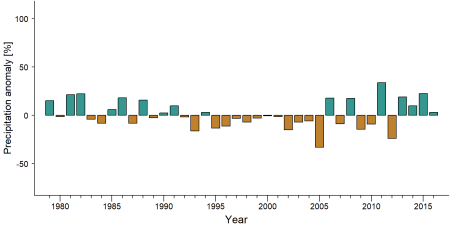
Precipitation anomaly in Gombe National Park -
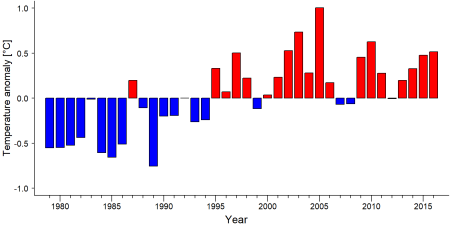
Temperature anomaly in Gombe National Park


External links
References
Goodall, J. (1963). Feeding behaviour of wild chimpanzees. A preliminary report. Symposium of the Zoological Society of London 10:39–47.
Goodall, J. (1964). Tool-Using and Aimed Throwing in a Community of Free-Living Chimpanzees. Nature, 201(4926), 1264-1266. doi:10.1038/2011264a0
Goodall, J. (1968). The behaviour of free-living chimpanzees in the Gombe Stream Reserve. Anim. Behav. Mon. 1, p. 161-311. doi:10.1016/s0066-1856(68)80003-2
Goodall, J. (1986). The chimpanzees of Gombe: Patterns of behaviour. Harvard University Press, Cambridge, Mass.
Langat, A. (2019, February 28). For the famed chimps of Gombe, human encroachment takes a toll. Mongabay. Online: https://news.mongabay.com/2019/02/for-the-famed-chimps-of-gombe-human-encroachment-takes-a-toll/
Lonsdorf, E. V., Travis, D. A., Raphael, J., Kamenya, S., Lipende, I., Mwacha, D., …, & Gillespie, T. R. (2021). The Gombe Ecosystem Health Project: 16 years of program evolution and lessons learned. American Journal of Primatology, 84(4-5). doi:10.1002/ajp.23300
Pusey, A. E., Pintea, L., Wilson, M. L., Kamenya, S., & Goodall, J. (2007). The Contribution of Long‐Term Research at Gombe National Park to Chimpanzee Conservation. Conservation Biology, 21(3), 623-634. doi:10.1111/j.1523-1739.2007.00704.x
Weiss, A., Wilson, M. L., Collins, D. A., Mjungu, D., Kamenya, S., Foerster, S., & Pusey, A. E. (2017). Personality in the chimpanzees of Gombe National Park. Scientific Data, 4(1), 1-18. doi:10.1038/sdata.2017.146
Wilson, M. L., Lonsdorf, E. V., Mjungu, D. C., Kamenya, S., Kimaro, E. W., Collins, D. A., …, & Goodall, J. (2020). Research and conservation in the greater Gombe ecosystem: challenges and opportunities. Biological Conservation, 252, 108853. doi:10.1016/j.biocon.2020.108853
TAWIRI. (2018). Tanzania Chimpanzee Conservation Action Plan 2018-2023. TAWIRI Contact: info@tawiri.or.tz
Kiribou, R., Tehoda, P., Chukwu, O., Bempah, G., Kühl, H. S., Ferreira, J., …, & Heinicke, S. (2024). Exposure of African ape sites to climate change impacts. PLOS Climate, 3(2), 1-19. doi:10.1371/journal.pclm.0000345
Page created by: APES Atlas Team Date: 2022-01-19
Page updated by: Priscilla Stanley Shao Date: 2025-09-15