
Bwindi Impenetrable National Park
East Africa > Uganda > Bwindi Impenetrable National Park
Français | Português | Español | Bahasa Indonesia | Melayu
Summary
- Eastern chimpanzees (Pan troglodytes schweinfurthii) & mountain gorillas (Gorilla beringei beringei) are present in Bwindi Impenetrable National Park.
- It has been estimated that 459 gorillas occur in the site; the chimpanzee population size is unknown.
- The gorilla population trend is increasing.
- The site has a total size of 331 km².
- Key threats to great apes are linked to high human presence, which poses some risk of disturbance and disease transmission.
- Conservation activities have focused on ecotourism programs, awareness raising, education, and regularly monitoring the health of habituated gorillas.
- The park is a UNESCO Natural World Heritage Site.
-
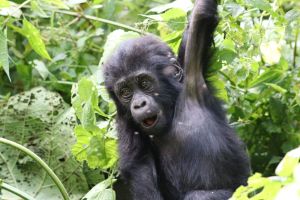
Mountain gorilla infant © Dirck Byler -

Mountain gorilla © Dirck Byler -
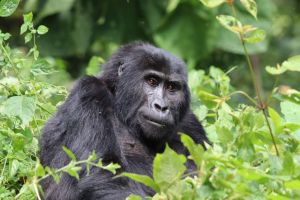
Mountain gorilla © Dirck Byler


Site characteristics
Bwindi Impenetrable National Park is located in southwestern Uganda, on the edge of the Albertine Rift Valley. The area is one of Uganda's oldest and most biologically diverse rainforests, which dates back over 25,000 years (Uganda Wildlife Authority). Encompassing a series of steep ridges and valleys, Bwindi is the source of five major rivers, which flow into Lake Edward. The park is famous for being home to almost half of the world's mountain gorilla population (Uganda Wildlife Authority). The site is a designated Important Bird Area, with 347 bird species documented in the forest, including 23 endemic species to the Albertine Rift (BirdLife International 2020). Bwindi was gazetted as a National Park in 1991 and declared a (UNESCO Natural World Heritage Site) in 1994.
Table 1. Basic site information for Bwindi Impenetrable National Park
| Species | Gorilla beringei beringei, Pan troglodytes schweinfurthii |
| Area | 331 km² |
| Coordinates | Lat: -1.017254 , Lon: 29.671192 |
| Type of site | Protected area (National Park) |
| Habitat types | Subtropical/tropical montane forest, Subtropical/tropical moist lowland forest |
| Type of governance | Governance by government |
Types of sites Governance types Habitat types
Ape status
The park is home to one of the two subpopulations of mountain gorillas in the world, the Bwindi-Sarambwe subpopulation (Hickey et al. 2018). Increases in both the Virunga Massif and the Bwindi-Sarambwe subpopulations led to a change in the IUCN Red List classification from Critically Endangered to Endangered in 2018 (Hickey et al. 2018). In spite of this increase, the overall population size is still small.
Table 2. Ape population estimates reported for Bwindi Impenetrable National Park
| Species | Year | Occurrence | Encounter or vistation rate (nests/km; ind/day) | Density estimate [ind./ km²] (95% CI) | Abundance estimate (95% CI) | Survey area | Sampling method | Analytical framework | Source | Comments | A.P.E.S. database ID |
|---|---|---|---|---|---|---|---|---|---|---|---|
| Gorilla beringei beringei | 2018 | 459.0 | Bwindi-Sarambwe ecosystem | Reconnaissance walk | Hickey et al. 2018 | Sweep method, with high density of reconnaissance trails covering the forest. | |||||
| Gorilla beringei beringei | 2011 | 400.0 | Bwindi Impenetrable National Park | Genetic (dung/hair) | Roy et al. 2014 | ||||||
| Gorilla beringei beringei | 2002 | 320.0 | Bwindi Impenetrable National Park | Reconnaissance walk | McNeilage et al. 2006 | Sweep method, with high density of reconnaissance trails covering the forest. | UGA0009 | ||||
| Gorilla beringei beringei | 1997 | 292.0 | Bwindi Impenetrable National Park | Reconnaissance walk | McNeilage et al. 2001 | Sweep method, with high density of reconnaissance trails covering the forest. | UGA0007 |
Sampling methods Analytical frameworks
Threats
Table 3. Threats to apes reported for Bwindi Impenetrable National Park
| Category | Specific threats | Threat level | Description | Year of threat |
|---|---|---|---|---|
| 1 Residential & commercial development | 1.1 Residential areas | Present (unknown severity) | Human encroachment near park edges, with a lot of informal settlements (Basiibye, personal observation, 2025; McNeilage et al. 2006) | 2006-Ongoing (2025) |
| 11 Climate change & severe weather | 11.1 Habitat shifting & alteration | Present (unknown severity) | Increased temperatures and modified rainfall patterns likely to cause changes in food availability and habitat quality (Hickey et al. 2018). | Ongoing (2018) |
| 5 Biological resource use | 5.1 Hunting & collecting terrestrial animals | Low (up to 30% of population affected) | Signs of illegal hunting reported during a census (Bitariho et al. 2022). | 1994-Ongoing (2022) |
| 5 Biological resource use | 5.1.2 Unintentional effects | Present (unknown severity) | Poaching as a non-target species, e.g., snares set up for other animals (Hickey et al. 2018). Great apes have sustained injuries after being caught in traps probably intended for other animals (Robbins pers. comm. 2025). | Ongoing (2025) |
| 5 Biological resource use | 5.1.5 Persecution/human wildlife conflict | Present (unknown severity) | Bwindi gorillas appear to crop-raid because of the availability of palatable foods at the edge of the park, not due to a lack of dietary items in the park (Hickey et al. 2018). | Ongoing (2018) |
| 5 Biological resource use | 5.2 Gathering terrestrial plants | Present (unknown severity) | Wild honey and wild yam collection (Bitariho et al. 2022). | 1994-Ongoing (2022) |
| 5 Biological resource use | 5.3 Logging & wood harvesting | Present (unknown severity) | Collection of firewood and tree cuttings (Bitariho et al. 2022). | 1994-Ongoing (2022) |
| 6 Human intrusions & disturbance | 6.3 Other human disturbances | Present (unknown severity) | Human presence due to tourism, conservation and scientific work, camps for security forces, etc., all of which pose some risk of disturbance and disease transmission (Hickey et al. 2018). | Ongoing (2018) |
| 7 Natural system modifications | 7.1 Fire & fire suppression | Present (unknown severity) | 2.64 km² burnt (≈0.8% of park area) in 1999 and 0.2 km² burnt (≈0.05%) in 2000 (Kasangaki et al. 2001). Most fires are human induced, started by illegal honey collectors and some fires spread from community agricultural fields(UWA 2014, Kasangaki et al. 2001). | 1990-Ongoing (2014) |
| 7 Natural system modifications | 7.3 Other ecosystem modifications | Low (up to 30% of population affected) | A 2002 survey revealed gorillas avoided disturbed areas with high human activity; this reflected habitat fragmentation and altered habitat quality and movement patterns (McNeilage et al. 2006). However, more gorillas are continuously using disturbed and human impacted areas but threat of fragmentation and alteration of habitat quality persists (Basiibye, personal observation, 2025). | 2002-Ongoing (2025) |
| 8 Invasive & other problematic species, genes & diseases | 8.4 Pathogens | High (more than 70% of population affected) | Vulnerability to human pathogens, and outbreaks of respiratory virus diseases and gastrointestinal parasite infections (Hickey et al. 2018). | Ongoing (2018) |
| 8 Invasive & other problematic species, genes & diseases | 8.4 Pathogens | Present (unknown severity) | A potential risk of disease transmission between humans and great apes is reported, details are unknown (Robbins pers. comm. 2025). | Ongoing (2025) |
Conservation activities
The site is managed by the Uganda Wildlife Authority. The management of the site has developed ecotourism programs that support the livelihoods of local communities (UNESCO). Nine groups have been habituated for tourism; the first one was the Mubare gorilla group, since 1993. Conservation Through Public Health work on reducing human-gorilla conflicts in and around the park, and avoiding the transmission of diseases.
Table 4. Conservation activities reported for Bwindi Impenetrable National Park
| Category | Specific activity | Description | Implementing organization(s) | Year of activity |
|---|---|---|---|---|
| 1 Development impact mitigation | 1.5 Install mechanical barriers or use natural hedges to deter apes | Construct and maintain barriers to control problem animals (UWA 2014). Intended to reduce crop raiding and human–wildlife conflict, by gorillas. Physical barriers such as Mauritius thorn hedges, trenching, and tea planting have been used in several community zones, especially around Nkuringo and Buhoma, to deter gorilla movement (IGCP 2022). | HuGo (Human–Gorilla Conflict Resolution) squads under Uganda Wildlife Authority, International Gorilla Conservation Programme (IGCP) | 2000-Ongoing (2022) |
| 2 Counter-wildlife crime | 2.14 Employ hunters in the conservation sector to reduce their impact | 50 reformed poachers from the Nteko and Kakoka communities planted four kilometers of Mauritius thorny hedge along the park boundary, to deter problem animal and reduced human wildlife conflict but most importantly involving ex-poachers in conservation and supporting livelihood. The participants earned a daily wage of about $42 (IGCP 2022). Community members, including former poachers, are trained to safely guide gorillas back into the forest when they stray into villages, many employed as porters and guides (Basiibye, personal observation, 2025; Bwindi Uganda Gorilla Trekking 2025). | HuGo (Human–Gorilla Conflict Resolution) squads under Uganda Wildlife Authority, International Gorilla Conservation Programme (IGCP) | 2000-Ongoing (2025) |
| 3 Species health | 3.10 Treat sick/injured apes | Gorilla Doctors is an international veterinary and conservation NGO that provides health monitoring and veterinary care to endangered mountain gorillas. A veterinary program began in 1994. | Gorilla Doctors | 1994-Ongoing (2025) |
| 3 Species health | 3.11 Implement continuous health monitoring/permanent vet on site | Gorilla Doctors is an international veterinary and conservation NGO that provides health monitoring and veterinary care to endangered mountain gorillas. A veterinary program began in 1994. | Gorilla Doctors | 1994-Ongoing (2025) |
| 3 Species health | 3.2 Keep safety distance to habituated apes | Bwindi Impenetrable National Park | Uganda Wildlife Authority | Ongoing (2025) |
| 3 Species health | 3.3 Limit time that researchers/tourists are allowed to spend with habituated apes | Bwindi Impenetrable National Park | Uganda Wildlife Authority | Ongoing (2025) |
| 4 Education & awareness | 4.1 Educate local communities about apes and sustainable use | Activities aimed at teaching local communities about the great apes were documented, along with efforts to provide general education and life skills (Robbins pers. comm. 2025). | Uganda Wildlife Authority | Ongoing (2025) |
| 4 Education & awareness | 4.2 Involve local community in ape research and conservation management | Local community members are involved in conservation programs, with the majority of staff recruited from surrounding communities (Robbins pers. comm. 2025). | Uganda Wildlife Authority | Ongoing (2025) |
| 5 Protection & restoration | 5.1 Create buffer zones around protected ape habitat | Acquire land to act as a buffer area around the necks (UWA 2014), in order to reduce human–gorilla conflict in narrow boundary zones (UWA 2014; suggested in the management plan, no recent report mentions its implementation).Private people (such as owners of tourists lodges) buy land near park and pay people to move away (Basiibye, personal observation 2025). | Uganda Wildlife Authority (UWA), International Gorilla Conservation Programme (IGCP), Private individuals | 1991-Ongoing (2025) |
| 5 Protection & restoration | 5.2 Legally protect ape habitat | The site was declared a National Park in 1991. | Uganda Wildlife Authority | 1991-Ongoing (2026) |
| 5 Protection & restoration | 5.5 Demarcate and enforce boundaries of protected areas | Negotiate and sign boundary management agreements with communities, plant new, appropriate and live markers along the boundary (direct physical demarcation) (UWA, 2014). No recent evidence for implementation (Basiibye, personal observation 2025). | Uganda Wildlife Authority, Institute of Tropical Forest Conservation (ITFC) | Ongoing (2014) |
| 6 Species management | 6.1 Habituate primates to human presence to reduce stress from tourists/researchers | Ampumuza & Driessen 2020. | 1991-Ongoing (2025) | |
| 6 Species management | 6.2 Guard habituated ape groups to ensure their safety/well-being | The (Gorilla Doctors) who work at Bwindi Impenetrable National Park regularly monitor the health of habituated gorillas. | Uganda Wildlife Authority, Gorilla Doctors | Ongoing (2025) |
| 7 Economic & other incentives | 7.1 Provide monetary benefits to local communities for sustainably managing their forest and its wildlife (e.g., REDD, alternative income, employment) | Local people are hired to work in conservation management and initiatives (Bitariho et al. 2022, Robbins pers. comm. 2025). | Uganda Wildlife Authority | 1994-Ongoing (2025) |
| 7 Economic & other incentives | 7.2 Provide non-monetary benefits to local communities for sustainably managing their forest and its wildlife (e.g., better education, infrastructure development) | Community members receive basic education and essential life skills training (Bitariho et al. 2022, Robbins pers. comm. 2025). Water and sanitation and household income-generating projects have been the most funded activities (Bitariho et al. 2022). | Uganda Wildlife Authority | 1994-Ongoing (2025) |
| 8 Permanent presence | 8.2 Run tourist projects and ensure permanent human presence at site | Bwindi Impenetrable National Park | Uganda Wildlife Authority | 1993-Ongoing (2025) |
Challenges
Table 5. Challenges reported for Bwindi Impenetrable National Park
| Challenges | Specific challenges | Source | Year(s) |
|---|---|---|---|
| 2 Resources and capacity | 2.1 Lack of capacity/training | UWA 2001, UWA 2014, Basiibye S. pers. comm. 2025 | 2001-Ongoing (2025) |
| 2 Resources and capacity | 2.2 Lack of staff | UWA 2001, UWA 2014 | 2001-Ongoing (2014) |
| 2 Resources and capacity | 2.3 General lack of funding | UWA 2001, UWA 2014 | 2001-Ongoing (2014) |
| 2 Resources and capacity | 2.5 Lack of equipment/transportation | UWA 2001, UWA 2014, Basiibye S. pers. comm. 2025 | 2001-Ongoing (2025) |
| 3 Engaged community | 3.1 General lack of community engagement or support | UWA 2001, UWA 2014 | 2001-Ongoing (2014) |
| 4 Institutional support | 4.1 Lack of law enforcement | UWA 2001, UWA 2014, Basiibye S. pers. comm. 2025 | 2001-Ongoing (2025) |
Enablers
Table 6. Enablers reported for Bwindi Impenetrable National Park
| Enablers | Specific enablers | Source | Year(s) |
|---|---|---|---|
| 2 Resources and capacity | 2.1 Sufficient staff | UWA 2014 | 2001-Ongoing (2025) |
| 2 Resources and capacity | 2.3 Continuous/long-term funding | BINP 2025, Bitariho et al.2022, UWA 2014, UWA 2001 | 2001-Ongoing (2025) |
| 2 Resources and capacity | 2.5 Sufficient capacity/expertise to advise, design, or implement actions | BINP 2025, IIED 2016, UWA 2014, UWA 2001 | 2001-Ongoing (2025) |
| 2 Resources and capacity | 2.6 External partnerships that add expertise or resources | BINP 2025, IIED 2016, UWA 2014 | 1994-Ongoing (2025) |
| 3 Engaged community | 3.1 Strong local environmental knowledge | Ssebaggala 2025, UWA 2014 | 2001-Ongoing (2025) |
| 3 Engaged community | 3.6 Local community engagement and support | Ssebaggala 2025, Bitariho et al. 2022, UWA 2014 | 2001-Ongoing (2025) |
| 4 Institutional support | 4.1 Effective legislation and law enforcement | BINP 2025, UWA 2014, UWA 2001 | 2001-Ongoing (2025) |
Research activities
Dietary Variability of Mountain Gorillas in Bwindi Impenetrable National Park, Uganda
Population dynamics of the Bwindi mountain gorillas
Sleeping tree choice by Bwindi chimpanzees
Documented behaviours
Table 7. Behaviours documented for Bwindi Impenetrable National Park
| Category | Behavior | Observation type | Prevalence | Observation dates | Source | Habituation | Species | Comment |
|---|---|---|---|---|---|---|---|---|
| Diet | Seasonal dietary overlap and divergence between chimpanzees and gorillas | Direct observation, fecal analysis | Diverse diets for both species | 1997-2000 | Stanford & Nkurunung 2003 | Yes for Gorillas | Gorilla beringei beringei & Pan troglodytes schweinfurthii | Both species consume similar fruits during peak seasons; gorillas rely more on fibrous fallback foods during lean periods |
| Foraging | Seasonal dietary shifts in fruit and foliage consumption | Direct observation, fecal analysis | Widespread among groups | 2004.0 | Ganas et al. 2004 | Habituated | Gorilla beringei beringei | Gorillas adjust diet based on seasonal availability of fruits and herbs |
| Tool use | Use of modified stick tools to extract honey from stingless and stinging bees | Direct observation | Rare but confirmed | Stanford & Nkurunung 2003 | Not habituated | Pan troglodytes schweinfurthii | Chimpanzees selected and modified tools based on bee species and hive type | |
| Social play | Variation in social play among immature gorillas linked to sex, age, fruit intake, and peer availability | Focal sampling (6,000+ hrs), longitudinal data | Widespread across 5 groups | 2005–2023 | Richardson et al. 2025 | Yes | Gorilla beringei beringei | Males played more than females; play increased with fruit availability and number of peers; reflects motor and social development under energetic constraints |
| Communication | Use of 63 distinct gesture actions across 10 behavioral contexts | Video coding (ELAN), focal observation | ~6 gestures/hour across 4 groups | 2019–2022 | Grund et al. 2025 | Yes | Gorilla beringei beringei | First systematic description of mountain gorilla gestural repertoire; includes species-specific forms and 126 morph variants |
| Locomotion | Arboreal climbing and nesting by adult gorillas | Direct observation, GPS tracking | Frequent in multiple groups | 2019–2024 | Robbins et al. 2025 | Yes | Gorilla beringei beringei | Bwindi gorillas spent ~21% of time in trees; silverbacks reached heights of 20–40m, challenging assumptions of terrestriality |
Exposure to climate change impacts
As part of a study on the exposure of African great ape sites to climate change impacts, Kiribou et al. (2024) extracted climate data and data on projected extreme climate impact events for the site. Climatological characteristics were derived from observation-based climate data provided by the Inter-Sectoral Impact Model Intercomparison Project (ISIMIP, www.isimip.org). Parameters were calculated as the average across each 30-year period. For 1981-2010, the EWEMBI dataset from ISIMIP2a was used. For the two future periods (2021-2050 and 2071-2099) ISIMIP2b climate data based on four CMIP5 global climate models were used. For future projections, two Representative Concentration Pathways (RCP) were used. RCP 2.6 is a scenario with strong mitigation measures in which global temperatures would likely rise below 2C. RCP 6.0 is a scenario with medium emissions in which global temperatures would likely rise up to 3C by 2100. For the number of days with heavy precipitation events, the 98th percentile of all precipitation days (>1mm/d) was calculated for the 1979-2013 reference period as a threshold for a heavy precipitation event. Then, for each year, the number of days above that threshold was derived. The figures on temperature and precipitation anomaly show the deviation from the mean temperature and mean precipitation for the 1979-2013 reference period.
The estimated exposure to future extreme climate impact events (crop failure, drought, river flood, wildfire, tropical cyclone, and heatwave) is based on a published dataset by Lange et al. 2020 derived from ISIMIP2b data. The same global climate models and RCPs as described above were used. Within each 30-year period, the number of years with an extreme event and the average proportion of the site affected were calculated (Kiribou et al. 2024).
Table 8. Estimated past and projected climatological characteristics in Bwindi Impenetrable National Park
| Value | 1981-2010 | 2021-2050, RCP 2.6 | 2021-2050, RCP 6.0 | 2071-2099, RCP 2.6 | 2071-2099, RCP 6.0 |
|---|---|---|---|---|---|
| Mean temperature [C] | 16.6 | 17.8 | 17.5 | 17.9 | 19.1 |
| Annual precipitation [mm] | 1272 | 1288 | 1422 | 1293 | 1411 |
| Max no. consecutive dry days (per year) | 19.4 | 28.4 | 28.9 | 31.6 | 25.8 |
| No. days with heavy precipitation (per year) | 5.6 | 6.9 | 8.1 | 7.5 | 9.5 |
Table 9. Projected exposure of apes to extreme climate impact events in Bwindi Impenetrable National Park
| Type | No. of years with event (2021-2050, RCP 2.6) | % of site exposed (2021-2050, RCP 2.6) | No. of years with event (2021-2050, RCP 6.0) | % of site exposed (2021-2050, RCP 6.0) | No. of years with event (2070-2099, RCP 2.6) | % of site exposed (2070-2099, RCP 2.6) | No. of years with event (2070-2099, RCP 6.0) | % of site exposed (2070-2099, RCP 6.0) |
|---|---|---|---|---|---|---|---|---|
| Crop failure | 5 | 0.28 | 4 | 0.72 | 5.5 | 0.38 | 6 | 0.18 |
| Drought | 0 | 0 | 0 | 0 | 0 | 0 | 0 | 0 |
| Heatwave | 0 | 0 | 0 | 0 | 0 | 0 | 0 | 0 |
| River flood | 1 | 1.98 | 3 | 2.77 | 1.5 | 1.74 | 3.5 | 2.88 |
| Tropical cyclone | 0 | 0 | 0 | 0 | 0 | 0 | 0 | 0 |
| Wildfire | 30 | 1.11 | 30 | 0.88 | 29 | 1.13 | 29 | 0.75 |
-
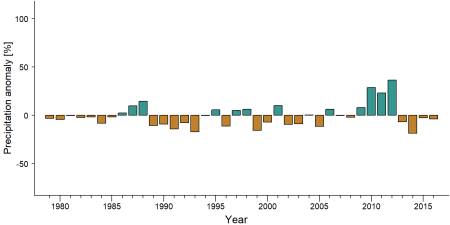
Precipitation anomaly in Bwindi Impenetrable National Park -
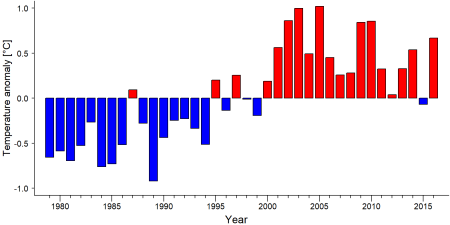
Temperature anomaly in Bwindi Impenetrable National Park


External links
UNESCO Bwindi Impenetrable National Park
Bwindi Forest National Park in Uganda
References
Ampumuza, C., & Driessen, C. (2020). Gorilla habituation and the role of animal agency in conservation and tourism development at Bwindi, South Western Uganda. Environment and Planning E: Nature and Space, 4(4), 1601-1621. doi:10.1177/2514848620966502
Bitariho, R., Akampurira, E., & Mugerwa, B. (2022). Long‐term funding of community projects has contributed to mitigation of illegal activities within a premier African protected area, Bwindi impenetrable National Park, Uganda. Conservation Science and Practice, 4(9). doi:10.1111/csp2.12761
Bwindi Impenetrable National Park. (2025). Gorilla levy funds. https://www.bwindiimpenetrablenationalpark.com/conservation/gorilla-levy/
Bwindi Uganda Gorilla Trekking. (2025, June 18). Community-based conservation initiatives around Bwindi Forest. https://www.bwindiugandagorillatrekking.com/community-based-conservation-around-bwindi/
Castro Mayo, A., Flores-Fernandez, V., Twinamatsiko, M., & Parra, C. (2025). Compensation and Power in Human-Wildlife Conflicts in Bwindi National Park. SSRN. https://doi.org/10.2139/ssrn.4769632. doi:10.2139/ssrn.5397858
Ganas, J., Robbins, M. M., Nkurunungi, J. B., Kaplin, B. A., & McNeilage, A. (2004). Dietary Variability of Mountain Gorillas in Bwindi Impenetrable National Park, Uganda. International Journal of Primatology, 25(5), 1043-1072. doi:10.1023/b:ijop.0000043351.20129.44
Grund, C., Robbins, M. M., & Hobaiter, C. (2025). The gestural repertoire of Bwindi mountain gorillas (Gorilla beringei beringei): gesture form and frequency of use. Animal Cognition, 28(1), 1-22. doi:10.1007/s10071-025-01977-8
Hickey, J. R., Basabose, A., Gilardi, K. V., Greer, D., Nampindo, S., Robbins, M. M., & Stoinski, T. S. (2018). Gorilla beringei ssp. beringei: Hickey, J.R., Basabose, A., Gilardi, K.V., Greer, D., Nampindo, S., Robbins, M.M. & Stoinski, T.S: The IUCN Red List of Threatened Species 2018: e.T39999A17989719. doi:10.2305/iucn.uk.2018-2.rlts.t39999a17989719.en
International Gorilla Conservation Programme. (2022, July 5). Reformed poachers plant four kilometers of Mauritius thorny hedge in Bwindi Impenetrable National Park. https://igcp.org/updates/reformed-poachers-plant-four-kilometers-of-mauritius-thorny-hedge-in-bwindi-impenetrable-national-park/
International Institute for Environment and Development. (2016). Uganda: Conserving Bwindi Impenetrable National Park and reducing local poverty. https://www.iied.org/uganda-conserving-bwindi-impenetrable-national-park-reducing-local-poverty
Kasangaki, A., Babaasa, D., Bitariho, R., & Mugiri, G. (2001). A survey of burnt areas in Bwindi Impenetrable and Mgahinga Gorilla National Parks, SW Uganda: The fires of 2000 [Unpublished report].
McNeilage, A., Plumptre, A. J., Brock-Doyle, A., & Vedder, A. (2001). Bwindi Impenetrable National Park, Uganda: gorilla census 1997. Oryx, 35(1), 39-47. doi:10.1046/j.1365-3008.2001.00154.x
McNeilage, A., Robbins, M. M., Gray, M., Olupot, W., Babaasa, D., Bitariho, R., …, & Baker, J. (2006). Census of the mountain gorilla Gorilla beringei beringei population in Bwindi Impenetrable National Park, Uganda. Oryx, 40(4), 419-427. doi:10.1017/s0030605306001311
Richardson, J. L., McFarlin, S. C., & Robbins, M. M. (2025). Biological, social and ecological correlates of social play in immature Bwindi mountain gorillas, Gorilla beringei beringei. Animal Behaviour, 224, 123190. doi:10.1016/j.anbehav.2025.123190
Robbins, M. M., Drummond-Clarke, R. C., Robbins, A. M., Ostrofsky, K. R., & Kivell, T. L. (2025). Gorillas are arboreal apes. Current Biology, 35(12), 2974-2979.e3. doi:10.1016/j.cub.2025.05.015
Roy, J., Vigilant, L., Gray, M., Wright, E., Kato, R., Kabano, P., …, & Robbins, M. M. (2014). Challenges in the use of genetic mark-recapture to estimate the population size of Bwindi mountain gorillas (Gorilla beringei beringei). Biological Conservation, 180, 249-261. doi:10.1016/j.biocon.2014.10.011
Ssebaggala, J. (2025). Tourism, protected areas, and the well-being of local residents near Bwindi, Uganda. African Journal of Sustainable Tourism, 1(1). doi:10.4102/ajst.v1i1.3
Stanford, C. B., & Nkurunungi, J. B. (2003). Behavioral Ecology of Sympatric Chimpanzees and Gorillas in Bwindi Impenetrable National Park, Uganda: Diet. International Journal of Primatology, 24(4), 901-918. doi:10.1023/a:1024689008159
Uganda Wildlife Authority. (2001). Bwindi Impenetrable National Park: General management plan 2001–2011. Uganda Wildlife Authority.
Uganda Wildlife Authority. (2014). Bwindi Impenetrable National Park: General management plan 2014–2024 (pp. 23–25). Uganda Wildlife Authority.
Kiribou, R., Tehoda, P., Chukwu, O., Bempah, G., Kühl, H. S., Ferreira, J., …, & Heinicke, S. (2024). Exposure of African ape sites to climate change impacts. PLOS Climate, 3(2), 1-19. doi:10.1371/journal.pclm.0000345
Gorilla Doctors. https://www.gorilladoctors.org/about-us/
Bwindi Impenetrable National Park. https://www.bwindiimpenetrablenationalpark.com/gorilla-trekking/
Gorilla Doctors. https://www.gorilladoctors.org/about-us/where-we-work/
Page created by: APES Atlas Team Date: 2021-01-14
Page updated by: I. Ordaz-Nemeth, Steven Joel Basiibye Date: 2025-10-10