
RAFALE (Refuge Altitude Forests of the Albert Lake Escarpment)
Central Africa > Democratic Republic of the Congo > RAFALE (Refuge Altitude Forests of the Albert Lake Escarpment)
Français | Português | Español | Bahasa Indonesia | Melayu
Summary
- Eastern chimpanzees (Pan troglodytes schweinfurthii) are present in Refuge Altitude Forests of the Albert Lake Escarpment.
- The population size is unknown.
- The population trend is unknown.
- The site covers approximately 500 km².
- Key threats to chimpanzees are human encroachment, habitat degradation and destruction, and hunting traps intended for other species.
- Conservation activities have focused on education and awareness raising, involvement of the local community in research and conservation activities.
Site characteristics
The site consists of forest fragments located along the Congolese Albertine Rift slope. It is known as the RAFALE landscape (Refuge Altitude Forest Fragments of the Albert Lake Escarpment) to distinguish it from the Ituri highlands, which have altitudes ranging from 1,700 m up to 2,455 m at Mount Aboro (Meessen 1951). A vast area of the Ituri highlands is classified as an IBA (code CD007, 410,000 ha, <8% protected - 2001 criteria met A1, 2 and 3) and Alliance For Zero Extinction - based on existing KBA boundaries and due to the historical presence of the Lendu crombec (IUCN CR - Sylvietta chapini) and the Lendu plateau clawed frog (IUCN CR - Xenopus lenduensis). None of the fragments within the RAFALE landscape are currently protected.
The RAFALE landscape consists of a mosaic of 20 semi-deciduous montane forest fragments (>0.5km² each) comprising a total forested surface area of ±70km2 (Laudisoit et al. 2021). They form a string, which is oriented southwest-northeast along 80 km of steep slopes on the western side of Lake Albert, ranging from an elevation of 620 m at Lake Albert to 2,020 m above sea level on the highest ridge. Each of the fragments is a riverine gallery forest surrounded by open grassland savannah, fallow land and crop fields, with streams that flow into a central river that empties into Lake Albert. These forest fragments are characterized as high-altitude closed-canopy strips with a moderately dense understory (10-50 m horizontal visibility). Depending on the altitude, the average daily temperature varies from 17-25°C and the annual average precipitation ranges from 1,200-1,700 mm. A short rainy season, characterized by heavy rainfall, occurs between March and the end of May, and a long rainy season occurs between August to mid-November (Messen 1951).
Besides a large community of Eastern chimpanzees, named the Mbudha community, eight other primate species have been observed (direct observations, small mammal live trapping, camera trapping), cited here by decreasing frequency of observation: Cercopithecus mitis stuhlmannii, Cercopithecus ascanius schmidti, Papio anubis, Lophocebus albigena johnstoni, Piliocolobus oustaleti (Hart et al. 2019). It is possibly a hybrid zone for P.o. tephrosceles / oustaleti (Tom Struhsaker, pers. comm.), Chlorocebus pygerythrus, Colobus guereza occidentalis, and Galagoides cfr. thomasi (handled by chimpanzees , not known if eaten or actively hunted by the local chimpanzee community (Hicks et al. 2019). Total estimated forest cover and suitable habitat for chimpanzees: ±70km2, of which ±20km2 have been explored with scientific objectives (preliminary inventory, habitat description, density estimation). Considering the mosaic of forest patches, shrubland, savanna and wetland on the shores of Lake Albert, the site covers approximately 500 sq.km (Laudisoit et al. 2021).
Other remarkable species thriving up to 2000 m include two species of pangolins (EN – IUCN; Phataginus tricuspis and P. tetradactyla; (Khwaja et al. 2019)), a duiker (Cephalophus rufilatus), crested porcupine (Hystrix cristata), Heterohyrax brucei, Jackson's mongoose Bdeogale jacksoni, dwarf scaly-tailed squirrels (Anomalurus pusillus), elephant shrew (Rhynchocyon sp.), and least dwarf shrew (Suncus infinitesimus). The provisional full mammalian inventory consists of 60 species with 9 Primates, 9 Carnivora, 1 Afrosoricida, 2 Cetartiodactyla, 1 Hyracoidea, 2 Pholidota, 19 Rodentia, 6 Eulipotyphla, 1 Macroscelidae and 10 Chiroptera (Laudisoit et al. 2021). These records represent new locations for most species as well as known geographic range limits.
Table 1. Basic site information for RAFALE (Refuge Altitude Forests of the Albert Lake Escarpment)
| Species | Pan troglodytes schweinfurthii |
| Area | 500 km² |
| Coordinates | Lat: 1.937869 , Lon: 30.899338 |
| Type of site | Non-protected area (Community Forest) |
| Habitat types | Subtropical/tropical moist montane forest, Shrubland, Wetlands (lakes, rivers, streams, bogs, marshes), Savanna, Rocky areas (inland cliffs, mountain peaks) |
| Type of governance |
Types of sites Governance types Habitat types
-
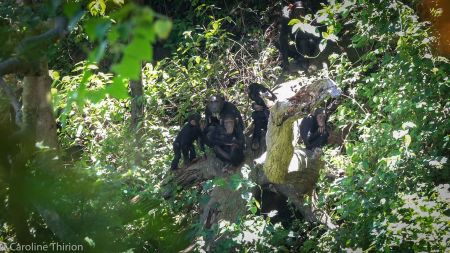
Mbudha chimpanzees. Female holding a galago in her mouth © Caroline Thirion, 2017 -
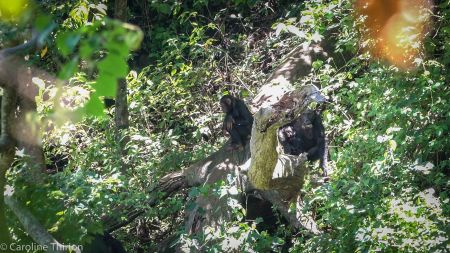
Mbudha chimpanzees © Caroline Thirion, 2017


Ape status
Between 2015 and 2017, preliminary surveys were conducted in and around three fragments named Tsili-Bai forest (or FG1), Rogo-Zalu forest (FG2) and Dolokpa-Dzoo forest (FG3) covering ±18.15 km2 (Laudisoit et al. 2021). The presence of chimpanzees in relict forest fragments of the Congolese Albertine Rift region — determined in November 2015 based on informal discussion with local inhabitants — was unexpected. In March, June, August and September 2016, and in April 2017, a total of 14 unplanned pilot walks following the path of least resistance were conducted (Laudisoit et al. 2021). In August 2016 and April 2017, a structured investigation was carried out to estimate the density of chimpanzees in three forest fragments and the nest encounter rates (Laudisoit et al., 2021). Based on the identifications of individuals made over the course of the study period (2016-2017), the minimum size of the Mbudha community was determined to be 42 weaned chimpanzees and 10 infants. A total of 283 chimpanzee nests were recorded (123 along transects and 160 on the pilot walks). The mean number of nests per kilometer was 4.3 (min=0 and max=14.3) and 18.4 (min=0 and max=43.6) on pilot walks and transect surveys respectively (Laudisoit et al. 2021). Using the truncated dataset of 117 nests recorded along the six transects we surveyed between 1,100 and 1,700 m altitude, we estimated a density of 4.62 weaned chimpanzee individuals per km² (Uniform simple polynomial). This chimpanzee community was named “Mbudha”, which in Bbaledha (Badha or Lendu) language means “the water of the chimpanzees”.
Table 2. Ape population estimates reported for RAFALE (Refuge Altitude Forests of the Albert Lake Escarpment)
| Species | Year | Occurrence | Encounter or vistation rate (nests/km; ind/day) | Density estimate [ind./ km²] (95% CI) | Abundance estimate (95% CI) | Survey area | Sampling method | Analytical framework | Source | Comments | A.P.E.S. database ID |
|---|---|---|---|---|---|---|---|---|---|---|---|
| Pan troglodytes schweinfurthii | 2017 | FG3 | Opportunistic observation | Laudisoit et al. 2021 | Recorded 2 hr of live observation. First live observation of 18 members of the Mbudha community. | ||||||
| Pan troglodytes schweinfurthii | 2016-2017 | 4.3 | FG1, FG2 and FG3 | Reconnaissance walk | Laudisoit et al. 2021 | Preliminary surveys in FG1, FG2 and FG3. Survey effort: 37.6 km | |||||
| Pan troglodytes schweinfurthii | 2016-2017 | 18.4 | FG1, FG2 and FG3 | Line transects | Laudisoit et al. 2021 | Survey effort: 6.7 km. | |||||
| Pan troglodytes schweinfurthii | 2015 | FG1 | Interviews, Reconnaissance walk | Laudisoit et al. 2021 | No survey, first acoustic detection of chimpanzees |
Sampling methods Analytical frameworks

Threats
The Mbudha chimpanzee community is not the only one surviving along the Lake Albert escarpment as reported by locals, but recurrent militia’s incursions in the Djugu and Mahagi territories have impeded the exploration of western forest fragments. As local people do not eat nor hunt chimpanzees, which they consider “as close to human beings that they could live in the village“, the major threats are population growth (natural and internally displaced), habitat degradation and destruction, mainly due to poverty and ignorance of the forestry code causing illegal logging and slash-and-burn agriculture. Huyghe (2017) estimated that about 1.2% of the natural habitat and forest cover is lost each year over the three explored fragments. While chimpanzees are not targeted by snares, snare mutilations have been observed on 12 individuals caught on camera trap footage, and in 2020, a young chimpanzee was found dead with a snare around its neck.
Table 3. Threats to apes reported for RAFALE (Refuge Altitude Forests of the Albert Lake Escarpment)
| Category | Specific threats | Threat level | Description | Year of threat |
|---|---|---|---|---|
| 10 Geological events | 10.3 Avalanches/landslides | Low (up to 30% of population affected) | Destruction of suitable chimpanzee nesting sites following a landslide (News24 2017). | 2017 |
| 2 Agriculture & aquaculture | 2.1 Annual & perennial non-timber crops | High (more than 70% of population affected) | Habitat loss due to expansion of slash-and-burn agriculture (Laudisoit et al. 2021). | Ongoing (2021) |
| 5 Biological resource use | 5.1 Hunting & collecting terrestrial animals | Medium (30-70% of population affected) | Chimpanzees are injured or killed by traps that are intended for other animals (Laudisoit et al. 2021). | Ongoing (2021) |
| 5 Biological resource use | 5.3 Logging & wood harvesting | High (more than 70% of population affected) | Charcoal production (Laudisoit et al. 2021). | Ongoing (2021) |
| 4 Transportation & service corridors | Other | Low (up to 30% of population affected) | Unknown | |
| 6 Human intrusions & disturbance | Other | Present (unknown severity) | Unknown | |
| 7 Natural system modifications | Other | Present (unknown severity) | Unknown |
Conservation activities
The Mbudha team is sensitizing the population around the fragments about the potential by-catch of chimpanzees by their hunting techniques and are encouraging smaller and alternative traps use in the forested area.
Table 4. Conservation activities reported for RAFALE (Refuge Altitude Forests of the Albert Lake Escarpment)
| Category | Specific activity | Description | Implementing organization(s) | Year of activity |
|---|---|---|---|---|
| 1 Development impact mitigation | 1.4 Farm more intensively and effectively in selected areas and spare more natural land | Encourage and develop a no-cost local organic manure, introduce agro forestry and soil stabilization with rapid growth trees (e.g. Acacia mearnsii). | Ongoing (2021) | |
| 4 Education & awareness | 4.1 Educate local communities about apes and sustainable use | Includes citizen science project (cybertracker), create a pedagogic space within the local institution, develop educational activities about zoochory with local institutions and schools, supervision of local MSc students. | Ongoing (2021) | |
| 4 Education & awareness | 4.2 Involve local community in ape research and conservation management | Local community members trained in ecological monitoring, placing camera traps and gathering data.Establish a permanent base and office in the local higher institution. The Mbudha garden is based on zoochory by animals – local tree nursery based on seeds collected in vertebrate feces. | Ongoing (2021) | |
| 5 Protection & restoration | 5.4 Create natural habitat patches (including corridors) | Writing of a conservation plan for a community managed reserve. | Ongoing (2021) | |
| 7 Economic & other incentives | 7.2 Provide non-monetary benefits to local communities for sustainably managing their forest and its wildlife (e.g., better education, infrastructure development) | 30 beehives have been installed, which provide sustainable funding for the Mbudha team, the health centers of the villages located around the forest, and the conservation project including compensation for forest protection to local chiefs. | Ongoing (2021) | |
| 8 Permanent presence | 8.1 Run research project and ensure permanent human presence at site | Chimpanzee research | Ongoing (2021) |
Challenges
Frequent incursions of unidentified militias in the region preventing access to the study site (road blocks) or discouraging funders and researchers to invest in a long term project.
Table 5. Challenges reported for RAFALE (Refuge Altitude Forests of the Albert Lake Escarpment)
| Challenges | Specific challenges | Source | Year(s) |
|---|---|---|---|
| 2 Resources and capacity | 2.5 Lack of equipment/transportation | Laudisoit pers. comm. | |
| 3 Engaged community | 3.5 Anticipated disadvantages/costs created by conservation activities (e.g., restricted access/resource use) | Laudisoit pers. comm. | |
| 4 Institutional support | 4.1 Lack of law enforcement | Laudisoit pers. comm. | |
| 4 Institutional support | 4.1 Lack of law enforcement | Laudisoit pers. comm. |
Enablers
Table 6. Enablers reported for RAFALE (Refuge Altitude Forests of the Albert Lake Escarpment)
| Enablers | Specific enablers | Source | Year(s) |
|---|---|---|---|
| 1 Site management | |||
| 2 Resources and capacity | |||
| 3 Engaged community | |||
| 4 Institutional support | |||
| 5 Ecological context | |||
| 6 Safety and stability |
Research activities
Laudisoit and local colleagues (the Mbudha team) are seeking support to establish a permanent research site in the area and, with the support of the local communities, are developing income generating activities to support forest protection. They hope to attract other research projects on the Congolese Albertine Rift and in the Ituri highlands where other scientifically undocumented population of apes and primates are known and reported by locals. Research is ongoing and Anne Laudisoit is currently supported by a National Geographic Explorer’s grant (NGS-61178C-19).

Documented behaviours
Table 7. Behaviours documented for RAFALE (Refuge Altitude Forests of the Albert Lake Escarpment)
| Category | Behavior | Observation type | Prevalence | Observation dates | Source | Habituation | Species | Comment |
|---|---|---|---|---|---|---|---|---|
| Making ground nests | Laudisoit et al. 2021 | |||||||
| Rock licking | Laudisoit pers. comm. | |||||||
| Meat eating | Hicks et al. 2019 |
Exposure to climate change impacts
As part of a study on the exposure of African great ape sites to climate change impacts, Kiribou et al. (2024) extracted climate data and data on projected extreme climate impact events for the site. Climatological characteristics were derived from observation-based climate data provided by the Inter-Sectoral Impact Model Intercomparison Project (ISIMIP, www.isimip.org). Parameters were calculated as the average across each 30-year period. For 1981-2010, the EWEMBI dataset from ISIMIP2a was used. For the two future periods (2021-2050 and 2071-2099) ISIMIP2b climate data based on four CMIP5 global climate models were used. For future projections, two Representative Concentration Pathways (RCP) were used. RCP 2.6 is a scenario with strong mitigation measures in which global temperatures would likely rise below 2C. RCP 6.0 is a scenario with medium emissions in which global temperatures would likely rise up to 3C by 2100. For the number of days with heavy precipitation events, the 98th percentile of all precipitation days (>1mm/d) was calculated for the 1979-2013 reference period as a threshold for a heavy precipitation event. Then, for each year, the number of days above that threshold was derived. The figures on temperature and precipitation anomaly show the deviation from the mean temperature and mean precipitation for the 1979-2013 reference period.
The estimated exposure to future extreme climate impact events (crop failure, drought, river flood, wildfire, tropical cyclone, and heatwave) is based on a published dataset by Lange et al. 2020 derived from ISIMIP2b data. The same global climate models and RCPs as described above were used. Within each 30-year period, the number of years with an extreme event and the average proportion of the site affected were calculated (Kiribou et al. 2024).
Table 8. Estimated past and projected climatological characteristics in RAFALE (Refuge Altitude Forests of the Albert Lake Escarpment)
| Value | 1981-2010 | 2021-2050, RCP 2.6 | 2021-2050, RCP 6.0 | 2071-2099, RCP 2.6 | 2071-2099, RCP 6.0 |
|---|---|---|---|---|---|
| Mean temperature [C] | 21.4 | 22.5 | 22.7 | 22.9 | 23.9 |
| Annual precipitation [mm] | 1187 | 1192 | 1273 | 1118 | 1375 |
| Max no. consecutive dry days (per year) | 19.8 | 21.5 | 27 | 25.4 | 24.1 |
| No. days with heavy precipitation (per year) | 6.6 | 7.6 | 7.5 | 7.6 | 12.8 |
Table 9. Projected exposure of apes to extreme climate impact events in RAFALE (Refuge Altitude Forests of the Albert Lake Escarpment)
| Type | No. of years with event (2021-2050, RCP 2.6) | % of site exposed (2021-2050, RCP 2.6) | No. of years with event (2021-2050, RCP 6.0) | % of site exposed (2021-2050, RCP 6.0) | No. of years with event (2070-2099, RCP 2.6) | % of site exposed (2070-2099, RCP 2.6) | No. of years with event (2070-2099, RCP 6.0) | % of site exposed (2070-2099, RCP 6.0) |
|---|---|---|---|---|---|---|---|---|
| Crop failure | 2 | 1.4 | 3 | 0.98 | 2 | 1.38 | 4.5 | 1.47 |
| Drought | 0 | 0 | 0 | 0 | 0 | 0 | 0 | 0 |
| Heatwave | 0 | 0 | 0 | 0 | 0 | 0 | 0 | 0 |
| River flood | 1 | 0.16 | 5.5 | 15.64 | 0.5 | 0.06 | 5 | 19.23 |
| Tropical cyclone | 0 | 0 | 0 | 0 | 0 | 0 | 0 | 0 |
| Wildfire | 30 | 1.16 | 30 | 1.31 | 29 | 1.21 | 29 | 0.93 |
-
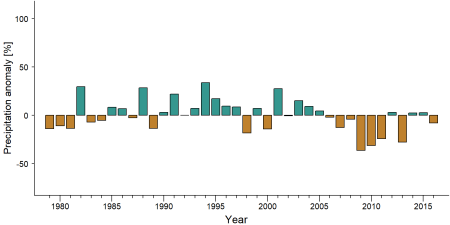
Precipitation anomaly in RAFALE (Refuge Altitude Forests of the Albert Lake Escarpment) -
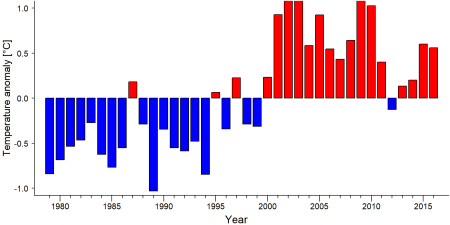
Temperature anomaly in RAFALE (Refuge Altitude Forests of the Albert Lake Escarpment)


External links
Mbudha, in the chimpanzees’ footsteps
Chimpanzees surviving in a fragmented high-altitude forest landscape of the Congolese Albertine Rift
New Population of Eastern Chimpanzees Discovered in Remote Congolese Mountain Forests
References
Hart, J., Maisels, F., Oates, J.F., Laudisoit, A., Hicks, T.C., & Struhsaker, T.T. (2019). Piliocolobus oustaleti The IUCN Red List of Threatened Species 2019.
Hicks, T.C., Menken, S.B.J., Laudisoit, A.,& Hart, J. (2019). Chapter 1. Handling and Consumption of Vertebrate Prey by Chimpanzees (Pan troglodytes schweinfurthii) in the Northern Democratic Republic of the Congo. Chimpanzee Behaviour: Recent Understandings from Captivity and the Forest Central Washington University, Ellensburg, WA USA. Friends of Washoe, Ellensburg, WA, USA. : Mary Lee Abshire Jensvold, PhD (Editor). ; 2019. p. 218.
Khwaja, H., Buchan, C., Wearn, O.R., Bahaa-el-din, L., Bantlin, D., Bernard, H., et al. (2019). Pangolins in global camera trap data: Implications for ecological monitoring. Global Ecology and Conservation, 20:e00769.
Laudisoit, A., Huyghe., P., Willie., J., et al. (2021). Chimpanzees surviving in a fragmented high-altitude forest landscape of the Congolese Albertine Rift. Conservation Science and Practice, 3:e403. https://doi.org/10.1111/csp2.403
Meessen, J.M.T. (1951). Monographie de l'Ituri (Nord-est du Congo belge) : histoire, géographie, économie. In: Direction de l'agriculture df, de l'élevage et de la colonisation, 1951., editor. Congo (Democratic Republic): Belgium. Ministère des affaires africaines. p. 305.
News24. (2017, August 25). Up to 250 feared dead in DRC mudslide. https://www.news24.com/news24/africa/news/up-to-250-feared-dead-in-drc-mudslide-20170825
Page created by: Dr. Anne Laudisoit Date: 2021-11-01