
Bossematie Nature Reserve
West Africa > Côte d'Ivoire > Bossematie Nature Reserve
Français | Português | Español | Bahasa Indonesia | Melayu
Summary
- Western chimpanzees (Pan troglodytes verus) are present in Bossematie Nature Reserve.
- The last population size is unknown.
- The chimpanzee population trend is unknown.
Site characteristics
This forest was upgraded from a classified forest to a nature reserve in 2022. It is home to iconic wildlife species, including elephants and chimpanzees. However, few studies have been conducted on its wildlife. Located in southeastern Côte d'Ivoire, the forest was managed by SODEFOR until 2021, after which it was designated a nature reserve and placed under the authority of the Ivorian Office of Parks and Reserves (OIPR). The reserve is situated 30 km southeast of Abengourou (Jamonneau 2024, Ouattara et al. 2021).
Table 1. Basic site information for Bossematie Nature Reserve
| Species | Pan troglodytes verus |
| Area | 219 km² |
| Coordinates | Lat: 6.615059 , Lon: -3.453851 |
| Type of site | Protected area (Nature Reserve) |
| Habitat types | Subtropical/tropical moist lowland forest, Agricultural land, Subtropical/tropical heavily degraded former forest |
| Type of governance | Governance by government |
Types of sites Governance types Habitat types
Ape status
Table 2. Ape population estimates reported for Bossematie Nature Reserve
| Species | Year | Occurrence | Encounter or vistation rate (nests/km; ind/day) | Density estimate [ind./ km²] (95% CI) | Abundance estimate (95% CI) | Survey area | Sampling method | Analytical framework | Source | Comments | A.P.E.S. database ID |
|---|---|---|---|---|---|---|---|---|---|---|---|
| Pan troglodytes verus | 2024 | 0.23 | Bossematie Nature Reserve | Reconnaissance walk | Jamonneau 2024 | They used oriented prospecting and surveyed the habitats most favorable to the presence of chimpanzees. |
Sampling methods Analytical frameworks
Threats
Table 3. Threats to apes reported for Bossematie Nature Reserve
| Category | Specific threats | Threat level | Description | Year of threat |
|---|---|---|---|---|
| 2 Agriculture & aquaculture | 2.1 Annual & perennial non-timber crops | High (more than 70% of population affected) | During surveys in 2015-2017, 20 farmers, 29 active plots, and 18 recent clearings were recorded. In the questionnaires, twelve farmers pinpointed their fields within the RNB, and through interviews and participant observation, multiple pieces of evidence, mostly indirect, were collected (Jamonneau 2024). The threat was already reported in 1991, but especially after 2015, occupancy of Bossématié has considerably increased. Between 2015 and 2020, the area under cultivation rose from 6% to 35% (Kouakou & Atta 2023), and reached 43% by the end of 2022 (Vancutsem et al. 2023). | 2015-Ongoing (2024) |
| 5 Biological resource use | 5.1 Hunting & collecting terrestrial animals | Present (unknown severity) | Poaching may be decreasing due to more regular patrols (Jamonneau 2024). | 1990-Ongoing (2024) |
| 5 Biological resource use | 5.1.5 Persecution/human wildlife conflict | Present (unknown severity) | Currently very low (Jamonneau 2024). | Ongoing (2024) |
Conservation activities
Table 4. Conservation activities reported for Bossematie Nature Reserve
| Category | Specific activity | Description | Implementing organization(s) | Year of activity |
|---|---|---|---|---|
| 2 Counter-wildlife crime | 2.3 Conduct regular anti-poaching patrols | Hunting in the area seems to have declined since patrols are conducted more regularly (Jamonneau 2024). | OIPR | 2022-Ongoing (2024) |
| 4 Education & awareness | 4.1 Educate local communities about apes and sustainable use | Awareness-raising campaigns have been implemented by OIPR (Jamonneau 2024). | OIPR | 2022 |
| 5 Protection & restoration | 5.2 Legally protect ape habitat | The site was upgraded to Nature Reserve in 2022; before that, it was a forest reserve, established in 1956. | OIPR | 1956-2022 |
| 5 Protection & restoration | 5.2 Legally protect ape habitat | The site was upgraded to Nature Reserve in 2022; before that, it was a forest reserve, established in 1956. | OIPR | 2022-Ongoing (2026) |
Challenges
Table 5. Challenges reported for Bossematie Nature Reserve
| Challenges | Specific challenges | Source | Year(s) |
|---|---|---|---|
| 1 Site management | 1.3 Corruption | 1956-2022 | |
| 1 Site management | 1.4 Conflict on land tenure | Ongoing (2024) | |
| 3 Engaged community | 3.5 Anticipated disadvantages/costs created by conservation activities (e.g., restricted access/resource use) | Ongoing (2024) |
Enablers
Research activities
Documented behaviours
Exposure to climate change impacts
As part of a study on the exposure of African great ape sites to climate change impacts, Kiribou et al. subm. extracted climate data and data on projected extreme climate impact events for the site. Climatological characteristics were derived from observation-based climate data provided by the Inter-Sectoral Impact Model Intercomparison Project (ISIMIP, www.isimip.org). Parameters were calculated as the average across each 30-year period. For 1981-2010, the EWEMBI dataset from ISIMIP2a was used. For the two future periods (2021-2050 and 2071-2099) ISIMIP2b climate data based on four CMIP5 global climate models were used. For future projections, two Representative Concentration Pathways (RCP) were used. RCP 2.6 is a scenario with strong mitigation measures in which global temperatures would likely rise below 2C. RCP 6.0 is a scenario with medium emissions in which global temperatures would likely rise up to 3C by 2100. For the number of days with heavy precipitation events, the 98th percentile of all precipitation days (>1mm/d) was calculated for the 1979-2013 reference period as a threshold for a heavy precipitation event. Then, for each year, the number of days above that threshold was derived. The figures on temperature and precipitation anomaly show the deviation from the mean temperature and mean precipitation for the 1979-2013 reference period.
The estimated exposure to future extreme climate impact events (crop failure, drought, river flood, wildfire, tropical cyclone, and heatwave) is based on a published dataset by Lange et al. 2020 derived from ISIMIP2b data. The same global climate models and RCPs as described above were used. Within each 30-year period, the number of years with an extreme event and the average proportion of the site affected were calculated (see Kiribou et al. subm. for details).
Table 8. Estimated past and projected climatological characteristics in Bossematie Nature Reserve
| Value | 1981-2010 | 2021-2050, RCP 2.6 | 2021-2050, RCP 6.0 | 2071-2099, RCP 2.6 | 2071-2099, RCP 6.0 |
|---|---|---|---|---|---|
| Mean temperature [C] | 27 | 28.1 | 27.9 | 28.2 | 29.4 |
| Annual precipitation [mm] | 1295 | 1253 | 1314 | 1258 | 1335 |
| Max no. consecutive dry days (per year) | 28.9 | 26.1 | 28.8 | 30.3 | 30.6 |
| No. days with heavy precipitation (per year) | 6.5 | 6.1 | 6.5 | 5.8 | 8.3 |
-
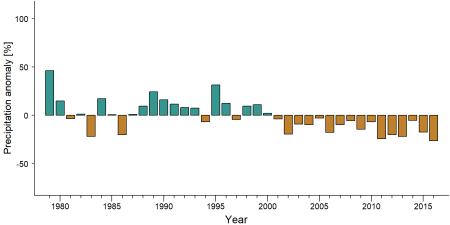
Precipitation anomaly in Bossematie Nature Reserve -
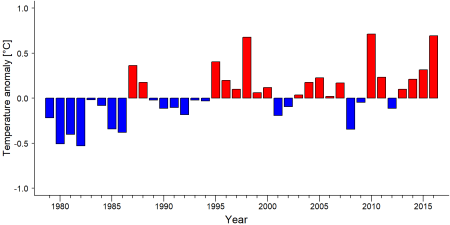
Temperature anomaly in Bossematie Nature Reserve


External links
References
Jamonneau, T. (2024). Relations entre humains, chimpanzés et éléphants en périphérie, et dans la Réserve Naturelle de la Bossématié, sud-est de la Côte d'Ivoire [Rapport de stage de Master, Faculté des Sciences de l'Université de Montpellier, France].
Kouakou, Y. K., & Atta, J.-M. K. (2023). Dynamique spatiale de la forêt classée de Bossématié au sud-est de la Côte d’Ivoire. Regardsuds.
Ouattara, S., Benoît, K. K., Cyrille-Joseph, A. A., Alphonse, Y. K., Jean-Louis, K., Blaise, K. S., & Paterne, K. J. (2021). Densité et distribution des éléphants de la forêt classée de la Bossematié (Sud-Est, Côte d'Ivoire). International Journal of Innovation and Applied Studies, 34(3), 573–582. https://www.ijias.issr-journals.org
Vancutsem, C., Achard, F., Tillie, P., Costa, C., & Brossard, S. (2023). Évaluation de l’état des forêts dans la réserve de Bossématié en Côte d’Ivoire. https://doi.org/10.2760/451686
Page created by: Diorne Zausa Date: 2025-03-25