
Salonga National Park
Central Africa > Democratic Republic of the Congo > Salonga National Park
Français | Português | Español | Bahasa Indonesia | Melayu
Summary
- Bonobos (Pan paniscus) are present in Salonga National Park.
- It has been estimated that 9,246 (CI: 3,596-20,720) individuals occur in the South Block (2018 estimate), and 7,826 (CI: 3,814-10,618) individuals inhabit the North Block (2006 estimate).
- The bonobo population trend is unknown.
- The site has a total size of 33,350 km².
- Hunting is the most important threat to bonobos; expansion of land for agriculture and disease transmission threaten the bonobo population to a lower extent, but may increase in severity in the nearby future.
- Conservation activities have focused on biomonitoring, anti-poaching patrols and surveillance with SMART software application, education and awareness raising, and presence of researchers and staff.
- The park was declared a World Heritage Site in 1984 and is the largest expanse of legally protected bonobo habitat.
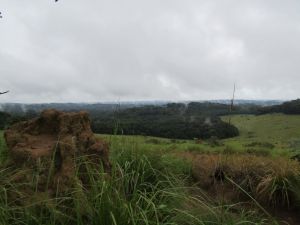
View of Salonga National Park, South Block, from the guard Station of Anga © Mattia Bessone – PNS Survey -
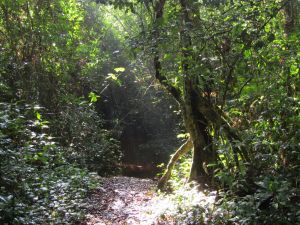
A small stream on the path to Iyaelima, Sector of Anga © Mattia Bessone – PNS Survey 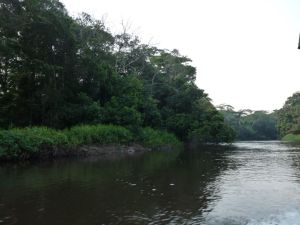
Luilaka river, Sector of Monkoto © Mattia Bessone – PNS Survey


Site characteristics
Salonga National Park (SNP) is the largest protected area of pristine rainforest in the African continent (33,500 km²). Located south of the Congo river, in the Democratic Republic of the Congo, it is a UNESCO World Heritage site and a stronghold for many endangered species. SNP, is divided into two blocks, North and South, separated by a 45 km wide inhabited buffer zone. Since 2015, the park is co-managed by the Congolese Institute for Nature Conservation (ICCN) in collaboration with the World Wide Fund for Nature (WWF). In addition to bonobos, SNP harbours one of the few remnant populations of forest elephants (Loxodonta cyclotis) in the country. SNP is also home to 8 species of monkeys: Thollon’s red colobus (Piliocolobus tholloni), the Angola Pied Colobus (Colobus angolensis), Allen’s Swamp Monkey (Allenopithecus nigroviridis), Red-tailed monkey (Cercopithecus ascanius), Wolf's mona monkey (Cercopithecus wolfii), De Brazza’s Monkey (Cercopithecus neglectus), the Black Mangabey (Lophocebus aterrinus) and the Golden-bellied mangabey (Cercocebus chrysogaster). A large ungulate community is found in the Park, including the forest buffalo (Syncerus caffer) and the endangered Bongo (Tragelaphus euryceros), along with large carnivores such a the leopard (Panthera pardus) and the African golden cat (Caracal aurata). Finally, SNP is a stronghold for other endangered mammals such as the Giant ground pangolin (Smutsia gigantea), and for stunning birds such as the endemic Congo peafowl (Afropavo congensis). The entomofauna and floral diversity is equally rich, with many species expected being still unknown to science.
Table 1. Basic site information for Salonga National Park
| Species | Pan paniscus |
| Area | 33,350 km² |
| Coordinates | Lat: -2.533783 , Lon: 20.907380 |
| Type of site | Protected area (National Park) |
| Habitat types | Subtropical/tropical moist lowland forest, Subtropical/tropical swamp forest, Savanna, Agricultural land, Wetlands (lakes, rivers, streams, bogs, marshes) |
| Type of governance | Shared governance |
Types of sites Governance types Habitat types
Ape status
Table 2. Ape population estimates reported for Salonga National Park
| Species | Year | Occurrence | Encounter or vistation rate (nests/km; ind/day) | Density estimate [ind./ km²] (95% CI) | Abundance estimate (95% CI) | Survey area | Sampling method | Analytical framework | Source | Comments | A.P.E.S. database ID |
|---|---|---|---|---|---|---|---|---|---|---|---|
| Pan paniscus | 2005 | 1.15 | 0.27 (0.14-0.56) | 541 (281-1,119) | Salonga Lokofa (2,000 km²) | Line transects | Grossmann et al. 2008 | ||||
| Pan paniscus | 2015 | 3.19 | 0.38 (0.15-0.96) | 1,042 (419-2,591) | Salonga Lokofa (2,700 km²) | Line transects | WCS 2015 | ||||
| Pan paniscus | 2006 | 2.20 | 0.51 (0.28-1.01) | 1,282 (699-2,533) | Salonga Iyaelima (2,500 km²) | Line transects | Grossmann et al. 2008 | ||||
| Pan paniscus | 2016-2018 | 0.54 (0.21-1.21) | 9,246 (3,596-20,720) | Salonga National Park, South block (17,000 km²,) | Camera trap | Bessone et al. 2020 | |||||
| Pan paniscus | 2000 | 8 | 1.36 | Salonga Beminyo (<10 km²) | Line transects | Reinartz et al. 2006 | |||||
| Pan paniscus | 2000-2002 | 24.4 | 2.78 | Salonga Lokofa (25 km²) | Line transects | Reinartz et al. 2006 | |||||
| Pan paniscus | 2005-2006 | 2.29 | Lomela Block (2,750 km²) | Line transects | Grossman et al. 2008 | Survey effort: 95.2 km | |||||
| Pan paniscus | 2006 | 7,826 (3,814-10,618) | Salonga National Park, North Block | Line transects & recces | Grossman et al. 2008 | ||||||
| Pan paniscus | 2005-2006 | 1.8 | Lomela Block (2,750 km²) | Reconnaissance walk | Grossman et al. 2008 | Survey effort: 515 km |
Sampling methods Analytical frameworks

Threats
The bonobo is a taboo animal in some part of the South block, particularly (but not exclusively) in the Iyaelima area (Thompson et al. 2008), where the highest bonobo densities of the site have been observed, despite the presence of 8 permanent villages (Grossmann et al. 2008). However commercial hunters reach very deep into the site and hunting remains the main threat to the ape population (Hart et al. 2008). In addition, the frequent human presence within the site exposes bonobos to human-transmitted diseases such as the Ebola Haemorrhagic Fever. Two recent Ebola outbreaks were recorded north of the site, in Mbandaka (2018) and Boende (2014). Both are major centres in the region, with constant movement of people and traders from, and to, these towns.
Table 3. Threats to apes reported for Salonga National Park
| Category | Specific threats | Threat level | Description | Year of threat |
|---|---|---|---|---|
| 2 Agriculture & aquaculture | 2.1.1 Shifting agriculture | Low (up to 30% of population affected) | Clearing land for agriculture (Salonga National Park). A small proportion of the site is concerned, with slash and burn concentrated outside the site borders. | Ongoing (2021) |
| 5 Biological resource use | 5.1 Hunting & collecting terrestrial animals | High (more than 70% of population affected) | SNP has a history of intense poaching for ivory and bushmeat. Bonobos are taboo in some area of the Park, but are nevertheless hunted for commercial purposes, demand for bonobo meat and parts coming from cities outside the block. Signs of both traditional and professional hunting can be found everywhere in the block. (Hart et al., 2008; Bessone pers. comm. 2020). Poaching has led to declines of up to 70% in bonobo numbers in some areas of the park. Surveys in the corridor between the two blocks showed that bonobos were rare or absent within 10 km of villages and completely absent in most of the northern part of the corridor (IUCN & ICCN 2012, WWF n.d.). | 2008-Ongoing (2020) |
| 8 Invasive & other problematic species, genes & diseases | 8.4 Pathogens | Low (up to 30% of population affected) | The frequent presence of humans, particularly (but not solely) due to the presence of 8 villages within the site borders, exposes bonobos to human-transmitted diseases such as Ebola Haemorrhagic Fever, with two recent outbreaks north of the Park, in Mbandaka (2018) and Boende (2014). | 2014, 2018 |
| 4 Transportation & service corridors | Other | High (more than 70% of population affected) | Nearly 85% of the north block is within 15 km of a river navigable by dugout canoe (Grossman et al. 2008). | Ongoing (2008) |
Conservation activities
WWF has been working in Salonga since 2005, supporting the Congolese park authority ICCN (Institut Congolais pour la Conservation de la Nature) in managing the park and engaging with local communities to identify and develop alternative livelihood opportunities (WWF n.d.). Since 2015, WWF is co-managing the park together with the ICCN (WWF n.d.). The site represents the largest existing expanse of legally-protected and intact bonobo habitat; protection of this park and it’s wildlife is therefore of paramount importance (IUCN & ICCN 2012). To control the increase in elephant poaching and the proliferation of military weapons in the region, government armed forces (FARDC) undertook a joint operation with ICCN, called Operation Bonobo, in 2011 (IUCN & ICCN 2012, Mukpo 2019). The operation was said to be successful in returning the ICCN control of the park.
Table 4. Conservation activities reported for Salonga National Park
| Category | Specific activity | Description | Implementing organization(s) | Year of activity |
|---|---|---|---|---|
| 2 Counter-wildlife crime | 2.11 Implement monitoring surveillance strategies (e.g., SMART) or use monitoring data to improve effectiveness of patrols | Introduction of SMART to support anti-poaching efforts (WWF n.d., IUCN 2020). | Ongoing (2020) | |
| 2 Counter-wildlife crime | 2.3 Conduct regular anti-poaching patrols | Regular patrols are conducted by the Park management and have significantly increased over the past 5 years (IUCN 2020). | Ongoing (2020) | |
| 2 Counter-wildlife crime | 2.7 Provide better equipment (e.g., guns) to anti-poaching ranger patrols | IUCN 2020 | Ongoing (2020) | |
| 2 Counter-wildlife crime | 2.8 Provide training to anti-poaching ranger patrols | IUCN 2020 | 2018 and 2020 | |
| 4 Education & awareness | 4.1 Educate local communities about apes and sustainable use | IUCN 2020 | Ongoing (2020) | |
| 5 Protection & restoration | 5.2 Legally protect ape habitat | National Park since 1970. | 1970-Ongoing (2026) | |
| 8 Permanent presence | 8.3 Permanent presence of staff/manager | IUCN 2020 | Ongoing (2020) |
Challenges
Table 5. Challenges reported for Salonga National Park
| Challenges | Specific challenges | Source | Year(s) |
|---|---|---|---|
| 1 Site management | 1.3 Corruption | WWF n.d. | |
| 2 Resources and capacity | 2.1 Lack of capacity/training | WWF n.d. | |
| 2 Resources and capacity | 2.5 Lack of equipment/transportation | WWF n.d. |
Enablers
Table 6. Enablers reported for Salonga National Park
| Enablers | Specific enablers | Source | Year(s) |
|---|---|---|---|
| 1 Site management | |||
| 2 Resources and capacity | |||
| 3 Engaged community | |||
| 4 Institutional support | |||
| 5 Ecological context | |||
| 6 Safety and stability |
Research activities
Reinartz et al. (2006; 2008), Grossmann et al. (2008), Maisels et al. (2010), WCS (2015) and Bessone et al. (2020) conducted surveys estimating bonobo and other species densities. Hart et al. (2008) reported on the impact of human activities on bonobos, and Thompson et al. (2008) on traditional culture of the Iyaelima people, with regard to bonobo conservation. In the buffer zone, west of the site, the LuiKotale Bonobo Project is conducting research on habituated bonobos, focusing on all aspects of bonobos’ ecology, physiology, behaviour and evolutionary history, as well as on ethnobotany (Hohmann and Fruth 2003). Research by Bessone et al. (2021) revealed that increasingly drier conditions have resulted in longer decay times of bonobo nests in Salonga. As climate change continues to affect the processes of nest decomposition and nest construction behaviour, nest decomposition times are likely to increase further in future years (Bessone et al. 2021). Unless population assessments account for this variation in nest decay, it may lead to the erroneous conclusion of increasing ape numbers when populations are actually stable or decreasing (Bessone et al. 2021).
Documented behaviours
Table 7. Behaviours documented for Salonga National Park
| Category | Behavior | Observation type | Prevalence | Observation dates | Source | Habituation | Species | Comment |
|---|---|---|---|---|---|---|---|---|
| Not reported |
Exposure to climate change impacts
Table 8. Estimated past and projected climatological characteristics in Salonga National Park
| Value | 1981-2010 | 2021-2050, RCP 2.6 | 2021-2050, RCP 6.0 | 2071-2099, RCP 2.6 | 2071-2099, RCP 6.0 |
|---|---|---|---|---|---|
| Mean temperature [C] | 25.2 | 26.4 | 26.4 | 26.6 | 27.7 |
| Annual precipitation [mm] | 1851 | 1829 | 1823 | 1834 | 1851 |
| Max no. consecutive dry days (per year) | 12.9 | 16.2 | 15.9 | 19.1 | 15.4 |
| No. days with heavy precipitation (per year) | 6.8 | 9.7 | 10.3 | 9.8 | 12.2 |
Table 9. Projected exposure of apes to extreme climate impact events in Salonga National Park
| Type | No. of years with event (2021-2050, RCP 2.6) | % of site exposed (2021-2050, RCP 2.6) | No. of years with event (2021-2050, RCP 6.0) | % of site exposed (2021-2050, RCP 6.0) | No. of years with event (2070-2099, RCP 2.6) | % of site exposed (2070-2099, RCP 2.6) | No. of years with event (2070-2099, RCP 6.0) | % of site exposed (2070-2099, RCP 6.0) |
|---|---|---|---|---|---|---|---|---|
| Crop failure | 20 | 0.01 | 17 | 0.01 | 19 | 0.01 | 29 | 0.02 |
| Drought | 0 | 0 | 0 | 0 | 0 | 0 | 0 | 0 |
| Heatwave | 10.5 | 41.73 | 11.5 | 29.11 | 12 | 43.06 | 25 | 55.5 |
| River flood | 1.5 | 0.04 | 2.25 | 0.38 | 2.75 | 0.39 | 5 | 1.77 |
| Tropical cyclone | 0 | 0 | 0 | 0 | 0 | 0 | 0 | 0 |
| Wildfire | 30 | 0.57 | 30 | 0.56 | 29 | 0.6 | 29 | 0.42 |
-
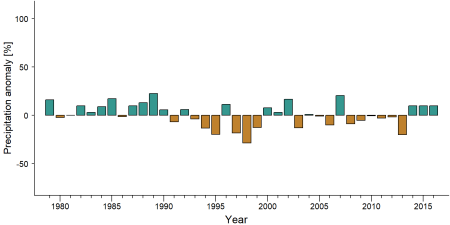
Precipitation anomaly in Salonga National Park -
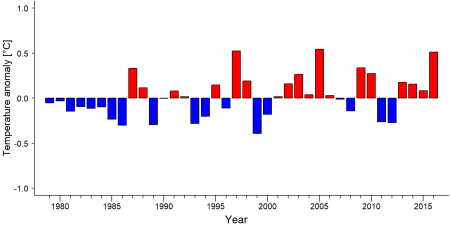
Temperature anomaly in Salonga National Park


External links
Salonga National Park UNESCO World Heritage
Salonga National Park IUCN World Heritage Outlook
References
Bessone, M., Kühl, H. S., Hohmann, G., Herbinger, I., N'Goran, K. P., Asanzi, P., . . . Beka, B. (2020). Drawn out of the shadows: Surveying secretive forest species with camera-trap distance sampling. Journal of Applied Ecology, 57(5), 963-974.
Bessone, M., Booto, L., Santos, A. R., Kühl, H. S., & Fruth, B. (2021). No time to rest: How the effects of climate change on nest decay threaten the conservation of apes in the wild. PloS one, 16(6), e0252527.
BirdLife International. (2021). Important Bird Areas factsheet: Salonga National Park. Downloaded from http://www.birdlife.org on 11/11/2021.
Fruth, B., Hickey, J. M., Andre, C., Furuichi, T., Hart, J., Hart, T., . . . Reinartz, G. (2016). Pan paniscus. The IUCN Red List of Threatened Species 2016: e.T15932A102331567.
Grossmann, F., Hart, J. A., Vosper, A., & Ilambu, O. (2008). Range occupation and population estimates of bonobos in the Salonga National Park: application to large-scale surveys of bonobos in the Democratic Republic of Congo. In The Bonobos (pp. 189-216): Springer.
Hart, J. A., Grossmann, F., Vosper, A., & Ilanga, J. (2008). Human hunting and its impact on bonobos in the Salonga National Park, Democratic Republic of Congo. In The Bonobos (pp. 245-271): Springer.
Hohmann, G., & Fruth, B. (2003). Lui Kotal: a new site for field research on bonobos in the Salonga National Park. Pan Africa News, 10(2), 25-27.
IUCN (2020). Salonga National Park - 2020 Conservation Outlook Assessment. IUCN World Heritage Outlook: https://worldheritageoutlook.iucn.org.
IUCN & ICCN. (2012). Bonobo (Pan paniscus): Conservation Strategy 2012–2022. Gland, Switzerland: IUCN/SSC Primate Specialist Group & Institut Congolais pour la Conservation de la Nature. 65 pp.
Kano, T. (1984). Distribution of pygmy chimpanzees (Pan paniscus) in the central Zaire basin. Folia primatologica, 43(1), 36-52.
Thompson, J. M., Nestor, L. M., & Kabanda, R. B. (2008). Traditional land-use practices for bonobo conservation. In The Bonobos (pp. 227-244): Springer.
Maisels, F., Nkumu, P., Bonyenge, A., & Naky, P. (2010). Salonga National Park, Democratic Republic of Congo: Terrestrial Wildlife and Human-Impact Monitoring Programme. Survey Report–Eastern Sector of Park. Unpublished report, Wildlife Conservation Society, New York.
Mukpo, A. (2019, June 12). Did efforts to protect DRC’s elephants and bonobos leave a trail of abuses? Mongabay. https://news.mongabay.com/2019/06/did-efforts-to-protect-drcs-elephants-and-bonobos-leave-a-trail-of-abuses/
Reinartz, G. E., Isia, I. B., Ngamankosi, M., & Wema, L. W. (2006). Effects of Forest Type and Human Presence on Bonobo ( Pan paniscus) Density in the Salonga National Park. International Journal of Primatology, 27(4), 1229-1231.
Reinartz, G. E., Guislain, P., Bolinga, T. M., Isomana, E., Inogwabini, B.-I., Bokomo, N., . . . Wema, L. W. (2008). Ecological factors influencing bonobo density and distribution in the Salonga National Park: applications for population assessment. In The Bonobos (pp. 167-188): Springer.
WCS (2015). Survey of the Lokofa Block of the Salonga National Park: preliminary report. Wildlife Conservation Society, Kinshasa, DRC.
WWF. (n.d.). Salonga Programme. Online: https://www.wwf-congobasin.org/where_we_work/democratic_republic_of_congo/salonga_programme/
Page created by: Mattia Bessone Date: 2021-11-02
Page updated by: APES Atlas Team Date: 2025-10-29