
Tayna Nature Reserve
Central Africa > Democratic Republic of the Congo > Tayna Nature Reserve
Français | Português | Español | Bahasa Indonesia | Melayu
Summary
- Eastern chimpanzees (‘’Pan troglodytes schweinfurthii’’) & Grauer's gorillas (‘’Gorilla beringei graueri’’) are present in Tayna Nature Reserve.
- The population estimates are unknown.
- The great ape population trend is decreasing.
- The site has a total size of 900 km².
- Key threats to great apes include subsistence hunting, expansion of land for agriculture, wood harvesting, and artisanal mining.
- Conservation activities have focused on community engagement, gorilla rehabilitation and reintroduction, and conservation education.
Site characteristics
Tayna Nature Reserve is located in eastern Democratic Republic of the Congo, within the transition zone between lowland forests and the Congo river to the west, and the Albertine Rift to the east (GRACE 2021). The reserve is not only important as one of the last strongholds for the critically endangered Gauer's gorilla, but it also sustains a wide species diversity, including endemic species. In addition the Grauer's gorilla and eastern chimpanzees, other species of conservation concern present at the site include owl faced monkeys, L'Hoest's monkeys, golden cats, Ruwenzori leopards, giant pangolins, forest elephants, aardvarks, red river hogs, giant forest hogs, and okapis (Vwirasihikya & Matsitsi 2003). The reserve was identified by Plumptre et al. (2016) as one of four priority areas for the conservation of Grauer's gorilla outside of national parks within the entire Albertine Rift.
Table 1. Basic site information for Tayna Nature Reserve
| Species | Pan troglodytes schweinfurthii, Gorilla beringei graueri |
| Area | 900 km² |
| Coordinates | Lat: -0.346968 , Lon: 28.933953 |
| Type of site | Protected area (Nature Reserve) |
| Habitat types | Subtropical/tropical moist montane forest |
| Type of governance | Shared governance |
Types of sites Governance types Habitat types

Ape status
Tayna holds one of the most important gorilla populations and represents a priority site for conservation efforts (Plumptre et al. 2015a, Maldonado et al. 2012). Survey information has been very limited in the past due to insecurity in the region. In 2012, a survey was halted after only a few days due to unresolved conflict between the Reserve and the survey team. In 2021, the first survey to cover the entire reserve was conducted. Survey teams recorded 305 gorillas nests, 280 chimpanzee nests, and 25 signs of other animals, including 5 species of monkeys, pangolin, forest buffalo, African grey parrot, leopard, and a single Okapi footprint (Fawcett & Kabuyaya Mbeke 2021).
The gorilla population at Tayna is also considered a priority in terms of the preservation of genetic diversity (Valk et al. 2018). Based on historical museum specimens and modern faecal samples, Grauer's gorilla populations have experienced a rapid loss of genetic diversity. This decline is attributed to the loss of peripheral populations rather than a decrease in genetic diversity in the core range of the species (Valk et al. 2018). Tayna is located at the northeastern extreme of the Grauer landscape, potentially representing a unique genetic profile.
Table 2. Ape population estimates reported for Tayna Nature Reserve
| Species | Year | Occurrence | Encounter or vistation rate (nests/km; ind/day) | Density estimate [ind./ km²] (95% CI) | Abundance estimate (95% CI) | Survey area | Sampling method | Analytical framework | Source | Comments | A.P.E.S. database ID |
|---|---|---|---|---|---|---|---|---|---|---|---|
| Gorilla beringei graueri | 2023 | Present | Tayna Nature Reserve | Camera trap | |||||||
| Gorilla beringei graueri | 2011-2015 | 0.289 | 541 (121-2414) | Tayna-Kisimba-Ikobo (1,869 km²) | Line transects & recces | Plumptre et al. 2016 | |||||
| Gorilla beringei graueri | 2001-2002 | 1.00 | 450.0 | Tayna Gorilla Reserve | Reconnaissance walk | Vwirasihikya & Matsitsi 2003 | |||||
| Gorilla beringei graueri | 2021 | Present | Tayna Nature Reserve (900 km²) | Strip transect | Fawcett & Kabuyaya Mbeke 2021 | ||||||
| Pan troglodytes schweinfurthii | 2021 | Present | Tayna Nature Reserve (900 km²) | Strip transect | Fawcett & Kabuyaya Mbeke 2021 | ||||||
| Gorilla beringei graueri | 2012 | 185-210 | Tayna Nature Reserve (906 km²) | Survey data, Line transects, Partial count | Plumptre et al. 2015b |
Sampling methods Analytical frameworks
Threats
The socioeconomic depression arising from over a decade of civil war placed enormous pressure on the forest resources and fauna in the region (Plumptre et al. 2015b). In addition, since 1996, the entire Grauer's gorilla range has been consumed in conflict, resulting in a breakdown of wildlife protection activities. Key ongoing threats at the site include agricultural expansion (Ayebare et al. 2018), subsistence hunting and wood harvesting, and mining (Plumptre et al. 2015b, Plumptre et al. 2016).
Table 3. Threats to apes reported for Tayna Nature Reserve
| Category | Specific threats | Threat level | Description | Year of threat |
|---|---|---|---|---|
| 2 Agriculture & aquaculture | 2.1 Annual & perennial non-timber crops | High (more than 70% of population affected) | Subsistence agriculture (GRACE 2021). | Ongoing (2021) |
| 3 Energy production & mining | 3.2 Mining & quarrying | High (more than 70% of population affected) | Artisanal mining for minerals such as cassiterite, gold and coltan (Plumptre et al. 2015b, Fawcett, K. pers. comm. 2022). | 2015-Ongoing (2022) |
| 5 Biological resource use | 5.1 Hunting & collecting terrestrial animals | High (more than 70% of population affected) | Bushmeat hunting for subsistence (Fawcett, K., pers. comm. 2022). Furthermore, several gorillas were killed (and an infant captured) in the Tayna Nature Reserve between 2004 and 2007, as reported by Nixon, S. (Plumptre et al. 2015b). | 2004-Ongoing (2022) |
| 5 Biological resource use | 5.3 Logging & wood harvesting | Low (up to 30% of population affected) | Logging for local subsistence, e.g., gathering fuelwood, timber harvesting for construction (Fawcett, K., pers. comm. 2022, GRACE 2021). | Ongoing (2022) |
| 8 Invasive & other problematic species, genes & diseases | 8.4 Pathogens | Present (unknown severity) | Ebola outbreak that lasted 18 months, not directly inside the reserve, but in eastern DRC (GRACE 2021). | 2017-2019 |
Conservation activities
Since the late 1990s community leaders have led an effort to protect the area; in fact, the site was created from land donated by community members (GRACE). By protecting the land, local communities aimed to prevent the loss of local forests, wildlife, and sacred cultural sites to agricultural expansion and commercial cattle ranchers (GRACE). The site was officially declared the Tayna Nature Reserve in 2006 by the government of DRC. The reserve is managed by the community in partnership with the Gorilla Rehabilitation and Conservation Education (GRACE) center, and the ICCN.
Conservation activities at the reserve are divided into four main strategies: 1) Gorilla rehabilitation, 2) Gorilla conservation (reintroduction of rehabilitated gorillas back into the wild), 3) Conservation education, and 4) Community engagement, e.g., assisting local communities with finding sustainable solutions for co-existing with wildlife, promoting local conservation leadership and building pride (GRACE).
Table 4. Conservation activities reported for Tayna Nature Reserve
| Category | Specific activity | Description | Implementing organization(s) | Year of activity |
|---|---|---|---|---|
| 2 Counter-wildlife crime | 2.13 Provide sustainable alternative livelihoods; establish fish- or domestic meat farms | GRACE supports domestic livestock initiatives started by local women’s groups, including a guinea pig program (https://gracegorillas.org/grace-about-the-organization/#our-programs). | Ongoing (2022) | |
| 2 Counter-wildlife crime | 2.3 Conduct regular anti-poaching patrols | Regular patrols and law enforcement activities are reported (D. Caillaud & K. Fawcett. pers. comm. 2025). | Ongoing (2025) | |
| 4 Education & awareness | 4.1 Educate local communities about apes and sustainable use | GRACE provides conservation education programs with schoolchildren and local communities (GRACE). | Ongoing (2022) | |
| 4 Education & awareness | 4.2 Involve local community in ape research and conservation management | Extensive training of local community members to lead field data collection, e.g., monitoring gorillas and other wildlife, as well as human activity signs in the reserve (GRACE 2021). | Ongoing (2022) | |
| 4 Education & awareness | 4.5 Implement multimedia campaigns using theatre, film, print media, discussions | Conservation outreach through a radio program; the Tayna radio station estimates its audience is 60,000 people (GRACE 2021). | Ongoing (2022) | |
| 5 Protection & restoration | 5.2 Legally protect ape habitat | The site is a Nature Reserve. | 2006-Ongoing (2026) | |
| 5 Protection & restoration | 5.6 Habitat restoration | Forest rehabilitation and protection activities are reported (D. Caillaud & K. Fawcett. pers. comm. 2025). | Ongoing (2025) | |
| 6 Species management | 6.9 Rehabilitate injured/orphaned apes | Sanctuary for rescued orphans and illegally captured gorillas, which are confiscated by the ICCN; GRACE cares for the rehabilitation and release outside the reserve, within the Grauer's range (GRACE). Currently GRACE is working towards the release of gorillas in Virunga National Park to reinforce the functionally extinct population at the park (Fawcett, K. pers. comm. 2022). | Ongoing (2022) | |
| 7 Economic & other incentives | 7.1 Provide monetary benefits to local communities for sustainably managing their forest and its wildlife (e.g., REDD, alternative income, employment) | Jobs brought to local communities through conservation (Fawcett, K. pers. comm. 2022, GRACE). | Ongoing (2022) | |
| 7 Economic & other incentives | 7.2 Provide non-monetary benefits to local communities for sustainably managing their forest and its wildlife (e.g., better education, infrastructure development) | Many community engagement activities focus on women to support their empowerment, and because they're the primary users of natural resources. For example, GRACE is working with women’s groups to build and install more efficient stoves to significantly reduce the amount of wood needed per household. (GRACE).In addition, local communities are supported in developing new income sources, such as selling local products and managing their own forests, and are provided with services such as health care and wellbeing (D. Caillaud & K. Fawcett. pers. comm. 2025). | 2022-Ongoing (2025) |
Challenges
Table 5. Challenges reported for Tayna Nature Reserve
| Challenges | Specific challenges | Source | Year(s) |
|---|---|---|---|
| 2 Resources and capacity | 2.1 Lack of capacity/training | Fawcett, K. pers. comm. 2022 | |
| 2 Resources and capacity | 2.2 Lack of staff | D. Caillaud & K. Fawcett. pers. comm. 2025 | Ongoing (2025) |
| 2 Resources and capacity | 2.3 General lack of funding | D. Caillaud & K. Fawcett. pers. comm. 2025 | Ongoing (2025) |
| 2 Resources and capacity | 2.4 Lack of continuous/long-term funding | D. Caillaud & K. Fawcett. pers. comm. 2025 | Ongoing (2025) |
| 3 Engaged community | 3.5 Anticipated disadvantages/costs created by conservation activities (e.g., restricted access/resource use) | Fawcett, K. pers. comm. 2022 | |
| 6 Safety and stability | 6.3 Civil unrest/war | Plumptre et al. 2015 |
Enablers
Table 6. Enablers reported for Tayna Nature Reserve
| Enablers | Specific enablers | Source | Year(s) |
|---|---|---|---|
| 2 Resources and capacity | 2.5 Sufficient capacity/expertise to advise, design, or implement actions | D. Caillaud & K. Fawcett. pers. comm. 2025 | Ongoing (2025) |
| 2 Resources and capacity | 2.6 External partnerships that add expertise or resources | D. Caillaud & K. Fawcett. pers. comm. 2025 | Ongoing (2025) |
| 3 Engaged community | 3.6 Local community engagement and support | D. Caillaud & K. Fawcett. pers. comm. 2025 | Ongoing (2025) |
| 1 Site management | |||
| 4 Institutional support | |||
| 5 Ecological context | |||
| 6 Safety and stability |
Research activities
There is a permanent presence of monitoring teams in the Tayna Nature Reserve led by the community management authority RGT in partnership with GRACE. Damien Caillaud, Associate Professor at UC Davis is a GRACE science advisor for this work.
Documented behaviours
Table 7. Behaviours documented for Tayna Nature Reserve
| Category | Behavior | Observation type | Prevalence | Observation dates | Source | Habituation | Species | Comment |
|---|---|---|---|---|---|---|---|---|
| Not reported |
Exposure to climate change impacts
As part of a study on the exposure of African great ape sites to climate change impacts, Kiribou et al. subm. extracted climate data and data on projected extreme climate impact events for the site. Climatological characteristics were derived from observation-based climate data provided by the Inter-Sectoral Impact Model Intercomparison Project (ISIMIP, www.isimip.org). Parameters were calculated as the average across each 30-year period. For 1981-2010, the EWEMBI dataset from ISIMIP2a was used. For the two future periods (2021-2050 and 2071-2099) ISIMIP2b climate data based on four CMIP5 global climate models were used. For future projections, two Representative Concentration Pathways (RCP) were used. RCP 2.6 is a scenario with strong mitigation measures in which global temperatures would likely rise below 2C. RCP 6.0 is a scenario with medium emissions in which global temperatures would likely rise up to 3C by 2100. For the number of days with heavy precipitation events, the 98th percentile of all precipitation days (>1mm/d) was calculated for the 1979-2013 reference period as a threshold for a heavy precipitation event. Then, for each year, the number of days above that threshold was derived. The figures on temperature and precipitation anomaly show the deviation from the mean temperature and mean precipitation for the 1979-2013 reference period.
The estimated exposure to future extreme climate impact events (crop failure, drought, river flood, wildfire, tropical cyclone, and heatwave) is based on a published dataset by Lange et al. 2020 derived from ISIMIP2b data. The same global climate models and RCPs as described above were used. Within each 30-year period, the number of years with an extreme event and the average proportion of the site affected were calculated (see Kiribou et al. subm. for details).
Table 8. Estimated past and projected climatological characteristics in Tayna Nature Reserve
| Value | 1981-2010 | 2021-2050, RCP 2.6 | 2021-2050, RCP 6.0 | 2071-2099, RCP 2.6 | 2071-2099, RCP 6.0 |
|---|---|---|---|---|---|
| Mean temperature [C] | 20.6 | 21.7 | 21.4 | 21.9 | 23 |
| Annual precipitation [mm] | 1443 | 1427 | 1476 | 1383 | 1502 |
| Max no. consecutive dry days (per year) | 9.9 | 15.7 | 16.9 | 20.3 | 13.9 |
| No. days with heavy precipitation (per year) | 7.1 | 8.2 | 9.4 | 8.1 | 11.9 |
Table 9. Projected exposure of apes to extreme climate impact events in Tayna Nature Reserve
| Type | No. of years with event (2021-2050, RCP 2.6) | % of site exposed (2021-2050, RCP 2.6) | No. of years with event (2021-2050, RCP 6.0) | % of site exposed (2021-2050, RCP 6.0) | No. of years with event (2070-2099, RCP 2.6) | % of site exposed (2070-2099, RCP 2.6) | No. of years with event (2070-2099, RCP 6.0) | % of site exposed (2070-2099, RCP 6.0) |
|---|---|---|---|---|---|---|---|---|
| Crop failure | 4 | 0 | 2 | 0.06 | 4 | 0.15 | 6.5 | 0.13 |
| Drought | 0 | 0 | 0 | 0 | 0 | 0 | 0 | 0 |
| Heatwave | 0 | 0 | 0 | 0 | 0 | 0 | 0 | 0 |
| River flood | 1.5 | 0.02 | 1.75 | 1.01 | 1.5 | 0.23 | 4.5 | 0.74 |
| Tropical cyclone | 0 | 0 | 0 | 0 | 0 | 0 | 0 | 0 |
| Wildfire | 30 | 0.56 | 30 | 0.57 | 29 | 0.59 | 29 | 0.36 |
-
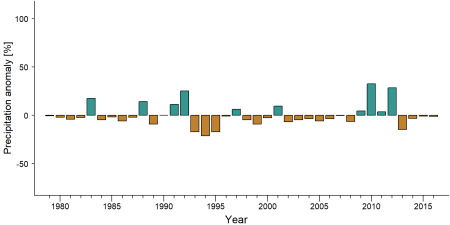
Precipitation anomaly in Tayna Nature Reserve -
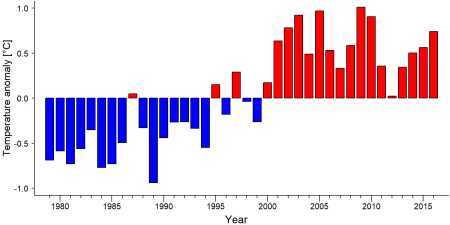
Temperature anomaly in Tayna Nature Reserve


External links
References
Fawcett, K. & Kabuyaya Mbeke, J. (2021): Survey of Great Apes (Gorilla beringei graueri, Pan troglodytes schweinfurthii) in Tayna Nature Reserve, Eastern DR Congo. Unpublished report, Gorilla Rehabilitation and Conservation Education (GRACE) Center.
Plumptre, A.J., Ayebare, S. & Kujirakwinja, D. (2015a). Priority Areas for Conservation in the Maiko, Tayna, Kahuzi Biega Landscape. Unpublished Report for USAID and USFWS.
Plumptre, A.J., Nixon, S., Critchlow, R., Vieilledent, G., Nishuli, R., Kirkby, A., Williamson, E.A., Hall, J.S. & Kujirakwinja, D. (2015b). Status of Grauer’s gorilla and chimpanzees in eastern Democratic Republic of Congo: Historical and current distribution and abundance. Unpublished report to Arcus Foundation, USAID and US Fish and Wildlife Service.
Plumptre, A. J., Nixon, S., Kujirakwinja, D. K., Vieilledent, G., Critchlow, R., Williamson, E. A., ... & Hall, J. S. (2016). Catastrophic decline of world's largest primate: 80% loss of Grauer's Gorilla (Gorilla beringei graueri) population justifies critically endangered status. PloS one, 11(10), e0162697. https://doi.org/10.1371/journal.pone.0162697
Plumptre, A. J., Ayebare, S., Kujirakwinja, D., & Segan, D. (2020). Conservation planning for Africa's Albertine Rift: conserving a biodiverse region in the face of multiple threats. Oryx, 55(2), 302-310. https://doi.org/10.1017/S0030605319000218
Vwirasihikya, K.P. & Matsitsi, S.D. (2003). Census in the Tayna Gorilla Reserve. Gorilla Journal 26. https://www.berggorilla.org/en/journal/issues/journal-no-26/article-view/census-in-the-tayna-gorilla-reserve/
Page created by: Dr. Katie Fawcett & APES Atlas Team Date: 2022-03-23