
Kibale National Park
East Africa > Uganda > Kibale National Park
Français | Português | Español | Bahasa Indonesia | Melayu
Summary
- Eastern chimpanzees (Pan troglodytes schweinfurthii) are present in Kibale National Park.
- The population size is unknown.
- The chimpanzee population trend is unknown.
- The site has a total size of 795 km².
- Hunting, snare injuries, disease risks, and human wildlife conflicts are a key threat to chimpanzees.
- Conservation activities have focused on veterinary intervention and snare removal, habitat restoration, conducting regular anti-poaching patrols, education, local community engagement and supoort.
Site characteristics
Kibale National Park is situated in southwestern Uganda. The park is contiguous with Queen Elizabeth National Park in the south. Established in 1993, Kibale National Park is famously known for the long-term research of chimpanzee communities inhabiting the area (see Kanyawara and Ngogo sites). In addition to the eastern chimpanzee, the park is home to other species of global conservation concern, including the forest elephant (Loxodonta cyclotis), western red colobus (Procolobus badius), and L'Hoest's monkey (Cercopithecus l’hoesti) (BirdLife International 2020). With at least 339 bird species, the site is an Important Bird Area (BirdLife International 2020).
Table 1. Basic site information for Kibale National Park
| Species | Pan troglodytes schweinfurthii |
| Area | 795 km² |
| Coordinates | Lat: 0.487463 , Lon: 30.390052 |
| Type of site | Protected area (National Park) |
| Habitat types | Subtropical/tropical moist montane forest, Subtropical/tropical moist lowland forest |
| Type of governance | Governance by government |
Types of sites Governance types Habitat types
Ape status
Table 2. Ape population estimates reported for Kibale National Park
| Species | Year | Occurrence | Encounter or vistation rate (nests/km; ind/day) | Density estimate [ind./ km²] (95% CI) | Abundance estimate (95% CI) | Survey area | Sampling method | Analytical framework | Source | Comments | A.P.E.S. database ID |
|---|---|---|---|---|---|---|---|---|---|---|---|
| Pan troglodytes schweinfurthii | Kibale National Park |
Sampling methods Analytical frameworks
Threats
Table 3. Threats to apes reported for Kibale National Park
| Category | Specific threats | Threat level | Description | Year of threat |
|---|---|---|---|---|
| 5 Biological resource use | 5.1 Hunting & collecting terrestrial animals | High (more than 70% of population affected) | Although snares are set up to mainly target small duikers and bushpigs, chimpanzees are at risk of falling victim to the snares and get severely maimed or killed (Dudley 2020). | Ongoing (2020) |
| 5 Biological resource use | 5.1.2 Unintentional effects (species is not the target) | Present (unknown severity) | Great apes are getting hurt by traps, likely intended for other animals (Langergraber K. pers. comm. 2025). | Ongoing (2025) |
| 5 Biological resource use | 5.1.5 Persecution/human wildlife conflict | Present (unknown severity) | Conflicts between people and great apes include crop raiding, livestock attacks, shared use of water and forest resources, aggressive behavior, trail encounters, and even killings of apes for trade or cultural reasons (Langergraber K. pers. comm. 2025). | Ongoing (2025) |
| 8 Invasive & other problematic species, genes & diseases | 8.4 Pathogens | Present (unknown severity) | The presence of risk of disease transmission between humans and apes, in both directions reported (Langergraber K. pers. comm. 2025). | Ongoing (2025) |
Conservation activities
The park is managed by the Uganda Wildlife Authority.
Table 4. Conservation activities reported for Kibale National Park
| Category | Specific activity | Description | Implementing organization(s) | Year of activity |
|---|---|---|---|---|
| 2 Counter-wildlife crime | 2.3 Conduct regular anti-poaching patrols | Regular patrolling and law enforcement activities reported (Langergraber K. pers. comm. 2025). | Ongoing (2025) | |
| 2 Counter-wildlife crime | 2.6 Regularly de-activate/remove ground snares | The Kibale Snare Removal Program (KSRP) was established in 1997 to reduce snaring in the park and involve the local community (Dudley 2020). | Ongoing (2020) | |
| 4 Education & awareness | 4.1 Educate local communities about apes and sustainable use | Efforts have been reported to educate local communities about great apes and their conservation (Langergraber K. pers. comm. 2025). | Ongoing (2025) | |
| 4 Education & awareness | 4.2 Involve local community in ape research and conservation management | Local people are supported to manage their own forests (Langergraber K. pers. comm. 2025). | Ongoing (2025) | |
| 5 Protection & restoration | 5.2 Legally protect ape habitat | The site is a National Park since, 1993. | 1993-Ongoing (2026) | |
| 5 Protection & restoration | 5.6 Habitat restoration | Forest restoration and protection activities reported (Langergraber K. pers. comm. 2025). | Ongoing (2025) | |
| 6 Species management | 6.9 Rehabilitate injured/orphaned apes | Veterinary intervention when chimpanzees are injured by snares (Kibale Chimpanzee Project). | Unknown | |
| 7 Economic & other incentives | 7.1 Provide monetary benefits to local communities for sustainably managing their forest and its wildlife (e.g., REDD, alternative income, employment) | Hiring local people to work in conservation (Langergraber K. pers. comm. 2025). | Ongoing (2025) | |
| 7 Economic & other incentives | 7.2 Provide non-monetary benefits to local communities for sustainably managing their forest and its wildlife (e.g., better education, infrastructure development) | Providing services for community health, wellbeing, education and life skills, as well supporting local people in develping ecotourism ventures and other income sources (Langergraber K. pers. comm. 2025). | Ongoing (2025) |
Challenges
Table 5. Challenges reported for Kibale National Park
| Challenges | Specific challenges | Source | Year(s) |
|---|---|---|---|
| 2 Resources and capacity | 2.4 Lack of continuous/long-term funding | Langergraber K. pers. comm. 2025 | Ongoing (2025) |
Enablers
Table 6. Enablers reported for Kibale National Park
| Enablers | Specific enablers | Source | Year(s) |
|---|---|---|---|
| 2 Resources and capacity | 2.1 Sufficient staff | Langergraber K. pers. comm. 2025 | Ongoing (2025) |
| 2 Resources and capacity | 2.2 Sufficient funding | Langergraber K. pers. comm. 2025 | Ongoing (2025) |
| 2 Resources and capacity | 2.5 Sufficient capacity/expertise to advise, design, or implement actions | Langergraber K. pers. comm. 2025 | Ongoing (2025) |
| 2 Resources and capacity | 2.6 External partnerships that add expertise or resources | Langergraber K. pers. comm. 2025 | Ongoing (2025) |
| 3 Engaged community | 3.6 Local community engagement and support | Langergraber K. pers. comm. 2025 | Ongoing (2025) |
| 1 Site management | |||
| 4 Institutional support | |||
| 5 Ecological context | |||
| 6 Safety and stability |
Research activities
Kibale is an important site for research. Long-term projects based on the site include the Kibale Chimpanzee Project and the Kibale EcoHealth Project.
Changing perceptions of protected area benefits and problems around Kibale National Park, Uganda
Long‐term trends in fruit production in a tropical forest at Ngogo, Kibale National Park, Uganda
Documented behaviours
Table 7. Behaviours documented for Kibale National Park
| Category | Behavior | Observation type | Prevalence | Observation dates | Source | Habituation | Species | Comment |
|---|---|---|---|---|---|---|---|---|
| Not reported |
Exposure to climate change impacts
As part of a study on the exposure of African great ape sites to climate change impacts, Kiribou et al. subm. extracted climate data and data on projected extreme climate impact events for the site. Climatological characteristics were derived from observation-based climate data provided by the Inter-Sectoral Impact Model Intercomparison Project (ISIMIP, www.isimip.org). Parameters were calculated as the average across each 30-year period. For 1981-2010, the EWEMBI dataset from ISIMIP2a was used. For the two future periods (2021-2050 and 2071-2099) ISIMIP2b climate data based on four CMIP5 global climate models were used. For future projections, two Representative Concentration Pathways (RCP) were used. RCP 2.6 is a scenario with strong mitigation measures in which global temperatures would likely rise below 2C. RCP 6.0 is a scenario with medium emissions in which global temperatures would likely rise up to 3C by 2100. For the number of days with heavy precipitation events, the 98th percentile of all precipitation days (>1mm/d) was calculated for the 1979-2013 reference period as a threshold for a heavy precipitation event. Then, for each year, the number of days above that threshold was derived. The figures on temperature and precipitation anomaly show the deviation from the mean temperature and mean precipitation for the 1979-2013 reference period.
The estimated exposure to future extreme climate impact events (crop failure, drought, river flood, wildfire, tropical cyclone, and heatwave) is based on a published dataset by Lange et al. 2020 derived from ISIMIP2b data. The same global climate models and RCPs as described above were used. Within each 30-year period, the number of years with an extreme event and the average proportion of the site affected were calculated (see Kiribou et al. subm. for details).
Table 8. Estimated past and projected climatological characteristics in Kibale National Park
| Value | 1981-2010 | 2021-2050, RCP 2.6 | 2021-2050, RCP 6.0 | 2071-2099, RCP 2.6 | 2071-2099, RCP 6.0 |
|---|---|---|---|---|---|
| Mean temperature [C] | 22.3 | 23.4 | 23.5 | 23.6 | 24.8 |
| Annual precipitation [mm] | 1234 | 1279 | 1359 | 1198 | 1448 |
| Max no. consecutive dry days (per year) | 17.6 | 22.1 | 25.7 | 24.2 | 23.3 |
| No. days with heavy precipitation (per year) | 6.7 | 8.9 | 8.7 | 9.6 | 14.1 |
Table 9. Projected exposure of apes to extreme climate impact events in Kibale National Park
| Type | No. of years with event (2021-2050, RCP 2.6) | % of site exposed (2021-2050, RCP 2.6) | No. of years with event (2021-2050, RCP 6.0) | % of site exposed (2021-2050, RCP 6.0) | No. of years with event (2070-2099, RCP 2.6) | % of site exposed (2070-2099, RCP 2.6) | No. of years with event (2070-2099, RCP 6.0) | % of site exposed (2070-2099, RCP 6.0) |
|---|---|---|---|---|---|---|---|---|
| Crop failure | 4 | 0.14 | 3 | 0.21 | 4 | 0.32 | 8 | 0.09 |
| Drought | 0 | 0 | 0 | 0 | 0 | 0 | 0 | 0 |
| Heatwave | 0 | 0 | 0 | 0 | 0 | 0 | 0 | 0 |
| River flood | 1.75 | 2.67 | 4 | 3.87 | 2 | 0.09 | 6 | 3.28 |
| Tropical cyclone | 0 | 0 | 0 | 0 | 0 | 0 | 0 | 0 |
| Wildfire | 30 | 1.14 | 30 | 1.06 | 29 | 1.29 | 29 | 1.06 |
-
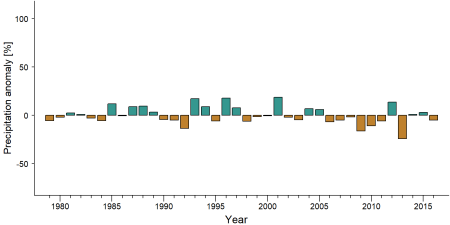
Precipitation anomaly in Kibale National Park -
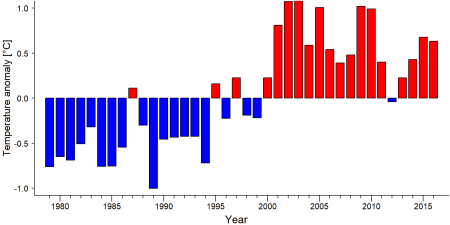
Temperature anomaly in Kibale National Park


External links
References
BirdLife International (2020). Important Bird Areas factsheet: Kibale National Park. Downloaded from http://www.birdlife.org on 21/10/2020.
Dudley, A. (2020). In Uganda, safeguarding chimpanzees against the scourge of snaring. Retrieved 21 October 2020 from Mongabay.com. Web site: https://news.mongabay.com/2020/10/in-uganda-safeguarding-chimpanzees-against-the-scourge-of-snaring/?fbclid=IwAR0qzwA0DmheeoKtcX4ZYdyNTJOGBJX7yf0gPTTri5XdDGjIL0dSFXzW3J0#
Wrangham, R., & Mugume, S. (2000). Snare Removal Program in Kibale National Park: a Preliminary Report. Pan Africa News, 7(2), 18-20.
Kibale Chimpanzee Project (n.d.). Veterinary Intervention. https://kibalechimpanzees.wordpress.com/veterinary-intervention/
RA-PNCD (2023). Rapport Annuel du Parc National de Conkouati-Douli 2023. Noé, Brazzaville, République du Congo.
Page created by: APES Atlas Team Date: 2020-12-05
Page updated by: Kevin Langergraber Date: 2025-10-30