
Kibale National Park
East Africa > Uganda > Kibale National Park
Français | Português | Español | Bahasa Indonesia | Melayu
Summary
- Eastern chimpanzees (Pan troglodytes schweinfurthii) are present in Kibale National Park.
- The population size is unknown.
- The chimpanzee population trend is unknown.
- The site has a total size of 795 km².
- Hunting, snare injuries, disease risks, and human wildlife conflicts are a key threat to chimpanzees.
- Conservation activities have focused on veterinary intervention and snare removal, habitat restoration, conducting regular anti-poaching patrols, education, local community engagement and support.
Site characteristics
Kibale National Park is situated in southwestern Uganda. The park is contiguous with Queen Elizabeth National Park in the south. Established in 1993, Kibale National Park is famously known for the long-term research of chimpanzee communities inhabiting the area (see Kanyawara and Ngogo sites). In addition to the eastern chimpanzee, the park is home to other species of global conservation concern, including the forest elephant (Loxodonta cyclotis), western red colobus (Procolobus badius), and L'Hoest's monkey (Cercopithecus l’hoesti) (BirdLife International 2020). With at least 339 bird species, the site is an Important Bird Area (BirdLife International 2020).
Table 1. Basic site information for Kibale National Park
| Species | Pan troglodytes schweinfurthii |
| Area | 795 km² |
| Coordinates | Lat: 0.487463 , Lon: 30.390052 |
| Type of site | Protected area (National Park) |
| Habitat types | Subtropical/tropical moist montane forest, Subtropical/tropical moist lowland forest |
| Type of governance | Governance by government |
Types of sites Governance types Habitat types
Ape status
Table 2. Ape population estimates reported for Kibale National Park
| Species | Year | Occurrence | Encounter or vistation rate (nests/km; ind/day) | Density estimate [ind./ km²] (95% CI) | Abundance estimate (95% CI) | Survey area | Sampling method | Analytical framework | Source | Comments | A.P.E.S. database ID |
|---|---|---|---|---|---|---|---|---|---|---|---|
| Pan troglodytes schweinfurthii | 1999 | Present | 2.32 | 1298 (817-1,615) | Kibale National Park | Line transects | Distance sampling (decay time unknown) | Plumptre & Cox 2006; Plumptre, Cox & Mugume 2003 | Area had highest chimpanzee desnity and abundance in recorded in any forest suurvey in Africa. |
Sampling methods Analytical frameworks
Threats
Table 3. Threats to apes reported for Kibale National Park
| Category | Specific threats | Threat level | Description | Year of threat |
|---|---|---|---|---|
| 5 Biological resource use | 5.1 Hunting & collecting terrestrial animals | High (more than 70% of population affected) | Although snares are set up to mainly target small duikers and bushpigs, chimpanzees are at risk of falling victim to the snares and get severely maimed or killed (Dudley 2020). Chimpanzees occasionally hunted in retaliation for crop-raiding (Plumptre et al. 2003). This has significantly reduced due to sensitisation, however, chimpanzees still face risk of snaring from the forest by poachers (Basiibye S. pers. comm. 2026). | 2020-Ongoing (2026) |
| 5 Biological resource use | 5.3 Logging & wood harvesting | Medium (30-70% of population affected) | It was initially gazetted as a forest reserve in 1930 with the sole purpose for exploitation of timber and charcoal, however it was elevated to national park status in 1993, reducing commercial logging and other activities (Kibale National Park Uganda 2022). Logging and timber harvesting reduces canopy cover, lower basal area for chimpanzee fruiting and nesting trees hence altering habitat quality (Kissa et al. 2025; Plumptre et al. 2003; Skorupa, 1988). | 1930-Ongoing (2026) |
| 2 Agriculture & aquaculture | 2.1 Annual & perennial non-timber crops | Medium (30-70% of population affected) | The forest has been encroached upon for farmland. Subsistence agriculture is the dominant livelihood for communities surrounding the park (Ainebyona et al. 2025). The northern part of the national park (Sebitoli site) is surrounded by tea and eucalyptus plantations, as well as gardens located at the forest edge. This has resulted in increased fragmentation and loss of critical chimpanzee habitat (Bortolamiol et al. 2014; Plumptre et al. 2003). | 1970-Ongoing (2026) |
| 4 Transportation & service corridors | 4.1 Roads & railroads | Low (up to 30% of population affected) | Fort portal- Mubende tarmac road cuts through the park (for example Sebitoli site), Fort portal- Mbarara road cuts through the forest (communities exposed include those around Kanyanchu Visitors Centre). This expose the chimpanzees to accidents while crossing roads cutting through their home ranges, and also pollution (Basiibye S. pers. comm. 2026; Krief et al. 2020; Bortolamiol et al. 2014). | 2014-Ongoing (2026) |
| 1 Residential & commercial development | 1.1 Residential areas | Low (up to 30% of population affected) | Areas such as Sebitoli, Kanyawara, and Kanyanchu are surrounded by areas highly transformed by human population (Basiibye S. pers. comm. 2026; Bortolamiol et al. 2014). | 2014-Ongoing (2026) |
| 1 Residential & commercial development | 1.3 Tourism & recreation areas | Low (up to 30% of population affected) | Areas such as Kanyanchu visitors centre, receive a high number of tourists, this exposes the chimpanzee to zoonotic diseases and stress (Basiibye S. pers. comm. 2026; Glasser et al. 2021; Johns 1996). | 1996-Ongoing (2026) |
| 11 Climate change & severe weather | 11.1 Habitat shifting & alteration | Present (unknown severity) | The maximum monthly temperatures have risen by 1.05 °C over the last 50 years (1970–2020), with implications for forest phenology and wildlife health (Chapman et al. 2022). Phenological changes have been observed in important chimpanzee feeding trees. | 1970-Ongoing (2026) |
| 5 Biological resource use | 5.2 Gathering terrestrial plants | Low (up to 30% of population affected) | Local community use of plants for food, medicinal purposes, and sometimes destructive practices involved during the collection of these NFTPs. For example people who cut down trees to get Piper guineense fruits (used as a food spice) (Basiibye S. pers. comm. 2026). Unintentional effects on chimpanzees (Birdlife International 2020; Plumptre et al. 2003). | 2003-Ongoing (2026) |
| 5 Biological resource use | 5.1.2 Unintentional effects | Present (unknown severity) | Great apes are getting hurt by traps, likely intended for other animals (Langergraber K. pers. comm. 2025). | Ongoing (2025) |
| 5 Biological resource use | 5.1.5 Persecution/human wildlife conflict | Present (unknown severity) | Conflicts between people and great apes include crop raiding, livestock attacks, shared use of water and forest resources, aggressive behavior, trail encounters, and even killings of apes for trade or cultural reasons (Langergraber K. pers. comm. 2025). | Ongoing (2025) |
| 8 Invasive & other problematic species, genes & diseases | 8.4 Pathogens | High (more than 70% of population affected) | The presence of risk of disease transmission between humans and apes, in both directions reported (Langergraber K. pers. comm. 2025). Human respiratory viruses pose a serious and growing threat to wild apes (Negrey et al. 2025), with tourism, research, and forest use increasing the risk of transmission. Negrey et al. (2019), reported outbreaks of two distinct human respiratory viruses, human metapneumovirus (MPV; Pneumoviridae: Metapneumovirus) and human respirovirus 3 (HRV3; Paramyxoviridae; Respirovirus, in Ngogo and Kanyawara chimpanzees. Respiratory illnesses in Kanyawara community was reported as the leading cause of mortality over 31 years (1986 to 2016), contributing to 27% of deaths (Emery Thompson et al. 2018). | 1986-Ongoing (2025) |
Conservation activities
The park is managed by the Uganda Wildlife Authority.
Table 4. Conservation activities reported for Kibale National Park
| Category | Specific activity | Description | Implementing organization(s) | Year of activity |
|---|---|---|---|---|
| 2 Counter-wildlife crime | 2.3 Conduct regular anti-poaching patrols | Regular patrolling and law enforcement activities reported (Langergraber K. pers. comm. 2025). Snare removal teams together with rangers from Uganda Wildlife Authority conduct anti-poaching patrols (Ngogo Chimpanzee Project 2026; American Society of Primatologists 2020). | Research site and NGOs, Ngogo Chimpanzee Project, Kibale Chimpanzee Project, Uganda Wildlife Authority | 1997-Ongoing (2026) |
| 2 Counter-wildlife crime | 2.6 Regularly de-activate/remove ground snares | The Kibale Snare Removal Program (KSRP) was established in 1997 to reduce snaring in the park and involve the local community (Dudley 2020). Ngogo Chimpanzee Project employs a team of 8 people, who patrol the park for snares and signs of poaching activity (Ngogo Chimpanzee Project, 2026). | Research site and NGOs, Ngogo Chimpanzee Project, Kibale Chimpanzee Project, Uganda Wildlife Authority | 2020-Ongoing (2026) |
| 2 Counter-wildlife crime | 2.14 Employ hunters in the conservation sector to reduce their impact | Ex-poachers are employed on snare removal teams (Ngogo Chimpanzee Project 2026). | Research site and NGOs, Ngogo Chimpanzee Project, Kibale Chimpanzee Project | Ongoing (2026) |
| 4 Education & awareness | 4.1 Educate local communities about apes and sustainable use | Efforts have been reported to educate local communities about great apes and their conservation (Langergraber K. pers. comm. 2025). Organisations provide conservation education to community members, local school teachers, which is incorporated into the school programs for learners. For example Ngogo Chimpanzee Project partners with U.N.I.T.E. for the Environment providing them with information and educational material related to chimpanzees and our snare removal program which is passed on to the community. Face the future project is committed to Imparting forest management skills and knowledge to the local communities. Kibale Chimpanzee Project through The Kasiisi Project offer conservation education programs that often have a chimpanzee focus (Chapman et al. 2005; Kibale Chimpanzee Project). | Ngogo Chimpanzee Project, U.N.I.T.E. for the Environment, Face the Future, Kibale Chimpanzee Project, Sebitoli Chimpanzee Project, Uganda Wildlife Authority | 1985-Ongoing (2026) |
| 4 Education & awareness | 4.2 Involve local community in ape research and conservation management | Local people are supported to manage their own forests (Langergraber K. pers. comm. 2025). | Ongoing (2025) | |
| 4 Education & awareness | 4.5 Implement multimedia campaigns using theatre, film, print media, discussions | Ngogo chimpanzee project organise community outreach programs that show documentaries and movies the The Ngogo chimpanzees have been featured in for example Netflix’s Chimp Empire series (2023). This is to provide knowledge about chimp and also promote stewardship for conservation (Basiibye S. pers. comm. 2026). | Ngogo Chimpanzee Project | 2023-Ongoing (2025) |
| 5 Protection & restoration | 5.2 Legally protect ape habitat | The site is a National Park since, 1993. It was initially gazetted as a forest reserve in 1930 and it was elevated to national park status in 1993. Designated as both an Important Bird Area (IBA) and a Key Biodiversity Area (KBA) due to its exceptional species richness (Birdlife International 2020). | Uganda Wildlife Authority, Birdlife International | 1993-Ongoing (2026) |
| 5 Protection & restoration | 5.6 Habitat restoration | Forest restoration and protection activities reported (Langergraber K. pers. comm. 2025). Climate Impact Partners, coordinate a large-scale initiative of reforestation and ecosystem recovery called Kibale Forest Restoration, Uganda. Scope is to restoration of over 10,000 hectares of degraded land affected by poor land management, natural disturbance, and soil erosion. | Climate Impact Partners, Uganda Wildlife Authority, Face the Future | 1994-Ongoing (2025) |
| 5 Protection & restoration | 5.5 Demarcate and enforce boundaries of protected areas | Park boundaries clearly marked and maintained (UWA 2015). | Uganda Wildlife Authority | 1993-Ongoing (2026) |
| 6 Species management | 6.2 Guard habituated ape groups to ensure their safety/well-being | Ngogo employs people from community to work as Chimp guardian, to deter chimps from crop-raiding but also protect them from persecution by people (Basiibye S. pers. comm. 2026). | Ngogo Chimpanzee Project | 2020-Ongoing (2026) |
| 6 Species management | 6.9 Rehabilitate injured/orphaned apes | Veterinary intervention when chimpanzees are injured by snares (Kibale Chimpanzee Project). | Unknown | |
| 7 Economic & other incentives | 7.1 Provide monetary benefits to local communities for sustainably managing their forest and its wildlife (e.g., REDD, alternative income, employment) | Hiring local people to work in conservation (Langergraber K. pers. comm. 2025). | Ongoing (2025) | |
| 7 Economic & other incentives | 7.2 Provide non-monetary benefits to local communities for sustainably managing their forest and its wildlife (e.g., better education, infrastructure development) | Providing services for community health, wellbeing, education and life skills, as well supporting local people in develping ecotourism ventures and other income sources (Langergraber K. pers. comm. 2025). | Ongoing (2025) | |
| 3 Species health | 3.4 Implement quarantine for people arriving at, and leaving the site | Ngogo and other research sites implemented more stringent disease prevention protocols which includes a 7-day quarantine period prior to any exposure to chimpanzees (Negrey et al. 2025). | Research site and NGOs, Ngogo Chimpanzee Project, Kibale Chimpanzee Project | 2018-Ongoing (2026) |
| 3 Species health | 3.1 Wear face-masks to avoid transmission of viral and bacterial diseases to primates | The use of face masks in the presence of chimpanzees for researchers, rangers and tourists (Negrey et al. 2025; Emery Thompson et al. 2018). | Research site and NGOs, Ngogo Chimpanzee Project, Kibale Chimpanzee Project, Sebitoli Chimpanzee Project, Uganda Wildlife Authority (Through the ranger guides) | 2018-Ongoing (2026) |
| 3 Species health | 3.2 Keep safety distance to habituated apes | Maintaining a 7-m distance from chimpanzees and prohibiting physical contact between humans and chimpanzees (Negrey et al. 2025; Emery Thompson et al. 2018). | Research site and NGOs, Ngogo Chimpanzee Project, Kibale Chimpanzee Project, Uganda Wildlife Authority (Through the ranger guides) | 2018-Ongoing (2026) |
| 3 Species health | 3.10 Treat sick/injured apes | Veterinary intervention when chimpanzees are snared, snares removed and wounds are treated (Basiibye S. pers. comm. 2026; Kibale Chimpanzee Project). | Research site and NGOs, Ngogo Chimpanzee Project, Kibale Chimpanzee Project | 2018-Ongoing (2026) |
| 3 Species health | 3.7 Regularly disinfect clothes, boots etc. | Disinfection of field gear for all field assistants and researchers. Sanitization before entering chimpanzee areas or handling field equipment. (Negrey et al. 2025; Emery Thompson et al. 2018). | Research site and NGOs, Ngogo Chimpanzee Project, Kibale Chimpanzee Project | 2018-Ongoing (2026) |
Challenges
Table 5. Challenges reported for Kibale National Park
| Challenges | Specific challenges | Source | Year(s) |
|---|---|---|---|
| 1 Site management | 1.2 Need for improved coordination | MTWA 2023; UWA 2015; Chege et al. 2002 | 2002-Ongoing (2023) |
| 2 Resources and capacity | 2.4 Lack of continuous/long-term funding | Langergraber K. pers. comm. 2025 | Ongoing (2025) |
| 2 Resources and capacity | 2.2 Lack of staff | MTWA 2023; UWA 2015; Chege et al. 2002 | 2002-Ongoing (2023) |
| 2 Resources and capacity | 2.3 General lack of funding | MTWA 2023; UWA 2015; Chege et al. 2002 | 2002-Ongoing (2023) |
| 2 Resources and capacity | 2.5 Lack of equipment/transportation | MTWA 2023; UWA 2015; Chege et al. 2002 | 2002-Ongoing (2023) |
| 2 Resources and capacity | 2.1 Lack of capacity/training | MTWA 2023; UWA 2015; Chege et al. 2002 | 2002-Ongoing (2023) |
| 2 Resources and capacity | 2.7 Lack of infrastructure | MTWA 2023; UWA 2015; Chege et al. 2002 | 2002-Ongoing (2023) |
| 3 Engaged community | 3.1 General lack of community engagement or support | MTWA 2023; UWA 2015; Chege et al. 2002 | 2002-Ongoing (2023) |
| 4 Institutional support | 4.1 Lack of law enforcement | MTWA 2023; UWA 2015; Chege et al. 2002 | 2002-Ongoing (2023) |
| 6 Safety and stability | 6.2 Insecurity | Recent ADF threats, in 2024. (Basiibye S. pers. comm. 2024; Plumptre et al., 2003) | 2001-2024 |
Enablers
Table 6. Enablers reported for Kibale National Park
| Enablers | Specific enablers | Source | Year(s) |
|---|---|---|---|
| 1 Site management | 1.2 Effective coordination | MTWA 2023; UWA 2015; Chege et al. 2002 | 2002-Ongoing (2023) |
| 2 Resources and capacity | 2.1 Sufficient staff | MTWA 2023; UWA 2015; Chege et al. 2002; Langergraber K. pers. comm. 2025 | 2022-Ongoing (2025) |
| 2 Resources and capacity | 2.2 Sufficient funding | Langergraber K. pers. comm. 2025 | Ongoing (2025) |
| 2 Resources and capacity | 2.5 Sufficient capacity/expertise to advise, design, or implement actions | MTWA 2023; UWA 2015; Chege et al. 2002; Langergraber K. pers. comm. 2025 | 2022-Ongoing (2025) |
| 2 Resources and capacity | 2.6 External partnerships that add expertise or resources | Langergraber K. pers. comm. 2025 | Ongoing (2025) |
| 3 Engaged community | 3.6 Local community engagement and support | MTWA 2023; UWA 2015; Chege et al. 2002; Langergraber K. pers. comm. 2025 | 2022-Ongoing (2025) |
| 3 Engaged community | 3.1 Strong local environmental knowledge | MTWA 2023; UWA 2015; Chege et al. 2002 | 2002-Ongoing (2023) |
| 4 Institutional support | 4.1 Effective legislation and law enforcement | MTWA 2023; UWA 2015; Chege et al. 2002 | 2002-Ongoing (2023) |
| 6 Safety and stability | 6.2 Social and civil security | MTWA 2023; UWA 2015; Chege et al. 2002 | Ongoing (2025) |
Research activities
Kibale is an important site for research. Long-term projects based on the site include the Kibale Chimpanzee Project, Ngogo Chimpanzee Project, and the Kibale EcoHealth Project.
Changing perceptions of protected area benefits and problems around Kibale National Park, Uganda
Long‐term trends in fruit production in a tropical forest at Ngogo, Kibale National Park, Uganda
Documented behaviours
Table 7. Behaviours documented for Kibale National Park
| Category | Behavior | Observation type | Prevalence | Observation dates | Source | Habituation | Species | Comment |
|---|---|---|---|---|---|---|---|---|
| foraging | leaf sponge | direct observation | customary | 1987-2025 | Edwards et al. 2023; Watts 2008 | fully habituated | Pan troglodytes schweinfurthii | Demonstrates cognitive flexibility and environmental adaptation. |
| foraging | pestle pounding | direct observation | customary | 1987-2025 | Edwards et al. 2023; Watts 2008 | fully habituated | Pan troglodytes schweinfurthii | Demonstrates cognitive flexibility and environmental adaptation. |
| foraging | hunting | direct observation | present | 1995-Ongoing (2026) | Watts & Mitani 2002 | fully habituated | Pan troglodytes schweinfurthii | Coordinated red colobus monkey hunts are very frequent in Ngogo, involving complex social coordination and role specialization.
|
| communication | other (Social Bonds, Maternal affiliation into adulthood) | direct observation | present | 1990-Ongoing (2026) | Reddy & Sandel 2020 | fully habituated | Pan troglodytes schweinfurthii | Bonds endure but shift in form during male maturation. |
| ground protection | other (territorial defense and group safety) | direct observation | present | 1990-Ongoing (2026) | Sandel & Watts 2021; Mitani et al. 2010 | fully habituated | Pan troglodytes schweinfurthii | Linked to male coalition dynamics and resource defense. |
| communication | other (Pant-hoots, drumming, gestural signaling) | camera trap | customary | 1996-Ongoing (2026) | Mine 2024; Johns 199 | fully habituated | Pan troglodytes schweinfurthii | Used for coordination, bonding, and territory assertion. |
Exposure to climate change impacts
As part of a study on the exposure of African great ape sites to climate change impacts, Kiribou et al. (2024) extracted climate data and data on projected extreme climate impact events for the site. Climatological characteristics were derived from observation-based climate data provided by the Inter-Sectoral Impact Model Intercomparison Project (ISIMIP, www.isimip.org). Parameters were calculated as the average across each 30-year period. For 1981-2010, the EWEMBI dataset from ISIMIP2a was used. For the two future periods (2021-2050 and 2071-2099) ISIMIP2b climate data based on four CMIP5 global climate models were used. For future projections, two Representative Concentration Pathways (RCP) were used. RCP 2.6 is a scenario with strong mitigation measures in which global temperatures would likely rise below 2C. RCP 6.0 is a scenario with medium emissions in which global temperatures would likely rise up to 3C by 2100. For the number of days with heavy precipitation events, the 98th percentile of all precipitation days (>1mm/d) was calculated for the 1979-2013 reference period as a threshold for a heavy precipitation event. Then, for each year, the number of days above that threshold was derived. The figures on temperature and precipitation anomaly show the deviation from the mean temperature and mean precipitation for the 1979-2013 reference period.
The estimated exposure to future extreme climate impact events (crop failure, drought, river flood, wildfire, tropical cyclone, and heatwave) is based on a published dataset by Lange et al. 2020 derived from ISIMIP2b data. The same global climate models and RCPs as described above were used. Within each 30-year period, the number of years with an extreme event and the average proportion of the site affected were calculated (Kiribou et al. 2024).
Table 8. Estimated past and projected climatological characteristics in Kibale National Park
| Value | 1981-2010 | 2021-2050, RCP 2.6 | 2021-2050, RCP 6.0 | 2071-2099, RCP 2.6 | 2071-2099, RCP 6.0 |
|---|---|---|---|---|---|
| Mean temperature [C] | 22.3 | 23.4 | 23.5 | 23.6 | 24.8 |
| Annual precipitation [mm] | 1234 | 1279 | 1359 | 1198 | 1448 |
| Max no. consecutive dry days (per year) | 17.6 | 22.1 | 25.7 | 24.2 | 23.3 |
| No. days with heavy precipitation (per year) | 6.7 | 8.9 | 8.7 | 9.6 | 14.1 |
Table 9. Projected exposure of apes to extreme climate impact events in Kibale National Park
| Type | No. of years with event (2021-2050, RCP 2.6) | % of site exposed (2021-2050, RCP 2.6) | No. of years with event (2021-2050, RCP 6.0) | % of site exposed (2021-2050, RCP 6.0) | No. of years with event (2070-2099, RCP 2.6) | % of site exposed (2070-2099, RCP 2.6) | No. of years with event (2070-2099, RCP 6.0) | % of site exposed (2070-2099, RCP 6.0) |
|---|---|---|---|---|---|---|---|---|
| Crop failure | 4 | 0.14 | 3 | 0.21 | 4 | 0.32 | 8 | 0.09 |
| Drought | 0 | 0 | 0 | 0 | 0 | 0 | 0 | 0 |
| Heatwave | 0 | 0 | 0 | 0 | 0 | 0 | 0 | 0 |
| River flood | 1.75 | 2.67 | 4 | 3.87 | 2 | 0.09 | 6 | 3.28 |
| Tropical cyclone | 0 | 0 | 0 | 0 | 0 | 0 | 0 | 0 |
| Wildfire | 30 | 1.14 | 30 | 1.06 | 29 | 1.29 | 29 | 1.06 |
-
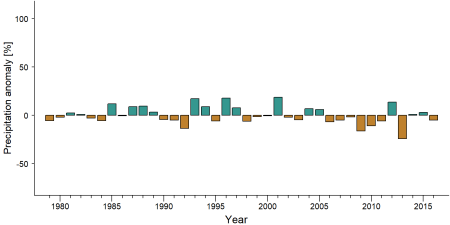
Precipitation anomaly in Kibale National Park -
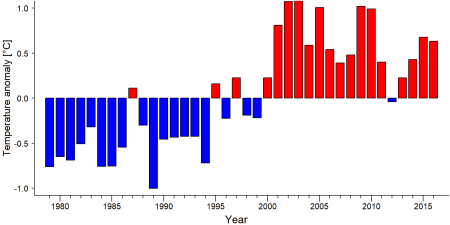
Temperature anomaly in Kibale National Park


External links
References
Ainebyona, B., Kendall, C., Flauro, A., John, T., Folta, E., & Perry, L. (2025). Understanding the motivations and barriers to adoption of environmentally sustainable activities around Kibale National Park, Uganda. Folia Primatologica, 1-14. doi:10.1163/14219980-bja10048
BirdLife International. (2020). Important Bird Areas factsheet: Kibale National Park. Retrieved October 11, 2025, from https://datazone.birdlife.org/site/factsheet/7046-kibale-national-park
Bortolamiol, S., Cohen, M., Potts, K., Pennec, F., Rwaburindore, P., Kasenene, J., …, & Krief, S. (2014). Suitable Habitats for Endangered Frugivorous Mammals: Small-Scale Comparison, Regeneration Forest and Chimpanzee Density in Kibale National Park, Uganda. PLoS ONE, 9(7), e102177. doi:10.1371/journal.pone.0102177
Chapman, C. A., Abernathy, K., Chapman, L. J., Downs, C., Effiom, E. O., Gogarten, J. F., …, & Sarkar, D. (2022). The future of sub-Saharan Africa’s biodiversity in the face of climate and societal change. Frontiers in Ecology and Evolution, 10. doi:10.3389/fevo.2022.790552
Chapman, C. A., Struhsaker, T. T., & Lambert, J. E. (2005). Thirty Years of Research in Kibale National Park, Uganda, Reveals a Complex Picture for Conservation. International Journal of Primatology, 26(3), 539-555. doi:10.1007/s10764-005-4365-z
Chege, F., Onyango, G., Drazu, C., & Mwandha, S. (2002). Kibale and Semuliki Conservation and Development Project: End-of-Phase III / End-of-Project Evaluation (July–August 2002). IUCN Eastern Africa Regional Office. https://iucn.org/sites/default/files/2022-05/kscdp_final.pdf
Climate Impact Partners. (2025). Kibale Forest Restoration, Uganda. Retrieved October 10, 2025, from https://www.climateimpact.com/global-projects/kibale-forest-restoration-uganda/
Dudley, A. (2020). In Uganda, safeguarding chimpanzees against the scourge of snaring. Mongabay. Retrieved October 21, 2020, from https://news.mongabay.com/2020/10/in-uganda-safeguarding-chimpanzees-against-the-scourge-of-snaring/
Edwards, W. I., Guma, N., Agaba, H., Balyesiima, G., Asalu, E., Rothman, J. M., & Stevens, N. J. (2023). Leaf sponge tool use by Buraiga chimpanzees (Pan troglodytes schweinfurthii) in Kibale National Park, Uganda. African Journal of Ecology, 61(4), 989–993. https://doi.org/10.1111/aje.13115
Emery Thompson, M., Machanda, Z. P., Scully, E. J., Enigk, D. K., Otali, E., Muller, M. N., …, & Wrangham, R. W. (2018). Risk factors for respiratory illness in a community of wild chimpanzees ( Pan troglodytes schweinfurthii ). Royal Society Open Science, 5(9), 180840. doi:10.1098/rsos.180840
Glasser, D. B., Goldberg, T. L., Guma, N., Balyesiima, G., Agaba, H., Gessa, S. J., & Rothman, J. M. (2021). Opportunities for respiratory disease transmission from people to chimpanzees at an East African tourism site. American Journal of Primatology, 83(2). doi:10.1002/ajp.23228
Johns, B. G. (1996). Responses of chimpanzees to habituation and tourism in the Kibale Forest, Uganda. Biological Conservation, 78(3), 257-262. doi:10.1016/s0006-3207(96)00044-4
Kibale Chimpanzee Project. (n.d.). Veterinary intervention. https://kibalechimpanzees.wordpress.com/veterinary-intervention/
Kibale National Park Uganda. (2022). Conservation status of Kibale Forest. Retrieved October 10, 2025, from https://www.kibalenationalparkuganda.com/cons
Kissa, D. O., Nzunda, E. F., Tweheyo, M., Lussetti, D., Ssekuubwa, E., & Sheil, D. (2025). Forest structure, timber species regeneration, and timber volume dynamics along a logging gradient in a lowland tropical rainforest in Africa: Implications for biodiversity conservation and sustainable timber management. PLOS One, 20(6), e0323413. doi:10.1371/journal.pone.0323413
Krief, S., Iglesias-González, A., Appenzeller, B. M. R., Okimat, J. P., Fini, J., Demeneix, B., …, & Spirhanzlova, P. (2020). Road impact in a protected area with rich biodiversity: the case of the Sebitoli road in Kibale National Park, Uganda. Environmental Science and Pollution Research, 27(22), 27914-27925. doi:10.1007/s11356-020-09098-0
Mine, J. (2024). Vocal-visual communication in wild chimpanzees (Doctoral dissertation, University of Zurich). University of Zurich Research Repository. https://www.zora.uzh.ch/server/api/core/bitstreams/a23bfeea-bad0-4d6a-9f86-b2655417295d/content
Ministry of Tourism, W. a. A. (. (2023). National Chimpanzee Conservation Strategy for Uganda (2023/24–2032/33): Abridged version. Uganda Biodiversity Fund. https://ugandabiodiversityfund.org/wp-content/uploads/2023/08/National-Chimpanzee-Conservation-Strategy-of-Uganda_2023-2033_Abridged-Version.pdf.
Mitani, J. C., Watts, D. P., & Amsler, S. J. (2010). Lethal intergroup aggression leads to territorial expansion in wild chimpanzees. Current Biology, 20(12), R507-R508. doi:10.1016/j.cub.2010.04.021
Negrey, J. D., Angedakin, S., Reddy, R. B., Sandel, A. A., Jombela, S., Akamumpa, E., …, & Langergraber, K. E. (2025). Decreases in chimpanzee respiratory disease signs and enteric viral quantity following implementation of anthroponotic disease prevention protocols at a long-term research site. Biological Conservation, 308, 111225. doi:10.1016/j.biocon.2025.111225
Negrey, J. D., Reddy, R. B., Scully, E. J., Phillips-Garcia, S., Owens, L. A., Langergraber, K. E., …, & Goldberg, T. L. (2019). Simultaneous outbreaks of respiratory disease in wild chimpanzees caused by distinct viruses of human origin. Emerging Microbes & Infections, 8(1), 139-149. doi:10.1080/22221751.2018.1563456
Ngogo Chimpanzee Project. (2025). Conservation. Retrieved July 17, 2026, from http://ngogochimpanzeeproject.org/conservation/
Plumptre, A. J., Cox, D., & Mugume, S. (2003). The status of chimpanzees in Uganda. Albertine Rift Technical Report Series No. 2. Wildlife Conservation Society. link
Reddy, R. B., & Sandel, A. A. (2020). Social relationships between chimpanzee sons and mothers endure but change during adolescence and adulthood. Behavioral Ecology and Sociobiology, 74(12), 150. doi:10.1007/s00265-020-02937-7
Sandel, A. A., & Watts, D. P. (2021). Lethal Coalitionary Aggression Associated with a Community Fission in Chimpanzees (Pan troglodytes) at Ngogo, Kibale National Park, Uganda. International Journal of Primatology, 42(1), 26-48. doi:10.1007/s10764-020-00185-0
Skorupa, J. P. (1988). The effects of selective timber harvesting on rain-forest primates in Kibale Forest, Uganda (Doctoral dissertation, University of California, Davis). ProQuest Dissertations and Theses Global.
Uganda Wildlife Authority. (2015). Kibale National Park: General Management Plan (2015–2025). Uganda Wildlife Authority. https://ugandawildlife.org/wp-content/uploads/2022/01/Kibale_National_Park_
Watts, D. P. (2008). Tool use by chimpanzees at Ngogo, Kibale National Park, Uganda. International Journal of Primatology, 29(1), 83–94. doi:10.1007/s10764-007-9227-4
Watts, D. P., & Mitani, J. C. (2002). Hunting Behavior of Chimpanzees at Ngogo, Kibale National Park, Uganda. International Journal of Primatology, 23(1), 1-28. doi:10.1023/a:1013270606320
Wrangham, R., & Mugume, S. (2000). Snare Removal Program in Kibale National Park: a Preliminary Report. Pan Africa News, 7(2), 18-20. doi:10.5134/143557
Plumptre, A. J., & Cox, D. (2006). Counting primates for conservation: primate surveys in Uganda. Primates, 47(1), 65-73. doi:10.1007/s10329-005-0146-8
Kiribou, R., Tehoda, P., Chukwu, O., Bempah, G., Kühl, H. S., Ferreira, J., …, & Heinicke, S. (2024). Exposure of African ape sites to climate change impacts. PLOS Climate, 3(2), e0000345. doi:10.1371/journal.pclm.0000345
Page created by: APES Atlas Team Date: 2020-12-05
Page updated by: Steven Joel Basiibye & Kevin Langergraber Date: 2026-07-20