
Lower Kinabatangan Wildlife Sanctuary: Difference between revisions
No edit summary |
No edit summary Tag: Reverted |
||
| Line 132: | Line 132: | ||
|Low (up to 30% of population affected) | |Low (up to 30% of population affected) | ||
|Linear infrastructure (Ancrenaz pers. comm. 2024). | |Linear infrastructure (Ancrenaz pers. comm. 2024). | ||
|Ongoing (2024) | |||
|- | |||
|12 Other threat | |||
|Other | |||
|High (more than 70% of population affected) | |||
|Habitat fragmentation (Ancrenaz pers. comm. 2024). | |||
|Ongoing (2024) | |Ongoing (2024) | ||
|- | |- | ||
| Line 157: | Line 163: | ||
|Pollution in the Sungai Kinabatangan catchment area from palm oil mills, pesticides, fertilizers and sediment from plantations, sediment from logging activities and sewage and refuse from villages along the river (BirdLife International 2021). | |Pollution in the Sungai Kinabatangan catchment area from palm oil mills, pesticides, fertilizers and sediment from plantations, sediment from logging activities and sewage and refuse from villages along the river (BirdLife International 2021). | ||
|Ongoing (2021) | |Ongoing (2021) | ||
|} | |} | ||
Revision as of 05:27, 21 April 2026
Asia > Malaysia > Lower Kinabatangan Wildlife Sanctuary
Français | Português | Español | Bahasa Indonesia | Melayu
Summary
- Northeast Bornean orangutans (Pongo pygmaeus morio) are present in Lower Kinabatangan Wildlife Sanctuary.
- It has been estimated that 785 (414-1467) individuals occur in the site.
- The orangutan population trend is decreasing.
- The site has a total size of 280 km².
- Key threats to orangutans are logging and clearing land for oil palm plantations, and hunting.
- Conservation activities have focused on helping orangutans survive in fragmented forests by installing bridges, and running research activities and monitoring the population.
© HUTAN/KOCP -
© HUTAN/KOCP 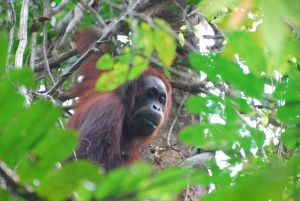
© HUTAN/KOCP


Site characteristics
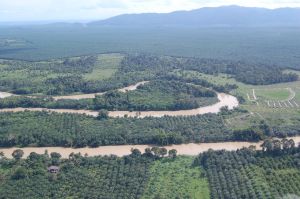
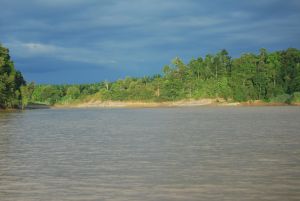
The Lower Kinabatangan Wildlife Sanctuary (LKWS) is an important floodplain in the state of Sabah, in northern Malaysia. Sungai Kinabatangan, Sabah's largest and longest river (560 km), runs through this floodplain and floods seasonally (BirdLife International 2021). The catchment area of the river is about 1,680,000 ha, covering almost 23% of the total land area in Sabah (BirdLife International 2021). In spite of the intense exploitation of natural resources that has resulted if forest degradation and fragmentation, Kibatangan remains a biodiversity hotspot, harboring a remarkable diversity of wildlife; in addition to orangutans, the area is also home to proboscis monkeys, Bornean gibbons, Bornean elephants, cloud leopards, sun bears and several bird species, including several globally threatened waterbirds, such as Storm's Stork, Ciconia stormi (HUTAN 2019, BirdLife International 2021). In 2002 the government of Sabah gazetted 27,000 ha of highly disturbed forests as the LKWS (Ancrenaz 2004).
Table 1. Basic site information for Lower Kinabatangan Wildlife Sanctuary
| Species | Pongo pygmaeus morio |
| Area | 280 km² |
| Coordinates | Lat: 5.32 , Lon: 118.15 |
| Type of site | Protected area (Wildlife Sanctuary) |
| Habitat types | Subtropical/tropical swamp forest, Subtropical/tropical moist lowland forest, Subtropical/tropical heavily degraded former forest, Agricultural land, Wetlands (lakes, rivers, streams, bogs, marshes) |
| Type of governance | Governance by government |
Types of sites Governance types Habitat types

Ape status
In the early 2000s, the population in Kinabatangan was 1,125 individuals (CI: 691-1,807), with an estimate of 670 individuals for the then-proposed Lower Kinabatangan Wildlife Sanctuary (Ancrenaz 2018). Compared to that estimate, the 2006-2007 surveys revealed a 28% decline in the population, and a further decline was revealed by a 2015 survey which estimated 785 (CI: 414-1,467) (Ancrenaz 2018).
Table 2. Ape population estimates reported for Lower Kinabatangan Wildlife Sanctuary
| Species | Year | Occurrence | Encounter or vistation rate (nests/km; ind/day) | Density estimate [ind./ km²] (95% CI) | Abundance estimate (95% CI) | Survey area | Sampling method | Analytical framework | Source | Comments | A.P.E.S. database ID |
|---|---|---|---|---|---|---|---|---|---|---|---|
| Pongo pygmaeus morio | 2002-2003 | 1.5-7.37 | 0.7-6.0 | 1,125 (691-1,807) | Kinabatangan and surrounding forest fragments | Aerial (drones/plane/helicopter), Line transects | Ancrenaz et al. 2004 | ||||
| Pongo pygmaeus morio | 2006-2007 | 812 (425-1,418) | Lower Kinabatangan Wildlife Sanctuary and surrounding forest fragments | Aerial (drones/plane/helicopter), Line transects | Ancrenaz 2018 | ||||||
| Pongo pygmaeus morio | 2015 | 785 (414-1,467) | Lower Kinabatangan Wildlife Sanctuary | Aerial (drones/plane/helicopter), Line transects | Ancrenaz 2018 | ||||||
| Pongo pygmaeus morio | 2024 | 867 (457-1,636) | Lower Kinabatangan Wildlife Sanctuary | Aerial (drones/plane/helicopter), Line transects | HUTAN | Methodolog y following Ancrenaz et al., 2005 |
Sampling methods Analytical frameworks
Threats
Table 3. Threats to apes reported for Lower Kinabatangan Wildlife Sanctuary
| Category | Specific threats | Threat level | Description | Year of threat |
|---|---|---|---|---|
| 1 Residential & commercial development | 1.1 Residential areas | Low (up to 30% of population affected) | Linear infrastructure (Ancrenaz pers. comm. 2024). | Ongoing (2024) |
| 12 Other threat | Other | High (more than 70% of population affected) | Habitat fragmentation (Ancrenaz pers. comm. 2024). | Ongoing (2024) |
| 2 Agriculture & aquaculture | 2.1.3 Industrial farming (including palm oil) | Medium (30-70% of population affected) | Habitat loss due to conversion of forest to oil palm plantations (Ancrenaz 2018). Most of the floodplain is affected by agriculture (90%). Little forest conversion since 2015 (Ancrenaz pers. comm. 2024). | 1980-2015, 2015-2024 |
| 5 Biological resource use | 5.1 Hunting & collecting terrestrial animals | High (more than 70% of population affected) | Signs of hunting have been found at the site, such as cartridges, snares and traps (Ancrenaz 2018). | Ongoing (2018) |
| 5 Biological resource use | 5.3 Logging & wood harvesting | High (more than 70% of population affected) | Logging and clearing land for oil palm plantations (Ancrenaz 2018). | Ongoing (2018) |
| 9 Pollution | 9.3 Agricultural & forestry effluents | Present (unknown severity) | Pollution in the Sungai Kinabatangan catchment area from palm oil mills, pesticides, fertilizers and sediment from plantations, sediment from logging activities and sewage and refuse from villages along the river (BirdLife International 2021). | Ongoing (2021) |
Conservation activities
In 1998, the NGO called HUTAN established the Kinabatangan Orang-utan Conservation Programme with support from Sabah's Wildlife Department. Research by HUTAN has shown that orangutans can thrive in highly disturbed and logged forests. In areas where hunting is not an issue, they can use the mixed forest/oil palm matrix as long as they have forest corridors (HUTAN 2019). It is therefore crucial to design orangutan conservation strategies at the landscape level that can incorporate existing oil palm plantations with the network of protected forest (HUTAN 2019).
Table 4. Conservation activities reported for Lower Kinabatangan Wildlife Sanctuary
| Category | Specific activity | Description | Implementing organization(s) | Year of activity |
|---|---|---|---|---|
| 1 Development impact mitigation | 1.8 Use set-aside areas of natural habitat (e.g., mining, logging, agricultural areas) | Ancrenaz pers. comm. 2024 | HUTAN | 2010-Ongoing (2024) |
| 1 Development impact mitigation | 1.9 Install green bridges (overpasses) or canopy bridges over transportation or service corridors | As part of the Kinabatangan Orang-utan Conservation Programme of HUTAN, orangutan bridges started to be installed in the early 2000s to address the issue of habitat fragmentation. This allows venturing males and adolescents to ensure proper gene flow between sub-populations (HUTAN 2019). | HUTAN | 2010-Ongoing (2024) |
| 2 Counter-wildlife crime | 2.1 Implement road blocks to inspect cars for illegal ape bushmeat | Law enforcement activities include roadblocks to spot-check for poaching (HUTAN, Ancrenaz pers. comm. 2024). | Sabah Wildlife Department (SWD) | 2000-Ongoing (2024) |
| 2 Counter-wildlife crime | 2.11 Implement monitoring surveillance strategies (e.g., SMART) or use monitoring data to improve effectiveness of patrols | Biomonitoring and research applied conservation and management (HUTAN, Ancrenaz pers. comm. 2024). | HUTAN | 2000-Ongoing (2024) |
| 2 Counter-wildlife crime | 2.3 Conduct regular anti-poaching patrols | Since 2002, groups of people from the Kinabatangan community are appointed to become “Honorary Wildlife Wardens”. The Wardens are civilians who are given the same legal powers as rangers from the Sabah Wildlife Department to conserve and manage the natural resources, and to apprehend offenders when necessary. Enforcement activities primarily involve regular patrols by boat, car, and on foot. Patrols are conducted throughout the year and typically consist of two or three Wardens (HUTAN, Ancrenaz pers. comm. 2024). | HUTAN | 2000-Ongoing (2024) |
| 3 Species health | 3.2 Keep safety distance to habituated apes | Ancrenaz pers. comm. 2024 | HUTAN | 2000-Ongoing (2024) |
| 3 Species health | 3.3 Limit time that researchers/tourists are allowed to spend with habituated apes | Ancrenaz pers. comm. 2024 | HUTAN | 2000-Ongoing (2024) |
| 4 Education & awareness | 4.1 Educate local communities about apes and sustainable use | Ancrenaz pers. comm. 2024 | HUTAN | 2000-Ongoing (2024) |
| 4 Education & awareness | 4.2 Involve local community in ape research and conservation management | A major function of the Honorary Wildlife Wardens is to make the public aware of the existence of the Lower Kinabatangan Wildlife Sanctuary, the protection status of wildlife living in the region, the laws regarding wildlife and wildlife trade, and the ongoing presence of the wardens in the site. The presence of the wardens acts as a deterrent to illegal activities ([1]). | HUTAN | 1998-Ongoing (2024) |
| 4 Education & awareness | 4.5 Implement multimedia campaigns using theatre, film, print media, discussions | Ancrenaz pers. comm. 2024 | HUTAN | 2000-Ongoing (2024) |
| 5 Protection & restoration | 5.2 Legally protect ape habitat | The site is a protected area. | HUTAN, Sabah Wildlife Department (SWD) | 2005-Ongoing (2025) |
| 5 Protection & restoration | 5.3 Establish areas for conservation which are not protected by national or international legislation (e.g., private sector standards & codes) | Ancrenaz pers. comm. 2024 | HUTAN | 2010-Ongoing (2024) |
| 5 Protection & restoration | 5.6 Habitat restoration | Establishment of forest linkages that reconnect key forest fragments and allow orang-utans, elephants, and other wildlife to move freely along the banks of the Kinabatangan river (HUTAN, Ancrenaz pers. comm. 2024). | HUTAN | 2000-Ongoing (2024) |
| 6 Species management | 6.1 Habituate primates to human presence to reduce stress from tourists/researchers etc | Ancrenaz pers. comm. 2024 | HUTAN | 2000-Ongoing (2024) |
| 7 Economic & other incentives | 7.1 Provide monetary benefits to local communities for sustainably managing their forest and its wildlife (e.g., REDD, alternative income, employment) | Ancrenaz pers. comm. 2024 | HUTAN | 1998-Ongoing (2024) |
| 8 Permanent presence | 8.1 Run research project and ensure permanent human presence at site | Ancrenaz pers. comm. 2024 | HUTAN | 1998-Ongoing (2024) |
| 8 Permanent presence | 8.3 Permanent presence of staff/manager | Ancrenaz pers. comm. 2024 | HUTAN | 1998-Ongoing (2024) |
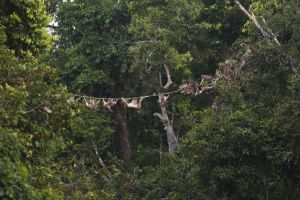
Primate bridge © HUTAN/KOCP -
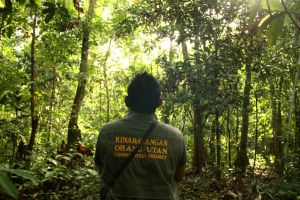
© HUTAN/KOCP


Challenges
Table 5. Challenges reported for Lower Kinabatangan Wildlife Sanctuary
| Challenges | Specific challenges | Source | Year(s) |
|---|---|---|---|
| Not reported |
Enablers
Table 6. Enablers reported for Lower Kinabatangan Wildlife Sanctuary
| Enablers | Specific enablers | Source | Year(s) |
|---|---|---|---|
| 1 Site management | 1.1 Effective leadership | Ancrenaz pers. obs. 2024 | Ongoing (2024) |
| 1 Site management | 1.3 Adaptive management practices | Ancrenaz pers. obs. 2024 | Ongoing (2024) |
| 2 Resources and capacity | 2.1 Sufficient staff | Ancrenaz pers. obs. 2024 | Ongoing (2024) |
| 2 Resources and capacity | 2.2 Sufficient funding | Ancrenaz pers. obs. 2024 | Ongoing (2024) |
| 2 Resources and capacity | 2.3 Continuous/long-term funding | Ancrenaz pers. obs. 2024 | Ongoing (2024) |
| 2 Resources and capacity | 2.5 Sufficient capacity/expertise to advise, design, or implement actions | Ancrenaz pers. obs. 2024 | Ongoing (2024) |
| 2 Resources and capacity | 2.6 External partnerships that add expertise or resources | Ancrenaz pers. obs. 2024 | Ongoing (2024) |
| 3 Engaged community | 3.1 Strong local environmental knowledge | Ancrenaz pers. obs. 2024 | Ongoing (2024) |
| 3 Engaged community | 3.6 Local community engagement and support | Ancrenaz pers. obs. 2024 | Ongoing (2024) |
| 4 Institutional support | 4.1 Effective legislation and law enforcement | Ancrenaz pers. obs. 2024 | Ongoing (2024) |
| 4 Institutional support | 4.2 Strong government support | Ancrenaz pers. obs. 2024 | Ongoing (2024) |
| 6 Safety and stability | 6.1 Political and economic stability | Ancrenaz pers. obs. 2024 | Ongoing (2024) |
| 6 Safety and stability | 6.2 Social and civil security | Ancrenaz pers. obs. 2024 | Ongoing (2024) |
Research activities
Ecological studies on orangutan adaptation to disturbed forest and survival in multiple-use landscapes dominated by oil palm plantations undertaken by HUTAN since 1998 (Ancrenaz pers. comm. 2024). Research activities in LKWS have been mainly focused on surveys and biomonitoring, studies on orangutan ecology in fragmented and degraded forest as well as agricultural landscapes. In addition to orangutans, other species that are subject of research studies include elephants, proboscis monkeys, swiftlets and hornbills. Relevant literature:
- Rival, A., Ancrenaz, M., Lakman, I., Shafiq, M., Roda, J.M., Guizol, P., Djama, M. 2022. Innovative agroforestry designs for tropical plantation landscapes – the TRAILS project. Acta Horticultura. 1355. ISHS. XXXI IHC – Proc. Int. Symp. on Agroecology and System Approach for Sustainable and Resilient Horticultural Production. DOI 10.17660/ActaHortic.2022.1355.14
- Oram, F., Kapar, M.D., Saharon, A.R., Elahan, H., Segaran, P., Poloi, S., Saidal, H., Abulani, A., Lackman, I., Ancrenaz, M. 2022. “Engaging the Enemy”: Orangutan (Pongo pygmaeus morio) conservation in human modified environments in the Kinabatangan floodplain of Sabah, Malaysian Borneo. International Journal of Primatology. https://doi.org/10.1007/s10764-022-00288-w
- Seaman, D.J.I., Voigt, M., Bocedi, G., Travis, J.M.J., Palmer, S.C.F., Ancrenaz, M., Wich, S., Meijarrd, E., Bernard, H., Deere, N.J., Humle, T., Struebig, M.J. 2021. Orangutan movement and population dynamics across human-modified landscapes: implications of policy and management. Landscape Ecology. https://doi.org/10.1007/s10980-021-01286-8
- Ancrenaz, M., Oram, F., Nardiyono, Silmi, M., Jopony, M.E.M., Voigt, M., Seaman, D.J.I., Sherman, J., lackman, I., Traeholt, C., Santika, T., Wich, S., Strubig, M., Meijaard, E. 2021. The importance of orangutans in small fragments for maintaining metapopulation dynamics. Frontiers in Forests and Global Changes. https://doi.org/10.3389/ffgc.2021.560944
- Simon, D., Davies, G., Ancrenaz, M. 2019. Changes to Sabah’s orangutan population in recent times: 2002- 2017. Plos One, 14(7): e0218819. https://doi.org/10.1371/journal.pone.0218819
- Davies, A.B., Oram, F., Ancrenaz, M., Asner, G. 2019. Combining behavioural and LIDAR data to reveal relationships between canopy structure and orangutan nest selection in disturbed forests. Biological Conservation, 97-107. https://doi.org/10.1016/j.biocon.2019.01.032
- Ancrenaz, M., Barton, C., Riger, P., Wich, S. 2018. Building relationships: how zoos and other partners can contribute to the conservation of wild orangutans Pongo spp. Int. Zoo Yb.. doi:10.1111/izy.12184
- Davies, A.B., Ancrenaz, M., Oram, F., Asner, G.P. 2017. Canopy structure drives orangutan habitat selection in disturbed Bornean forests. Proceedings of Natural Academy of Science, doi 10.1073/pnas.1706780114.
For a full list of research articles visit https://www.hutan.org.my/research-articles/

Documented behaviours
Table 7. Behaviours documented for Lower Kinabatangan Wildlife Sanctuary
| Category | Behavior | Observation type | Prevalence | Observation dates | Source | Habituation | Species | Comment |
|---|---|---|---|---|---|---|---|---|
| Bunk nests: Build a nest a short distance above the nest used for resting (during rain) | Van Schaik et al. 2003 | |||||||
| Sun cover: Building cover on nest during bright sunshine | Van Schaik et al. 2003 | |||||||
| Hide under nest: Seek shelter under nest for rain | Van Schaik et al. 2003 | |||||||
| Raspberry: Spluttering sounds associated with nest building | Van Schaik et al. 2003 | |||||||
| Branch as swatter: Using detached leafy branches to ward off bees/wasps attacking subject (who is usually raiding their nest) | Van Schaik et al. 2003 | |||||||
| Bouquet feeding: Using lips to pick ants from fistful of dry, fresh, or rotting leaves | Van Schaik et al. 2003 | |||||||
| Branch dragging display on ground | Van Schaik et al. 2003 | |||||||
| Hiding behind detached branch from predators or humans | Van Schaik et al. 2003 |
Exposure to climate change impacts
External links
References
Ancrenaz, M., Goossens, B., Gimenez, O., Sawang, A., & Lackman-Ancrenaz, I. (2004, November). Determination of ape distribution and population size using ground and aerial surveys: a case study with orang-utans in lower Kinabatangan, Sabah, Malaysia. In Animal Conservation forum (Vol. 7, No. 4, pp. 375-385). Cambridge University Press.
Ancrenaz, M. (2018). Wildlife Surveys in the Lower Kinabatangan. Report to Kinabatangan Orang-utan Conservation Project, HUTAN.
BirdLife International (2021). Important Bird Areas factsheet: Kinabatangan floodplain. Downloaded from http://www.birdlife.org on 04/11/2021.
HUTAN (2019). Kinabatangan Orang-utan Conservation Programme, 2019 Yearly Activity Report. https://www.hutan.org.my/wp-content/uploads/Reports/Internal%20reports/Report_2019.pdf
Boonratana, R. (2013). Fragmentation and its significance on the conservation of proboscis monkey (Nasalis larvatus) in the Lower Kinabatangan, Sabah (North Borneo). In Primates in fragments (pp. 459-475). Springer, New York, NY.
Van Schaik, C. P., Ancrenaz, M., Borgen, G., Galdikas, B., Knott, C. D., Singleton, I., ... & Merrill, M. (2003). Orangutan cultures and the evolution of material culture. Science, 299(5603), 102-105.
Page created by: Marc Ancrenaz & APES Atlas Team Date: 2021-12-10
Page updated by: Marc Ancrenaz Date: 2024-08-12