
Kahuzi-Biega National Park: Difference between revisions
No edit summary |
No edit summary |
||
| Line 13: | Line 13: | ||
* Conservation activities reported include different types of patrolling, e.g., for surveillance, demarcation, wildlife/threat research and ecotourism. | * Conservation activities reported include different types of patrolling, e.g., for surveillance, demarcation, wildlife/threat research and ecotourism. | ||
* Kahuzi-Biega National Park was declared a UNESCO World Heritage site in 1980. | * Kahuzi-Biega National Park was declared a UNESCO World Heritage site in 1980. | ||
| Line 157: | Line 153: | ||
!Description | !Description | ||
!Year of threat | !Year of threat | ||
|- | |- | ||
|3 Energy production & mining | |3 Energy production & mining | ||
| Line 175: | Line 165: | ||
|High levels of subsistence hunting and bushmeat extraction, linked to mining activities in and around the site (Spira et al. 2019). | |High levels of subsistence hunting and bushmeat extraction, linked to mining activities in and around the site (Spira et al. 2019). | ||
|Ongoing (2019) | |Ongoing (2019) | ||
|- | |||
|6 Human intrusions & disturbance | |||
|6.2 War, civil unrest & military exercises | |||
|High (more than 70% of population affected) | |||
|Breakdown of government control with the onset of civil war in 1996. The Congolese wildlife authority lost control of the park; armed groups settled within its boundaries and unregulated extraction of minerals continue to fuel civil conflict in the region (Plumptre et al. 2015). | |||
|1996-2003 | |||
|} | |} | ||
Revision as of 10:44, 25 March 2026
Central Africa > Democratic Republic of the Congo > Kahuzi-Biega National Park
Français | Português | Español | Bahasa Indonesia | Melayu
Summary
- Eastern chimpanzees (Pan troglodytes schweinfurthii) & Grauer's gorillas (Gorilla beringei graueri) are present in Kahuzi-Biega National Park.
- The gorilla population in the park has been estimated at 1,571 (95% CI 824–2,993) individuals; the chimpanzee population at 2,500 (95% CI: 1,804–3,462) individuals.
- The site has a total size of 6,000 km².
- Poaching linked to mining activities is a key threat to great apes at the site.
- Conservation activities reported include different types of patrolling, e.g., for surveillance, demarcation, wildlife/threat research and ecotourism.
- Kahuzi-Biega National Park was declared a UNESCO World Heritage site in 1980.
Site characteristics
Kahuzi-Biega National Park (KBNP) is located in eastern Democratic Republic of Congo, close to the border with Rwanda. KBNP holds an exceptional diversity of flora and fauna, making it one of the most important sites in the Albertine Rift Valley. The park is named after two dormant volcanoes, Mount Kahuzi (3,308 m) and Mount Biega (2,790 m) (UNESCO). In 1970, Kahuzi-Biega National Park was created and in 1975 its area was extended to 6,000 sq. km. Since then, the park comprises two sectors, the low and high altitude sectors, which are linked by an ecological corridor (UNESCO). In 1980, the site was declared a UNESCO World Heritage site. KBNP is special in that the faunal and floral transition from low to highlands can be observed. With at least 1,178 plant species recorded in the highland sector, KBNP was designated as a centre of diversity for plants by IUCN and WWF in 1994 (UNESCO). KBNP is home to a large proportion of the endangered Grauer's gorilla population; in fact, KBNP and Maiko National Park support the most important Grauer's gorilla populations (Plumptre et al. 2015, Spira et al. 2016).
Table 1. Basic site information for Kahuzi-Biega National Park
| Species | Gorilla beringei graueri, Pan troglodytes schweinfurthii |
| Area | 6,000 km² |
| Coordinates | Lat: -2.223171 , Lon: 28.389500 |
| Type of site | Protected area (National Park) |
| Habitat types | Subtropical/tropical moist montane forest |
| Type of governance |
Types of sites Governance types Habitat types
Ape status
Between 1996 and 2000, it has been estimated that the highland gorilla population of KNBP decreased by almost 40%; the lowland population also experienced a decline during this time, and the forest corridor connecting the two populations was severed (Maldonado et al. 2012). Thanks to transect surveys conducted between 2015 and 2019 that could cover larger portions of the park, more accurate estimates could be derived (Plumptre et al. 2021). The Grauer's gorilla population is estimated to have declined by 80% in KBNP since the mid-1990s, whereas the chimpanzee population was estimated to have remained stable (Plumptre et al. 2021).
Table 2. Ape population estimates reported for Kahuzi-Biega National Park
| Species | Year | Occurrence | Encounter or vistation rate (nests/km; ind/day) | Density estimate [ind./ km²] (95% CI) | Abundance estimate (95% CI) | Survey area | Sampling method | Analytical framework | Source | Comments | A.P.E.S. database ID |
|---|---|---|---|---|---|---|---|---|---|---|---|
| Gorilla beringei graueri | 1978-1979 | 0.37 | 223.0 | Kahuzi-Biega National Park | Full count | Murnyak 1981 | |||||
| Gorilla beringei graueri | 1990 | 258.0 | Kahuzi-Biega National Park | Full count | Yamagiwa et al. 1993 | ||||||
| Gorilla beringei graueri | 2015 | 0.79 | 325.0 | Kahuzi-Biega National Park highland sector | Line transects | WCS and ICCN, as cited by Spira et al. 2016 | |||||
| Pan troglodytes schweinfurthii | 2011-2019 | 2,500 (1,804-3,462) | Kahuzi-Biega National Park | Line transects & recces | Plumptre et al. 2021 | ||||||
| Gorilla beringei graueri | 2011-2019 | 1,571 (824-2,993) | Kahuzi-Biega National Park | Line transects & recces | Plumptre et al. 2021 | ||||||
| Gorilla beringei graueri | 2015 | 213.0 | Kahuzi-Biega National Park highland sector | Reconnaissance walk | Spira et al. 2016 | abundance estimate is a minimum |
Sampling methods Analytical frameworks
Threats
With the onset of civil war in 1996, armed groups settled within the boundaries of the park, as the Institut Congolais pour la Conservation de la Nature (ICCN), the Congolese wildlife authority, had lost control of the park. This exacerbated natural resource extraction from within the park, including hunting of wildlife for subsistence and trade (Spira et al. 2016). In a 2014 survey of local miners surrounding the site, almost all the interviewed miners stated that they consumed bushmeat regularly because of the lack of alternatives. Most of the respondents also believed that bushmeat hunting had caused declines and local extinctions of some mammals, including great apes (Spira et al. 2019).
Table 3. Threats to apes reported for Kahuzi-Biega National Park
| Category | Specific threats | Threat level | Description | Year of threat |
|---|---|---|---|---|
| 3 Energy production & mining | 3.2 Mining & quarrying | High (more than 70% of population affected) | Artisanal mining. Unregulated extraction of gold, tin (cassiterite), tungsten, diamond and coltan. Numerous active mining sites are present in the park. Many mines are controlled by armed militia (Plumptre et al. 2015; Spira et al. 2019). | 2015-Ongoing (2019) |
| 5 Biological resource use | 5.1 Hunting & collecting terrestrial animals | High (more than 70% of population affected) | High levels of subsistence hunting and bushmeat extraction, linked to mining activities in and around the site (Spira et al. 2019). | Ongoing (2019) |
| 6 Human intrusions & disturbance | 6.2 War, civil unrest & military exercises | High (more than 70% of population affected) | Breakdown of government control with the onset of civil war in 1996. The Congolese wildlife authority lost control of the park; armed groups settled within its boundaries and unregulated extraction of minerals continue to fuel civil conflict in the region (Plumptre et al. 2015). | 1996-2003 |
Conservation activities
KBNP is managed by the Congolese wildlife authority, Institut Congolais pour la Conservation de la Nature (ICCN), which employs rangers (Spira, Kirkby & Plumptre 2019).
Table 4. Conservation activities reported for Kahuzi-Biega National Park
| Category | Specific activity | Description | Implementing organization(s) | Year of activity |
|---|---|---|---|---|
| 2 Counter-wildlife crime | 2.11 Implement monitoring surveillance strategies (e.g., SMART) or use monitoring data to improve effectiveness of patrols | Since 2014 rangers in Kahuzi–Biega National Park have been using SMART (Spira, Kirkby & Plumptre 2019). | 2014-Ongoing (2019) | |
| 2 Counter-wildlife crime | 2.3 Conduct regular anti-poaching patrols | The park employs several rangers who conduct surveillance, demarcation, and threat research patrols (Spira, Kirkby & Plumptre 2019). | Ongoing (2019) | |
| 5 Protection & restoration | 5.2 Legally protect ape habitat | The site is a National Park. | 1970-Ongoing (2026) |
Challenges
The most urgent need is to demilitarise artisanal mines in and around KBNP to reduce poaching and enable the ICCN to enforce conservation laws (Spira et al. 2016). Based on a 2015-2016 interview survey of rangers in KBNP, ranger job satisfaction could improve with higher salaries, more promotion opportunities and recognition from the government, positive performance incentives, better security, improved living conditions in remote patrol posts and more support from the judicial system (Spira, Kirkby & Plumptre 2019).
Table 5. Challenges reported for Kahuzi-Biega National Park
| Challenges | Specific challenges | Source | Year(s) |
|---|---|---|---|
| 6 Safety and stability | 6.3 Civil unrest/war | Plumptre et al. 2015; Spira, Kirkby & Plumptre 2019 | |
| 4 Institutional support | 4.1 Lack of law enforcement | Plumptre et al. 2015; Spira, Kirkby & Plumptre 2019 |
Enablers
Table 6. Enablers reported for Kahuzi-Biega National Park
| Enablers | Specific enablers | Source | Year(s) |
|---|---|---|---|
| 1 Site management | |||
| 2 Resources and capacity | |||
| 3 Engaged community | |||
| 4 Institutional support | |||
| 5 Ecological context | |||
| 6 Safety and stability |
Research activities
Documented behaviours
Table 7. Behaviours documented for Kahuzi-Biega National Park
| Category | Behavior | Observation type | Prevalence | Observation dates | Source | Habituation | Species | Comment |
|---|---|---|---|---|---|---|---|---|
| Not reported |
Exposure to climate change impacts
As part of a study on the exposure of African great ape sites to climate change impacts, Kiribou et al. subm. extracted climate data and data on projected extreme climate impact events for the site. Climatological characteristics were derived from observation-based climate data provided by the Inter-Sectoral Impact Model Intercomparison Project (ISIMIP, www.isimip.org). Parameters were calculated as the average across each 30-year period. For 1981-2010, the EWEMBI dataset from ISIMIP2a was used. For the two future periods (2021-2050 and 2071-2099) ISIMIP2b climate data based on four CMIP5 global climate models were used. For future projections, two Representative Concentration Pathways (RCP) were used. RCP 2.6 is a scenario with strong mitigation measures in which global temperatures would likely rise below 2C. RCP 6.0 is a scenario with medium emissions in which global temperatures would likely rise up to 3C by 2100. For the number of days with heavy precipitation events, the 98th percentile of all precipitation days (>1mm/d) was calculated for the 1979-2013 reference period as a threshold for a heavy precipitation event. Then, for each year, the number of days above that threshold was derived. The figures on temperature and precipitation anomaly show the deviation from the mean temperature and mean precipitation for the 1979-2013 reference period.
The estimated exposure to future extreme climate impact events (crop failure, drought, river flood, wildfire, tropical cyclone, and heatwave) is based on a published dataset by Lange et al. 2020 derived from ISIMIP2b data. The same global climate models and RCPs as described above were used. Within each 30-year period, the number of years with an extreme event and the average proportion of the site affected were calculated (see Kiribou et al. subm. for details).
Table 8. Estimated past and projected climatological characteristics in Kahuzi-Biega National Park
| Value | 1981-2010 | 2021-2050, RCP 2.6 | 2021-2050, RCP 6.0 | 2071-2099, RCP 2.6 | 2071-2099, RCP 6.0 |
|---|---|---|---|---|---|
| Mean temperature [C] | 20.7 | 21.9 | 21.6 | 22 | 23.2 |
| Annual precipitation [mm] | 1788 | 1791 | 1836 | 1769 | 1854 |
| Max no. consecutive dry days (per year) | 11.8 | 33.8 | 30 | 39.7 | 31.4 |
| No. days with heavy precipitation (per year) | 7.3 | 7.1 | 7.2 | 6.7 | 10.7 |
Table 9. Projected exposure of apes to extreme climate impact events in Kahuzi-Biega National Park
| Type | No. of years with event (2021-2050, RCP 2.6) | % of site exposed (2021-2050, RCP 2.6) | No. of years with event (2021-2050, RCP 6.0) | % of site exposed (2021-2050, RCP 6.0) | No. of years with event (2070-2099, RCP 2.6) | % of site exposed (2070-2099, RCP 2.6) | No. of years with event (2070-2099, RCP 6.0) | % of site exposed (2070-2099, RCP 6.0) |
|---|---|---|---|---|---|---|---|---|
| Crop failure | 7 | 0.03 | 3.5 | 0.01 | 6 | 0.04 | 11 | 0.05 |
| Drought | 0 | 0 | 0 | 0 | 0 | 0 | 0 | 0 |
| Heatwave | 0 | 0 | 0.5 | 16.67 | 0.5 | 16.67 | 5.5 | 35.42 |
| River flood | 4.25 | 1.62 | 6 | 2.59 | 5 | 0.75 | 11.25 | 1.4 |
| Tropical cyclone | 0 | 0 | 0 | 0 | 0 | 0 | 0 | 0 |
| Wildfire | 30 | 0.79 | 30 | 0.76 | 29 | 0.85 | 29 | 0.73 |
-
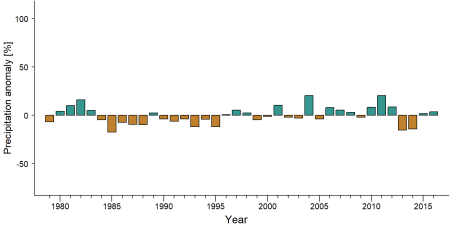
Precipitation anomaly in Kahuzi-Biega National Park -
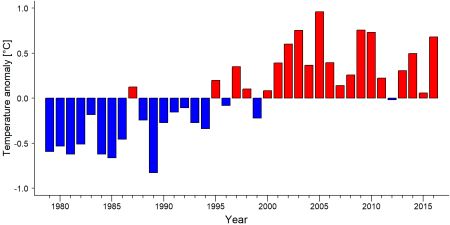
Temperature anomaly in Kahuzi-Biega National Park


External links
UNESCO World Heritage - Kahuzi-Biega National Park
References
Spira, C., Mitamba, G., Kirkby, A., Kalikunguba, T., Nishuli, R. and Plumptre,A. (2016) Grauer’s Gorilla Numbers Increasing in Kahuzi-Biega National Park Highlands: 2015 Census in Tshivanga Sector. Unpublished report by the Wildlife Conservation Society.
Spira, C., Kirkby, A., Kujirakwinja, D., & Plumptre, A. J. (2019). The socio-economics of artisanal mining and bushmeat hunting around protected areas: Kahuzi–Biega National Park and Itombwe Nature Reserve, eastern Democratic Republic of Congo. Oryx, 53(1), 136-144.
Spira, C., Kirkby, A., & Plumptre, A. (2019). Understanding ranger motivation and job satisfaction to improve wildlife protection in Kahuzi–Biega National Park, eastern Democratic Republic of the Congo. Oryx, 53(3), 460-468. doi:10.1017/S0030605318000856
Plumptre, A.J., Nixon, S., Critchlow, R., Vieilledent, G., Nishuli, R., Kirkby, A., Williamson, E.A., Hall, J.S. & Kujirakwinja, D. (2015). Status of Grauer’s gorilla and chimpanzees in eastern Democratic Republic of Congo: Historical and current distribution and abundance. Unpublished report to Arcus Foundation, USAID and US Fish and Wildlife Service.
Plumptre, A. J., Kirkby, A., Spira, C., Kivono, J., Mitamba, G., Ngoy, E., ... & Kujirakwinja, D. (2021). Changes in Grauer's gorilla (Gorilla beringei graueri) and other primate populations in the Kahuzi‐Biega National Park and Oku Community Reserve, the heart of Grauer's gorilla global range. American Journal of Primatology, 83(7), e23288.
Maldonado, O., Aveling, C., Cox, D., Nixon, S., Nishuli, R., Merlo, D., Pintea, L. & Williamson, E.A. (2012). Grauer’s Gorillas and Chimpanzees in Eastern Democratic Republic of Congo (Kahuzi-Biega, Maiko, Tayna and Itombwe Landscape): Conservation Action Plan 2012–2022. Gland, Switzerland: IUCN/SSC Primate Specialist Group, Ministry of Environment, Nature Conservation & Tourism, Institut Congolais pour la Conservation de la Nature & the Jane Goodall Institute. 66pp.
Murnyak, D. F. (1981). Censusing the gorillas in Kahuzi-Biega National Park. Biol. Conservl, 21, 163-76.
Yamagiwa, J., Mwanza, N., Spangenberg, A., Maruhashi, T., Yumoto, T., Fischer, A. & Steinhauer, B.B. (1993). A census of the eastern lowland gorillas Gorilla gorilla graueri in Kahuzi-Biega National Park with reference to mountain gorillas G.g. beringei in the Virunga region, Zaire. Biol Conserv 64, 83–89.
Page created by: APES Atlas Team Date: 2023-11-23