
Monte Alén National Park: Difference between revisions
No edit summary |
No edit summary |
||
| Line 11: | Line 11: | ||
* The great ape population trend is unknown. | * The great ape population trend is unknown. | ||
* The site has a total size of 2,000 km². | * The site has a total size of 2,000 km². | ||
* Key threats to great apes are hunting, logging, and | * Key threats to great apes are hunting, logging, and pressure for farmland. | ||
* Conservation activities | * Conservation activities include awareness raising activities and biomonitoring. | ||
| Line 19: | Line 18: | ||
<div><ul><li style="display: inline-block; vertical-align: top;"> [[File:River_MonteAlen.jpg | 300px | thumb| none | © R. Nchama Okenve]] </li><li style="display: inline-block; vertical-align: top;"> [[File: Camaleon_MonteAlen.jpg | 300px | thumb| none | © R. Nchama Okenve]] </li><li style="display: inline-block; vertical-align: top;"> [[File: Bushbuck_MonteAlen.jpg | 300px | thumb| none | © R. Nchama Okenve]] </li><li style="display: inline-block; vertical-align: top;"> [[File: Waterfalls_MonteAlen.jpg | 300px | thumb| none | © R. Nchama Okenve]] </li></ul></div> | |||
= Site characteristics = | = Site characteristics = | ||
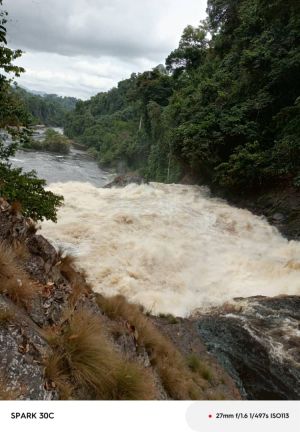
Established in 1990, Monte Alén National Park is located in Equatorial Guinea. The size of the park was doubled in 1998 with the inclusion of Mount Mitra, and in 2000 another section to the south was added (BirdLife International 2020). | Established in 1990, Monte Alén National Park is located in Equatorial Guinea. Monte Alén and Monte Mitra (both located within the National Park) are considered the highest massifs on mainland Equatorial Guinea, although available elevation data remain incomplete. The park is bounded to the west by the large, fast-flowing Uoro River, and to the east by the main road linking Niefang to Gabon. The size of the park was doubled in 1998 with the inclusion of Mount Mitra, and in 2000 another section to the south was added (Key Biodiversity Areas Partnership 2025). The site is designated as an Important Bird Area and also a [https://www.keybiodiversityareas.org/site/factsheet/6381 Key Biodiversity Area] (BirdLife International 2020, Key Biodiversity Areas Partnership 2025). Primate species include Colobus satanas (VU, fairly common), Cercocebus torquatus (LR/near threatened), Mandrillus sphinx (LR/nt), Gorilla gorilla (EN), and Pan troglodytes (EN) (Key Biodiversity Areas Partnership 2025). | ||
'''Table 1. Basic site information for Monte Alén National Park''' | '''Table 1. Basic site information for Monte Alén National Park''' | ||
| Line 38: | Line 38: | ||
|- | |- | ||
|Habitat types | |Habitat types | ||
|Subtropical/tropical moist lowland forest | |Subtropical/tropical moist lowland forest, Subtropical/tropical moist montane forest | ||
|- | |- | ||
|Type of governance | |Type of governance | ||
| Line 65: | Line 65: | ||
!A.P.E.S. database ID | !A.P.E.S. database ID | ||
|- | |- | ||
| | |''Gorilla gorilla gorilla'' | ||
|1994 | |||
| | |||
|2.16 | |||
| | |||
| | | | ||
|Monte Alén National Park | |||
|Line transects | |||
| | | | ||
|Garcia & Mba 1997 | |||
|145 gorilla nests were reported. Survey effort: 84.9 km. Nest encounter rate is the mean taken from three estimates (dense forest (1.01), open forest (0.32), secondary forest (5.15)). | |||
| | | | ||
|- | |||
|''Pan troglodytes troglodytes'' | |||
|1994 | |||
| | |||
|3.02 | |||
| | | | ||
| | | | ||
|Monte Alén National Park | |Monte Alén National Park | ||
|Line transects | |||
| | |||
|Garcia & Mba 1997 | |||
|290 chimpanzee nests recorded. Survey effort: 84.9 km. Nest encounter rate is the mean taken from three estimates (dense forest (3.41), open forest (5.35), secondary forest (0.31)). | |||
| | |||
|- | |||
|''Pan troglodytes troglodytes'' & ''Gorilla gorilla gorilla'' | |||
|2024 | |||
|Present | |||
| | |||
| | | | ||
| | | | ||
|Monte Alén National Park | |||
|Line transects, Camera trap | |||
| | | | ||
|Nchama Okenve, R., pers. comm. 2025 | |||
| | | | ||
| | | | ||
| Line 96: | Line 122: | ||
|5.1 Hunting & collecting terrestrial animals | |5.1 Hunting & collecting terrestrial animals | ||
|High (more than 70% of population affected) | |High (more than 70% of population affected) | ||
|Commercial trapping and hunting ( | |Commercial trapping and hunting (BirdLife International 2020, Nchama Okenve, R., pers. comm. 2025). Bristol Zoological Society conducts biomonitoring in the site and have repeatedly reported hunting signs, including snares, shotgun shells, and presence of hunting dogs (McLaughlin, McCabe & Fernández 2020). | ||
|2005-Ongoing (2020) | |2005-Ongoing (2020) | ||
|- | |||
|5 Biological resource use | |||
|5.1.5 Persecution/human wildlife conflict | |||
|Present (unknown severity) | |||
|Human-wildlife conflict due to crop raiding (Nchama Okenve, R., pers. comm. 2025). | |||
|Ongoing (2025) | |||
|- | |- | ||
|2 Agriculture & aquaculture | |2 Agriculture & aquaculture | ||
|2.1 Annual & perennial non-timber crops | |2.1 Annual & perennial non-timber crops | ||
|Present (unknown severity) | |Present (unknown severity) | ||
|Agricultural expansion (Sunderland 2005 | |Agricultural expansion (Sunderland 2005, Kenfack 2014). Farming is mainly occurring at the borders of the park (Nchama Okenve, R., pers. comm. 2025). | ||
|Ongoing ( | |2005-Ongoing (2025) | ||
|- | |- | ||
|5 Biological resource use | |5 Biological resource use | ||
|5.3 | |5.3.1 Subsistence logging | ||
|Present (unknown severity) | |Present (unknown severity) | ||
|Logging activity (Sunderland 2005 | |Logging activity (Sunderland 2005, Kenfack 2014), mainly subsistence logging or wood harvesting (Nchama Okenve, R., pers. comm. 2025). | ||
|Ongoing ( | |2005-Ongoing (2025) | ||
|} | |} | ||
| Line 116: | Line 148: | ||
= Conservation activities = | = Conservation activities = | ||
The park was managed by the European-Union-funded ECOFAC project from 1992 until 2005 (Key Biodiversity Areas Partnership 2025, Nchama Okenve, R., pers. comm. 2025). Bristol Zoological Society is conducting biomonitoring activities in the site and, with support from IUCN, there are projects to reduce human-wildlife conflict around the park as well as support for micro-projects to generate income (Nchama Okenve, R., pers. comm. 2025). | |||
'''Table 4. Conservation activities reported for Monte Alén National Park''' | |||
{| border="1" cellpadding="5" cellspacing="0" class="Conservation_activities-table" | |||
!Category | |||
!Specific activity | |||
!Description | |||
!Implementing organization(s) | |||
!Year of activity | |||
|- | |||
|5 Protection & restoration | |||
|5.2 Legally protect ape habitat | |||
|The site is a National Park. | |||
| | |||
|1990-Ongoing (2025) | |||
|- | |||
|2 Counter-wildlife crime | |||
|2.11 Implement monitoring surveillance strategies (e.g., SMART) or use monitoring data to improve effectiveness of patrols | |||
|Monitoring program that uses different methods (recces, line transects, camera traps) also detects human activities, such as illegal hunting (McLaughlin, McCabe & Fernández 2020). | |||
|Bristol Zoological Society, INDEFOR | |||
|2019-Ongoing (2020) | |||
|- | |||
|2 Counter-wildlife crime | |||
|Other | |||
|Eco-guards patrol and take care of the park (Nchama Okenve, R., pers. comm. 2025). | |||
|IUCN | |||
|Ongoing (2025) | |||
|- | |||
|4 Education & awareness | |||
|4.4 Regularly play TV and radio announcements to raise ape conservation awareness | |||
|Radio programs to raise awareness in local population (Nchama Okenve, R., pers. comm. 2025). | |||
|INDEFOR | |||
|Ongoing (2025) | |||
|- | |||
|7 Economic & other incentives | |||
|7.1 Provide monetary benefits to local communities for sustainably managing their forest and its wildlife (e.g., REDD, alternative income, employment) | |||
|Funding of microprojects to support income generation in local communities (Nchama Okenve, R., pers. comm. 2025). | |||
|IUCN, Bristol Zoological Society | |||
|Ongoing (2025) | |||
|- | |||
|7 Economic & other incentives | |||
|Other | |||
|There is some eco-tourism in the site, but not with permanent presence (Nchama Okenve, R., pers. comm. 2025). | |||
| | |||
|Ongoing (2025) | |||
|} | |||
[[Conservation activities]] | |||
= Challenges = | = Challenges = | ||
| Line 132: | Line 210: | ||
|2 Resources and capacity | |2 Resources and capacity | ||
|2.3 General lack of funding | |2.3 General lack of funding | ||
|Kenfack 2014 | |Kenfack 2014, Nchama Okenve, R., pers. comm. 2025 | ||
| | |2014-Ongoing (2025) | ||
|- | |- | ||
|2 Resources and capacity | |2 Resources and capacity | ||
|2.1 Lack of capacity/training | |2.1 Lack of capacity/training | ||
|Kenfack 2014 | |Kenfack 2014 | ||
| | |Ongoing (2014) | ||
|- | |||
|2 Resources and capacity | |||
|2.4 Lack of continuous/long-term funding | |||
|Nchama Okenve, R., pers. comm. 2025 | |||
|Ongoing (2025) | |||
|- | |||
|4 Institutional support | |||
|4.1 Lack of law enforcement | |||
|McLaughlin, McCabe & Fernández 2020, Nchama Okenve, R., pers. comm. 2025 | |||
|2020-Ongoing (2025) | |||
|} | |} | ||
| Line 160: | Line 248: | ||
|- | |- | ||
|2 Resources and capacity | |2 Resources and capacity | ||
| | |2.6 External partnerships that add expertise or resources | ||
| | |McLaughlin, McCabe & Fernández 2020 | ||
| | |Ongoing (2020) | ||
|- | |- | ||
|3 Engaged community | |3 Engaged community | ||
| Line 348: | Line 436: | ||
= References = | = References = | ||
BirdLife International. (2020). Important Bird Areas factsheet: Monte Alen National Park. Downloaded from http://www.birdlife.org on 10/12/2020. | BirdLife International. (2020). Important Bird Areas factsheet: Monte Alen National Park. Downloaded from http://www.birdlife.org on 10/12/2020. <br> | ||
Garcia, J. E., & Mba, J. (1997). Distribution, status and conservation of primates in Monte Alen National Park, equatorial Guinea. Oryx, 31(1), 67-76. <br> | |||
Miles, J. O. C. L., & Annan, K. (2005). World atlas of great apes and their conservation. Univ of California Press. | Kenfack, C.E. (2014). El paisaje del Monte Alén /Montes de Cristal. CIFOR report, retrieved from: https://www.cifor.org/publications/pdf_files/brief/4507-brief.pdf <br> | ||
Key Biodiversity Areas Partnership (2025) Key Biodiversity Areas factsheet: Monte Alen National Park. Extracted from the World Database of Key Biodiversity Areas. Developed by the Key Biodiversity Areas Partnership: BirdLife International, IUCN, American Bird Conservancy, Amphibian Survival Alliance, Conservation International, Critical Ecosystem Partnership Fund, Global Environment Facility, Re:wild, NatureServe, Rainforest Trust, Royal Society for the Protection of Birds, World Wildlife Fund and Wildlife Conservation Society. Downloaded from https://keybiodiversityareas.org/ on Nov 14, 2025. <br> | |||
Murai M, Ruffler H, Berlemont A, Campbell G, Esono F, Agbor A, et al. (2013). Priority Areas for Large Mammal Conservation in Equatorial Guinea. PLoS ONE 8(9): e75024. https://doi.org/10.1371/journal.pone.0075024 | McLaughlin, P., McCabe, G., & Fernández, D. (2020, June). A long-term monitoring programme for great apes in Monte Alén National Park. Gorilla Journal, (60), 20–22. Retrieved from https://www.berggorilla.org/en/gorillas/species/western-gorillas/articles-western-gorillas/a-long-term-monitoring-programme-for-great-apes-in-monte-alen-national-park/ <br> | ||
Miles, J. O. C. L., & Annan, K. (2005). World atlas of great apes and their conservation. Univ of California Press. <br> | |||
Sunderland, T. C. H. (2005). A biodiversity assessment of the Monte Mitra forest, Monte Alén National Park, Equatorial Guinea. Washington, D. C.: Smithsonian Institution Press. | Murai M, Ruffler H, Berlemont A, Campbell G, Esono F, Agbor A, et al. (2013). Priority Areas for Large Mammal Conservation in Equatorial Guinea. PLoS ONE 8(9): e75024. https://doi.org/10.1371/journal.pone.0075024 <br> | ||
Sunderland, T. C. H. (2005). A biodiversity assessment of the Monte Mitra forest, Monte Alén National Park, Equatorial Guinea. Washington, D. C.: Smithsonian Institution Press. <br> | |||
'''Page created by: '''APES Atlas Team''' Date:''' 2020-12-29 | '''Page created by: '''Regina Nchama Okenve & APES Atlas Team''' Date:''' 2020-12-29 | ||
Revision as of 09:54, 23 November 2025
Central Africa > Equatorial Guinea > Monte Alén National Park
Français | Português | Español | Bahasa Indonesia | Melayu
Summary
- Central chimpanzees (Pan troglodytes troglodytes) & western lowland gorillas (Gorilla gorilla gorilla) are present in Monte Alén National Park.
- The population sizes are unknown.
- The great ape population trend is unknown.
- The site has a total size of 2,000 km².
- Key threats to great apes are hunting, logging, and pressure for farmland.
- Conservation activities include awareness raising activities and biomonitoring.
-
© R. Nchama Okenve -
© R. Nchama Okenve -

© R. Nchama Okenve -
© R. Nchama Okenve


Site characteristics
Established in 1990, Monte Alén National Park is located in Equatorial Guinea. Monte Alén and Monte Mitra (both located within the National Park) are considered the highest massifs on mainland Equatorial Guinea, although available elevation data remain incomplete. The park is bounded to the west by the large, fast-flowing Uoro River, and to the east by the main road linking Niefang to Gabon. The size of the park was doubled in 1998 with the inclusion of Mount Mitra, and in 2000 another section to the south was added (Key Biodiversity Areas Partnership 2025). The site is designated as an Important Bird Area and also a Key Biodiversity Area (BirdLife International 2020, Key Biodiversity Areas Partnership 2025). Primate species include Colobus satanas (VU, fairly common), Cercocebus torquatus (LR/near threatened), Mandrillus sphinx (LR/nt), Gorilla gorilla (EN), and Pan troglodytes (EN) (Key Biodiversity Areas Partnership 2025).
Table 1. Basic site information for Monte Alén National Park
| Species | Pan troglodytes troglodytes, Gorilla gorilla gorilla |
| Area | 2,000 km² |
| Coordinates | Lat: 1.533574 , Lon: 10.126031 |
| Type of site | Protected area (National Park) |
| Habitat types | Subtropical/tropical moist lowland forest, Subtropical/tropical moist montane forest |
| Type of governance | Governance by government |
Types of sites Governance types Habitat types
Ape status
The site has been identified as a priority area for gorillas and chimpanzees in Equatorial Guinea, as it holds very high ape and large mammal densities (Murai et al. 2013).
Table 2. Ape population estimates reported for Monte Alén National Park
| Species | Year | Occurrence | Encounter or vistation rate (nests/km; ind/day) | Density estimate [ind./ km²] (95% CI) | Abundance estimate (95% CI) | Survey area | Sampling method | Analytical framework | Source | Comments | A.P.E.S. database ID |
|---|---|---|---|---|---|---|---|---|---|---|---|
| Gorilla gorilla gorilla | 1994 | 2.16 | Monte Alén National Park | Line transects | Garcia & Mba 1997 | 145 gorilla nests were reported. Survey effort: 84.9 km. Nest encounter rate is the mean taken from three estimates (dense forest (1.01), open forest (0.32), secondary forest (5.15)). | |||||
| Pan troglodytes troglodytes | 1994 | 3.02 | Monte Alén National Park | Line transects | Garcia & Mba 1997 | 290 chimpanzee nests recorded. Survey effort: 84.9 km. Nest encounter rate is the mean taken from three estimates (dense forest (3.41), open forest (5.35), secondary forest (0.31)). | |||||
| Pan troglodytes troglodytes & Gorilla gorilla gorilla | 2024 | Present | Monte Alén National Park | Line transects, Camera trap | Nchama Okenve, R., pers. comm. 2025 |
Sampling methods Analytical frameworks
Threats
Table 3. Threats to apes reported for Monte Alén National Park
| Category | Specific threats | Threat level | Description | Year of threat |
|---|---|---|---|---|
| 5 Biological resource use | 5.1 Hunting & collecting terrestrial animals | High (more than 70% of population affected) | Commercial trapping and hunting (BirdLife International 2020, Nchama Okenve, R., pers. comm. 2025). Bristol Zoological Society conducts biomonitoring in the site and have repeatedly reported hunting signs, including snares, shotgun shells, and presence of hunting dogs (McLaughlin, McCabe & Fernández 2020). | 2005-Ongoing (2020) |
| 5 Biological resource use | 5.1.5 Persecution/human wildlife conflict | Present (unknown severity) | Human-wildlife conflict due to crop raiding (Nchama Okenve, R., pers. comm. 2025). | Ongoing (2025) |
| 2 Agriculture & aquaculture | 2.1 Annual & perennial non-timber crops | Present (unknown severity) | Agricultural expansion (Sunderland 2005, Kenfack 2014). Farming is mainly occurring at the borders of the park (Nchama Okenve, R., pers. comm. 2025). | 2005-Ongoing (2025) |
| 5 Biological resource use | 5.3.1 Subsistence logging | Present (unknown severity) | Logging activity (Sunderland 2005, Kenfack 2014), mainly subsistence logging or wood harvesting (Nchama Okenve, R., pers. comm. 2025). | 2005-Ongoing (2025) |
Conservation activities
The park was managed by the European-Union-funded ECOFAC project from 1992 until 2005 (Key Biodiversity Areas Partnership 2025, Nchama Okenve, R., pers. comm. 2025). Bristol Zoological Society is conducting biomonitoring activities in the site and, with support from IUCN, there are projects to reduce human-wildlife conflict around the park as well as support for micro-projects to generate income (Nchama Okenve, R., pers. comm. 2025).
Table 4. Conservation activities reported for Monte Alén National Park
| Category | Specific activity | Description | Implementing organization(s) | Year of activity |
|---|---|---|---|---|
| 5 Protection & restoration | 5.2 Legally protect ape habitat | The site is a National Park. | 1990-Ongoing (2025) | |
| 2 Counter-wildlife crime | 2.11 Implement monitoring surveillance strategies (e.g., SMART) or use monitoring data to improve effectiveness of patrols | Monitoring program that uses different methods (recces, line transects, camera traps) also detects human activities, such as illegal hunting (McLaughlin, McCabe & Fernández 2020). | Bristol Zoological Society, INDEFOR | 2019-Ongoing (2020) |
| 2 Counter-wildlife crime | Other | Eco-guards patrol and take care of the park (Nchama Okenve, R., pers. comm. 2025). | IUCN | Ongoing (2025) |
| 4 Education & awareness | 4.4 Regularly play TV and radio announcements to raise ape conservation awareness | Radio programs to raise awareness in local population (Nchama Okenve, R., pers. comm. 2025). | INDEFOR | Ongoing (2025) |
| 7 Economic & other incentives | 7.1 Provide monetary benefits to local communities for sustainably managing their forest and its wildlife (e.g., REDD, alternative income, employment) | Funding of microprojects to support income generation in local communities (Nchama Okenve, R., pers. comm. 2025). | IUCN, Bristol Zoological Society | Ongoing (2025) |
| 7 Economic & other incentives | Other | There is some eco-tourism in the site, but not with permanent presence (Nchama Okenve, R., pers. comm. 2025). | Ongoing (2025) |
Challenges
Table 5. Challenges reported for Monte Alén National Park
| Challenges | Specific challenges | Source | Year(s) |
|---|---|---|---|
| 2 Resources and capacity | 2.3 General lack of funding | Kenfack 2014, Nchama Okenve, R., pers. comm. 2025 | 2014-Ongoing (2025) |
| 2 Resources and capacity | 2.1 Lack of capacity/training | Kenfack 2014 | Ongoing (2014) |
| 2 Resources and capacity | 2.4 Lack of continuous/long-term funding | Nchama Okenve, R., pers. comm. 2025 | Ongoing (2025) |
| 4 Institutional support | 4.1 Lack of law enforcement | McLaughlin, McCabe & Fernández 2020, Nchama Okenve, R., pers. comm. 2025 | 2020-Ongoing (2025) |
Enablers
Table 6. Enablers reported for Monte Alén National Park
| Enablers | Specific enablers | Source | Year(s) |
|---|---|---|---|
| 1 Site management | |||
| 2 Resources and capacity | 2.6 External partnerships that add expertise or resources | McLaughlin, McCabe & Fernández 2020 | Ongoing (2020) |
| 3 Engaged community | |||
| 4 Institutional support | |||
| 5 Ecological context | |||
| 6 Safety and stability |
Research activities
Documented behaviours
Table 7. Behaviours documented for Monte Alén National Park
| Category | Behavior | Observation type | Prevalence | Observation dates | Source | Habituation | Species | Comment |
|---|---|---|---|---|---|---|---|---|
| Not reported |
Exposure to climate change impacts
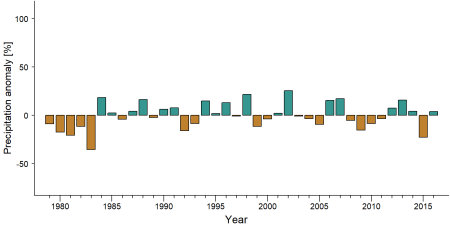
As part of a study on the exposure of African great ape sites to climate change impacts, Kiribou et al. subm. extracted climate data and data on projected extreme climate impact events for the site. Climatological characteristics were derived from observation-based climate data provided by the Inter-Sectoral Impact Model Intercomparison Project (ISIMIP, www.isimip.org). Parameters were calculated as the average across each 30-year period. For 1981-2010, the EWEMBI dataset from ISIMIP2a was used. For the two future periods (2021-2050 and 2071-2099) ISIMIP2b climate data based on four CMIP5 global climate models were used. For future projections, two Representative Concentration Pathways (RCP) were used. RCP 2.6 is a scenario with strong mitigation measures in which global temperatures would likely rise below 2C. RCP 6.0 is a scenario with medium emissions in which global temperatures would likely rise up to 3C by 2100. For the number of days with heavy precipitation events, the 98th percentile of all precipitation days (>1mm/d) was calculated for the 1979-2013 reference period as a threshold for a heavy precipitation event. Then, for each year, the number of days above that threshold was derived. The figures on temperature and precipitation anomaly show the deviation from the mean temperature and mean precipitation for the 1979-2013 reference period.
The estimated exposure to future extreme climate impact events (crop failure, drought, river flood, wildfire, tropical cyclone, and heatwave) is based on a published dataset by Lange et al. 2020 derived from ISIMIP2b data. The same global climate models and RCPs as described above were used. Within each 30-year period, the number of years with an extreme event and the average proportion of the site affected were calculated (see Kiribou et al. subm. for details).
Table 8. Estimated past and projected climatological characteristics in Monte Alén National Park
| Value | 1981-2010 | 2021-2050, RCP 2.6 | 2021-2050, RCP 6.0 | 2071-2099, RCP 2.6 | 2071-2099, RCP 6.0 |
|---|---|---|---|---|---|
| Mean temperature [C] | 24.1 | 25.2 | 25.1 | 25.3 | 26.4 |
| Annual precipitation [mm] | 3229 | 3314 | 3289 | 3382 | 3341 |
| Max no. consecutive dry days (per year) | 17.9 | 7.6 | 6.7 | 7.2 | 6.7 |
| No. days with heavy precipitation (per year) | 6.4 | 11.3 | 10.6 | 11.3 | 12.6 |
Table 9. Projected exposure of apes to extreme climate impact events in Monte Alén National Park
| Type | No. of years with event (2021-2050, RCP 2.6) | % of site exposed (2021-2050, RCP 2.6) | No. of years with event (2021-2050, RCP 6.0) | % of site exposed (2021-2050, RCP 6.0) | No. of years with event (2070-2099, RCP 2.6) | % of site exposed (2070-2099, RCP 2.6) | No. of years with event (2070-2099, RCP 6.0) | % of site exposed (2070-2099, RCP 6.0) |
|---|---|---|---|---|---|---|---|---|
| Crop failure | 1.5 | 0 | 1 | 0 | 1.5 | 0 | 6 | 0 |
| Drought | 0 | 0 | 0 | 0 | 0 | 0 | 0 | 0 |
| Heatwave | 0 | 0 | 0 | 0 | 1 | 50 | 2.5 | 50 |
| River flood | 1.25 | 1.15 | 1 | 1.33 | 1 | 1.26 | 3 | 1.54 |
| Tropical cyclone | 0 | 0 | 0 | 0 | 0 | 0 | 0 | 0 |
| Wildfire | 26.5 | 0.12 | 25.25 | 0.1 | 25.75 | 0.12 | 26.5 | 0.12 |
-
Precipitation anomaly in Monte Alén National Park -
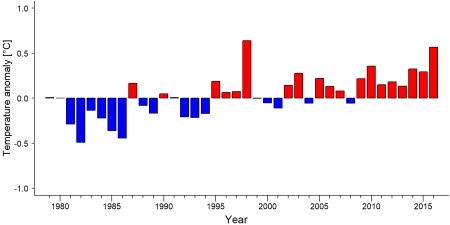
Temperature anomaly in Monte Alén National Park


External links
References
BirdLife International. (2020). Important Bird Areas factsheet: Monte Alen National Park. Downloaded from http://www.birdlife.org on 10/12/2020.
Garcia, J. E., & Mba, J. (1997). Distribution, status and conservation of primates in Monte Alen National Park, equatorial Guinea. Oryx, 31(1), 67-76.
Kenfack, C.E. (2014). El paisaje del Monte Alén /Montes de Cristal. CIFOR report, retrieved from: https://www.cifor.org/publications/pdf_files/brief/4507-brief.pdf
Key Biodiversity Areas Partnership (2025) Key Biodiversity Areas factsheet: Monte Alen National Park. Extracted from the World Database of Key Biodiversity Areas. Developed by the Key Biodiversity Areas Partnership: BirdLife International, IUCN, American Bird Conservancy, Amphibian Survival Alliance, Conservation International, Critical Ecosystem Partnership Fund, Global Environment Facility, Re:wild, NatureServe, Rainforest Trust, Royal Society for the Protection of Birds, World Wildlife Fund and Wildlife Conservation Society. Downloaded from https://keybiodiversityareas.org/ on Nov 14, 2025.
McLaughlin, P., McCabe, G., & Fernández, D. (2020, June). A long-term monitoring programme for great apes in Monte Alén National Park. Gorilla Journal, (60), 20–22. Retrieved from https://www.berggorilla.org/en/gorillas/species/western-gorillas/articles-western-gorillas/a-long-term-monitoring-programme-for-great-apes-in-monte-alen-national-park/
Miles, J. O. C. L., & Annan, K. (2005). World atlas of great apes and their conservation. Univ of California Press.
Murai M, Ruffler H, Berlemont A, Campbell G, Esono F, Agbor A, et al. (2013). Priority Areas for Large Mammal Conservation in Equatorial Guinea. PLoS ONE 8(9): e75024. https://doi.org/10.1371/journal.pone.0075024
Sunderland, T. C. H. (2005). A biodiversity assessment of the Monte Mitra forest, Monte Alén National Park, Equatorial Guinea. Washington, D. C.: Smithsonian Institution Press.
Page created by: Regina Nchama Okenve & APES Atlas Team Date: 2020-12-29