
Moyen-Bafing National Park: Difference between revisions
No edit summary |
No edit summary |
||
| (4 intermediate revisions by the same user not shown) | |||
| Line 17: | Line 17: | ||
= Site characteristics = | = Site characteristics = | ||
Moyen-Bafing National Park (MBNP) is a protected area in its final stages of official designation in Northern Guinea. The site covers an area of 6426 km² and is located around the Bafing river close to the border with Mali (WCF 2017a). The national park encompasses seven classified forests: Bakoum, Bakoun (since 1951, 295.07 km2), Bani (since 1952, 189 km2), Boula (since 1955, 275 km2), Dar-Es-Salam (also Darou-salam, since 1954, 174.74 km²), Dokoro (since 1952, 78 km2) and Sobory (since 1956, 11.75 km2, WCF 2016, UNEP-WCMC & IUCN 2019). | Moyen-Bafing National Park (MBNP) is a protected area in its final stages of official designation in Northern Guinea. The site covers an area of 6426 km² and is located around the Bafing river close to the border with Mali ([[#R01335|WCF 2017a]]). The national park encompasses seven classified forests: Bakoum, Bakoun (since 1951, 295.07 km2), Bani (since 1952, 189 km2), Boula (since 1955, 275 km2), Dar-Es-Salam (also Darou-salam, since 1954, 174.74 km²), Dokoro (since 1952, 78 km2) and Sobory (since 1956, 11.75 km2, [[#R01334|WCF 2016]], [[#R01330|UNEP-WCMC & IUCN 2019]]). | ||
Moyen-Bafing NP is created to meet the aim of the Government of Guinea to designate 25% of its terrestrial area as protected areas and it covers 8% of Guinea’s terrestrial territory (WCF 2017b). The main aim of this site is to offset the negative effects that bauxite mines run by the Guinea Alumina Corporation (GAC) and the | Moyen-Bafing NP is created to meet the aim of the Government of Guinea to designate 25% of its terrestrial area as protected areas and it covers 8% of Guinea’s terrestrial territory ([[#R01336|WCF 2017b]]). The main aim of this site is to offset the negative effects that bauxite mines run by the Guinea Alumina Corporation (GAC) and the | ||
Compagnie de Bauxite de Guinée (CBG) have on western chimpanzees in Sangaredi. Its designation has been mandated by the Guinean Ministry of Environment, Water and Forests in 2015, and park creation is implemented by the Guinean Office of Parks and Reserves (OGUIPAR) and the [https://www.wildchimps.org Wild Chimpanzee Foundation] (WCF 2018). The design of the national park includes several zones with different degree of anthropogenic usage: a core area incorporating all seven classified forests, a buffer area in which only sustainable activities may be conducted, and a zone called ‘development zone’ (WCF 2015). | Compagnie de Bauxite de Guinée (CBG) have on western chimpanzees in Sangaredi. Its designation has been mandated by the Guinean Ministry of Environment, Water and Forests in 2015, and park creation is implemented by the Guinean Office of Parks and Reserves (OGUIPAR) and the [https://www.wildchimps.org Wild Chimpanzee Foundation] ([[#R01337|WCF 2018]]). The design of the national park includes several zones with different degree of anthropogenic usage: a core area incorporating all seven classified forests, a buffer area in which only sustainable activities may be conducted, and a zone called ‘development zone’ ([[#R01333|WCF 2015]]). | ||
The Moyen-Bafing NP covers different habitat types: wooded and herbaceous savanna, gallery forests, bamboo forests, wooded grasslands, bowé, wetlands and rivers (WCF 2016, 2018). The area is also characterized by a high biodiversity with at least 33 different mammal species, including leopard (''Panthera pardus''), lion (''Panthera lion''), golden cat (''Caracal aurata''), hippopotamus (''Hippopotamus amphibius''), black-and-white colobus (''Colobus polykomos''), crested porcepine (''Hystrix cristata''), bay duiker (''Cephalophus dorsalis''), yellow-back duiker (''Cephalophus sylvicultur''), Guinean baboon (''Papio papio''), and bongo (''Tragelaphus eurycerus'', WCF 2016, 2017b). Surveys also confirmed the presence of a species new to the region, the Gambian mongoose (''Mungos gambianus'', WCF 2018). The forests of Bani and Dar-es-Salam are important areas for antelopes as they harbor the second highest diversity in antelope species across Guinea (Brugière 2012). An ornithological survey confirmed the presence of 147 bird species, including Scavenger Vulture (''Necrosyrtes monachus''), African Vulture (''Gyps africanus'') and Rüppell Vulture (''Gyps rueppellii''). A botanical survey found 206 plant species, 14 of which listed as threatened, and two plant species were new to science (WCF 2018). | The Moyen-Bafing NP covers different habitat types: wooded and herbaceous savanna, gallery forests, bamboo forests, wooded grasslands, bowé, wetlands and rivers ([[#R01334|WCF 2016]], 2018). The area is also characterized by a high biodiversity with at least 33 different mammal species, including leopard (''Panthera pardus''), lion (''Panthera lion''), golden cat (''Caracal aurata''), hippopotamus (''Hippopotamus amphibius''), black-and-white colobus (''Colobus polykomos''), crested porcepine (''Hystrix cristata''), bay duiker (''Cephalophus dorsalis''), yellow-back duiker (''Cephalophus sylvicultur''), Guinean baboon (''Papio papio''), and bongo (''Tragelaphus eurycerus'', [[#R01334|WCF 2016]], 2017b). Surveys also confirmed the presence of a species new to the region, the Gambian mongoose (''Mungos gambianus'', [[#R01337|WCF 2018]]). The forests of Bani and Dar-es-Salam are important areas for antelopes as they harbor the second highest diversity in antelope species across Guinea ([[#R01320|Brugière 2012]]). An ornithological survey confirmed the presence of 147 bird species, including Scavenger Vulture (''Necrosyrtes monachus''), African Vulture (''Gyps africanus'') and Rüppell Vulture (''Gyps rueppellii''). A botanical survey found 206 plant species, 14 of which listed as threatened, and two plant species were new to science ([[#R01337|WCF 2018]]). | ||
A study on the protected area network that ranked the most important Key Biodiversity Areas of Guinea based on the occurrence of globally threatened large and medium-sized mammals, ranked Bakoun Classified Forest as rank six and the forests of Bani and Dar-es-Salam on rank 12 (Brugière & Kormos 2009). | A study on the protected area network that ranked the most important Key Biodiversity Areas of Guinea based on the occurrence of globally threatened large and medium-sized mammals, ranked Bakoun Classified Forest as rank six and the forests of Bani and Dar-es-Salam on rank 12 ([[#R01319|Brugière & Kormos 2009]]). | ||
'''Table 1. Basic site information for Moyen-Bafing National Park''' | '''Table 1. Basic site information for Moyen-Bafing National Park''' | ||
| Line 52: | Line 52: | ||
= Ape status = | = Ape status = | ||
In a nationwide survey Rebecca Kormos confirmed the presence of western chimpanzees in Bakoun Classified Forest based on a questionnaire survey (Ham 1998). This was confirmed by a survey conducted in 2001 (Catterson et al. 2001). Chimpanzee presence was confirmed in the classified forests of Boula and Dokoro (Granier and Martinez 2002). In 2013/14 the Wild Chimpanzee Foundation (WCF) conducted detailed surveys of the area along the Bafing river and estimated that more than 5,000 chimpanzees occur in an area of approximately 8,000 km2 (WCF 2014). Chimpanzee densities were highest in the classified forests (WCF 2014). High chimpanzee densities were confirmed by a follow-up survey in 2015/16 by the WCF (WCF 2016). Since 2017, the WCF implements a biomonitoring study with camera traps (WCF 2017b). | In a nationwide survey Rebecca Kormos confirmed the presence of western chimpanzees in Bakoun Classified Forest based on a questionnaire survey ([[#R01324|Ham 1998]]). This was confirmed by a survey conducted in 2001 ([[#R01321|Catterson et al. 2001]]). Chimpanzee presence was confirmed in the classified forests of Boula and Dokoro (Granier and Martinez 2002). In 2013/14 the Wild Chimpanzee Foundation (WCF) conducted detailed surveys of the area along the Bafing river and estimated that more than 5,000 chimpanzees occur in an area of approximately 8,000 km2 ([[#R01332|WCF 2014]]). Chimpanzee densities were highest in the classified forests ([[#R01332|WCF 2014]]). High chimpanzee densities were confirmed by a follow-up survey in 2015/16 by the WCF ([[#R01334|WCF 2016]]). Since 2017, the WCF implements a biomonitoring study with camera traps ([[#R01336|WCF 2017b]]). | ||
'''Table 2. Ape population estimates reported for Moyen-Bafing National Park''' | '''Table 2. Ape population estimates reported for Moyen-Bafing National Park''' | ||
| Line 78: | Line 78: | ||
|Camera trap | |Camera trap | ||
| | | | ||
|WCF 2024 | |[[#R01338|WCF 2024]] | ||
| | | | ||
| | | | ||
| Line 91: | Line 91: | ||
|Camera trap | |Camera trap | ||
| | | | ||
|WCF 2024 | |[[#R01338|WCF 2024]] | ||
| | | | ||
| | | | ||
| Line 104: | Line 104: | ||
|Camera trap | |Camera trap | ||
| | | | ||
|Debetencourt et al. 2024 | |[[#R01322|Debetencourt et al. 2024]] | ||
| | | | ||
| | | | ||
| Line 117: | Line 117: | ||
|Camera trap | |Camera trap | ||
| | | | ||
|Debetencourt et al. 2024 | |[[#R01322|Debetencourt et al. 2024]] | ||
|The provided density estimate of 2.52 individuals/km² applies only to Bakoun (specifically group Bakoun 4). Because, its home range was least likely to extend beyond the camera grid. | |The provided density estimate of 2.52 individuals/km² applies only to Bakoun (specifically group Bakoun 4). Because, its home range was least likely to extend beyond the camera grid. | ||
| | | | ||
| Line 130: | Line 130: | ||
|Line transects | |Line transects | ||
| | | | ||
|WCF 2016 | |[[#R01334|WCF 2016]] | ||
| | | | ||
| | | | ||
| Line 143: | Line 143: | ||
|Line transects | |Line transects | ||
| | | | ||
|WCF 2014 | |[[#R01332|WCF 2014]] | ||
| | | | ||
| | | | ||
| Line 156: | Line 156: | ||
|Reconnaissance walk | |Reconnaissance walk | ||
| | | | ||
|Granier & Martinez 2004 | |[[#R01323|Granier & Martinez 2004]] | ||
|Reconnaissance survey | |Reconnaissance survey | ||
| | |MLI0001, MLI0004 | ||
|- | |- | ||
|''Pan troglodytes verus'' | |''Pan troglodytes verus'' | ||
| Line 169: | Line 169: | ||
|Reconnaissance walk | |Reconnaissance walk | ||
| | | | ||
|Catterson et al. 2001 | |[[#R01321|Catterson et al. 2001]] | ||
|Reconnaissance survey | |Reconnaissance survey | ||
| | | | ||
| Line 182: | Line 182: | ||
|Interviews | |Interviews | ||
| | | | ||
|Ham 1998 | |[[#R01324|Ham 1998]] | ||
|Questionnaire survey | |Questionnaire survey | ||
| | |GIN0019, GIN0021 | ||
|} | |} | ||
| Line 191: | Line 191: | ||
= Threats = | = Threats = | ||
A detailed demographic survey conducted by the WCF in 2016 found that 405 villages are located in Moyen-Bafing NP. 23 of those villages are in classified forests, 11 of which are not legally recognized (WCF 2016). Overall, human densities are low with 9.54 inhabitants per km² as 70% of the villages have less than 150 inhabitants (WCF 2016). People use the area for agriculture and hunting wildlife. Bush-fires for clearing agricultural areas are very prominent threats to ecosystems (WCF 2016). Further threats include overgrazing, poor agricultural methods, soil erosion, and overfishing (Bakarr 2001, WCF 2016, 2017b, 2018). Excessive deforestation and uncontrolled bush-fires reinforce negative effects of climatic changes, such as reduced rainfall, drought and dried up rivers (WCF 2016). In addition, a hydraulic dam is planned to be constructed upstream on the Bafing river, the Koukoutamba dam project lead by the Senegal River Basin Development Authority (OMVS:Organisation pour la Mise en Valeur du fleuve Sénégal), which could threaten 750 chimpanzee due to the permanent flooding of areas in the Moyen-Bafing NP (WCF 2016). There are also mining concessions by the Société Bauxite de Dabola-Tougué Corporation (SBDT) that encompass two classified forests in the southern part of Moyen-Bafing NP and if developed could threaten an estimated 1300 chimpanzees (WCF 2016). | A detailed demographic survey conducted by the [[#R01334|WCF in 2016]] found that 405 villages are located in Moyen-Bafing NP. 23 of those villages are in classified forests, 11 of which are not legally recognized ([[#R01334|WCF 2016]]). Overall, human densities are low with 9.54 inhabitants per km² as 70% of the villages have less than 150 inhabitants ([[#R01334|WCF 2016]]). People use the area for agriculture and hunting wildlife. Bush-fires for clearing agricultural areas are very prominent threats to ecosystems ([[#R01334|WCF 2016]]). Further threats include overgrazing, poor agricultural methods, soil erosion, and overfishing ([[#R01316|Bakarr 2001]], [[#R01334|WCF 2016]], 2017b, 2018). Excessive deforestation and uncontrolled bush-fires reinforce negative effects of climatic changes, such as reduced rainfall, drought and dried up rivers ([[#R01334|WCF 2016]]). In addition, a hydraulic dam is planned to be constructed upstream on the Bafing river, the Koukoutamba dam project lead by the Senegal River Basin Development Authority (OMVS:Organisation pour la Mise en Valeur du fleuve Sénégal), which could threaten 750 chimpanzee due to the permanent flooding of areas in the Moyen-Bafing NP ([[#R01334|WCF 2016]]). There are also mining concessions by the Société Bauxite de Dabola-Tougué Corporation (SBDT) that encompass two classified forests in the southern part of Moyen-Bafing NP and if developed could threaten an estimated 1300 chimpanzees ([[#R01334|WCF 2016]]). | ||
The area is very isolated so that people lack access to basic public services such as education, health, sanitation and drinking water (WCD 2018). Consequently, the local population relies strongly on the provision of ecosystem services and is involved in activities further damaging the local ecosystem, such as deforestation or bushfires (WCF 2018). Access to water is further limited by the effects of climate change resulting in a decrease of rainfall and the drying up of rivers (WCF 2018). | The area is very isolated so that people lack access to basic public services such as education, health, sanitation and drinking water (WCD 2018). Consequently, the local population relies strongly on the provision of ecosystem services and is involved in activities further damaging the local ecosystem, such as deforestation or bushfires ([[#R01337|WCF 2018]]). Access to water is further limited by the effects of climate change resulting in a decrease of rainfall and the drying up of rivers ([[#R01337|WCF 2018]]). | ||
'''Table 3. Threats to apes reported for Moyen-Bafing National Park''' | '''Table 3. Threats to apes reported for Moyen-Bafing National Park''' | ||
| Line 206: | Line 206: | ||
|1.1 Residential areas | |1.1 Residential areas | ||
|Medium (30-70% of population affected) | |Medium (30-70% of population affected) | ||
|405 villages (WCF 2016). As part of efforts to identify areas with high densities of the critically endangered western chimpanzee, the WCF and OGPNRF highlighted a site in Guinea’s Foutah Djallon region that supports a particularly large population (WCF 2016, Heinicke et al. 2019). Despite the presence of numerous villages within its boundaries, this area was selected to be designated as a national park (WCF 2024). | |405 villages ([[#R01334|WCF 2016]]). As part of efforts to identify areas with high densities of the critically endangered western chimpanzee, the WCF and OGPNRF highlighted a site in Guinea’s Foutah Djallon region that supports a particularly large population ([[#R01334|WCF 2016]], [[#R02094|Heinicke et al. 2019]]). Despite the presence of numerous villages within its boundaries, this area was selected to be designated as a national park ([[#R01338|WCF 2024]]). | ||
|2016-Ongoing (2024) | |2016-Ongoing (2024) | ||
|- | |- | ||
| Line 212: | Line 212: | ||
|11.2 Droughts | |11.2 Droughts | ||
|Present (unknown severity) | |Present (unknown severity) | ||
|Reduced rainfall, drought, and dried up rivers increase the pressure on chimpanzee habitat as more habitat is converted for human uses (WCF 2016). | |Reduced rainfall, drought, and dried up rivers increase the pressure on chimpanzee habitat as more habitat is converted for human uses ([[#R01334|WCF 2016]]). | ||
|Ongoing (2016) | |Ongoing (2016) | ||
|- | |- | ||
| Line 218: | Line 218: | ||
|2.1 Annual & perennial non-timber crops | |2.1 Annual & perennial non-timber crops | ||
|Medium (30-70% of population affected) | |Medium (30-70% of population affected) | ||
|Agricultural activities widespread (Bakarr et al. 2001; WCF 2016). In 2023, patrols revealed that agriculture was the leading category of infraction (Regnaut S. pers. comm. 2026). | |Agricultural activities widespread ([[#R01316|Bakarr et al. 2001]]; [[#R01334|WCF 2016]]). In 2023, patrols revealed that agriculture was the leading category of infraction (Regnaut S. pers. comm. 2026). | ||
|2001-Ongoing (2023) | |2001-Ongoing (2023) | ||
|- | |- | ||
| Line 224: | Line 224: | ||
|2.3 Livestock farming & ranching | |2.3 Livestock farming & ranching | ||
|Medium (30-70% of population affected) | |Medium (30-70% of population affected) | ||
|Area used for grazing livestock (Bakarr et al. 2001; WCF 2016). In 2023, patrols revealed that livestock farming second to agriculture were the leading categories of infraction (Regnaut S. pers. comm. 2026). | |Area used for grazing livestock ([[#R01316|Bakarr et al. 2001]]; [[#R01334|WCF 2016]]). In 2023, patrols revealed that livestock farming second to agriculture were the leading categories of infraction (Regnaut S. pers. comm. 2026). | ||
|2001-Ongoing (2023) | |2001-Ongoing (2023) | ||
|- | |- | ||
| Line 230: | Line 230: | ||
|3.2 Mining & quarrying | |3.2 Mining & quarrying | ||
|Present (unknown severity) | |Present (unknown severity) | ||
|Two mining concessions but not active (WCF 2016). Bauxite mining within and adjacent to the park could threatened affect 1,300 chimpanzees and severely degrade their habitat (O’Mahony 2019). Mining devastates everything in its way, from forests to wildlife and their habitats. Chimpanzees, and other primate species, are especially at risk from these operations (Sylla 2025). | |Two mining concessions but not active ([[#R01334|WCF 2016]]). Bauxite mining within and adjacent to the park could threatened affect 1,300 chimpanzees and severely degrade their habitat ([[#R01327|O’Mahony 2019]]). Mining devastates everything in its way, from forests to wildlife and their habitats. Chimpanzees, and other primate species, are especially at risk from these operations ([[#R01329|Sylla 2025]]). | ||
|2016-Ongoing (2025) | |2016-Ongoing (2025) | ||
|- | |- | ||
| Line 236: | Line 236: | ||
|5.1 Hunting & collecting terrestrial animals | |5.1 Hunting & collecting terrestrial animals | ||
|Medium (30-70% of population affected) | |Medium (30-70% of population affected) | ||
|Hunting occurs, but hunting taboos also widespread (Bakarr et al. 2001, Boesch et al. 2017, WCF 2016, WCF 2024). | |Hunting occurs, but hunting taboos also widespread ([[#R01316|Bakarr et al. 2001]], [[#R01318|Boesch et al. 2017]], [[#R01334|WCF 2016]], [[#R01338|WCF 2024]]). | ||
|2017-Ongoing (2024) | |2017-Ongoing (2024) | ||
|- | |- | ||
| Line 248: | Line 248: | ||
|5.3 Logging & wood harvesting | |5.3 Logging & wood harvesting | ||
|High (more than 70% of population affected) | |High (more than 70% of population affected) | ||
|Deforestation reinforces negative impacts of climate change (WCF 2016). On average, 27.4 ha of forest cover has been lost every year due to constant pressure between 2015 and 2023 (WCF 2024). During the patrols carried out in 2024, illegal logging activities were the most documented infraction, with 42 cases (Regnaut S. pers. comm. 2026). | |Deforestation reinforces negative impacts of climate change ([[#R01334|WCF 2016]]). On average, 27.4 ha of forest cover has been lost every year due to constant pressure between 2015 and 2023 ([[#R01338|WCF 2024]]). During the patrols carried out in 2024, illegal logging activities were the most documented infraction, with 42 cases (Regnaut S. pers. comm. 2026). | ||
|2015-Ongoing (2024) | |2015-Ongoing (2024) | ||
|- | |- | ||
| Line 254: | Line 254: | ||
|7.1 Fire & fire suppression | |7.1 Fire & fire suppression | ||
|High (more than 70% of population affected) | |High (more than 70% of population affected) | ||
|Bush fires for clearing agricultural land (WCF 2016). Uncontrolled bushfires represent the primary threat to habitat in the MBNP, impacting both gallery forests and open woodland areas (Regnaut S. pers. comm. 2026). | |Bush fires for clearing agricultural land ([[#R01334|WCF 2016]]). Uncontrolled bushfires represent the primary threat to habitat in the MBNP, impacting both gallery forests and open woodland areas (Regnaut S. pers. comm. 2026). | ||
|2016-Ongoing (2026) | |2016-Ongoing (2026) | ||
|} | |} | ||
| Line 262: | Line 262: | ||
= Conservation activities = | = Conservation activities = | ||
As part of the project “Projet de Conservation de Chimpanzés” local hunters were trained in 2001 to collect monitoring data on the number and movement of chimpanzees in Bakoun Classified Forest (Kormos et al. 2003). Since 2014, the WCF is implementing different environmental awareness raising activities, often focused on the protection of western chimpanzees, including radio and TV broadcasts, an extracurricular environmental education program at schools (Club P.A.N. program), and theater awareness raising campaigns in several villages with discussion rounds (WCF 2014, 2015, 2016, 2017b, 2018). To counteract the negative effects of deforestation the WCF started a plant nursery in 2016 and the first reforestation project has been launched in 2018 covering 4.34 ha (WCF 2016, WCF 2018). Since 2018, the WCF implements bushfire prevention activities such as cutting fire breaks [WCF 2018]. | As part of the project “Projet de Conservation de Chimpanzés” local hunters were trained in 2001 to collect monitoring data on the number and movement of chimpanzees in Bakoun Classified Forest ([[#R01328|Kormos et al. 2003]]). Since 2014, the WCF is implementing different environmental awareness raising activities, often focused on the protection of western chimpanzees, including radio and TV broadcasts, an extracurricular environmental education program at schools (Club P.A.N. program), and theater awareness raising campaigns in several villages with discussion rounds ([[#R01332|WCF 2014]], 2015, 2016, 2017b, 2018). To counteract the negative effects of deforestation the [[#R01334|WCF started a plant nursery in 2016]] and the first reforestation project has been launched in 2018 covering 4.34 ha ([[#R01334|WCF 2016]], [[#R01337|WCF 2018]]). Since 2018, the WCF implements bushfire prevention activities such as cutting fire breaks [WCF 2018]. | ||
The design of the national park includes several zones with different degree of anthropogenic usage: a fully protected core area incorporating all seven classified forests, a buffer zone in which only sustainable activities may be conducted, and a zone called ‘development zone’ (WCF 2015). The process of park creation involves regular community consultation meetings to understand people’s need and an environmental and social management plan was drafted (WCF 2016, WCF 2017b). As water shortage is a serious concern in the area, the WCF is implementing a monitoring study focused on water levels of the rivers, to inform measures that can improve water security for the human population and for the flora and fauna (WCF 2017b). | The design of the national park includes several zones with different degree of anthropogenic usage: a fully protected core area incorporating all seven classified forests, a buffer zone in which only sustainable activities may be conducted, and a zone called ‘development zone’ ([[#R01333|WCF 2015]]). The process of park creation involves regular community consultation meetings to understand people’s need and an environmental and social management plan was drafted ([[#R01334|WCF 2016]], [[#R01336|WCF 2017b]]). As water shortage is a serious concern in the area, the WCF is implementing a monitoring study focused on water levels of the rivers, to inform measures that can improve water security for the human population and for the flora and fauna ([[#R01336|WCF 2017b]]). | ||
Conservation intervations in the MBNP have been ongoing since 2017, first managed in partnership with the Wild Chimpanzee Foundation (WCF). From January 2024, responsibility transitioned to a reorganized MBOP team, with administrative support provided by LBS Trust Africa. The programme is structured around five core objectives: safeguarding park integrity through surveillance, managing fire and restoring habitat, engaging communities and supporting livelihoods, promoting environmental education, and strengthening governance (Regnaut S. pers. comm. 2026). | Conservation intervations in the MBNP have been ongoing since 2017, first managed in partnership with the Wild Chimpanzee Foundation (WCF). From January 2024, responsibility transitioned to a reorganized MBOP team, with administrative support provided by LBS Trust Africa. The programme is structured around five core objectives: safeguarding park integrity through surveillance, managing fire and restoring habitat, engaging communities and supporting livelihoods, promoting environmental education, and strengthening governance (Regnaut S. pers. comm. 2026). | ||
| Line 278: | Line 278: | ||
|1 Development impact mitigation | |1 Development impact mitigation | ||
|1.4 Farm more intensively and effectively in selected areas and spare more natural land | |1.4 Farm more intensively and effectively in selected areas and spare more natural land | ||
|Introduced Farmer Managed Natural Regeneration to support environmentally friendly and sustainable agricultural practices, support market gardens (WCF 2018) | |Introduced Farmer Managed Natural Regeneration to support environmentally friendly and sustainable agricultural practices, support market gardens ([[#R01337|WCF 2018]]) | ||
| | | | ||
|Ongoing (2018) | |Ongoing (2018) | ||
| Line 296: | Line 296: | ||
|4 Education & awareness | |4 Education & awareness | ||
|4.1 Educate local communities about apes and sustainable use | |4.1 Educate local communities about apes and sustainable use | ||
|Different environmental awareness raising activities implemented (WCF 2014, 2015, 2016, 2017b, 2018, 2024). The Club PAN programme, launched during the early stages of WCF’s involvement, now operates in more than 15 schools across the park area, where it educates children on biodiversity, chimpanzee conservation, and sustainable resource use (Regnaut S. pers. comm. 2026). | |Different environmental awareness raising activities implemented ([[#R01332|WCF 2014]], 2015, 2016, 2017b, 2018, 2024). The Club PAN programme, launched during the early stages of WCF’s involvement, now operates in more than 15 schools across the park area, where it educates children on biodiversity, chimpanzee conservation, and sustainable resource use (Regnaut S. pers. comm. 2026). | ||
|Wild Chimpanzee Foundation (WCF) | |Wild Chimpanzee Foundation (WCF) | ||
|2014-Ongoing (2026) | |2014-Ongoing (2026) | ||
| Line 302: | Line 302: | ||
|4 Education & awareness | |4 Education & awareness | ||
|4.2 Involve local community in ape research and conservation management | |4.2 Involve local community in ape research and conservation management | ||
|Community-based monitoring system of chimpanzees implemented (Kormos et al. 2013). In addition, Local communities are also involved in conservation programs by supporting the establishment of co-management structures (WCF 2024, Regnaut S. pers. comm. 2025). | |Community-based monitoring system of chimpanzees implemented (Kormos et al. 2013). In addition, Local communities are also involved in conservation programs by supporting the establishment of co-management structures ([[#R01338|WCF 2024]], Regnaut S. pers. comm. 2025). | ||
|Wild Chimpanzee Foundation (WCF) | |Wild Chimpanzee Foundation (WCF) | ||
|2001-Ongoing (2025) | |2001-Ongoing (2025) | ||
| Line 308: | Line 308: | ||
|4 Education & awareness | |4 Education & awareness | ||
|4.4 Regularly play TV and radio announcements to raise ape conservation awareness | |4.4 Regularly play TV and radio announcements to raise ape conservation awareness | ||
|Radio and TV shows used to raise environmental awareness (WCF 2014, 2015, 2016, 2017b, 2018) | |Radio and TV shows used to raise environmental awareness ([[#R01332|WCF 2014]], 2015, 2016, 2017b, 2018) | ||
| | | | ||
|2014-Ongoing (2018) | |2014-Ongoing (2018) | ||
| Line 314: | Line 314: | ||
|4 Education & awareness | |4 Education & awareness | ||
|4.5 Implement multimedia campaigns using theatre, film, print media, discussions | |4.5 Implement multimedia campaigns using theatre, film, print media, discussions | ||
|Environmental awareness raising activities include theater plays, discussion rounds and extra-curricular school activities (WCF 2014, 2015, 2016, 2017b, 2018) | |Environmental awareness raising activities include theater plays, discussion rounds and extra-curricular school activities ([[#R01332|WCF 2014]], 2015, 2016, 2017b, 2018) | ||
| | | | ||
|2014-Ongoing (2018) | |2014-Ongoing (2018) | ||
| Line 320: | Line 320: | ||
|5 Protection & restoration | |5 Protection & restoration | ||
|5.1 Create buffer zones around protected ape habitat | |5.1 Create buffer zones around protected ape habitat | ||
|Design of national park includes a core area, a buffer area for sustainable activities only and a so-called area for development (WCF 2015) | |Design of national park includes a core area, a buffer area for sustainable activities only and a so-called area for development ([[#R01333|WCF 2015]]) | ||
| | | | ||
|Ongoing (2015) | |Ongoing (2015) | ||
| Line 326: | Line 326: | ||
|5 Protection & restoration | |5 Protection & restoration | ||
|5.11 Protect important food/nest trees before burning | |5.11 Protect important food/nest trees before burning | ||
|Bushfire prevention activities such as cutting fire breaks (WCF 2018) | |Bushfire prevention activities such as cutting fire breaks ([[#R01337|WCF 2018]]) | ||
| | | | ||
|Ongoing (2018) | |Ongoing (2018) | ||
| Line 332: | Line 332: | ||
|5 Protection & restoration | |5 Protection & restoration | ||
|5.2 Legally protect ape habitat | |5.2 Legally protect ape habitat | ||
|Seven classified forests and a national park were in the process of being created (WCF 2015, UNEP-WCMC and IUCN 2019). Eventually, in 2021, Moyen-Bafing National Park was officially established and has remained in existence to this day [(https://www.wildchimps.org/news.html Wild Chimpanzee Foundation)]. | |Seven classified forests and a national park were in the process of being created ([[#R01333|WCF 2015]], [[#R01330|UNEP-WCMC and IUCN 2019]]). Eventually, in 2021, Moyen-Bafing National Park was officially established and has remained in existence to this day [(https://www.wildchimps.org/news.html Wild Chimpanzee Foundation)]. | ||
|Wild Chimpanzee Foundation (WCF), Office Guinéen des Parcs Nationaux et Réserves de Faune (OGPNRF) | |Wild Chimpanzee Foundation (WCF), Office Guinéen des Parcs Nationaux et Réserves de Faune (OGPNRF) | ||
|1952-Ongoing (2026) | |1952-Ongoing (2026) | ||
| Line 338: | Line 338: | ||
|5 Protection & restoration | |5 Protection & restoration | ||
|5.6 Habitat restoration | |5.6 Habitat restoration | ||
|Plant nursery and reforestation activities (WCF 2016, 2017b, 2018). Forest restoration and wildfire control activities have been reported at the site to create conditions that support the necessary increase in chimpanzee populations (WCF 2024, Regnaut S. pers. comm. 2026). | |Plant nursery and reforestation activities ([[#R01334|WCF 2016]], 2017b, 2018). Forest restoration and wildfire control activities have been reported at the site to create conditions that support the necessary increase in chimpanzee populations ([[#R01338|WCF 2024]], Regnaut S. pers. comm. 2026). | ||
|Wild Chimpanzee Foundation (WCF) | |Wild Chimpanzee Foundation (WCF) | ||
|2016-Ongoing (2026) | |2016-Ongoing (2026) | ||
| Line 350: | Line 350: | ||
|7 Economic & other incentives | |7 Economic & other incentives | ||
|7.2 Provide non-monetary benefits to local communities for sustainably managing their forest and its wildlife (e.g., better education, infrastructure development) | |7.2 Provide non-monetary benefits to local communities for sustainably managing their forest and its wildlife (e.g., better education, infrastructure development) | ||
|Hydrology study implemented by WCF (WCF 2017b). Local communities are supported in developing new income sources, such as selling local products; they are also provided with general education and life skills, supported in managing their own forests, and offered non-cash compensation, such as the construction of a new well if the previous one was used by great apes (Regnaut S. pers. comm. 2025). | |Hydrology study implemented by WCF ([[#R01336|WCF 2017b]]). Local communities are supported in developing new income sources, such as selling local products; they are also provided with general education and life skills, supported in managing their own forests, and offered non-cash compensation, such as the construction of a new well if the previous one was used by great apes (Regnaut S. pers. comm. 2025). | ||
| | | | ||
|2017-Ongoing (2025) | |2017-Ongoing (2025) | ||
| Line 375: | Line 375: | ||
|3 Engaged community | |3 Engaged community | ||
|3.1 General lack of community engagement or support | |3.1 General lack of community engagement or support | ||
|WCF 2024 | |[[#R01338|WCF 2024]] | ||
|Ongoing (2024) | |Ongoing (2024) | ||
|- | |- | ||
|5 Ecological context | |5 Ecological context | ||
|5.1 Ecological constraints (e.g., susceptibility to climate change, difficult terrain) | |5.1 Ecological constraints (e.g., susceptibility to climate change, difficult terrain) | ||
|WCF 2024 | |[[#R01338|WCF 2024]] | ||
|Ongoing (2024) | |Ongoing (2024) | ||
|} | |} | ||
| Line 404: | Line 404: | ||
|2 Resources and capacity | |2 Resources and capacity | ||
|2.2 Sufficient funding | |2.2 Sufficient funding | ||
|WCF 2024, Regnaut S. pers. comm. 2025 | |[[#R01338|WCF 2024]], Regnaut S. pers. comm. 2025 | ||
|2017-Ongoing (2025) | |2017-Ongoing (2025) | ||
|- | |- | ||
| Line 414: | Line 414: | ||
|2 Resources and capacity | |2 Resources and capacity | ||
|2.6 External partnerships that add expertise or resources | |2.6 External partnerships that add expertise or resources | ||
|WCF 2024, Regnaut S. pers. comm. 2025 | |[[#R01338|WCF 2024]], Regnaut S. pers. comm. 2025 | ||
|2021-Ongoing (2025) | |2021-Ongoing (2025) | ||
|- | |- | ||
| Line 429: | Line 429: | ||
|4 Institutional support | |4 Institutional support | ||
|4.2 Strong government support | |4.2 Strong government support | ||
|WCF 2024, Regnaut S. pers. comm. 2026 | |[[#R01338|WCF 2024]], Regnaut S. pers. comm. 2026 | ||
|2019-Ongoing (2026) | |2019-Ongoing (2026) | ||
|- | |- | ||
| Line 447: | Line 447: | ||
= Research activities = | = Research activities = | ||
In 2014/15, a study on the ecological and socio-economic drivers of mammal densities was conducted in Moyen-Bafing NP (Boesch et al. 2017). Similar data was collected in a follow-up survey in 2017 (WCF 2017b). A temporary research site was set up in Bakoun Classified Forest by researchers from the Max Planck Institute for Evolutionary Anthropology, Leipzig, Germany, and the WCF as part of the [http://panafrican.eva.mpg.de/index.php Pan African Programme (PanAf)] ‘The Cultured Chimpanzee’ from 2014 to 2015 (Boesch et al. 2016). Further research includes research on chimpanzee behavior (since 2017), study on the degradation of chimpanzee nests (since 2015), a meteorological study measuring rainfall, humidity and temperature (since 2016), a bushfire study on areas that burn regularly (since 2014) and a study on the hydrology of the rivers (since 2016, WCF 2017b). In 2018, a botanical survey was implemented as a collaboration between the WCF with the Kew Royal Botanical Garden and the National Herbarium of Guinea, that discovered two plant species new to science (WCF 2018). The same year an ornithological monitoring study was implemented by the WCF and Biotope (WCF 2018). | In 2014/15, a study on the ecological and socio-economic drivers of mammal densities was conducted in Moyen-Bafing NP ([[#R01318|Boesch et al. 2017]]). Similar data was collected in a follow-up survey in 2017 ([[#R01336|WCF 2017b]]). A temporary research site was set up in Bakoun Classified Forest by researchers from the Max Planck Institute for Evolutionary Anthropology, Leipzig, Germany, and the WCF as part of the [http://panafrican.eva.mpg.de/index.php Pan African Programme (PanAf)] ‘The Cultured Chimpanzee’ from 2014 to 2015 ([[#R01317|Boesch et al. 2016]]). Further research includes research on chimpanzee behavior (since 2017), study on the degradation of chimpanzee nests (since 2015), a meteorological study measuring rainfall, humidity and temperature (since 2016), a bushfire study on areas that burn regularly (since 2014) and a study on the hydrology of the rivers (since 2016, [[#R01336|WCF 2017b]]). In 2018, a botanical survey was implemented as a collaboration between the WCF with the Kew Royal Botanical Garden and the National Herbarium of Guinea, that discovered two plant species new to science ([[#R01337|WCF 2018]]). The same year an ornithological monitoring study was implemented by the WCF and Biotope ([[#R01337|WCF 2018]]). | ||
| Line 471: | Line 471: | ||
| | | | ||
| | | | ||
|Boesch et al. 2016 | |[[#R01317|Boesch et al. 2016]] | ||
| | | | ||
| | | | ||
| Line 481: | Line 481: | ||
= Exposure to climate change impacts = | = Exposure to climate change impacts = | ||
As part of a study on the exposure of African great ape sites to climate change impacts, Kiribou et al. | As part of a study on the exposure of African great ape sites to climate change impacts, [[#R02276|Kiribou et al. (2024)]] extracted climate data and data on projected extreme climate impact events for the site. Climatological characteristics were derived from observation-based climate data provided by the Inter-Sectoral Impact Model Intercomparison Project (ISIMIP, www.isimip.org). Parameters were calculated as the average across each 30-year period. For 1981-2010, the EWEMBI dataset from ISIMIP2a was used. For the two future periods (2021-2050 and 2071-2099) ISIMIP2b climate data based on four CMIP5 global climate models were used. For future projections, two Representative Concentration Pathways (RCP) were used. RCP 2.6 is a scenario with strong mitigation measures in which global temperatures would likely rise below 2C. RCP 6.0 is a scenario with medium emissions in which global temperatures would likely rise up to 3C by 2100. For the number of days with heavy precipitation events, the 98th percentile of all precipitation days (>1mm/d) was calculated for the 1979-2013 reference period as a threshold for a heavy precipitation event. Then, for each year, the number of days above that threshold was derived. The figures on temperature and precipitation anomaly show the deviation from the mean temperature and mean precipitation for the 1979-2013 reference period. | ||
The estimated exposure to future extreme climate impact events (crop failure, drought, river flood, wildfire, tropical cyclone, and heatwave) is based on a published dataset by Lange et al. 2020 derived from ISIMIP2b data. The same global climate models and RCPs as described above were used. Within each 30-year period, the number of years with an extreme event and the average proportion of the site affected were calculated ( | The estimated exposure to future extreme climate impact events (crop failure, drought, river flood, wildfire, tropical cyclone, and heatwave) is based on a published dataset by Lange et al. 2020 derived from ISIMIP2b data. The same global climate models and RCPs as described above were used. Within each 30-year period, the number of years with an extreme event and the average proportion of the site affected were calculated ([[#R02276|Kiribou et al. 2024]]). | ||
'''Table 8. Estimated past and projected climatological characteristics in Moyen-Bafing National Park''' | '''Table 8. Estimated past and projected climatological characteristics in Moyen-Bafing National Park''' | ||
| Line 606: | Line 606: | ||
= References = | = References = | ||
Bakarr M et al. 2001. in IUCN 2008. From forest to the sea: biodiversity connections from Guinea to Togo. Conservation priority setting workshop. Washington D.C., USA: Conservation International | <span id="R01316"></span>Bakarr M et al. 2001. in IUCN 2008. From forest to the sea: biodiversity connections from Guinea to Togo. Conservation priority setting workshop. Washington D.C., USA: Conservation International | ||
<span id="R01317"></span>Boesch, C., Kalan, A. K., Agbor, A., Arandjelovic, M., Dieguez, P., Lapeyre, V., & Kühl, H. S. (2016). Chimpanzees routinely fish for algae with tools during the dry season in Bakoun, Guinea. ''American Journal of Primatology'', 79(3). [https://doi.org/10.1002/ajp.22613 doi:10.1002/ajp.22613] | |||
<span id="R01318"></span>Boesch, L., Mundry, R., Kühl, H. S., & Berger, R. (2017). Wild mammals as economic goods and implications for their conservation. ''Ecology and Society'', 22(4). [https://doi.org/10.5751/es-09516-220436 doi:10.5751/es-09516-220436] | |||
<span id="R01319"></span>Brugière D, Kormos R. 2009. Review of the protected area network in Guinea, West Africa, and recommendations for new sites for biodiversity conservation, Biodiversity and Conservation, 18:847 [https://doi.org/10.1007/s10531-008-9508-z doi:10.1007/s10531-008-9508-z] | |||
<span id="R01320"></span>Brugière, D. (2012). Identifying priority areas for the conservation of antelopes in the Republic of Guinea, West Africa, using the complementarity approach. ''Oryx'', 46(2), 253-259. [https://doi.org/10.1017/s0030605311000391 doi:10.1017/s0030605311000391] | |||
<span id="R01321"></span>Catterson TM et al. 2001. Programmatic environmental assessment of co-management of reserved forests in Guinea, prepared for: USAID/GUINEA | |||
<span id="R01322"></span>Debetencourt, B., Barry, M. M., Arandjelovic, M., Stephens, C., Maldonado, N., & Boesch, C. (2024). Camera traps unveil demography, social structure, and home range of six unhabituated Western chimpanzee groups in the Moyen Bafing National Park, Guinea. American Journal of Primatology, 86, e23578. https://doi.org/10.1002/ajp.23578 | |||
<span id="R01323"></span>Granier N, Martinez L. 2004. Première reconnaissance des chimpanzés Pan troglodytes verus dans la zone transfontalière entre la Guinée et le Mali (Afrique de l’Ouest), Primatologie, 6:423-447. | |||
<span id="R01324"></span>Ham R. 1998. Nationwide chimpanzee census and large mammal survey Republic of Guinea. Projet de conservation des chimpanzés en Guineée. Report to the European Union. | |||
<span id="R01325"></span>Heinicke, S., Mundry, R., Boesch, C., Amarasekaran, B., Barrie, A., Brncic, T., … Kühl, H. S. | |||
<span id="R01326"></span>(2019). Characteristics of Positive Deviants in Western Chimpanzee Populations. Frontiers in Ecology and Evolution, 7, 16. https://doi.org/10.3389/fevo.2019.00016 | |||
<span id="R01327"></span>O’Mahony, J. (2019, May 23). Bauxite mining and Chinese dam push Guinea’s chimpanzees to the brink. *Mongabay*. https://news.mongabay.com/2019/05/bauxite-mining-and-chinese-dam-push-guineas-chimpanzees-to-the-brink/ | |||
<span id="R01328"></span>Kormos R et al. 2003. The Republic of Guinea, in Kormos, R. Boesch, C., Bakarr, M.I. & Butynski, T.M. [eds.] Status Survey and Conservation Action Plan, IUCN/SSC Primate Specialist Group. IUCN, Gland, Switzerland and Cambridge, UK | |||
<span id="R01329"></span>Sylla, Y. N. (2025, December 11). Wildlife and communities bear the cost as Simandou rail corridor advances across Guinea. Mongabay. https://news.mongabay.com/2025/12/wildlife-and-communities-bear-the-cost-as-simandou-rail-corridor-advances-across-guinea/ | |||
<span id="R01330"></span>UNEP-WCMC, IUCN. 2019. Protected Planet: The World Database on Protected Areas (WDPA), Cambridge, UK: UNEP-WCMC and IUCN Online: [https://www.protectedplanet.net/317286 www.protectedplanet.net] [https://web.archive.org/web/20190919232508/https://www.protectedplanet.net/lagoas-de-cufada-natural-park link] | |||
<span id="R01331"></span>WCF. 2012. Annual report 2012 – activities of the Wild Chimpanzee Foundation for improved conservation of chimpanzees and their habitat in West Africa. Online: [https://www.wildchimps.org/reports/reports.html Wild Chimpanzee Foundation] [https://web.archive.org/web/20241112052804/https://www.wildchimps.org/reports/reports.html link] | |||
<span id="R01332"></span>WCF. 2014. Annual report 2014 – activities of the Wild Chimpanzee Foundation for improved conservation of chimpanzees and their habitat in West Africa. Online: [https://www.wildchimps.org/reports/reports.html Wild Chimpanzee Foundation] [https://web.archive.org/web/20241112052804/https://www.wildchimps.org/reports/reports.html link] | |||
WCF. | <span id="R01333"></span>WCF. 2015 Annual report 2015 – activities of the Wild Chimpanzee Foundation for improved conservation of chimpanzees and their habitat in West Africa. Online: [https://www.wildchimps.org/reports/reports.html Wild Chimpanzee Foundation] [https://web.archive.org/web/20241112052804/https://www.wildchimps.org/reports/reports.html link] | ||
WCF. | <span id="R01334"></span>WCF. 2016. Annual report 2016 – activities of the Wild Chimpanzee Foundation for improved conservation of chimpanzees and their habitat in West Africa. Online: [https://www.wildchimps.org/reports/reports.html Wild Chimpanzee Foundation] [https://web.archive.org/web/20241112052804/https://www.wildchimps.org/reports/reports.html link] | ||
WCF. | <span id="R01335"></span>WCF. 2017a. Guinea approves creation of largest sanctuary for the West African chimpanzee. Press release of the Wild Chimpanzee Foundation from 30 October 2017. Online: [https://www.wildchimps.org/reports/press.html Wild Chimpanzee Foundation] [https://web.archive.org/web/20260122041832/https://www.wildchimps.org/reports/press.html link] | ||
WCF. | <span id="R01336"></span>WCF. 2017b. Annual report 2017 – activities of the Wild Chimpanzee Foundation for improved conservation of chimpanzees and their habitat in West Africa. Online: [https://www.wildchimps.org/reports/reports.html Wild Chimpanzee Foundation] | ||
WCF. | <span id="R01337"></span>WCF. 2018. Annual report 2018 – activities of the Wild Chimpanzee Foundation for improved conservation of chimpanzees and their habitat in West Africa. Online: [https://www.wildchimps.org/reports/reports.html Wild Chimpanzee Foundation] [https://web.archive.org/web/20241112052804/https://www.wildchimps.org/reports/reports.html link] | ||
<span id="R01338"></span>Wild Chimpanzee Foundation. (2024). Biomonitoring report – Moyen Bafing National Park: Phase 1 (2019–2021) and Phase 2 (2022–2023). | |||
<span id="R02094"></span>Heinicke, S., Mundry, R., Boesch, C., Amarasekaran, B., Barrie, A., Brncic, T., …, & Kühl, H. S. (2019). Advancing conservation planning for western chimpanzees using IUCN SSC A.P.E.S.—the case of a taxon-specific database. ''Environmental Research Letters'', 14(6), 64001. [https://doi.org/10.1088/1748-9326/ab1379 doi:10.1088/1748-9326/ab1379] | |||
<span id="R02276"></span>Kiribou, R., Tehoda, P., Chukwu, O., Bempah, G., Kühl, H. S., Ferreira, J., …, & Heinicke, S. (2024). Exposure of African ape sites to climate change impacts. ''PLOS Climate'', 3(2), e0000345. [https://doi.org/10.1371/journal.pclm.0000345 doi:10.1371/journal.pclm.0000345] | |||
Latest revision as of 17:54, 15 October 2026
West Africa > Republic of Guinea > Moyen-Bafing National Park
Français | Português | Español | Bahasa Indonesia | Melayu
Summary
- Western chimpanzees (Pan troglodytes verus) are present in Moyen-Bafing National Park.
- It has been estimated that more than 5,000 individuals occur in the proposed Moyen-Bafing National Park.
- The chimpanzee population trend is unknown.
- This site has a total size of 6676 km².
- Key threats to chimpanzees are agriculture, bauxite mining, human wildlife conflict and a proposed hydraulic dam.
- Conservation activities implemented by the Wild Chimpanzee Foundation (WCF) include the establishment of a national park, environmental education, supporting sustainable agriculture, Farmer Managed Natural Regeneration and reforestation.
- Moyen-Bafing National Park is in the final stage of being officially designated a National Park.
Site characteristics
Moyen-Bafing National Park (MBNP) is a protected area in its final stages of official designation in Northern Guinea. The site covers an area of 6426 km² and is located around the Bafing river close to the border with Mali (WCF 2017a). The national park encompasses seven classified forests: Bakoum, Bakoun (since 1951, 295.07 km2), Bani (since 1952, 189 km2), Boula (since 1955, 275 km2), Dar-Es-Salam (also Darou-salam, since 1954, 174.74 km²), Dokoro (since 1952, 78 km2) and Sobory (since 1956, 11.75 km2, WCF 2016, UNEP-WCMC & IUCN 2019).
Moyen-Bafing NP is created to meet the aim of the Government of Guinea to designate 25% of its terrestrial area as protected areas and it covers 8% of Guinea’s terrestrial territory (WCF 2017b). The main aim of this site is to offset the negative effects that bauxite mines run by the Guinea Alumina Corporation (GAC) and the
Compagnie de Bauxite de Guinée (CBG) have on western chimpanzees in Sangaredi. Its designation has been mandated by the Guinean Ministry of Environment, Water and Forests in 2015, and park creation is implemented by the Guinean Office of Parks and Reserves (OGUIPAR) and the Wild Chimpanzee Foundation (WCF 2018). The design of the national park includes several zones with different degree of anthropogenic usage: a core area incorporating all seven classified forests, a buffer area in which only sustainable activities may be conducted, and a zone called ‘development zone’ (WCF 2015).
The Moyen-Bafing NP covers different habitat types: wooded and herbaceous savanna, gallery forests, bamboo forests, wooded grasslands, bowé, wetlands and rivers (WCF 2016, 2018). The area is also characterized by a high biodiversity with at least 33 different mammal species, including leopard (Panthera pardus), lion (Panthera lion), golden cat (Caracal aurata), hippopotamus (Hippopotamus amphibius), black-and-white colobus (Colobus polykomos), crested porcepine (Hystrix cristata), bay duiker (Cephalophus dorsalis), yellow-back duiker (Cephalophus sylvicultur), Guinean baboon (Papio papio), and bongo (Tragelaphus eurycerus, WCF 2016, 2017b). Surveys also confirmed the presence of a species new to the region, the Gambian mongoose (Mungos gambianus, WCF 2018). The forests of Bani and Dar-es-Salam are important areas for antelopes as they harbor the second highest diversity in antelope species across Guinea (Brugière 2012). An ornithological survey confirmed the presence of 147 bird species, including Scavenger Vulture (Necrosyrtes monachus), African Vulture (Gyps africanus) and Rüppell Vulture (Gyps rueppellii). A botanical survey found 206 plant species, 14 of which listed as threatened, and two plant species were new to science (WCF 2018).
A study on the protected area network that ranked the most important Key Biodiversity Areas of Guinea based on the occurrence of globally threatened large and medium-sized mammals, ranked Bakoun Classified Forest as rank six and the forests of Bani and Dar-es-Salam on rank 12 (Brugière & Kormos 2009).
Table 1. Basic site information for Moyen-Bafing National Park
| Species | Pan troglodytes verus |
| Area | 6,767 km² |
| Coordinates | Lat: 11.59 , Lon: -11.18 |
| Type of site | Protected area (National Park) |
| Habitat types | Savanna, Shrubland, Subtropical/tropical dry forest, Grassland, Wetlands (lakes, rivers, streams, bogs, marshes), Agricultural land |
| Type of governance | Governance by government |
Types of sites Governance types Habitat types

Ape status
In a nationwide survey Rebecca Kormos confirmed the presence of western chimpanzees in Bakoun Classified Forest based on a questionnaire survey (Ham 1998). This was confirmed by a survey conducted in 2001 (Catterson et al. 2001). Chimpanzee presence was confirmed in the classified forests of Boula and Dokoro (Granier and Martinez 2002). In 2013/14 the Wild Chimpanzee Foundation (WCF) conducted detailed surveys of the area along the Bafing river and estimated that more than 5,000 chimpanzees occur in an area of approximately 8,000 km2 (WCF 2014). Chimpanzee densities were highest in the classified forests (WCF 2014). High chimpanzee densities were confirmed by a follow-up survey in 2015/16 by the WCF (WCF 2016). Since 2017, the WCF implements a biomonitoring study with camera traps (WCF 2017b).
Table 2. Ape population estimates reported for Moyen-Bafing National Park
| Species | Year | Occurrence | Encounter or vistation rate (nests/km; ind/day) | Density estimate [ind./ km²] (95% CI) | Abundance estimate (95% CI) | Survey area | Sampling method | Analytical framework | Source | Comments | A.P.E.S. database ID |
|---|---|---|---|---|---|---|---|---|---|---|---|
| Pan troglodytes verus | 2022-2023 | Present | 0.35 | 1109.0 | Moyen-Bafing National Park (3,138.8 km²) | Camera trap | WCF 2024 | ||||
| Pan troglodytes verus | 2019-2021 | Present | 0.72 | 2255.0 | Moyen-Bafing National Park (3,138.8 km²) | Camera trap | WCF 2024 | ||||
| Pan troglodytes verus | 2019-2020 | Present | 101 km² grids (Koukoutamba) | Camera trap | Debetencourt et al. 2024 | ||||||
| Pan troglodytes verus | 2018-2019 | Present | 2.52 | 100 km² grids (Bakoun) | Camera trap | Debetencourt et al. 2024 | The provided density estimate of 2.52 individuals/km² applies only to Bakoun (specifically group Bakoun 4). Because, its home range was least likely to extend beyond the camera grid. | ||||
| Pan troglodytes verus | 2015-2016 | 4365.0 | Moyen-Bafing National Park (4,228 km²) | Line transects | WCF 2016 | ||||||
| Pan troglodytes verus | 2013-2014 | 0.58 | 5542.0 | 8153 km² around the Bafing river | Line transects | WCF 2014 | |||||
| Pan troglodytes verus | 2003-2004 | Present | Boula and Dokoro CF | Reconnaissance walk | Granier & Martinez 2004 | Reconnaissance survey | MLI0001, MLI0004 | ||||
| Pan troglodytes verus | 2001 | Present | Bakoun CF | Reconnaissance walk | Catterson et al. 2001 | Reconnaissance survey | |||||
| Pan troglodytes verus | 1997 | Present | Bakoun CF | Interviews | Ham 1998 | Questionnaire survey | GIN0019, GIN0021 |
Sampling methods Analytical frameworks

Threats
A detailed demographic survey conducted by the WCF in 2016 found that 405 villages are located in Moyen-Bafing NP. 23 of those villages are in classified forests, 11 of which are not legally recognized (WCF 2016). Overall, human densities are low with 9.54 inhabitants per km² as 70% of the villages have less than 150 inhabitants (WCF 2016). People use the area for agriculture and hunting wildlife. Bush-fires for clearing agricultural areas are very prominent threats to ecosystems (WCF 2016). Further threats include overgrazing, poor agricultural methods, soil erosion, and overfishing (Bakarr 2001, WCF 2016, 2017b, 2018). Excessive deforestation and uncontrolled bush-fires reinforce negative effects of climatic changes, such as reduced rainfall, drought and dried up rivers (WCF 2016). In addition, a hydraulic dam is planned to be constructed upstream on the Bafing river, the Koukoutamba dam project lead by the Senegal River Basin Development Authority (OMVS:Organisation pour la Mise en Valeur du fleuve Sénégal), which could threaten 750 chimpanzee due to the permanent flooding of areas in the Moyen-Bafing NP (WCF 2016). There are also mining concessions by the Société Bauxite de Dabola-Tougué Corporation (SBDT) that encompass two classified forests in the southern part of Moyen-Bafing NP and if developed could threaten an estimated 1300 chimpanzees (WCF 2016).
The area is very isolated so that people lack access to basic public services such as education, health, sanitation and drinking water (WCD 2018). Consequently, the local population relies strongly on the provision of ecosystem services and is involved in activities further damaging the local ecosystem, such as deforestation or bushfires (WCF 2018). Access to water is further limited by the effects of climate change resulting in a decrease of rainfall and the drying up of rivers (WCF 2018).
Table 3. Threats to apes reported for Moyen-Bafing National Park
| Category | Specific threats | Threat level | Description | Year of threat |
|---|---|---|---|---|
| 1 Residential & commercial development | 1.1 Residential areas | Medium (30-70% of population affected) | 405 villages (WCF 2016). As part of efforts to identify areas with high densities of the critically endangered western chimpanzee, the WCF and OGPNRF highlighted a site in Guinea’s Foutah Djallon region that supports a particularly large population (WCF 2016, Heinicke et al. 2019). Despite the presence of numerous villages within its boundaries, this area was selected to be designated as a national park (WCF 2024). | 2016-Ongoing (2024) |
| 11 Climate change & severe weather | 11.2 Droughts | Present (unknown severity) | Reduced rainfall, drought, and dried up rivers increase the pressure on chimpanzee habitat as more habitat is converted for human uses (WCF 2016). | Ongoing (2016) |
| 2 Agriculture & aquaculture | 2.1 Annual & perennial non-timber crops | Medium (30-70% of population affected) | Agricultural activities widespread (Bakarr et al. 2001; WCF 2016). In 2023, patrols revealed that agriculture was the leading category of infraction (Regnaut S. pers. comm. 2026). | 2001-Ongoing (2023) |
| 2 Agriculture & aquaculture | 2.3 Livestock farming & ranching | Medium (30-70% of population affected) | Area used for grazing livestock (Bakarr et al. 2001; WCF 2016). In 2023, patrols revealed that livestock farming second to agriculture were the leading categories of infraction (Regnaut S. pers. comm. 2026). | 2001-Ongoing (2023) |
| 3 Energy production & mining | 3.2 Mining & quarrying | Present (unknown severity) | Two mining concessions but not active (WCF 2016). Bauxite mining within and adjacent to the park could threatened affect 1,300 chimpanzees and severely degrade their habitat (O’Mahony 2019). Mining devastates everything in its way, from forests to wildlife and their habitats. Chimpanzees, and other primate species, are especially at risk from these operations (Sylla 2025). | 2016-Ongoing (2025) |
| 5 Biological resource use | 5.1 Hunting & collecting terrestrial animals | Medium (30-70% of population affected) | Hunting occurs, but hunting taboos also widespread (Bakarr et al. 2001, Boesch et al. 2017, WCF 2016, WCF 2024). | 2017-Ongoing (2024) |
| 5 Biological resource use | 5.1.5 Persecution/human wildlife conflict | Present (unknown severity) | A potential human–wildlife conflict has been reported, where people feel unsafe around great apes. Both humans and great apes share the same water sources and rely on wild natural resources such as forest fruits (Regnaut S. pers. comm. 2025). | Ongoing (2025) |
| 5 Biological resource use | 5.3 Logging & wood harvesting | High (more than 70% of population affected) | Deforestation reinforces negative impacts of climate change (WCF 2016). On average, 27.4 ha of forest cover has been lost every year due to constant pressure between 2015 and 2023 (WCF 2024). During the patrols carried out in 2024, illegal logging activities were the most documented infraction, with 42 cases (Regnaut S. pers. comm. 2026). | 2015-Ongoing (2024) |
| 7 Natural system modifications | 7.1 Fire & fire suppression | High (more than 70% of population affected) | Bush fires for clearing agricultural land (WCF 2016). Uncontrolled bushfires represent the primary threat to habitat in the MBNP, impacting both gallery forests and open woodland areas (Regnaut S. pers. comm. 2026). | 2016-Ongoing (2026) |
Conservation activities
As part of the project “Projet de Conservation de Chimpanzés” local hunters were trained in 2001 to collect monitoring data on the number and movement of chimpanzees in Bakoun Classified Forest (Kormos et al. 2003). Since 2014, the WCF is implementing different environmental awareness raising activities, often focused on the protection of western chimpanzees, including radio and TV broadcasts, an extracurricular environmental education program at schools (Club P.A.N. program), and theater awareness raising campaigns in several villages with discussion rounds (WCF 2014, 2015, 2016, 2017b, 2018). To counteract the negative effects of deforestation the WCF started a plant nursery in 2016 and the first reforestation project has been launched in 2018 covering 4.34 ha (WCF 2016, WCF 2018). Since 2018, the WCF implements bushfire prevention activities such as cutting fire breaks [WCF 2018].
The design of the national park includes several zones with different degree of anthropogenic usage: a fully protected core area incorporating all seven classified forests, a buffer zone in which only sustainable activities may be conducted, and a zone called ‘development zone’ (WCF 2015). The process of park creation involves regular community consultation meetings to understand people’s need and an environmental and social management plan was drafted (WCF 2016, WCF 2017b). As water shortage is a serious concern in the area, the WCF is implementing a monitoring study focused on water levels of the rivers, to inform measures that can improve water security for the human population and for the flora and fauna (WCF 2017b).
Conservation intervations in the MBNP have been ongoing since 2017, first managed in partnership with the Wild Chimpanzee Foundation (WCF). From January 2024, responsibility transitioned to a reorganized MBOP team, with administrative support provided by LBS Trust Africa. The programme is structured around five core objectives: safeguarding park integrity through surveillance, managing fire and restoring habitat, engaging communities and supporting livelihoods, promoting environmental education, and strengthening governance (Regnaut S. pers. comm. 2026).
Table 4. Conservation activities reported for Moyen-Bafing National Park
| Category | Specific activity | Description | Implementing organization(s) | Year of activity |
|---|---|---|---|---|
| 1 Development impact mitigation | 1.4 Farm more intensively and effectively in selected areas and spare more natural land | Introduced Farmer Managed Natural Regeneration to support environmentally friendly and sustainable agricultural practices, support market gardens (WCF 2018) | Ongoing (2018) | |
| 2 Counter-wildlife crime | 2.3 Conduct regular anti-poaching patrols | Regular patrols and law enforcement activities have been reported (Regnaut S. pers. comm. 2025). Patrolling forms the central pillar of park protection. Units are made up of a mix of OGPNRF agents and project staff, with participation from local community members. These teams operate across fourteen management zones that encompass the park’s three administrative sectors: north‑west, north‑east, and south (Regnaut S. pers. comm. 2026). | Wild Chimpanzee Foundation (WCF), Office Guinéen des Parcs Nationaux et Réserves de Faune (OGPNRF) | 2017-Ongoing (2026) |
| 2 Counter-wildlife crime | 2.11 Implement monitoring surveillance strategies (e.g., SMART) or use monitoring data to improve effectiveness of patrols | After each patrol, all recorded observations are entered into the SMART system, which allows for detailed spatial threat mapping and supports adaptive patrol planning that is revised several times a year (Regnaut S. pers. comm. 2026). | Wild Chimpanzee Foundation (WCF), Office Guinéen des Parcs Nationaux et Réserves de Faune (OGPNRF) | 2017-Ongoing (2026) |
| 4 Education & awareness | 4.1 Educate local communities about apes and sustainable use | Different environmental awareness raising activities implemented (WCF 2014, 2015, 2016, 2017b, 2018, 2024). The Club PAN programme, launched during the early stages of WCF’s involvement, now operates in more than 15 schools across the park area, where it educates children on biodiversity, chimpanzee conservation, and sustainable resource use (Regnaut S. pers. comm. 2026). | Wild Chimpanzee Foundation (WCF) | 2014-Ongoing (2026) |
| 4 Education & awareness | 4.2 Involve local community in ape research and conservation management | Community-based monitoring system of chimpanzees implemented (Kormos et al. 2013). In addition, Local communities are also involved in conservation programs by supporting the establishment of co-management structures (WCF 2024, Regnaut S. pers. comm. 2025). | Wild Chimpanzee Foundation (WCF) | 2001-Ongoing (2025) |
| 4 Education & awareness | 4.4 Regularly play TV and radio announcements to raise ape conservation awareness | Radio and TV shows used to raise environmental awareness (WCF 2014, 2015, 2016, 2017b, 2018) | 2014-Ongoing (2018) | |
| 4 Education & awareness | 4.5 Implement multimedia campaigns using theatre, film, print media, discussions | Environmental awareness raising activities include theater plays, discussion rounds and extra-curricular school activities (WCF 2014, 2015, 2016, 2017b, 2018) | 2014-Ongoing (2018) | |
| 5 Protection & restoration | 5.1 Create buffer zones around protected ape habitat | Design of national park includes a core area, a buffer area for sustainable activities only and a so-called area for development (WCF 2015) | Ongoing (2015) | |
| 5 Protection & restoration | 5.11 Protect important food/nest trees before burning | Bushfire prevention activities such as cutting fire breaks (WCF 2018) | Ongoing (2018) | |
| 5 Protection & restoration | 5.2 Legally protect ape habitat | Seven classified forests and a national park were in the process of being created (WCF 2015, UNEP-WCMC and IUCN 2019). Eventually, in 2021, Moyen-Bafing National Park was officially established and has remained in existence to this day [(https://www.wildchimps.org/news.html Wild Chimpanzee Foundation)]. | Wild Chimpanzee Foundation (WCF), Office Guinéen des Parcs Nationaux et Réserves de Faune (OGPNRF) | 1952-Ongoing (2026) |
| 5 Protection & restoration | 5.6 Habitat restoration | Plant nursery and reforestation activities (WCF 2016, 2017b, 2018). Forest restoration and wildfire control activities have been reported at the site to create conditions that support the necessary increase in chimpanzee populations (WCF 2024, Regnaut S. pers. comm. 2026). | Wild Chimpanzee Foundation (WCF) | 2016-Ongoing (2026) |
| 7 Economic & other incentives | 7.1 Provide monetary benefits to local communities for sustainably managing their forest and its wildlife (e.g., REDD, alternative income, employment) | Local people are hired to work in conservation projects (Regnaut S. pers. comm. 2025). Under IFC Performance Standard 5, community engagement is explicitly treated as a conservation strategy: reducing pressure on park resources depends on providing viable alternatives to livelihoods tied to encroachment. Since 2019, the programme has promoted a structured set of income-generating activities, focusing on shea butter production, beekeeping, market gardening, and agroecological farming (Regnaut S. pers. comm. 2026). | 2019-Ongoing (2026) | |
| 7 Economic & other incentives | 7.2 Provide non-monetary benefits to local communities for sustainably managing their forest and its wildlife (e.g., better education, infrastructure development) | Hydrology study implemented by WCF (WCF 2017b). Local communities are supported in developing new income sources, such as selling local products; they are also provided with general education and life skills, supported in managing their own forests, and offered non-cash compensation, such as the construction of a new well if the previous one was used by great apes (Regnaut S. pers. comm. 2025). | 2017-Ongoing (2025) |
Challenges
Table 5. Challenges reported for Moyen-Bafing National Park
| Challenges | Specific challenges | Source | Year(s) |
|---|---|---|---|
| 2 Resources and capacity | 2.1 Lack of capacity/training | Regnaut S. pers. comm. 2025 | Ongoing (2025) |
| 3 Engaged community | 3.1 General lack of community engagement or support | WCF 2024 | Ongoing (2024) |
| 5 Ecological context | 5.1 Ecological constraints (e.g., susceptibility to climate change, difficult terrain) | WCF 2024 | Ongoing (2024) |
Enablers
Table 6. Enablers reported for Moyen-Bafing National Park
| Enablers | Specific enablers | Source | Year(s) |
|---|---|---|---|
| 2 Resources and capacity | 2.1 Sufficient staff | Regnaut S. pers. comm. 2025 | Ongoing (2025) |
| 2 Resources and capacity | 2.2 Sufficient funding | WCF 2024, Regnaut S. pers. comm. 2025 | 2017-Ongoing (2025) |
| 2 Resources and capacity | 2.3 Continuous/long-term funding | Regnaut S. pers. comm. 2025 | 2017-Ongoing (2025) |
| 2 Resources and capacity | 2.6 External partnerships that add expertise or resources | WCF 2024, Regnaut S. pers. comm. 2025 | 2021-Ongoing (2025) |
| 1 Site management | 1.2 Effective coordination | Regnaut S. pers. comm. 2026 | 2019-Ongoing (2026) |
| 3 Engaged community | |||
| 4 Institutional support | 4.2 Strong government support | WCF 2024, Regnaut S. pers. comm. 2026 | 2019-Ongoing (2026) |
| 5 Ecological context | |||
| 6 Safety and stability |
Research activities
In 2014/15, a study on the ecological and socio-economic drivers of mammal densities was conducted in Moyen-Bafing NP (Boesch et al. 2017). Similar data was collected in a follow-up survey in 2017 (WCF 2017b). A temporary research site was set up in Bakoun Classified Forest by researchers from the Max Planck Institute for Evolutionary Anthropology, Leipzig, Germany, and the WCF as part of the Pan African Programme (PanAf) ‘The Cultured Chimpanzee’ from 2014 to 2015 (Boesch et al. 2016). Further research includes research on chimpanzee behavior (since 2017), study on the degradation of chimpanzee nests (since 2015), a meteorological study measuring rainfall, humidity and temperature (since 2016), a bushfire study on areas that burn regularly (since 2014) and a study on the hydrology of the rivers (since 2016, WCF 2017b). In 2018, a botanical survey was implemented as a collaboration between the WCF with the Kew Royal Botanical Garden and the National Herbarium of Guinea, that discovered two plant species new to science (WCF 2018). The same year an ornithological monitoring study was implemented by the WCF and Biotope (WCF 2018).
Documented behaviours
Table 7. Behaviours documented for Moyen-Bafing National Park
| Category | Behavior | Observation type | Prevalence | Observation dates | Source | Habituation | Species | Comment |
|---|---|---|---|---|---|---|---|---|
| Algae fishing | Boesch et al. 2016 |
Exposure to climate change impacts
As part of a study on the exposure of African great ape sites to climate change impacts, Kiribou et al. (2024) extracted climate data and data on projected extreme climate impact events for the site. Climatological characteristics were derived from observation-based climate data provided by the Inter-Sectoral Impact Model Intercomparison Project (ISIMIP, www.isimip.org). Parameters were calculated as the average across each 30-year period. For 1981-2010, the EWEMBI dataset from ISIMIP2a was used. For the two future periods (2021-2050 and 2071-2099) ISIMIP2b climate data based on four CMIP5 global climate models were used. For future projections, two Representative Concentration Pathways (RCP) were used. RCP 2.6 is a scenario with strong mitigation measures in which global temperatures would likely rise below 2C. RCP 6.0 is a scenario with medium emissions in which global temperatures would likely rise up to 3C by 2100. For the number of days with heavy precipitation events, the 98th percentile of all precipitation days (>1mm/d) was calculated for the 1979-2013 reference period as a threshold for a heavy precipitation event. Then, for each year, the number of days above that threshold was derived. The figures on temperature and precipitation anomaly show the deviation from the mean temperature and mean precipitation for the 1979-2013 reference period.
The estimated exposure to future extreme climate impact events (crop failure, drought, river flood, wildfire, tropical cyclone, and heatwave) is based on a published dataset by Lange et al. 2020 derived from ISIMIP2b data. The same global climate models and RCPs as described above were used. Within each 30-year period, the number of years with an extreme event and the average proportion of the site affected were calculated (Kiribou et al. 2024).
Table 8. Estimated past and projected climatological characteristics in Moyen-Bafing National Park
| Value | 1981-2010 | 2021-2050, RCP 2.6 | 2021-2050, RCP 6.0 | 2071-2099, RCP 2.6 | 2071-2099, RCP 6.0 |
|---|---|---|---|---|---|
| Mean temperature [C] | 26 | 27.2 | 27.1 | 27.5 | 28.8 |
| Annual precipitation [mm] | 1253 | 1217 | 1214 | 1232 | 1171 |
| Max no. consecutive dry days (per year) | 84.1 | 88 | 89.7 | 94.2 | 95.3 |
| No. days with heavy precipitation (per year) | 3.2 | 4.3 | 3.8 | 4.8 | 3.6 |
Table 9. Projected exposure of apes to extreme climate impact events in Moyen-Bafing National Park
| Type | No. of years with event (2021-2050, RCP 2.6) | % of site exposed (2021-2050, RCP 2.6) | No. of years with event (2021-2050, RCP 6.0) | % of site exposed (2021-2050, RCP 6.0) | No. of years with event (2070-2099, RCP 2.6) | % of site exposed (2070-2099, RCP 2.6) | No. of years with event (2070-2099, RCP 6.0) | % of site exposed (2070-2099, RCP 6.0) |
|---|---|---|---|---|---|---|---|---|
| Crop failure | 10.5 | 0.53 | 7 | 0.53 | 9.5 | 0.53 | 14.5 | 0.53 |
| Drought | 0 | 0 | 0 | 0 | 0.25 | 25 | 0 | 0 |
| Heatwave | 0 | 0 | 0 | 0 | 0 | 0 | 0.5 | 50 |
| River flood | 1.25 | 0.65 | 0 | 0 | 0 | 0 | 0 | 0 |
| Tropical cyclone | 0 | 0 | 0 | 0 | 0.5 | 0.58 | 0 | 0 |
| Wildfire | 30 | 2.08 | 30 | 1.91 | 29 | 2.05 | 29 | 2.41 |
-
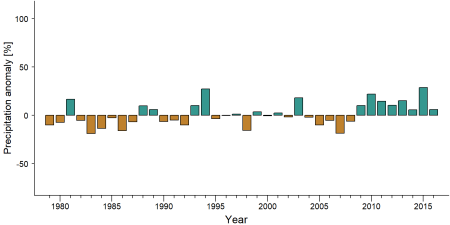
Precipitation anomaly in Moyen-Bafing National Park -
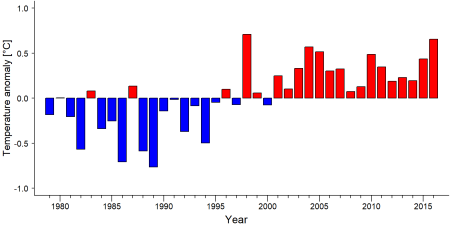
Temperature anomaly in Moyen-Bafing National Park


External links
References
Bakarr M et al. 2001. in IUCN 2008. From forest to the sea: biodiversity connections from Guinea to Togo. Conservation priority setting workshop. Washington D.C., USA: Conservation International
Boesch, C., Kalan, A. K., Agbor, A., Arandjelovic, M., Dieguez, P., Lapeyre, V., & Kühl, H. S. (2016). Chimpanzees routinely fish for algae with tools during the dry season in Bakoun, Guinea. American Journal of Primatology, 79(3). doi:10.1002/ajp.22613
Boesch, L., Mundry, R., Kühl, H. S., & Berger, R. (2017). Wild mammals as economic goods and implications for their conservation. Ecology and Society, 22(4). doi:10.5751/es-09516-220436
Brugière D, Kormos R. 2009. Review of the protected area network in Guinea, West Africa, and recommendations for new sites for biodiversity conservation, Biodiversity and Conservation, 18:847 doi:10.1007/s10531-008-9508-z
Brugière, D. (2012). Identifying priority areas for the conservation of antelopes in the Republic of Guinea, West Africa, using the complementarity approach. Oryx, 46(2), 253-259. doi:10.1017/s0030605311000391
Catterson TM et al. 2001. Programmatic environmental assessment of co-management of reserved forests in Guinea, prepared for: USAID/GUINEA
Debetencourt, B., Barry, M. M., Arandjelovic, M., Stephens, C., Maldonado, N., & Boesch, C. (2024). Camera traps unveil demography, social structure, and home range of six unhabituated Western chimpanzee groups in the Moyen Bafing National Park, Guinea. American Journal of Primatology, 86, e23578. https://doi.org/10.1002/ajp.23578
Granier N, Martinez L. 2004. Première reconnaissance des chimpanzés Pan troglodytes verus dans la zone transfontalière entre la Guinée et le Mali (Afrique de l’Ouest), Primatologie, 6:423-447.
Ham R. 1998. Nationwide chimpanzee census and large mammal survey Republic of Guinea. Projet de conservation des chimpanzés en Guineée. Report to the European Union.
Heinicke, S., Mundry, R., Boesch, C., Amarasekaran, B., Barrie, A., Brncic, T., … Kühl, H. S.
(2019). Characteristics of Positive Deviants in Western Chimpanzee Populations. Frontiers in Ecology and Evolution, 7, 16. https://doi.org/10.3389/fevo.2019.00016
O’Mahony, J. (2019, May 23). Bauxite mining and Chinese dam push Guinea’s chimpanzees to the brink. *Mongabay*. https://news.mongabay.com/2019/05/bauxite-mining-and-chinese-dam-push-guineas-chimpanzees-to-the-brink/
Kormos R et al. 2003. The Republic of Guinea, in Kormos, R. Boesch, C., Bakarr, M.I. & Butynski, T.M. [eds.] Status Survey and Conservation Action Plan, IUCN/SSC Primate Specialist Group. IUCN, Gland, Switzerland and Cambridge, UK
Sylla, Y. N. (2025, December 11). Wildlife and communities bear the cost as Simandou rail corridor advances across Guinea. Mongabay. https://news.mongabay.com/2025/12/wildlife-and-communities-bear-the-cost-as-simandou-rail-corridor-advances-across-guinea/
UNEP-WCMC, IUCN. 2019. Protected Planet: The World Database on Protected Areas (WDPA), Cambridge, UK: UNEP-WCMC and IUCN Online: www.protectedplanet.net link
WCF. 2012. Annual report 2012 – activities of the Wild Chimpanzee Foundation for improved conservation of chimpanzees and their habitat in West Africa. Online: Wild Chimpanzee Foundation link
WCF. 2014. Annual report 2014 – activities of the Wild Chimpanzee Foundation for improved conservation of chimpanzees and their habitat in West Africa. Online: Wild Chimpanzee Foundation link
WCF. 2015 Annual report 2015 – activities of the Wild Chimpanzee Foundation for improved conservation of chimpanzees and their habitat in West Africa. Online: Wild Chimpanzee Foundation link
WCF. 2016. Annual report 2016 – activities of the Wild Chimpanzee Foundation for improved conservation of chimpanzees and their habitat in West Africa. Online: Wild Chimpanzee Foundation link
WCF. 2017a. Guinea approves creation of largest sanctuary for the West African chimpanzee. Press release of the Wild Chimpanzee Foundation from 30 October 2017. Online: Wild Chimpanzee Foundation link
WCF. 2017b. Annual report 2017 – activities of the Wild Chimpanzee Foundation for improved conservation of chimpanzees and their habitat in West Africa. Online: Wild Chimpanzee Foundation
WCF. 2018. Annual report 2018 – activities of the Wild Chimpanzee Foundation for improved conservation of chimpanzees and their habitat in West Africa. Online: Wild Chimpanzee Foundation link
Wild Chimpanzee Foundation. (2024). Biomonitoring report – Moyen Bafing National Park: Phase 1 (2019–2021) and Phase 2 (2022–2023).
Heinicke, S., Mundry, R., Boesch, C., Amarasekaran, B., Barrie, A., Brncic, T., …, & Kühl, H. S. (2019). Advancing conservation planning for western chimpanzees using IUCN SSC A.P.E.S.—the case of a taxon-specific database. Environmental Research Letters, 14(6), 64001. doi:10.1088/1748-9326/ab1379
Kiribou, R., Tehoda, P., Chukwu, O., Bempah, G., Kühl, H. S., Ferreira, J., …, & Heinicke, S. (2024). Exposure of African ape sites to climate change impacts. PLOS Climate, 3(2), e0000345. doi:10.1371/journal.pclm.0000345
Page created by: APES Atlas Team Date: 2019-07-08
Page updated by: Sebastien Regnaut, Aime Mizero Date: 2026-04-08