
Nyungwe National Park: Difference between revisions
No edit summary |
No edit summary |
||
| (7 intermediate revisions by the same user not shown) | |||
| Line 13: | Line 13: | ||
* Key threats to chimpanzees are illegal mining and hunting, and fires. | * Key threats to chimpanzees are illegal mining and hunting, and fires. | ||
* Conservation activities have focused on running ecotourism projects. | * Conservation activities have focused on running ecotourism projects. | ||
<div><ul><li style="display: inline-block; vertical-align: top;"> [[File: Landscape_NyungweNP_copyright_Cyril_Grueter.jpg | 300px | thumb| none | Nyungwe National Park view © Cyril Grueter]] </li><li style="display: inline-block; vertical-align: top;"> [[File: Fieldwork_NyungweNP_copyright_Cyril_Grueter.jpg | 300px | thumb| none | Nyungwe National Park © Cyril Grueter]] </li></ul></div> | <div><ul><li style="display: inline-block; vertical-align: top;"> [[File: Landscape_NyungweNP_copyright_Cyril_Grueter.jpg | 300px | thumb| none | Nyungwe National Park view © Cyril Grueter]] </li><li style="display: inline-block; vertical-align: top;"> [[File: Fieldwork_NyungweNP_copyright_Cyril_Grueter.jpg | 300px | thumb| none | Nyungwe National Park © Cyril Grueter]] </li></ul></div> | ||
= Site characteristics = | = Site characteristics = | ||
Nyungwe National Park lies within the Albertine Rift Ecoregion and forms part of the Afro-montane Regional Centre of Endemism. Spanning 101,957 hectares, it is the second largest expanse of montane forest in this biodiversity hotspot. Rising from 1,480 to 2,950 meters above sea level, the park encompasses an impressive altitudinal range of 1,470 meters and supports a full spectrum of forest types characteristic of this elevation zone, including climax, pioneer, and secondary formations. Beyond its forests, NNP also features extensive bamboo stands, high altitude peat bogs (found between 1,650 and 2,550 meters), as well as moorlands and montane grasslands. Over 95% of these habitats remain intact, making the park one of the most representative and ecologically valuable landscapes in the entire Albertine Rift. However, historical hunting pressures led to the local extinction of several charismatic megafauna species, including elephants, buffaloes, and possibly leopards. NNP is home to 89 species of vertebrates endemic to the Albertine Rift and 28 threatened species of vertebrates. In total, 351 species of birds have been recorded within the limits of NNP (UNESCO 2023). Nyungwe harbours a total of 13 species of primates. Two chimpanzee communities—Mayebe (estimated at 6–70 individuals) and Cyamudongo (20–30 individuals, residing in a 430-hectare forest fragment located approximately 9 km west of Nyungwe Forest)—are fully habituated. One community, Gisovu, is semi-habituated, and another, Kamiranzovu, is currently undergoing habituation. Non-chimpanzee primates inhabiting Nyungwe include the Ruwenzori black-and-white colobus (''Colobus angolensis ruwenzorii''), L’Hoest’s monkey (''Cercopithecus lhoesti''), and the silver monkey (''Cercopithecus mitis doggetti'') (Moore et al. 2018; Grueter pers. comm. 2025). | Nyungwe National Park lies within the Albertine Rift Ecoregion and forms part of the Afro-montane Regional Centre of Endemism. Spanning 101,957 hectares, it is the second largest expanse of montane forest in this biodiversity hotspot. Rising from 1,480 to 2,950 meters above sea level, the park encompasses an impressive altitudinal range of 1,470 meters and supports a full spectrum of forest types characteristic of this elevation zone, including climax, pioneer, and secondary formations. Beyond its forests, NNP also features extensive bamboo stands, high altitude peat bogs (found between 1,650 and 2,550 meters), as well as moorlands and montane grasslands. Over 95% of these habitats remain intact, making the park one of the most representative and ecologically valuable landscapes in the entire Albertine Rift. However, historical hunting pressures led to the local extinction of several charismatic megafauna species, including elephants, buffaloes, and possibly leopards. NNP is home to 89 species of vertebrates endemic to the Albertine Rift and 28 threatened species of vertebrates. In total, 351 species of birds have been recorded within the limits of NNP ([[#R01447|UNESCO 2023]]). Nyungwe harbours a total of 13 species of primates. Two chimpanzee communities—Mayebe (estimated at 6–70 individuals) and Cyamudongo (20–30 individuals, residing in a 430-hectare forest fragment located approximately 9 km west of Nyungwe Forest)—are fully habituated. One community, Gisovu, is semi-habituated, and another, Kamiranzovu, is currently undergoing habituation. Non-chimpanzee primates inhabiting Nyungwe include the Ruwenzori black-and-white colobus (''Colobus angolensis ruwenzorii''), L’Hoest’s monkey (''Cercopithecus lhoesti''), and the silver monkey (''Cercopithecus mitis doggetti'') ([[#R01444|Moore et al. 2018]]; Grueter pers. comm. 2025). | ||
'''Table 1. Basic site information for Nyungwe National Park''' | '''Table 1. Basic site information for Nyungwe National Park''' | ||
| Line 48: | Line 44: | ||
= Ape status = | = Ape status = | ||
Two habituated communities reside in the park; the Mayebe community (50–60 individuals) and the Cyamudongo community (35–40 individuals; Moore et al. 2018). | Two habituated communities reside in the park; the Mayebe community (50–60 individuals) and the Cyamudongo community (35–40 individuals; [[#R01444|Moore et al. 2018]]). | ||
'''Table 2. Ape population estimates reported for Nyungwe National Park''' | '''Table 2. Ape population estimates reported for Nyungwe National Park''' | ||
| Line 74: | Line 70: | ||
|Line transects | |Line transects | ||
| | | | ||
|WCS unpublished data, cited by Plumptre et al. 2010 | |WCS unpublished data, cited by [[#R01446|Plumptre et al. 2010]] | ||
| | | | ||
| | | | ||
| Line 87: | Line 83: | ||
|Unknown | |Unknown | ||
| | | | ||
|WCS unpublished data, cited by Plumptre et al. 2010 | |WCS unpublished data, cited by [[#R01446|Plumptre et al. 2010]] | ||
| | | | ||
| | | | ||
| Line 105: | Line 101: | ||
!Description | !Description | ||
!Year of threat | !Year of threat | ||
|- | |||
|1 Residential & commercial development | |||
|1.3 Tourism & recreation areas | |||
|Low (up to 30% of population affected) | |||
|The development of new hiking trails in recent years has expanded opportunities for tourism, offering potential benefits such as revenue generation, diversified visitor experiences, and improved monitoring. However, the expansion of trail networks may also increase the likelihood of poaching-related threats ([[#R01444|Moore et al., 2018]]). | |||
|Ongoing (2018) | |||
|- | |- | ||
|3 Energy production & mining | |3 Energy production & mining | ||
|3.2 Mining & quarrying | |3.2 Mining & quarrying | ||
|Present (unknown severity) | |Present (unknown severity) | ||
|Evidence of gold mining (Plumptre et al. 2002). Illegal gold and coltan mining (Grueter pers. comm. 2025). | |Evidence of gold mining ([[#R01445|Plumptre et al. 2002]]). Illegal gold and coltan mining (Grueter pers. comm. 2025). | ||
|2002-Ongoing (2025) | |2002-Ongoing (2025) | ||
|- | |- | ||
| Line 115: | Line 117: | ||
|5.1 Hunting & collecting terrestrial animals | |5.1 Hunting & collecting terrestrial animals | ||
|Low (up to 30% of population affected) | |Low (up to 30% of population affected) | ||
|Evidence of poaching (Plumptre et al. 2002). While poaching in Nyungwe is significantly less prevalent than in the Guinean-Congolian lowland forests, it remains a concern. Between 2006 and 2015, 39,463 poaching-related threats were recorded in the park (Moore et al., 2018). For chimpanzees, the primary threat is accidental injury or death from snares set for other wildlife (Grueter pers. comm. 2025). | |Evidence of poaching ([[#R01445|Plumptre et al. 2002]]). While poaching in Nyungwe is significantly less prevalent than in the Guinean-Congolian lowland forests, it remains a concern. Between 2006 and 2015, 39,463 poaching-related threats were recorded in the park ([[#R01444|Moore et al., 2018]]). For chimpanzees, the primary threat is accidental injury or death from snares set for other wildlife (Grueter pers. comm. 2025). | ||
|2002-Ongoing (2025) | |2002-Ongoing (2025) | ||
|- | |- | ||
| | |5 Biological resource use | ||
| | |5.1.5 Persecution/human wildlife conflict | ||
|Low (up to 30% of population affected) | |Low (up to 30% of population affected) | ||
| | |Chimpanzees occasionally enter agricultural fields in certain areas (e.g., Mayebe/Banda), where they feed on crops such as sugarcane. A compensation scheme is in place to mitigate these conflicts and reduce retaliatory actions (Grueter pers. comm. 2025). | ||
| | |Ongoing (2025) | ||
|- | |- | ||
|7 Natural system modifications | |7 Natural system modifications | ||
|7.1 Fire & fire suppression | |7.1 Fire & fire suppression | ||
|Present (unknown severity) | |Present (unknown severity) | ||
|Fires often caused by people entering the forest to smoke bees from wild hives to obtain honey (Plumptre et al. 2002). | |Fires often caused by people entering the forest to smoke bees from wild hives to obtain honey ([[#R01445|Plumptre et al. 2002]]). | ||
|Ongoing (2002) | |Ongoing (2002) | ||
|- | |- | ||
| | |8 Invasive & other problematic species, genes & diseases | ||
|1 | |8.1 Invasive non-native/alien species | ||
|Low (up to 30% of population affected) | |Low (up to 30% of population affected) | ||
| | |A potential threat to Nyungwe’s ecological balance is ''Sericostachys'', a fast-spreading, pest-like liana that has become increasingly common in degraded montane forests across the Albertine Rift. This species may disrupt ecosystem functioning by contributing to tree mortality and hindering regeneration. Fortunately, ''Sericostachys'' appears to be less prevalent in undisturbed areas of Nyungwe. According to the conclusions of a workshop on the species ([[#R02095|Scholte et al., 2010]]), it is unlikely to pose a serious threat to the ecosystem. Nonetheless, its impact on forest dynamics should continue to be monitored, and evidence-based management interventions considered if needed, particularly given its multiyear life cycle (Grueter pers. comm. 2025). | ||
|2010-Ongoing (2025) | |||
|Ongoing (2025) | |||
|} | |} | ||
| Line 197: | Line 193: | ||
|The site was declared a National Park in 2004. | |The site was declared a National Park in 2004. | ||
| | | | ||
|2004-Ongoing ( | |2004-Ongoing (2026) | ||
|- | |- | ||
|6 Species management | |6 Species management | ||
|6.1 Habituate primates to human presence to reduce stress from tourists/researchers | |6.1 Habituate primates to human presence to reduce stress from tourists/researchers | ||
|Chimpanzee trekking, with habituated groups ([ | |Chimpanzee trekking, with habituated groups ([[#R02050|Nyungwe Forest National Park]]). | ||
| | | | ||
|Ongoing (2025) | |Ongoing (2025) | ||
| Line 219: | Line 215: | ||
|8 Permanent presence | |8 Permanent presence | ||
|8.2 Run tourist projects and ensure permanent human presence at site | |8.2 Run tourist projects and ensure permanent human presence at site | ||
|The site is a major tourist attraction and several activities are offered, e.g., chimpanzee and colobus monkey trekking, canopy walks, safari tours ([ | |The site is a major tourist attraction and several activities are offered, e.g., chimpanzee and colobus monkey trekking, canopy walks, safari tours ([[#R02050|Nyungwe Forest National Park]]). | ||
| | | | ||
|2006-Ongoing (2025) | |2006-Ongoing (2025) | ||
| Line 297: | Line 293: | ||
= Research activities = | = Research activities = | ||
Since 2016, Cyril C. Grueter (The University of Western Australia and University of Oxford) and his PhD students have been studying the Mayebe chimpanzee community in Nyungwe National Park, Rwanda, to examine how they have adapted to life in a thermally challenging, low-productivity, high-elevation forest. This research is conducted in collaboration with African Parks, the Rwanda Development Board, and the University of Rwanda. Their work has primarily focused on the chimpanzees' dietary profile and responses to food scarcity, as well as the influence of landscape characteristics and the spatio-temporal availability of fruit resources on their ranging decisions. They have demonstrated that figs are a key dietary staple and a preferred food source, that flowers seasonally constitute a major part of their diet, and that herbs serve as fallback foods (Matthews, Ridley, Kaplin, & Grueter 2020; Matthews, Ridley, Niyigaba, Kaplin & Grueter 2019). Analyses of ranging data indicate that this chimpanzee community occupies an exceptionally large home range (>40 km²) compared to other chimpanzee populations. Green, Boruff & Grueter (2020) also show a preference for human-made trails when moving between resource patches. Furthermore, Green, Boruff, Niyigaba, Ndikubwimana, & Grueter (2020) found that during periods of fruit scarcity, the chimpanzees reduce their daily travel distances and shift their home range in response to the elevational distribution of food resources. Data also support the interpretation that these chimpanzees possess the cognitive ability to plan least-cost travel routes in their rugged environment (Green, Boruff, Bonnell, & Grueter 2020). Recent findings further suggest that fruit distribution indirectly influences party size by affecting the presence of estrous females (Matthews, Ridley, Kaplin, & Grueter 2021). Additionally, Grueter, Ridley, Kaplin, & Matthews (2023) have shown that female gregariousness increases when feeding on clumped food resources. Ongoing research by Grueter and his team is exploring the interplay between social and environmental factors in shaping the chimpanzee gut microbiome, as well as behavioral thermoregulation strategies, including microhabitat selection and nest construction. Ongoing research by Grueter and his team is exploring the interplay between social and environmental factors in shaping the chimpanzee gut microbiome, as well as behavioral thermoregulation strategies, including microhabitat selection and nest construction. | Since 2016, Cyril C. Grueter (The University of Western Australia and University of Oxford) and his PhD students have been studying the Mayebe chimpanzee community in Nyungwe National Park, Rwanda, to examine how they have adapted to life in a thermally challenging, low-productivity, high-elevation forest. This research is conducted in collaboration with African Parks, the Rwanda Development Board, and the University of Rwanda. Their work has primarily focused on the chimpanzees' dietary profile and responses to food scarcity, as well as the influence of landscape characteristics and the spatio-temporal availability of fruit resources on their ranging decisions. They have demonstrated that figs are a key dietary staple and a preferred food source, that flowers seasonally constitute a major part of their diet, and that herbs serve as fallback foods ([[#R01442|Matthews, Ridley, Kaplin, & Grueter 2020]]; [[#R01441|Matthews, Ridley, Niyigaba, Kaplin & Grueter 2019]]). Analyses of ranging data indicate that this chimpanzee community occupies an exceptionally large home range (>40 km²) compared to other chimpanzee populations. [[#R01437|Green, Boruff & Grueter (2020)]] also show a preference for human-made trails when moving between resource patches. Furthermore, [[#R01439|Green, Boruff, Niyigaba, Ndikubwimana, & Grueter (2020)]] found that during periods of fruit scarcity, the chimpanzees reduce their daily travel distances and shift their home range in response to the elevational distribution of food resources. Data also support the interpretation that these chimpanzees possess the cognitive ability to plan least-cost travel routes in their rugged environment ([[#R01438|Green, Boruff, Bonnell, & Grueter 2020]]). Recent findings further suggest that fruit distribution indirectly influences party size by affecting the presence of estrous females ([[#R01443|Matthews, Ridley, Kaplin, & Grueter 2021]]). Additionally, [[#R01440|Grueter, Ridley, Kaplin, & Matthews (2023)]] have shown that female gregariousness increases when feeding on clumped food resources. Ongoing research by Grueter and his team is exploring the interplay between social and environmental factors in shaping the chimpanzee gut microbiome, as well as behavioral thermoregulation strategies, including microhabitat selection and nest construction. Ongoing research by Grueter and his team is exploring the interplay between social and environmental factors in shaping the chimpanzee gut microbiome, as well as behavioral thermoregulation strategies, including microhabitat selection and nest construction. | ||
[[File: Forest_NyungweNP_copyright_Cyril_Grueter.jpg | 300px | thumb| none | Nyungwe National Park © Cyril Grueter]] | [[File: Forest_NyungweNP_copyright_Cyril_Grueter.jpg | 300px | thumb| none | Nyungwe National Park © Cyril Grueter]] | ||
| Line 341: | Line 337: | ||
= Exposure to climate change impacts = | = Exposure to climate change impacts = | ||
As part of a study on the exposure of African great ape sites to climate change impacts, Kiribou et al. | As part of a study on the exposure of African great ape sites to climate change impacts, [[#R02289|Kiribou et al. (2024)]] extracted climate data and data on projected extreme climate impact events for the site. Climatological characteristics were derived from observation-based climate data provided by the Inter-Sectoral Impact Model Intercomparison Project (ISIMIP, www.isimip.org). Parameters were calculated as the average across each 30-year period. For 1981-2010, the EWEMBI dataset from ISIMIP2a was used. For the two future periods (2021-2050 and 2071-2099) ISIMIP2b climate data based on four CMIP5 global climate models were used. For future projections, two Representative Concentration Pathways (RCP) were used. RCP 2.6 is a scenario with strong mitigation measures in which global temperatures would likely rise below 2C. RCP 6.0 is a scenario with medium emissions in which global temperatures would likely rise up to 3C by 2100. For the number of days with heavy precipitation events, the 98th percentile of all precipitation days (>1mm/d) was calculated for the 1979-2013 reference period as a threshold for a heavy precipitation event. Then, for each year, the number of days above that threshold was derived. The figures on temperature and precipitation anomaly show the deviation from the mean temperature and mean precipitation for the 1979-2013 reference period. | ||
The estimated exposure to future extreme climate impact events (crop failure, drought, river flood, wildfire, tropical cyclone, and heatwave) is based on a published dataset by Lange et al. 2020 derived from ISIMIP2b data. The same global climate models and RCPs as described above were used. Within each 30-year period, the number of years with an extreme event and the average proportion of the site affected were calculated ( | The estimated exposure to future extreme climate impact events (crop failure, drought, river flood, wildfire, tropical cyclone, and heatwave) is based on a published dataset by Lange et al. 2020 derived from ISIMIP2b data. The same global climate models and RCPs as described above were used. Within each 30-year period, the number of years with an extreme event and the average proportion of the site affected were calculated ([[#R02289|Kiribou et al. 2024]]). | ||
'''Table 8. Estimated past and projected climatological characteristics in Nyungwe National Park''' | '''Table 8. Estimated past and projected climatological characteristics in Nyungwe National Park''' | ||
| Line 470: | Line 466: | ||
= References = | = References = | ||
Green, S. J., Boruff, B. J | <span id="R01437"></span>Green, S. J., Boruff, B. J., & Grueter, C. C. (2020). From ridge tops to ravines: Landscape drivers of chimpanzee ranging patterns. Animal Behaviour, 163, 51–60. [https://doi.org/10.1101/795393 doi:10.1101/795393] | ||
Green, S. J., Boruff, B. J., & Grueter, C. C. (2020). | |||
Green, S. J., Boruff, B. J., Niyigaba, P., Ndikubwimana, I., & Grueter, C. C. (2020). Chimpanzee ranging responses to fruit availability in a high‐elevation environment. American Journal of Primatology, 82(5) | <span id="R01438"></span>Green, S. J., Boruff, B. J., Bonnell, T. R., & Grueter, C. C. (2020). Chimpanzees Use Least-Cost Routes to Out-of-Sight Goals. ''Current Biology'', 30(22), 4528-4533.e5. [https://doi.org/10.1016/j.cub.2020.08.076 doi:10.1016/j.cub.2020.08.076] | ||
Grueter, C. C., Ridley, A. R., Kaplin, B. A., & Matthews, J. K. (2023). Association patterns in a high-elevation chimpanzee community in Rwanda. Ethology Ecology & Evolution 35 (5), | <span id="R01439"></span>Green, S. J., Boruff, B. J., Niyigaba, P., Ndikubwimana, I., & Grueter, C. C. (2020). Chimpanzee ranging responses to fruit availability in a high‐elevation environment. ''American Journal of Primatology'', 82(5). [https://doi.org/10.1002/ajp.23119 doi:10.1002/ajp.23119] | ||
Matthews, J. K., Ridley, A., Kaplin, B. A., & Grueter, C. C. (2020). A comparison of fecal sampling and direct feeding observations for quantifying the diet of a frugivorous primate. Current Zoology, 66(4), | |||
Matthews, J. K., Ridley, A., Kaplin, B. A., & Grueter, C. C. (2021). Ecological and reproductive drivers of fission-fusion dynamics in chimpanzees (Pan troglodytes schweinfurthii) inhabiting a montane forest. | <span id="R01440"></span>Grueter, C. C., Ridley, A. R., Kaplin, B. A., & Matthews, J. K. (2023). Association patterns in a high-elevation chimpanzee community in Rwanda. Ethology Ecology & Evolution, 35(5), 669–685. [https://doi.org/10.1080/03949370.2022.2152104 doi:10.1080/03949370.2022.2152104] | ||
Behavioral Ecology and Sociobiology, 75, 23. < | |||
<span id="R01441"></span>Matthews, J. K., Ridley, A., Niyigaba, P., Kaplin, B. A., & Grueter, C. C. (2019). Chimpanzee feeding ecology and fallback food use in the montane forest of Nyungwe National Park, Rwanda. ''American Journal of Primatology'', 81(4). [https://doi.org/10.1002/ajp.22971 doi:10.1002/ajp.22971] | |||
<span id="R01442"></span>Matthews, J. K., Ridley, A., Kaplin, B. A., & Grueter, C. C. (2020). A comparison of fecal sampling and direct feeding observations for quantifying the diet of a frugivorous primate. Current Zoology, 66(4), 333–343. [https://doi.org/10.1093/cz/zoz058 doi:10.1093/cz/zoz058] | |||
Plumptre, A. J., Masozera, M., Fashing, P. J., McNeilage, A., Ewango, C., Kaplin, B. A., & Liengola, I. (2002). Biodiversity | |||
Plumptre, A., Rose Nangendo, G., Williamson, E., Didier, K., Hart, J., Mulindahabi, F., | <span id="R01443"></span>Matthews, J. K., Ridley, A., Kaplin, B. A., & Grueter, C. C. (2021). Ecological and reproductive drivers of fission-fusion dynamics in chimpanzees (Pan troglodytes schweinfurthii) inhabiting a montane forest. ''Behavioral Ecology and Sociobiology'', 75(1), 23. [https://doi.org/10.1007/s00265-020-02964-4 doi:10.1007/s00265-020-02964-4] | ||
UNESCO World Heritage Centre. (2023). Decision: 45 COM 8B.26. Retrieved April 9, 2025, from https://whc.unesco.org/en/decisions/8407/ < | |||
<span id="R01444"></span>Moore, J. F., Mulindahabi, F., Gatorano, G., Niyigaba, P., Ndikubwimana, I., Cipolletta, C., & Masozera, M. K. (2018). Shifting through the forest: home range, movement patterns, and diet of the eastern chimpanzee (Pan troglodytes schweinfurthii) in Nyungwe National Park, Rwanda. ''American Journal of Primatology'', 80(8), e22897. [https://doi.org/10.1002/ajp.22897 doi:10.1002/ajp.22897] | |||
<span id="R01445"></span>Plumptre, A. J., Masozera, M., Fashing, P. J., McNeilage, A., Ewango, C., Kaplin, B. A., & Liengola, I. (2002). Biodiversity Surveys of the Nyungwe Forest Reserve In S.W. Rwanda.WCS Working Paper No. 19. [https://web.archive.org/web/20120604053800/http://anthro.fullerton.edu/pfashing/publications/Biodiversity_surveys.pdf link] | |||
<span id="R01446"></span>Plumptre, A., Rose Nangendo, G., Williamson, E., Didier, K., Hart, J., Mulindahabi, F., … Bennett, E. (2010). Eastern chimpanzee (Pan troglodytes schweinfurthii): Status survey and conservation action plan 2010–2020. IUCN. https://portals.iucn.org/library/efiles/documents/2010-023.pdf [http://www.primate-sg.org/PDF/ECCAP.pdf link] | |||
<span id="R01447"></span>UNESCO World Heritage Centre. (2023). Decision: 45 COM 8B.26. Retrieved April 9, 2025, from https://whc.unesco.org/en/decisions/8407/ | |||
<span id="R02095"></span>Scholte, P., Rugerinyange, L., Bizimungu, F., & Ruzigandekwe, F. (2010). Reaching consensus: Impact of the liana Sericostachys scandens on forest dynamics in Nyungwe National Park, Rwanda. Oryx, 44(3), 325–326. [https://doi.org/10.1017/s003060531000061x doi:10.1017/s003060531000061x] | |||
<span id="R02289"></span>Kiribou, R., Tehoda, P., Chukwu, O., Bempah, G., Kühl, H. S., Ferreira, J., …, & Heinicke, S. (2024). Exposure of African ape sites to climate change impacts. ''PLOS Climate'', 3(2), e0000345. [https://doi.org/10.1371/journal.pclm.0000345 doi:10.1371/journal.pclm.0000345] | |||
<span id="R02050"></span>Nyungwe Forest National Park. https://www.nyungweforest.com/ | |||
Latest revision as of 17:54, 15 October 2026
East Africa > Rwanda > Nyungwe National Park
Français | Português | Español | Bahasa Indonesia | Melayu
Summary
- Eastern chimpanzees (Pan troglodytes schweinfurthii) are present in Nyungwe National Park.
- In 2009 it was estimated that 306 chimpanzees inhabit the site.
- The population size decreased between
- The site has a total size of 1,019 km².
- Key threats to chimpanzees are illegal mining and hunting, and fires.
- Conservation activities have focused on running ecotourism projects.
-
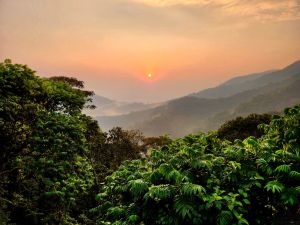
Nyungwe National Park view © Cyril Grueter -

Nyungwe National Park © Cyril Grueter


Site characteristics
Nyungwe National Park lies within the Albertine Rift Ecoregion and forms part of the Afro-montane Regional Centre of Endemism. Spanning 101,957 hectares, it is the second largest expanse of montane forest in this biodiversity hotspot. Rising from 1,480 to 2,950 meters above sea level, the park encompasses an impressive altitudinal range of 1,470 meters and supports a full spectrum of forest types characteristic of this elevation zone, including climax, pioneer, and secondary formations. Beyond its forests, NNP also features extensive bamboo stands, high altitude peat bogs (found between 1,650 and 2,550 meters), as well as moorlands and montane grasslands. Over 95% of these habitats remain intact, making the park one of the most representative and ecologically valuable landscapes in the entire Albertine Rift. However, historical hunting pressures led to the local extinction of several charismatic megafauna species, including elephants, buffaloes, and possibly leopards. NNP is home to 89 species of vertebrates endemic to the Albertine Rift and 28 threatened species of vertebrates. In total, 351 species of birds have been recorded within the limits of NNP (UNESCO 2023). Nyungwe harbours a total of 13 species of primates. Two chimpanzee communities—Mayebe (estimated at 6–70 individuals) and Cyamudongo (20–30 individuals, residing in a 430-hectare forest fragment located approximately 9 km west of Nyungwe Forest)—are fully habituated. One community, Gisovu, is semi-habituated, and another, Kamiranzovu, is currently undergoing habituation. Non-chimpanzee primates inhabiting Nyungwe include the Ruwenzori black-and-white colobus (Colobus angolensis ruwenzorii), L’Hoest’s monkey (Cercopithecus lhoesti), and the silver monkey (Cercopithecus mitis doggetti) (Moore et al. 2018; Grueter pers. comm. 2025).
Table 1. Basic site information for Nyungwe National Park
| Species | Pan troglodytes schweinfurthii |
| Area | 1,019 km² |
| Coordinates | Lat: -2.508690 , Lon: 29.284232 |
| Type of site | Protected area (National Park) |
| Habitat types | Subtropical/tropical moist montane forest |
| Type of governance | Shared governance |
Types of sites Governance types Habitat types

Ape status
Two habituated communities reside in the park; the Mayebe community (50–60 individuals) and the Cyamudongo community (35–40 individuals; Moore et al. 2018).
Table 2. Ape population estimates reported for Nyungwe National Park
| Species | Year | Occurrence | Encounter or vistation rate (nests/km; ind/day) | Density estimate [ind./ km²] (95% CI) | Abundance estimate (95% CI) | Survey area | Sampling method | Analytical framework | Source | Comments | A.P.E.S. database ID |
|---|---|---|---|---|---|---|---|---|---|---|---|
| Pan troglodytes schweinfurthii | 2009 | 306.0 | Nyungwe Forest National Park | Line transects | WCS unpublished data, cited by Plumptre et al. 2010 | ||||||
| Pan troglodytes schweinfurthii | 2004-2005 | 380.0 | Nyungwe Forest National Park | Unknown | WCS unpublished data, cited by Plumptre et al. 2010 |
Sampling methods Analytical frameworks
Threats
Table 3. Threats to apes reported for Nyungwe National Park
| Category | Specific threats | Threat level | Description | Year of threat |
|---|---|---|---|---|
| 1 Residential & commercial development | 1.3 Tourism & recreation areas | Low (up to 30% of population affected) | The development of new hiking trails in recent years has expanded opportunities for tourism, offering potential benefits such as revenue generation, diversified visitor experiences, and improved monitoring. However, the expansion of trail networks may also increase the likelihood of poaching-related threats (Moore et al., 2018). | Ongoing (2018) |
| 3 Energy production & mining | 3.2 Mining & quarrying | Present (unknown severity) | Evidence of gold mining (Plumptre et al. 2002). Illegal gold and coltan mining (Grueter pers. comm. 2025). | 2002-Ongoing (2025) |
| 5 Biological resource use | 5.1 Hunting & collecting terrestrial animals | Low (up to 30% of population affected) | Evidence of poaching (Plumptre et al. 2002). While poaching in Nyungwe is significantly less prevalent than in the Guinean-Congolian lowland forests, it remains a concern. Between 2006 and 2015, 39,463 poaching-related threats were recorded in the park (Moore et al., 2018). For chimpanzees, the primary threat is accidental injury or death from snares set for other wildlife (Grueter pers. comm. 2025). | 2002-Ongoing (2025) |
| 5 Biological resource use | 5.1.5 Persecution/human wildlife conflict | Low (up to 30% of population affected) | Chimpanzees occasionally enter agricultural fields in certain areas (e.g., Mayebe/Banda), where they feed on crops such as sugarcane. A compensation scheme is in place to mitigate these conflicts and reduce retaliatory actions (Grueter pers. comm. 2025). | Ongoing (2025) |
| 7 Natural system modifications | 7.1 Fire & fire suppression | Present (unknown severity) | Fires often caused by people entering the forest to smoke bees from wild hives to obtain honey (Plumptre et al. 2002). | Ongoing (2002) |
| 8 Invasive & other problematic species, genes & diseases | 8.1 Invasive non-native/alien species | Low (up to 30% of population affected) | A potential threat to Nyungwe’s ecological balance is Sericostachys, a fast-spreading, pest-like liana that has become increasingly common in degraded montane forests across the Albertine Rift. This species may disrupt ecosystem functioning by contributing to tree mortality and hindering regeneration. Fortunately, Sericostachys appears to be less prevalent in undisturbed areas of Nyungwe. According to the conclusions of a workshop on the species (Scholte et al., 2010), it is unlikely to pose a serious threat to the ecosystem. Nonetheless, its impact on forest dynamics should continue to be monitored, and evidence-based management interventions considered if needed, particularly given its multiyear life cycle (Grueter pers. comm. 2025). | 2010-Ongoing (2025) |
Conservation activities
Table 4. Conservation activities reported for Nyungwe National Park
| Category | Specific activity | Description | Implementing organization(s) | Year of activity |
|---|---|---|---|---|
| 2 Counter-wildlife crime | 2.3 Conduct regular anti-poaching patrols | Grueter pers. comm. 2025 | Ongoing (2025) | |
| 2 Counter-wildlife crime | 2.6 Regularly de-activate/remove ground snares | Grueter pers. comm. 2025 | Ongoing (2025) | |
| 3 Species health | 3.10 Treat sick/injured apes | Grueter pers. comm. 2025 | Ongoing (2025) | |
| 3 Species health | 3.2 Keep safety distance to habituated apes | Grueter pers. comm. 2025 | Ongoing (2025) | |
| 3 Species health | 3.3 Limit time that researchers/tourists are allowed to spend with habituated apes | Tourists are allowed to spend 1 hour with the chimpanzees (Grueter pers. comm. 2025). | Ongoing (2025) | |
| 5 Protection & restoration | 5.1 Create buffer zones around protected ape habitat | Grueter pers. comm. 2025 | Ongoing (2025) | |
| 5 Protection & restoration | 5.2 Legally protect ape habitat | The site was declared a National Park in 2004. | 2004-Ongoing (2026) | |
| 6 Species management | 6.1 Habituate primates to human presence to reduce stress from tourists/researchers | Chimpanzee trekking, with habituated groups (Nyungwe Forest National Park). | Ongoing (2025) | |
| 7 Economic & other incentives | 7.1 Provide monetary benefits to local communities for sustainably managing their forest and its wildlife (e.g., REDD, alternative income, employment) | Grueter pers. comm. 2025 | Ongoing (2025) | |
| 8 Permanent presence | 8.1 Run research project and ensure permanent human presence at site | Grueter pers. comm. 2025 | Ongoing (2025) | |
| 8 Permanent presence | 8.2 Run tourist projects and ensure permanent human presence at site | The site is a major tourist attraction and several activities are offered, e.g., chimpanzee and colobus monkey trekking, canopy walks, safari tours (Nyungwe Forest National Park). | 2006-Ongoing (2025) | |
| 8 Permanent presence | 8.3 Permanent presence of staff/manager | Grueter pers. comm. 2025 | Ongoing (2025) |
Challenges
Table 5. Challenges reported for Nyungwe National Park
| Challenges | Specific challenges | Source | Year(s) |
|---|---|---|---|
| Not reported |
Enablers
Table 6. Enablers reported for Nyungwe National Park
| Enablers | Specific enablers | Source | Year(s) |
|---|---|---|---|
| 1 Site management | |||
| 2 Resources and capacity | |||
| 3 Engaged community | |||
| 4 Institutional support | |||
| 5 Ecological context | |||
| 6 Safety and stability |
Research activities
Since 2016, Cyril C. Grueter (The University of Western Australia and University of Oxford) and his PhD students have been studying the Mayebe chimpanzee community in Nyungwe National Park, Rwanda, to examine how they have adapted to life in a thermally challenging, low-productivity, high-elevation forest. This research is conducted in collaboration with African Parks, the Rwanda Development Board, and the University of Rwanda. Their work has primarily focused on the chimpanzees' dietary profile and responses to food scarcity, as well as the influence of landscape characteristics and the spatio-temporal availability of fruit resources on their ranging decisions. They have demonstrated that figs are a key dietary staple and a preferred food source, that flowers seasonally constitute a major part of their diet, and that herbs serve as fallback foods (Matthews, Ridley, Kaplin, & Grueter 2020; Matthews, Ridley, Niyigaba, Kaplin & Grueter 2019). Analyses of ranging data indicate that this chimpanzee community occupies an exceptionally large home range (>40 km²) compared to other chimpanzee populations. Green, Boruff & Grueter (2020) also show a preference for human-made trails when moving between resource patches. Furthermore, Green, Boruff, Niyigaba, Ndikubwimana, & Grueter (2020) found that during periods of fruit scarcity, the chimpanzees reduce their daily travel distances and shift their home range in response to the elevational distribution of food resources. Data also support the interpretation that these chimpanzees possess the cognitive ability to plan least-cost travel routes in their rugged environment (Green, Boruff, Bonnell, & Grueter 2020). Recent findings further suggest that fruit distribution indirectly influences party size by affecting the presence of estrous females (Matthews, Ridley, Kaplin, & Grueter 2021). Additionally, Grueter, Ridley, Kaplin, & Matthews (2023) have shown that female gregariousness increases when feeding on clumped food resources. Ongoing research by Grueter and his team is exploring the interplay between social and environmental factors in shaping the chimpanzee gut microbiome, as well as behavioral thermoregulation strategies, including microhabitat selection and nest construction. Ongoing research by Grueter and his team is exploring the interplay between social and environmental factors in shaping the chimpanzee gut microbiome, as well as behavioral thermoregulation strategies, including microhabitat selection and nest construction.

Documented behaviours
Table 7. Behaviours documented for Nyungwe National Park
| Category | Behavior | Observation type | Prevalence | Observation dates | Source | Habituation | Species | Comment |
|---|---|---|---|---|---|---|---|---|
| Use of sticks to extract honey from the underground nests of stingless bees | Grueter, al-Razi et al. unpubl. | |||||||
| Use of sticks to extract honey from arboreal bee nests | Grueter, Green et al., unpubl. |
Exposure to climate change impacts
As part of a study on the exposure of African great ape sites to climate change impacts, Kiribou et al. (2024) extracted climate data and data on projected extreme climate impact events for the site. Climatological characteristics were derived from observation-based climate data provided by the Inter-Sectoral Impact Model Intercomparison Project (ISIMIP, www.isimip.org). Parameters were calculated as the average across each 30-year period. For 1981-2010, the EWEMBI dataset from ISIMIP2a was used. For the two future periods (2021-2050 and 2071-2099) ISIMIP2b climate data based on four CMIP5 global climate models were used. For future projections, two Representative Concentration Pathways (RCP) were used. RCP 2.6 is a scenario with strong mitigation measures in which global temperatures would likely rise below 2C. RCP 6.0 is a scenario with medium emissions in which global temperatures would likely rise up to 3C by 2100. For the number of days with heavy precipitation events, the 98th percentile of all precipitation days (>1mm/d) was calculated for the 1979-2013 reference period as a threshold for a heavy precipitation event. Then, for each year, the number of days above that threshold was derived. The figures on temperature and precipitation anomaly show the deviation from the mean temperature and mean precipitation for the 1979-2013 reference period.
The estimated exposure to future extreme climate impact events (crop failure, drought, river flood, wildfire, tropical cyclone, and heatwave) is based on a published dataset by Lange et al. 2020 derived from ISIMIP2b data. The same global climate models and RCPs as described above were used. Within each 30-year period, the number of years with an extreme event and the average proportion of the site affected were calculated (Kiribou et al. 2024).
Table 8. Estimated past and projected climatological characteristics in Nyungwe National Park
| Value | 1981-2010 | 2021-2050, RCP 2.6 | 2021-2050, RCP 6.0 | 2071-2099, RCP 2.6 | 2071-2099, RCP 6.0 |
|---|---|---|---|---|---|
| Mean temperature [C] | 19.1 | 20.3 | 20 | 20.4 | 21.7 |
| Annual precipitation [mm] | 1304 | 1321 | 1373 | 1291 | 1348 |
| Max no. consecutive dry days (per year) | 42.5 | 54.8 | 50.8 | 60.5 | 48.4 |
| No. days with heavy precipitation (per year) | 6.7 | 6.6 | 7 | 7.6 | 8.9 |
Table 9. Projected exposure of apes to extreme climate impact events in Nyungwe National Park
| Type | No. of years with event (2021-2050, RCP 2.6) | % of site exposed (2021-2050, RCP 2.6) | No. of years with event (2021-2050, RCP 6.0) | % of site exposed (2021-2050, RCP 6.0) | No. of years with event (2070-2099, RCP 2.6) | % of site exposed (2070-2099, RCP 2.6) | No. of years with event (2070-2099, RCP 6.0) | % of site exposed (2070-2099, RCP 6.0) |
|---|---|---|---|---|---|---|---|---|
| Crop failure | 9 | 0.58 | 6.5 | 0.55 | 9.5 | 0.9 | 15.5 | 0.63 |
| Drought | 0 | 0 | 0 | 0 | 0 | 0 | 0 | 0 |
| Heatwave | 0 | 0 | 0 | 0 | 0 | 0 | 0 | 0 |
| River flood | 5 | 0.32 | 6 | 0.9 | 3.5 | 0.69 | 8.5 | 1.36 |
| Tropical cyclone | 0 | 0 | 0 | 0 | 0 | 0 | 0 | 0 |
| Wildfire | 30 | 0.73 | 30 | 0.65 | 29 | 0.74 | 29 | 0.7 |
-
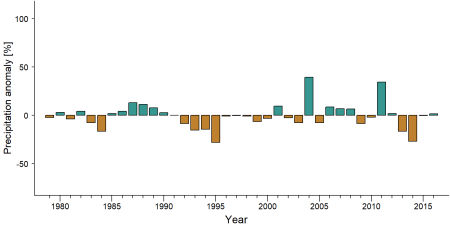
Precipitation anomaly in Nyungwe National Park -
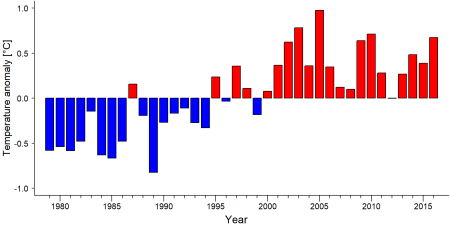
Temperature anomaly in Nyungwe National Park


External links
African Parks Nyungwe Forest National Park
References
Green, S. J., Boruff, B. J., & Grueter, C. C. (2020). From ridge tops to ravines: Landscape drivers of chimpanzee ranging patterns. Animal Behaviour, 163, 51–60. doi:10.1101/795393
Green, S. J., Boruff, B. J., Bonnell, T. R., & Grueter, C. C. (2020). Chimpanzees Use Least-Cost Routes to Out-of-Sight Goals. Current Biology, 30(22), 4528-4533.e5. doi:10.1016/j.cub.2020.08.076
Green, S. J., Boruff, B. J., Niyigaba, P., Ndikubwimana, I., & Grueter, C. C. (2020). Chimpanzee ranging responses to fruit availability in a high‐elevation environment. American Journal of Primatology, 82(5). doi:10.1002/ajp.23119
Grueter, C. C., Ridley, A. R., Kaplin, B. A., & Matthews, J. K. (2023). Association patterns in a high-elevation chimpanzee community in Rwanda. Ethology Ecology & Evolution, 35(5), 669–685. doi:10.1080/03949370.2022.2152104
Matthews, J. K., Ridley, A., Niyigaba, P., Kaplin, B. A., & Grueter, C. C. (2019). Chimpanzee feeding ecology and fallback food use in the montane forest of Nyungwe National Park, Rwanda. American Journal of Primatology, 81(4). doi:10.1002/ajp.22971
Matthews, J. K., Ridley, A., Kaplin, B. A., & Grueter, C. C. (2020). A comparison of fecal sampling and direct feeding observations for quantifying the diet of a frugivorous primate. Current Zoology, 66(4), 333–343. doi:10.1093/cz/zoz058
Matthews, J. K., Ridley, A., Kaplin, B. A., & Grueter, C. C. (2021). Ecological and reproductive drivers of fission-fusion dynamics in chimpanzees (Pan troglodytes schweinfurthii) inhabiting a montane forest. Behavioral Ecology and Sociobiology, 75(1), 23. doi:10.1007/s00265-020-02964-4
Moore, J. F., Mulindahabi, F., Gatorano, G., Niyigaba, P., Ndikubwimana, I., Cipolletta, C., & Masozera, M. K. (2018). Shifting through the forest: home range, movement patterns, and diet of the eastern chimpanzee (Pan troglodytes schweinfurthii) in Nyungwe National Park, Rwanda. American Journal of Primatology, 80(8), e22897. doi:10.1002/ajp.22897
Plumptre, A. J., Masozera, M., Fashing, P. J., McNeilage, A., Ewango, C., Kaplin, B. A., & Liengola, I. (2002). Biodiversity Surveys of the Nyungwe Forest Reserve In S.W. Rwanda.WCS Working Paper No. 19. link
Plumptre, A., Rose Nangendo, G., Williamson, E., Didier, K., Hart, J., Mulindahabi, F., … Bennett, E. (2010). Eastern chimpanzee (Pan troglodytes schweinfurthii): Status survey and conservation action plan 2010–2020. IUCN. https://portals.iucn.org/library/efiles/documents/2010-023.pdf link
UNESCO World Heritage Centre. (2023). Decision: 45 COM 8B.26. Retrieved April 9, 2025, from https://whc.unesco.org/en/decisions/8407/
Scholte, P., Rugerinyange, L., Bizimungu, F., & Ruzigandekwe, F. (2010). Reaching consensus: Impact of the liana Sericostachys scandens on forest dynamics in Nyungwe National Park, Rwanda. Oryx, 44(3), 325–326. doi:10.1017/s003060531000061x
Kiribou, R., Tehoda, P., Chukwu, O., Bempah, G., Kühl, H. S., Ferreira, J., …, & Heinicke, S. (2024). Exposure of African ape sites to climate change impacts. PLOS Climate, 3(2), e0000345. doi:10.1371/journal.pclm.0000345
Nyungwe Forest National Park. https://www.nyungweforest.com/
Page created by: Cyril C. Grueter & APES Atlas Team Date: 2021-01-14
Page updated by: Cyril C. Grueter Date: 2025-04-07