
Lake Piso Multiple Sustainable Use Reserve: Difference between revisions
No edit summary |
No edit summary |
||
| (6 intermediate revisions by the same user not shown) | |||
| Line 13: | Line 13: | ||
* Key threats to chimpanzees are pollution, logging, urban expansion, and hunting. | * Key threats to chimpanzees are pollution, logging, urban expansion, and hunting. | ||
* Conservation activities have focused on education and awareness campaigns. | * Conservation activities have focused on education and awareness campaigns. | ||
= Site characteristics = | = Site characteristics = | ||
The site is situated on the coast of the Atlantic Ocean. It is an important catchment area, with several streams and three rivers (Mafa, Mofe and Mawua) emptying into it (Sambolah 2007). Lake Piso has been designated as an Important Bird Area (IBA) by BirdLife International (BirdLife International 2019), and a wetland of international importance (Ramsar 2003). In addition to the western chimpanzee, the reserve hosts forest buffaloes ''Syncerus caffer'' and Bongos ''Tragelaphus eurycerus'', as well as several resident and migratory bird species (FFI 2015). The site has been protected since 2011 (The Analyst News 2018). | The site is situated on the coast of the Atlantic Ocean. It is an important catchment area, with several streams and three rivers (Mafa, Mofe and Mawua) emptying into it ([[#R01025|Sambolah 2007]]). Lake Piso has been designated as an Important Bird Area (IBA) by BirdLife International ([[#R01022|BirdLife International 2019]]), and a wetland of international importance ([[#R01024|Ramsar 2003]]). In addition to the western chimpanzee, the reserve hosts forest buffaloes ''Syncerus caffer'' and Bongos ''Tragelaphus eurycerus'', as well as several resident and migratory bird species ([[#R01023|FFI 2015]]). The site has been protected since 2011 ([[#R01030|The Analyst News 2018]]). | ||
'''Table 1. Basic site information for Lake Piso Multiple Sustainable Use Reserve''' | '''Table 1. Basic site information for Lake Piso Multiple Sustainable Use Reserve''' | ||
| Line 48: | Line 44: | ||
= Ape status = | = Ape status = | ||
Western chimpanzees are reported to still be present at the site (Sambolah 2007, Tweh et al. 2014). However, there is a lack of data on chimpanzee abundance and status, so the population size and trend are unknown. | Western chimpanzees are reported to still be present at the site ([[#R01025|Sambolah 2007]], [[#R01031|Tweh et al. 2014]]). However, there is a lack of data on chimpanzee abundance and status, so the population size and trend are unknown. | ||
'''Table 2. Ape population estimates reported for Lake Piso Multiple Sustainable Use Reserve''' | '''Table 2. Ape population estimates reported for Lake Piso Multiple Sustainable Use Reserve''' | ||
| Line 66: | Line 62: | ||
|- | |- | ||
|''Pan troglodytes verus'' | |''Pan troglodytes verus'' | ||
| | |2023 | ||
|Present | |Present | ||
| | | | ||
| | | | ||
| | | | ||
|Lake Piso forest | |Lake Piso, Warkolor forest area | ||
|Reconnaissance walk | |Reconnaissance walk | ||
| | | | ||
| | |Deh, J.J., pers. Comm. 2023 | ||
| | |||
| | | | ||
|- | |- | ||
|''Pan troglodytes verus'' | |''Pan troglodytes verus'' | ||
| | |2010-2012 | ||
|Present | |Present | ||
| | | | ||
| | | | ||
| | | | ||
|Lake Piso | |Lake Piso forest block | ||
|Reconnaissance walk | |Reconnaissance walk | ||
| | | | ||
| | |[[#R01031|Tweh et al. 2014]] | ||
|Total survey effort: 2 days, indirect signs of chimpanzee presence (vocalization, but no nests, Junker pers. comm. 2019) | |||
| | |LBR0026 | ||
|- | |- | ||
|''Pan troglodytes verus'' | |''Pan troglodytes verus'' | ||
| Line 100: | Line 96: | ||
|Unknown | |Unknown | ||
| | | | ||
|Sambolah 2007 | |[[#R01025|Sambolah 2007]] | ||
|19 observations of chimpanzees or signs of chimpanzees | |19 observations of chimpanzees or signs of chimpanzees | ||
| | | | ||
| Line 109: | Line 105: | ||
= Threats = | = Threats = | ||
The main threats in the site are pollution (including solid waste, sewage disposal, and industrial pollution), hunting, and habitat destruction due to logging, agricultural expansion, road construction and urban expansion (Sambolah 2007, Spalding et al. 2010). | The main threats in the site are pollution (including solid waste, sewage disposal, and industrial pollution), hunting, and habitat destruction due to logging, agricultural expansion, road construction and urban expansion ([[#R01025|Sambolah 2007]], [[#R01029|Spalding et al. 2010]]). | ||
'''Table 3. Threats to apes reported for Lake Piso Multiple Sustainable Use Reserve''' | '''Table 3. Threats to apes reported for Lake Piso Multiple Sustainable Use Reserve''' | ||
| Line 119: | Line 115: | ||
!Year of threat | !Year of threat | ||
|- | |- | ||
| | |1 Residential & commercial development | ||
| | |1.1 Residential areas | ||
| | |Present (unknown severity) | ||
| | |Expansion of urban areas ([[#R01029|Spalding et al. 2010]]) | ||
| | |Ongoing (2010) | ||
|- | |- | ||
| | |2 Agriculture & aquaculture | ||
| | |2.1 Annual & perennial non-timber crops | ||
| | |Present (unknown severity) | ||
| | |Conversion of land to rice field ([[#R01029|Spalding et al. 2010]]) and farming ([[#R01025|Sambolah 2007]]) | ||
| | |Ongoing (2010) | ||
|- | |- | ||
|3 Energy production & mining | |3 Energy production & mining | ||
|3.2 Mining & quarrying | |3.2 Mining & quarrying | ||
|High (more than 70% of population affected) | |High (more than 70% of population affected) | ||
|Sand mining (Sambolah 2007) | |Sand mining ([[#R01025|Sambolah 2007]]) | ||
|Ongoing (2007) | |Ongoing (2007) | ||
|- | |||
|4 Transportation & service corridors | |||
|4.1 Roads & railroads | |||
|Present (unknown severity) | |||
|Construction of roads ([[#R01029|Spalding et al. 2010]]) | |||
|Ongoing (2010) | |||
|- | |- | ||
|5 Biological resource use | |5 Biological resource use | ||
|5.1 Hunting & collecting terrestrial animals | |5.1 Hunting & collecting terrestrial animals | ||
|High (more than 70% of population affected) | |High (more than 70% of population affected) | ||
|Hunting pressure was especially high in the 1960s, 1970s and 1980s (Sambolah 2007) | |Hunting pressure was especially high in the 1960s, 1970s and 1980s ([[#R01025|Sambolah 2007]]) | ||
|Ongoing (2007) | |Ongoing (2007) | ||
|- | |- | ||
| Line 146: | Line 148: | ||
|5.3 Logging & wood harvesting | |5.3 Logging & wood harvesting | ||
|High (more than 70% of population affected) | |High (more than 70% of population affected) | ||
|Overharvest of timber and fuelwood (Sambolah 2007, Spalding et al. 2010) | |Overharvest of timber and fuelwood ([[#R01025|Sambolah 2007]], [[#R01029|Spalding et al. 2010]]) | ||
|Ongoing (2007) | |Ongoing (2007) | ||
|- | |||
|6 Human intrusions & disturbance | |||
|6.2 War, civil unrest & military exercises | |||
|High (more than 70% of population affected) | |||
|Pressure on mangroves greatly increased during civil conflict, by displaced people who moved to coastal areas ([[#R01029|Spalding et al. 2010]]) | |||
|1990-2003 | |||
|- | |- | ||
|7 Natural system modifications | |7 Natural system modifications | ||
|7.1 Fire & fire suppression | |7.1 Fire & fire suppression | ||
|High (more than 70% of population affected) | |High (more than 70% of population affected) | ||
|Burning of vegetation (savannah woodland, Sambolah 2007) | |Burning of vegetation (savannah woodland, [[#R01025|Sambolah 2007]]) | ||
|Ongoing (2007) | |Ongoing (2007) | ||
|- | |- | ||
|9 Pollution | |9 Pollution | ||
|9.1 Domestic & urban waste water | |9.1 Domestic & urban waste water | ||
|High (more than 70% of population affected) | |High (more than 70% of population affected) | ||
|Sewage pollution (Spalding et al. 2010) | |Sewage pollution ([[#R01029|Spalding et al. 2010]]) | ||
|Ongoing (2010) | |Ongoing (2010) | ||
|- | |- | ||
| Line 182: | Line 172: | ||
|9.2 Industrial & military effluents | |9.2 Industrial & military effluents | ||
|High (more than 70% of population affected) | |High (more than 70% of population affected) | ||
|Industrial pollution (Spalding et al. 2010) | |Industrial pollution ([[#R01029|Spalding et al. 2010]]) | ||
|Ongoing (2010) | |Ongoing (2010) | ||
|- | |||
|9 Pollution | |||
|9.4 Garbage & solid waste | |||
|High (more than 70% of population affected) | |||
|Solid waste disposal ([[#R01025|Sambolah 2007]], [[#R01029|Spalding et al. 2010]]), disposal of rotten fish ([[#R01025|Sambolah 2007]]). | |||
|2007-Ongoing (2010) | |||
|} | |} | ||
| Line 190: | Line 186: | ||
= Conservation activities = | = Conservation activities = | ||
Several projects have been funded by the Global Environment Facility’s Small Grant Program (SGP) aiming to protect wildlife whilst providing sustainable alternative sources of income for the local people. These include, for example, projects promoting sustainable fishing practices (SGPa 2019), as well as sustainable forestry community management (SGPb 2019). An ecolodge is currently being constructed in the Warkolor Forest, in the northern part of Lake Piso Multiple Sustainable Use Reserve; the presence of the ongoing construction and humans have reduced the presence of illegal activities in that part of the reserve (Deh, J.J., pers. Comm. 2023). | Several projects have been funded by the Global Environment Facility’s Small Grant Program (SGP) aiming to protect wildlife whilst providing sustainable alternative sources of income for the local people. These include, for example, projects promoting sustainable fishing practices ([[#R01026|SGPa 2019]]), as well as sustainable forestry community management ([[#R01027|SGPb 2019]]). An ecolodge is currently being constructed in the Warkolor Forest, in the northern part of Lake Piso Multiple Sustainable Use Reserve; the presence of the ongoing construction and humans have reduced the presence of illegal activities in that part of the reserve (Deh, J.J., pers. Comm. 2023). | ||
'''Table 4. Conservation activities reported for Lake Piso Multiple Sustainable Use Reserve''' | '''Table 4. Conservation activities reported for Lake Piso Multiple Sustainable Use Reserve''' | ||
| Line 202: | Line 198: | ||
|4 Education & awareness | |4 Education & awareness | ||
|4.1 Educate local communities about apes and sustainable use | |4.1 Educate local communities about apes and sustainable use | ||
|1) environmental education and awareness raising in nearby communities (Sambolah 2007); 2) project implemented by Ecosanity Services Liberia to engage local communities in the management of waste and raise awareness on the negative impacts of pollution on the reserve (SGPc 2019) | |1) environmental education and awareness raising in nearby communities ([[#R01025|Sambolah 2007]]); 2) project implemented by Ecosanity Services Liberia to engage local communities in the management of waste and raise awareness on the negative impacts of pollution on the reserve ([[#R01028|SGPc 2019]]) | ||
| | | | ||
|2005-2006, 2016-2017 | |2005-2006, 2016-2017 | ||
|- | |- | ||
|4 Education & awareness | |4 Education & awareness | ||
|4.2 Involve local community in ape research and conservation management | |4.2 Involve local community in ape research and conservation management | ||
|Establish community forests (SGPa 2019) | |Establish community forests ([[#R01026|SGPa 2019]]) | ||
| | | | ||
|Ongoing (2019) | |Ongoing (2019) | ||
| Line 220: | Line 210: | ||
|4 Education & awareness | |4 Education & awareness | ||
|4.4 Regularly play TV and radio announcements to raise ape conservation awareness | |4.4 Regularly play TV and radio announcements to raise ape conservation awareness | ||
|Create awareness on community forestry through local radio stations (SGPa 2019) | |Create awareness on community forestry through local radio stations ([[#R01026|SGPa 2019]]) | ||
| | | | ||
|Ongoing (2019) | |Ongoing (2019) | ||
| Line 226: | Line 216: | ||
|4 Education & awareness | |4 Education & awareness | ||
|4.5 Implement multimedia campaigns using theatre, film, print media, discussions | |4.5 Implement multimedia campaigns using theatre, film, print media, discussions | ||
|Information spread through posters, billboards, T-shirts to promote a sustainable community forest and create awareness implemented by Farmers Associated to Conserve the Environment (SGPb 2019) | |Information spread through posters, billboards, T-shirts to promote a sustainable community forest and create awareness implemented by Farmers Associated to Conserve the Environment ([[#R01027|SGPb 2019]]) | ||
| | | | ||
|Ongoing (2019) | |Ongoing (2019) | ||
|- | |||
|5 Protection & restoration | |||
|5.2 Legally protect ape habitat | |||
|The site is classified as a multiple sustainable use reserve since 2011 ([[#R01030|The Analyst News 2018]]) | |||
| | |||
|2011-Ongoing (2018) | |||
|} | |} | ||
| Line 332: | Line 328: | ||
= Exposure to climate change impacts = | = Exposure to climate change impacts = | ||
As part of a study on the exposure of African great ape sites to climate change impacts, Kiribou et al. | As part of a study on the exposure of African great ape sites to climate change impacts, [[#R02241|Kiribou et al. (2024)]] extracted climate data and data on projected extreme climate impact events for the site. Climatological characteristics were derived from observation-based climate data provided by the Inter-Sectoral Impact Model Intercomparison Project (ISIMIP, www.isimip.org). Parameters were calculated as the average across each 30-year period. For 1981-2010, the EWEMBI dataset from ISIMIP2a was used. For the two future periods (2021-2050 and 2071-2099) ISIMIP2b climate data based on four CMIP5 global climate models were used. For future projections, two Representative Concentration Pathways (RCP) were used. RCP 2.6 is a scenario with strong mitigation measures in which global temperatures would likely rise below 2C. RCP 6.0 is a scenario with medium emissions in which global temperatures would likely rise up to 3C by 2100. For the number of days with heavy precipitation events, the 98th percentile of all precipitation days (>1mm/d) was calculated for the 1979-2013 reference period as a threshold for a heavy precipitation event. Then, for each year, the number of days above that threshold was derived. The figures on temperature and precipitation anomaly show the deviation from the mean temperature and mean precipitation for the 1979-2013 reference period. | ||
The estimated exposure to future extreme climate impact events (crop failure, drought, river flood, wildfire, tropical cyclone, and heatwave) is based on a published dataset by Lange et al. 2020 derived from ISIMIP2b data. The same global climate models and RCPs as described above were used. Within each 30-year period, the number of years with an extreme event and the average proportion of the site affected were calculated ( | The estimated exposure to future extreme climate impact events (crop failure, drought, river flood, wildfire, tropical cyclone, and heatwave) is based on a published dataset by Lange et al. 2020 derived from ISIMIP2b data. The same global climate models and RCPs as described above were used. Within each 30-year period, the number of years with an extreme event and the average proportion of the site affected were calculated ([[#R02241|Kiribou et al. 2024]]). | ||
'''Table 8. Estimated past and projected climatological characteristics in Lake Piso Multiple Sustainable Use Reserve''' | '''Table 8. Estimated past and projected climatological characteristics in Lake Piso Multiple Sustainable Use Reserve''' | ||
| Line 457: | Line 453: | ||
= References = | = References = | ||
BirdLife International. 2019. Important Bird Areas factsheet: Lake Piso (Cape Mount). Online: http://www.birdlife.org | <span id="R01022"></span>BirdLife International. 2019. Important Bird Areas factsheet: Lake Piso (Cape Mount). Online: http://www.birdlife.org | ||
<span id="R01023"></span>Fauna & Flora of Liberia. 2015. Online: http://www.liberianfaunaflora.org/research/sapo-conservation-centre/7653-lake-piso [https://web.archive.org/web/20211020204806/http://www.liberianfaunaflora.org/research/sapo-conservation-centre/7653-lake-piso link] | |||
<span id="R01024"></span>Ramsar. 2003. Liberia joins the Ramsar Convention. Online: https://www.ramsar.org/news/liberia-joins-the-ramsar-convention | |||
<span id="R01025"></span>Sambolah, S. R. (2007). Biodiversity and environmental impacts of human activities on the proposed Lake Piso Nature Reserve. Farmers Associated to Conserve the Environment (FACE); Critical Ecosystem Partnership Fund (CEPF). | |||
<span id="R01026"></span>SGPa. 2019. Promoting Sustainable Fishery In The Lake Piso Basin Multiple Sustainable Use Reserve Without Reducing The Protected And Endangered Species To Maintain Their Population. Online: https://sgp.undp.org/spacial-itemid-projects-landing-page/spacial-itemid-project-search-results/spacial-itemid-project-detailpage.html?view=projectdetail&id=24555 | |||
<span id="R01027"></span>SGPb. 2019. Promoting Sustainable Community Forestry Management in the Lake Piso Sustainable Multipurpose Use Reserve, Liberia. Online: https://sgp.undp.org/spacial-itemid-projects-landing-page/spacial-itemid-project-search-results/spacial-itemid-project-detailpage.html?view=projectdetail&id=21597 | |||
<span id="R01028"></span>SGPc. 2019.Preventing organic pollution of Lake Piso; a catalyst for clean environment. Online: https://sgp.undp.org/spacial-itemid-projects-landing-page/spacial-itemid-project-search-results/spacial-itemid-project-detailpage.html?view=projectdetail&id=24550 | |||
<span id="R01029"></span>Spalding, M., Kainuma, M. and Collins, L. 2010. World atlas of mangroves. Earthscan, London. | |||
<span id="R01030"></span>The Analyst News. 2018. YES Visits Lake Piso Multiple Use Reserve in Robertsport. Online: https://liberiananalyst.com/2018/11/14/yes-visits-lake-piso-multiple-use-reserve-in-robertsport/ | |||
<span id="R01031"></span>Tweh, C. G., Lormie, M. M., Kouakou, C. Y., Hillers, A., Kühl, H. S., & Junker, J. (2015). Conservation status of chimpanzees Pan troglodytes verus and other large mammals in Liberia: a nationwide survey. ''Oryx'', 49(4), 710-718. [https://doi.org/10.1017/s0030605313001191 doi:10.1017/s0030605313001191] | |||
<span id="R02241"></span>Kiribou, R., Tehoda, P., Chukwu, O., Bempah, G., Kühl, H. S., Ferreira, J., …, & Heinicke, S. (2024). Exposure of African ape sites to climate change impacts. ''PLOS Climate'', 3(2), e0000345. [https://doi.org/10.1371/journal.pclm.0000345 doi:10.1371/journal.pclm.0000345] | |||
'''Page created by: '''APES Atlas Team''' Date:''' 2023-11-03 | '''Page created by: '''APES Atlas Team''' Date:''' 2023-11-03 | ||
Latest revision as of 17:53, 15 October 2026
West Africa > Liberia > Lake Piso Multiple Sustainable Use Reserve
Français | Português | Español | Bahasa Indonesia | Melayu
Summary
- Western chimpanzees (Pan troglodytes verus) are present in Lake Piso Multiple Sustainable Use Reserve.
- The population size is unknown.
- The chimpanzee population trend is unknown.
- This site has a total size of 972 km².
- Key threats to chimpanzees are pollution, logging, urban expansion, and hunting.
- Conservation activities have focused on education and awareness campaigns.
Site characteristics
The site is situated on the coast of the Atlantic Ocean. It is an important catchment area, with several streams and three rivers (Mafa, Mofe and Mawua) emptying into it (Sambolah 2007). Lake Piso has been designated as an Important Bird Area (IBA) by BirdLife International (BirdLife International 2019), and a wetland of international importance (Ramsar 2003). In addition to the western chimpanzee, the reserve hosts forest buffaloes Syncerus caffer and Bongos Tragelaphus eurycerus, as well as several resident and migratory bird species (FFI 2015). The site has been protected since 2011 (The Analyst News 2018).
Table 1. Basic site information for Lake Piso Multiple Sustainable Use Reserve
| Species | Pan troglodytes verus |
| Area | 972 km² |
| Coordinates | Lat: 6.678939 , Lon: -11.245522 |
| Type of site | Protected area (Multiple Sustainable Use Reserve) |
| Habitat types | Subtropical/tropical moist lowland forest, Subtropical/tropical swamp forest, Subtropical/tropical moist montane forest, Savanna, Wetlands (lakes, rivers, streams, bogs, marshes), Marine coastal/supratidal |
| Type of governance |
Types of sites Governance types Habitat types
Ape status
Western chimpanzees are reported to still be present at the site (Sambolah 2007, Tweh et al. 2014). However, there is a lack of data on chimpanzee abundance and status, so the population size and trend are unknown.
Table 2. Ape population estimates reported for Lake Piso Multiple Sustainable Use Reserve
| Species | Year | Occurrence | Encounter or vistation rate (nests/km; ind/day) | Density estimate [ind./ km²] (95% CI) | Abundance estimate (95% CI) | Survey area | Sampling method | Analytical framework | Source | Comments | A.P.E.S. database ID |
|---|---|---|---|---|---|---|---|---|---|---|---|
| Pan troglodytes verus | 2023 | Present | Lake Piso, Warkolor forest area | Reconnaissance walk | Deh, J.J., pers. Comm. 2023 | ||||||
| Pan troglodytes verus | 2010-2012 | Present | Lake Piso forest block | Reconnaissance walk | Tweh et al. 2014 | Total survey effort: 2 days, indirect signs of chimpanzee presence (vocalization, but no nests, Junker pers. comm. 2019) | LBR0026 | ||||
| Pan troglodytes verus | 2004 | Present | Lake Piso forest block | Unknown | Sambolah 2007 | 19 observations of chimpanzees or signs of chimpanzees |
Sampling methods Analytical frameworks
Threats
The main threats in the site are pollution (including solid waste, sewage disposal, and industrial pollution), hunting, and habitat destruction due to logging, agricultural expansion, road construction and urban expansion (Sambolah 2007, Spalding et al. 2010).
Table 3. Threats to apes reported for Lake Piso Multiple Sustainable Use Reserve
| Category | Specific threats | Threat level | Description | Year of threat |
|---|---|---|---|---|
| 1 Residential & commercial development | 1.1 Residential areas | Present (unknown severity) | Expansion of urban areas (Spalding et al. 2010) | Ongoing (2010) |
| 2 Agriculture & aquaculture | 2.1 Annual & perennial non-timber crops | Present (unknown severity) | Conversion of land to rice field (Spalding et al. 2010) and farming (Sambolah 2007) | Ongoing (2010) |
| 3 Energy production & mining | 3.2 Mining & quarrying | High (more than 70% of population affected) | Sand mining (Sambolah 2007) | Ongoing (2007) |
| 4 Transportation & service corridors | 4.1 Roads & railroads | Present (unknown severity) | Construction of roads (Spalding et al. 2010) | Ongoing (2010) |
| 5 Biological resource use | 5.1 Hunting & collecting terrestrial animals | High (more than 70% of population affected) | Hunting pressure was especially high in the 1960s, 1970s and 1980s (Sambolah 2007) | Ongoing (2007) |
| 5 Biological resource use | 5.3 Logging & wood harvesting | High (more than 70% of population affected) | Overharvest of timber and fuelwood (Sambolah 2007, Spalding et al. 2010) | Ongoing (2007) |
| 6 Human intrusions & disturbance | 6.2 War, civil unrest & military exercises | High (more than 70% of population affected) | Pressure on mangroves greatly increased during civil conflict, by displaced people who moved to coastal areas (Spalding et al. 2010) | 1990-2003 |
| 7 Natural system modifications | 7.1 Fire & fire suppression | High (more than 70% of population affected) | Burning of vegetation (savannah woodland, Sambolah 2007) | Ongoing (2007) |
| 9 Pollution | 9.1 Domestic & urban waste water | High (more than 70% of population affected) | Sewage pollution (Spalding et al. 2010) | Ongoing (2010) |
| 9 Pollution | 9.2 Industrial & military effluents | High (more than 70% of population affected) | Industrial pollution (Spalding et al. 2010) | Ongoing (2010) |
| 9 Pollution | 9.4 Garbage & solid waste | High (more than 70% of population affected) | Solid waste disposal (Sambolah 2007, Spalding et al. 2010), disposal of rotten fish (Sambolah 2007). | 2007-Ongoing (2010) |
Conservation activities
Several projects have been funded by the Global Environment Facility’s Small Grant Program (SGP) aiming to protect wildlife whilst providing sustainable alternative sources of income for the local people. These include, for example, projects promoting sustainable fishing practices (SGPa 2019), as well as sustainable forestry community management (SGPb 2019). An ecolodge is currently being constructed in the Warkolor Forest, in the northern part of Lake Piso Multiple Sustainable Use Reserve; the presence of the ongoing construction and humans have reduced the presence of illegal activities in that part of the reserve (Deh, J.J., pers. Comm. 2023).
Table 4. Conservation activities reported for Lake Piso Multiple Sustainable Use Reserve
| Category | Specific activity | Description | Implementing organization(s) | Year of activity |
|---|---|---|---|---|
| 4 Education & awareness | 4.1 Educate local communities about apes and sustainable use | 1) environmental education and awareness raising in nearby communities (Sambolah 2007); 2) project implemented by Ecosanity Services Liberia to engage local communities in the management of waste and raise awareness on the negative impacts of pollution on the reserve (SGPc 2019) | 2005-2006, 2016-2017 | |
| 4 Education & awareness | 4.2 Involve local community in ape research and conservation management | Establish community forests (SGPa 2019) | Ongoing (2019) | |
| 4 Education & awareness | 4.4 Regularly play TV and radio announcements to raise ape conservation awareness | Create awareness on community forestry through local radio stations (SGPa 2019) | Ongoing (2019) | |
| 4 Education & awareness | 4.5 Implement multimedia campaigns using theatre, film, print media, discussions | Information spread through posters, billboards, T-shirts to promote a sustainable community forest and create awareness implemented by Farmers Associated to Conserve the Environment (SGPb 2019) | Ongoing (2019) | |
| 5 Protection & restoration | 5.2 Legally protect ape habitat | The site is classified as a multiple sustainable use reserve since 2011 (The Analyst News 2018) | 2011-Ongoing (2018) |
Challenges
Table 5. Challenges reported for Lake Piso Multiple Sustainable Use Reserve
| Challenges | Specific challenges | Source | Year(s) |
|---|---|---|---|
| Not reported |
Enablers
Table 6. Enablers reported for Lake Piso Multiple Sustainable Use Reserve
| Enablers | Specific enablers | Source | Year(s) |
|---|---|---|---|
| 1 Site management | |||
| 2 Resources and capacity | |||
| 3 Engaged community | |||
| 4 Institutional support | |||
| 5 Ecological context | |||
| 6 Safety and stability |
Research activities
No information on research activities has been documented.
Documented behaviours
Table 7. Behaviours documented for Lake Piso Multiple Sustainable Use Reserve
| Category | Behavior | Observation type | Prevalence | Observation dates | Source | Habituation | Species | Comment |
|---|---|---|---|---|---|---|---|---|
| Not reported |
Exposure to climate change impacts
As part of a study on the exposure of African great ape sites to climate change impacts, Kiribou et al. (2024) extracted climate data and data on projected extreme climate impact events for the site. Climatological characteristics were derived from observation-based climate data provided by the Inter-Sectoral Impact Model Intercomparison Project (ISIMIP, www.isimip.org). Parameters were calculated as the average across each 30-year period. For 1981-2010, the EWEMBI dataset from ISIMIP2a was used. For the two future periods (2021-2050 and 2071-2099) ISIMIP2b climate data based on four CMIP5 global climate models were used. For future projections, two Representative Concentration Pathways (RCP) were used. RCP 2.6 is a scenario with strong mitigation measures in which global temperatures would likely rise below 2C. RCP 6.0 is a scenario with medium emissions in which global temperatures would likely rise up to 3C by 2100. For the number of days with heavy precipitation events, the 98th percentile of all precipitation days (>1mm/d) was calculated for the 1979-2013 reference period as a threshold for a heavy precipitation event. Then, for each year, the number of days above that threshold was derived. The figures on temperature and precipitation anomaly show the deviation from the mean temperature and mean precipitation for the 1979-2013 reference period.
The estimated exposure to future extreme climate impact events (crop failure, drought, river flood, wildfire, tropical cyclone, and heatwave) is based on a published dataset by Lange et al. 2020 derived from ISIMIP2b data. The same global climate models and RCPs as described above were used. Within each 30-year period, the number of years with an extreme event and the average proportion of the site affected were calculated (Kiribou et al. 2024).
Table 8. Estimated past and projected climatological characteristics in Lake Piso Multiple Sustainable Use Reserve
| Value | 1981-2010 | 2021-2050, RCP 2.6 | 2021-2050, RCP 6.0 | 2071-2099, RCP 2.6 | 2071-2099, RCP 6.0 |
|---|---|---|---|---|---|
| Mean temperature [C] | 26.3 | 27.3 | 27.2 | 27.3 | 28.5 |
| Annual precipitation [mm] | 2577 | 2625 | 2695 | 2644 | 2683 |
| Max no. consecutive dry days (per year) | 22.5 | 34 | 29.8 | 33.8 | 33.1 |
| No. days with heavy precipitation (per year) | 6.6 | 8.2 | 8.2 | 8.7 | 9.4 |
Table 9. Projected exposure of apes to extreme climate impact events in Lake Piso Multiple Sustainable Use Reserve
| Type | No. of years with event (2021-2050, RCP 2.6) | % of site exposed (2021-2050, RCP 2.6) | No. of years with event (2021-2050, RCP 6.0) | % of site exposed (2021-2050, RCP 6.0) | No. of years with event (2070-2099, RCP 2.6) | % of site exposed (2070-2099, RCP 2.6) | No. of years with event (2070-2099, RCP 6.0) | % of site exposed (2070-2099, RCP 6.0) |
|---|---|---|---|---|---|---|---|---|
| Crop failure | 6 | 0.02 | 5 | 0.02 | 5 | 0.01 | 6 | 0.03 |
| Drought | 0 | 0 | 0 | 0 | 0 | 0 | 0 | 0 |
| Heatwave | 7 | 100 | 11.5 | 100 | 11.5 | 100 | 15.5 | 100 |
| River flood | 1.5 | 2.79 | 1.5 | 2.85 | 1.5 | 1.63 | 5 | 2.78 |
| Tropical cyclone | 0 | 0 | 0.5 | 0.03 | 0 | 0 | 0.5 | 6.04 |
| Wildfire | 17.5 | 0.18 | 16.5 | 0.17 | 20 | 0.2 | 18.5 | 0.23 |
-
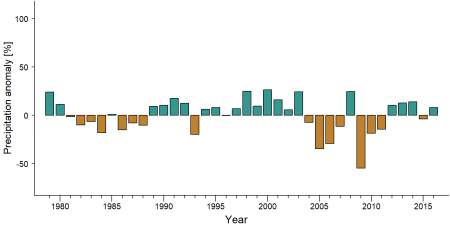
Precipitation anomaly in Lake Piso Multiple Sustainable Use Reserve -
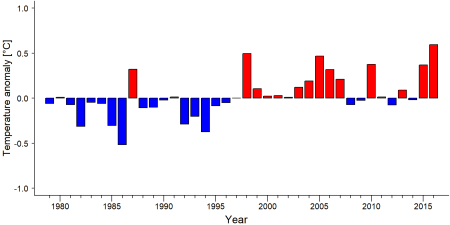
Temperature anomaly in Lake Piso Multiple Sustainable Use Reserve


External links
References
BirdLife International. 2019. Important Bird Areas factsheet: Lake Piso (Cape Mount). Online: http://www.birdlife.org
Fauna & Flora of Liberia. 2015. Online: http://www.liberianfaunaflora.org/research/sapo-conservation-centre/7653-lake-piso link
Ramsar. 2003. Liberia joins the Ramsar Convention. Online: https://www.ramsar.org/news/liberia-joins-the-ramsar-convention
Sambolah, S. R. (2007). Biodiversity and environmental impacts of human activities on the proposed Lake Piso Nature Reserve. Farmers Associated to Conserve the Environment (FACE); Critical Ecosystem Partnership Fund (CEPF).
SGPa. 2019. Promoting Sustainable Fishery In The Lake Piso Basin Multiple Sustainable Use Reserve Without Reducing The Protected And Endangered Species To Maintain Their Population. Online: https://sgp.undp.org/spacial-itemid-projects-landing-page/spacial-itemid-project-search-results/spacial-itemid-project-detailpage.html?view=projectdetail&id=24555
SGPb. 2019. Promoting Sustainable Community Forestry Management in the Lake Piso Sustainable Multipurpose Use Reserve, Liberia. Online: https://sgp.undp.org/spacial-itemid-projects-landing-page/spacial-itemid-project-search-results/spacial-itemid-project-detailpage.html?view=projectdetail&id=21597
SGPc. 2019.Preventing organic pollution of Lake Piso; a catalyst for clean environment. Online: https://sgp.undp.org/spacial-itemid-projects-landing-page/spacial-itemid-project-search-results/spacial-itemid-project-detailpage.html?view=projectdetail&id=24550
Spalding, M., Kainuma, M. and Collins, L. 2010. World atlas of mangroves. Earthscan, London.
The Analyst News. 2018. YES Visits Lake Piso Multiple Use Reserve in Robertsport. Online: https://liberiananalyst.com/2018/11/14/yes-visits-lake-piso-multiple-use-reserve-in-robertsport/
Tweh, C. G., Lormie, M. M., Kouakou, C. Y., Hillers, A., Kühl, H. S., & Junker, J. (2015). Conservation status of chimpanzees Pan troglodytes verus and other large mammals in Liberia: a nationwide survey. Oryx, 49(4), 710-718. doi:10.1017/s0030605313001191
Kiribou, R., Tehoda, P., Chukwu, O., Bempah, G., Kühl, H. S., Ferreira, J., …, & Heinicke, S. (2024). Exposure of African ape sites to climate change impacts. PLOS Climate, 3(2), e0000345. doi:10.1371/journal.pclm.0000345
Page created by: APES Atlas Team Date: 2023-11-03