
UFA 10-064 ZIC31: Difference between revisions
No edit summary |
No edit summary Tag: Manual revert |
||
| (6 intermediate revisions by the same user not shown) | |||
| Line 17: | Line 17: | ||
= Site characteristics = | = Site characteristics = | ||
UFA 10-064/ZIC 31, part of the transboundary Sangha Trinational (TNS) UNESCO World Heritage Site, is a biodiversity hotspot that supports endangered species such as gorillas, chimpanzees, elephants, duikers, buffaloes, pangolins, and various primates like colobus monkeys and gray-cheeked mangabeys, as documented in wildlife inventories from 2015 and 2018. This ecologically significant region provides critical habitat for species threatened by poaching and habitat loss, while its dense subtropical/tropical moist lowland forests play a vital role in carbon sequestration, helping to mitigate climate change. With over two decades of conservation efforts, including biodiversity monitoring and sustainable management of overlapping forest management units and hunting zones, the area also holds cultural value for Indigenous peoples and local communities who rely on it for traditional practices, subsistence activities, and sacred sites. As a buffer zone adjacent to Lobéké National Park, it enhances regional biodiversity conservation; however, it faces ongoing threats from illegal poaching, logging, mining, and the escalating impacts of climate change and human encroachment, underscoring the urgent need for continued conservation action (Beukou et al. 2019). | UFA 10-064/ZIC 31, part of the transboundary Sangha Trinational (TNS) UNESCO World Heritage Site, is a biodiversity hotspot that supports endangered species such as gorillas, chimpanzees, elephants, duikers, buffaloes, pangolins, and various primates like colobus monkeys and gray-cheeked mangabeys, as documented in wildlife inventories from 2015 and 2018. This ecologically significant region provides critical habitat for species threatened by poaching and habitat loss, while its dense subtropical/tropical moist lowland forests play a vital role in carbon sequestration, helping to mitigate climate change. With over two decades of conservation efforts, including biodiversity monitoring and sustainable management of overlapping forest management units and hunting zones, the area also holds cultural value for Indigenous peoples and local communities who rely on it for traditional practices, subsistence activities, and sacred sites. As a buffer zone adjacent to Lobéké National Park, it enhances regional biodiversity conservation; however, it faces ongoing threats from illegal poaching, logging, mining, and the escalating impacts of climate change and human encroachment, underscoring the urgent need for continued conservation action ([[#R01849|Beukou et al. 2019]]). | ||
| Line 71: | Line 71: | ||
|Line transects | |Line transects | ||
|Distance sampling with adopted decay time | |Distance sampling with adopted decay time | ||
|Beukou et al. 2019, WWF Cameroon | |[[#R01849|Beukou et al. 2019]], WWF Cameroon | ||
|47 transects were covered and an effort of 94km was made. | |47 transects were covered and an effort of 94km was made. | ||
| | |CMR0058, CMR0128<div class="mw-collapsible mw-collapsed" data-expandtext="+5 more" data-collapsetext="less">CMR0132, CMR0135, CMR0138, CMR0150, CMR0153</div> | ||
|- | |- | ||
|''Gorilla gorilla gorilla'' | |''Gorilla gorilla gorilla'' | ||
| Line 84: | Line 84: | ||
|Line transects | |Line transects | ||
|Distance sampling with adopted decay time | |Distance sampling with adopted decay time | ||
|Beukou et al. 2019, WWF Cameroon | |[[#R01849|Beukou et al. 2019]], WWF Cameroon | ||
|The highest densities of great apes are found in ZIC 31. These increases in average values are due to the fact that great apes are not among the primary targets of poaching in the area. Additionally, they benefit from local customs and traditions that prohibit the consumption of gorilla and chimpanzee meat in the Lobéké area. | |The highest densities of great apes are found in ZIC 31. These increases in average values are due to the fact that great apes are not among the primary targets of poaching in the area. Additionally, they benefit from local customs and traditions that prohibit the consumption of gorilla and chimpanzee meat in the Lobéké area. | ||
| | |CMR0058, CMR0128<div class="mw-collapsible mw-collapsed" data-expandtext="+5 more" data-collapsetext="less">CMR0132, CMR0135, CMR0138, CMR0150, CMR0153</div> | ||
|- | |- | ||
| | |''Gorilla gorilla gorilla'' | ||
|2015 | |2015 | ||
| | | | ||
| | | | ||
|2. | |2.04 (1.12-3.72) | ||
|2, | |2,365 (1,297-4,312) | ||
|UFA 10-064_ZIC31 | |UFA 10-064_ZIC31 | ||
|Line transects | |Line transects | ||
|Distance sampling with adopted decay time | |Distance sampling with adopted decay time | ||
|Beukou et al. 2019, WWF Cameroon | |[[#R01849|Beukou et al. 2019]], WWF Cameroon | ||
| | | | ||
|CMR0058, CMR0128<div class="mw-collapsible mw-collapsed" data-expandtext="+5 more" data-collapsetext="less">CMR0132, CMR0135, CMR0138, CMR0150, CMR0153</div> | |||
|- | |- | ||
|''Gorilla gorilla gorilla'' | |''Pan troglodytes troglodytes'' & ''Gorilla gorilla gorilla'' | ||
|2015 | |2015 | ||
| | | | ||
| | | | ||
|2. | |2.14 (1.25-3.70) | ||
|2, | |2,491 (1,445-4,294) | ||
|UFA 10-064_ZIC31 | |UFA 10-064_ZIC31 | ||
|Line transects | |Line transects | ||
|Distance sampling with adopted decay time | |Distance sampling with adopted decay time | ||
|Beukou et al. 2019, WWF Cameroon | |[[#R01849|Beukou et al. 2019]], WWF Cameroon | ||
| | |Between 2014 and 2015, 54 transects were covered with and effort of 147km. | ||
| | |CMR0058, CMR0128<div class="mw-collapsible mw-collapsed" data-expandtext="+5 more" data-collapsetext="less">CMR0132, CMR0135, CMR0138, CMR0150, CMR0153</div> | ||
|} | |} | ||
| Line 132: | Line 132: | ||
|3.2 Mining & quarrying | |3.2 Mining & quarrying | ||
|High (more than 70% of population affected) | |High (more than 70% of population affected) | ||
|Mining on the periphery of the park destroys or disturbs the natural wildlife habitats (Beukou et al. 2019). | |Mining on the periphery of the park destroys or disturbs the natural wildlife habitats ([[#R01849|Beukou et al. 2019]]). | ||
|2002-Ongoing (2018) | |2002-Ongoing (2018) | ||
|- | |- | ||
| Line 138: | Line 138: | ||
|5.1 Hunting & collecting terrestrial animals | |5.1 Hunting & collecting terrestrial animals | ||
|Medium (30-70% of population affected) | |Medium (30-70% of population affected) | ||
|Presence of sport hunting on the periphery of the park does not respect sustainable management principles (Beukou et al. 2019). | |Presence of sport hunting on the periphery of the park does not respect sustainable management principles ([[#R01849|Beukou et al. 2019]]). | ||
|2002-Ongoing (2018 | |2002-Ongoing (2018 | ||
|- | |- | ||
| Line 144: | Line 144: | ||
|5.1 Hunting & collecting terrestrial animals | |5.1 Hunting & collecting terrestrial animals | ||
|High (more than 70% of population affected) | |High (more than 70% of population affected) | ||
|The illegal circulation of weapons in the TNS landscape intensifies the high poaching of elephants for ivory trade as well as gorilla andchimpanzees, although elephants remain the main target (Beukou et al. 2019). | |The illegal circulation of weapons in the TNS landscape intensifies the high poaching of elephants for ivory trade as well as gorilla andchimpanzees, although elephants remain the main target ([[#R01849|Beukou et al. 2019]]). | ||
|2002-Ongoing (2018) | |2002-Ongoing (2018) | ||
|- | |- | ||
| Line 150: | Line 150: | ||
|5.3 Logging & wood harvesting | |5.3 Logging & wood harvesting | ||
|High (more than 70% of population affected) | |High (more than 70% of population affected) | ||
|Logging on the periphery of the park, which destroy and/or disturb natural wildlife habitats (Beukou et al. 2019). The presence of human activities, such as logging, threatens the integrity of forest habitats of the Lobeke landscape (Beukou et al. 2019). | |Logging on the periphery of the park, which destroy and/or disturb natural wildlife habitats ([[#R01849|Beukou et al. 2019]]). The presence of human activities, such as logging, threatens the integrity of forest habitats of the Lobeke landscape ([[#R01849|Beukou et al. 2019]]). | ||
|2014-Ongoing (2018) | |2014-Ongoing (2018) | ||
|} | |} | ||
| Line 170: | Line 170: | ||
|2 Counter-wildlife crime | |2 Counter-wildlife crime | ||
|2.11 Implement monitoring surveillance strategies (e.g., SMART) or use monitoring data to improve effectiveness of patrols | |2.11 Implement monitoring surveillance strategies (e.g., SMART) or use monitoring data to improve effectiveness of patrols | ||
|Conservation efforts in UFA 10-064 (ZIC 31) include wildlife population surveys using transect sampling methods to estimate densities of gorillas and chimpanzees. These efforts also assess habitat use, pressures from human activities, and the impact of conservation strategies. The surveys focus on understanding species distribution and the effects of poaching and habitat degradation (Beukou et al. 2019). | |Conservation efforts in UFA 10-064 (ZIC 31) include wildlife population surveys using transect sampling methods to estimate densities of gorillas and chimpanzees. These efforts also assess habitat use, pressures from human activities, and the impact of conservation strategies. The surveys focus on understanding species distribution and the effects of poaching and habitat degradation ([[#R01849|Beukou et al. 2019]]). | ||
|WWF Cameroon - Jengi-TNS Program, Cameroon Ministry of Forestry and Wildlife (MINFOF) | |WWF Cameroon - Jengi-TNS Program, Cameroon Ministry of Forestry and Wildlife (MINFOF) | ||
|2002-Ongoing (2019) | |2002-Ongoing (2019) | ||
| Line 190: | Line 190: | ||
|3 Engaged community | |3 Engaged community | ||
|3.1 General lack of community engagement or support | |3.1 General lack of community engagement or support | ||
|Beuko et al. 2019 | |[[#R01849|Beuko et al. 2019]] | ||
|2014-Ongoing (2019) | |2014-Ongoing (2019) | ||
|} | |} | ||
| Line 209: | Line 209: | ||
|2 Resources and capacity | |2 Resources and capacity | ||
|2.6 External partnerships that add expertise or resources | |2.6 External partnerships that add expertise or resources | ||
|Beuko et al. 2019 | |[[#R01849|Beuko et al. 2019]] | ||
|2014-Ongoing (2019) | |2014-Ongoing (2019) | ||
|- | |- | ||
|3 Engaged community | |3 Engaged community | ||
|3.2 Local taboos in favor of conservation | |3.2 Local taboos in favor of conservation | ||
|Beuko et al. 2019 | |[[#R01849|Beuko et al. 2019]] | ||
|2014-Ongoing (2019) | |2014-Ongoing (2019) | ||
|- | |- | ||
|3 Engaged community | |3 Engaged community | ||
|3.6 Local community engagement and support | |3.6 Local community engagement and support | ||
|Beuko et al. 2019 | |[[#R01849|Beuko et al. 2019]] | ||
|2014-Ongoing (2019) | |2014-Ongoing (2019) | ||
|- | |- | ||
|4 Institutional support | |4 Institutional support | ||
|4.2 Strong government support | |4.2 Strong government support | ||
|Beuko et al. 2019 | |[[#R01849|Beuko et al. 2019]] | ||
|2014-Ongoing (2019) | |2014-Ongoing (2019) | ||
|} | |} | ||
| Line 256: | Line 256: | ||
| | | | ||
| | | | ||
|Beuko et al. 2019 | |[[#R01849|Beuko et al. 2019]] | ||
| | | | ||
| | | | ||
| Line 266: | Line 266: | ||
| | | | ||
| | | | ||
|Beuko et al. 2019 | |[[#R01849|Beuko et al. 2019]] | ||
| | | | ||
| | | | ||
| Line 276: | Line 276: | ||
| | | | ||
| | | | ||
|Beuko et al. 2019 | |[[#R01849|Beuko et al. 2019]] | ||
| | | | ||
| | | | ||
| Line 286: | Line 286: | ||
| | | | ||
| | | | ||
|Beuko et al. 2019 | |[[#R01849|Beuko et al. 2019]] | ||
| | | | ||
| | | | ||
| Line 296: | Line 296: | ||
= Exposure to climate change impacts = | = Exposure to climate change impacts = | ||
As part of a study on the exposure of African great ape sites to climate change impacts, Kiribou et al. | As part of a study on the exposure of African great ape sites to climate change impacts, [[#R02332|Kiribou et al. (2024)]] extracted climate data and data on projected extreme climate impact events for the site. Climatological characteristics were derived from observation-based climate data provided by the Inter-Sectoral Impact Model Intercomparison Project (ISIMIP, www.isimip.org). Parameters were calculated as the average across each 30-year period. For 1981-2010, the EWEMBI dataset from ISIMIP2a was used. For the two future periods (2021-2050 and 2071-2099) ISIMIP2b climate data based on four CMIP5 global climate models were used. For future projections, two Representative Concentration Pathways (RCP) were used. RCP 2.6 is a scenario with strong mitigation measures in which global temperatures would likely rise below 2C. RCP 6.0 is a scenario with medium emissions in which global temperatures would likely rise up to 3C by 2100. For the number of days with heavy precipitation events, the 98th percentile of all precipitation days (>1mm/d) was calculated for the 1979-2013 reference period as a threshold for a heavy precipitation event. Then, for each year, the number of days above that threshold was derived. The figures on temperature and precipitation anomaly show the deviation from the mean temperature and mean precipitation for the 1979-2013 reference period. | ||
The estimated exposure to future extreme climate impact events (crop failure, drought, river flood, wildfire, tropical cyclone, and heatwave) is based on a published dataset by Lange et al. 2020 derived from ISIMIP2b data. The same global climate models and RCPs as described above were used. Within each 30-year period, the number of years with an extreme event and the average proportion of the site affected were calculated ( | The estimated exposure to future extreme climate impact events (crop failure, drought, river flood, wildfire, tropical cyclone, and heatwave) is based on a published dataset by Lange et al. 2020 derived from ISIMIP2b data. The same global climate models and RCPs as described above were used. Within each 30-year period, the number of years with an extreme event and the average proportion of the site affected were calculated ([[#R02332|Kiribou et al. 2024]]). | ||
'''Table 8. Estimated past and projected climatological characteristics in UFA 10-064_ZIC31''' | '''Table 8. Estimated past and projected climatological characteristics in UFA 10-064_ZIC31''' | ||
| Line 421: | Line 421: | ||
= References = | = References = | ||
Beukou, B., Sombambo, M., Nzooh, Z., | <span id="R01849"></span>Beukou, B., Sombambo, M., Nzooh, Z., N'Goran, K. P., Hessana, D., Sebogo, L., & Mengamenya, A. (2019). Dynamique des populations de grands et moyens mammiferes dans le segment Cameroun du paysage Tri-National dela Sangha. WWF Report and MINFOP. | ||
<span id="R02332"></span>Kiribou, R., Tehoda, P., Chukwu, O., Bempah, G., Kühl, H. S., Ferreira, J., …, & Heinicke, S. (2024). Exposure of African ape sites to climate change impacts. ''PLOS Climate'', 3(2), e0000345. [https://doi.org/10.1371/journal.pclm.0000345 doi:10.1371/journal.pclm.0000345] | |||
'''Page created by: '''Onella Mundi''' Date:''' 2024-11-27 09:30:00 | '''Page created by: '''Onella Mundi''' Date:''' 2024-11-27 09:30:00 | ||
Latest revision as of 17:55, 15 October 2026
Central Africa > Cameroon > UFA 10-064_ZIC31
Français | Português | Español | Bahasa Indonesia | Melayu
Summary
- Central chimpanzees (Pan troglodytes troglodytes) & western lowland gorillas (Gorilla gorilla gorilla) are present in UFA 10-064_ZIC31.
- In 2018, it was estimated that 2,270 gorillas inhabit the site.
- The population trend is unknown.
Site characteristics
UFA 10-064/ZIC 31, part of the transboundary Sangha Trinational (TNS) UNESCO World Heritage Site, is a biodiversity hotspot that supports endangered species such as gorillas, chimpanzees, elephants, duikers, buffaloes, pangolins, and various primates like colobus monkeys and gray-cheeked mangabeys, as documented in wildlife inventories from 2015 and 2018. This ecologically significant region provides critical habitat for species threatened by poaching and habitat loss, while its dense subtropical/tropical moist lowland forests play a vital role in carbon sequestration, helping to mitigate climate change. With over two decades of conservation efforts, including biodiversity monitoring and sustainable management of overlapping forest management units and hunting zones, the area also holds cultural value for Indigenous peoples and local communities who rely on it for traditional practices, subsistence activities, and sacred sites. As a buffer zone adjacent to Lobéké National Park, it enhances regional biodiversity conservation; however, it faces ongoing threats from illegal poaching, logging, mining, and the escalating impacts of climate change and human encroachment, underscoring the urgent need for continued conservation action (Beukou et al. 2019).
Table 1. Basic site information for UFA 10-064_ZIC31
| Species | Pan troglodytes troglodytes, Gorilla gorilla gorilla |
| Area | 1,159.17 km² |
| Coordinates | Lat: 1.955004 , Lon: 15.927939 |
| Type of site | Logging concession and community managed hunting interest zone |
| Habitat types | Subtropical/tropical moist lowland forest |
| Type of governance | Shared governance |
Types of sites Governance types Habitat types
Ape status
Table 2. Ape population estimates reported for UFA 10-064_ZIC31
| Species | Year | Occurrence | Encounter or vistation rate (nests/km; ind/day) | Density estimate [ind./ km²] (95% CI) | Abundance estimate (95% CI) | Survey area | Sampling method | Analytical framework | Source | Comments | A.P.E.S. database ID |
|---|---|---|---|---|---|---|---|---|---|---|---|
| Pan troglodytes troglodytes & Gorilla gorilla gorilla | 2018 | 2.20 (1.49-3.26) | 2,556 (1,729-3,778) | UFA 10-064_ZIC31 | Line transects | Distance sampling with adopted decay time | Beukou et al. 2019, WWF Cameroon | 47 transects were covered and an effort of 94km was made. | CMR0058, CMR0128 CMR0132, CMR0135, CMR0138, CMR0150, CMR0153
| ||
| Gorilla gorilla gorilla | 2018 | 2.70 (1.64-4.45) | 2,270 (1,378-3,738) | UFA 10-064_ZIC31 | Line transects | Distance sampling with adopted decay time | Beukou et al. 2019, WWF Cameroon | The highest densities of great apes are found in ZIC 31. These increases in average values are due to the fact that great apes are not among the primary targets of poaching in the area. Additionally, they benefit from local customs and traditions that prohibit the consumption of gorilla and chimpanzee meat in the Lobéké area. | CMR0058, CMR0128 CMR0132, CMR0135, CMR0138, CMR0150, CMR0153
| ||
| Gorilla gorilla gorilla | 2015 | 2.04 (1.12-3.72) | 2,365 (1,297-4,312) | UFA 10-064_ZIC31 | Line transects | Distance sampling with adopted decay time | Beukou et al. 2019, WWF Cameroon | CMR0058, CMR0128 CMR0132, CMR0135, CMR0138, CMR0150, CMR0153
| |||
| Pan troglodytes troglodytes & Gorilla gorilla gorilla | 2015 | 2.14 (1.25-3.70) | 2,491 (1,445-4,294) | UFA 10-064_ZIC31 | Line transects | Distance sampling with adopted decay time | Beukou et al. 2019, WWF Cameroon | Between 2014 and 2015, 54 transects were covered with and effort of 147km. | CMR0058, CMR0128 CMR0132, CMR0135, CMR0138, CMR0150, CMR0153
|
Sampling methods Analytical frameworks
Threats
Table 3. Threats to apes reported for UFA 10-064_ZIC31
| Category | Specific threats | Threat level | Description | Year of threat |
|---|---|---|---|---|
| 3 Energy production & mining | 3.2 Mining & quarrying | High (more than 70% of population affected) | Mining on the periphery of the park destroys or disturbs the natural wildlife habitats (Beukou et al. 2019). | 2002-Ongoing (2018) |
| 5 Biological resource use | 5.1 Hunting & collecting terrestrial animals | Medium (30-70% of population affected) | Presence of sport hunting on the periphery of the park does not respect sustainable management principles (Beukou et al. 2019). | 2002-Ongoing (2018 |
| 5 Biological resource use | 5.1 Hunting & collecting terrestrial animals | High (more than 70% of population affected) | The illegal circulation of weapons in the TNS landscape intensifies the high poaching of elephants for ivory trade as well as gorilla andchimpanzees, although elephants remain the main target (Beukou et al. 2019). | 2002-Ongoing (2018) |
| 5 Biological resource use | 5.3 Logging & wood harvesting | High (more than 70% of population affected) | Logging on the periphery of the park, which destroy and/or disturb natural wildlife habitats (Beukou et al. 2019). The presence of human activities, such as logging, threatens the integrity of forest habitats of the Lobeke landscape (Beukou et al. 2019). | 2014-Ongoing (2018) |
Conservation activities
Table 4. Conservation activities reported for UFA 10-064_ZIC31
| Category | Specific activity | Description | Implementing organization(s) | Year of activity |
|---|---|---|---|---|
| 2 Counter-wildlife crime | 2.11 Implement monitoring surveillance strategies (e.g., SMART) or use monitoring data to improve effectiveness of patrols | Conservation efforts in UFA 10-064 (ZIC 31) include wildlife population surveys using transect sampling methods to estimate densities of gorillas and chimpanzees. These efforts also assess habitat use, pressures from human activities, and the impact of conservation strategies. The surveys focus on understanding species distribution and the effects of poaching and habitat degradation (Beukou et al. 2019). | WWF Cameroon - Jengi-TNS Program, Cameroon Ministry of Forestry and Wildlife (MINFOF) | 2002-Ongoing (2019) |
Challenges
Table 5. Challenges reported for UFA 10-064_ZIC31
| Challenges | Specific challenges | Source | Year(s) |
|---|---|---|---|
| 3 Engaged community | 3.1 General lack of community engagement or support | Beuko et al. 2019 | 2014-Ongoing (2019) |
Enablers
Table 6. Enablers reported for UFA 10-064_ZIC31
| Enablers | Specific enablers | Source | Year(s) |
|---|---|---|---|
| 2 Resources and capacity | 2.6 External partnerships that add expertise or resources | Beuko et al. 2019 | 2014-Ongoing (2019) |
| 3 Engaged community | 3.2 Local taboos in favor of conservation | Beuko et al. 2019 | 2014-Ongoing (2019) |
| 3 Engaged community | 3.6 Local community engagement and support | Beuko et al. 2019 | 2014-Ongoing (2019) |
| 4 Institutional support | 4.2 Strong government support | Beuko et al. 2019 | 2014-Ongoing (2019) |
Research activities
Wildlife monitoring and research in the region focus on regular population assessments of gorillas and chimpanzees, including density estimation, habitat use, and the impact of human activities such as poaching and habitat degradation. Conducted by organizations like WWF Cameroon (Jengi-TNS Program), the Ministry of Forestry and Wildlife (MINFOF), and international partners such as USFWS and FTNS, these studies utilize methods like transect sampling and nest surveys to estimate population sizes and spatial distribution. Additionally, human-wildlife interaction studies, led by WWF Cameroon with support from local communities, assess the effects of activities like poaching, logging, and mining on great ape populations, aiming to develop management strategies that reduce human pressures and promote coexistence. Environmental and ecological research, carried out in collaboration with academic institutions, includes biodiversity surveys, analyses of gorilla and chimpanzee nest degradation rates, and habitat mapping to enhance understanding of ecosystem health and inform species conservation efforts (Beuko et al. 2019).
Documented behaviours
Table 7. Behaviours documented for UFA 10-064_ZIC31
| Category | Behavior | Observation type | Prevalence | Observation dates | Source | Habituation | Species | Comment |
|---|---|---|---|---|---|---|---|---|
| Nest-Building Behavior Behavior: Both gorillas and chimpanzees construct nests for resting, primarily observed at night. These nests are built in trees (chimpanzees) or on the ground (gorillas) using branches and leaves. | Beuko et al. 2019 | |||||||
| Feeding Behavior Behavior: Gorillas and chimpanzees forage on a variety of fruits, leaves, and other plant materials. Feeding signs, such as discarded fruit parts and broken branches, were frequently documented. | Beuko et al. 2019 | |||||||
| Social Grouping and Interaction Behavior: Evidence of group activity, such as multiple nests in proximity and vocalizations, indicates social interactions within gorilla troops and chimpanzee communities. | Beuko et al. 2019 | |||||||
| Territorial and Vocal Communication Behavior: Vocalizations, including hoots, screams, and chest-beating (gorillas), were documented as part of communication and territorial displays. | Beuko et al. 2019 |
Exposure to climate change impacts
As part of a study on the exposure of African great ape sites to climate change impacts, Kiribou et al. (2024) extracted climate data and data on projected extreme climate impact events for the site. Climatological characteristics were derived from observation-based climate data provided by the Inter-Sectoral Impact Model Intercomparison Project (ISIMIP, www.isimip.org). Parameters were calculated as the average across each 30-year period. For 1981-2010, the EWEMBI dataset from ISIMIP2a was used. For the two future periods (2021-2050 and 2071-2099) ISIMIP2b climate data based on four CMIP5 global climate models were used. For future projections, two Representative Concentration Pathways (RCP) were used. RCP 2.6 is a scenario with strong mitigation measures in which global temperatures would likely rise below 2C. RCP 6.0 is a scenario with medium emissions in which global temperatures would likely rise up to 3C by 2100. For the number of days with heavy precipitation events, the 98th percentile of all precipitation days (>1mm/d) was calculated for the 1979-2013 reference period as a threshold for a heavy precipitation event. Then, for each year, the number of days above that threshold was derived. The figures on temperature and precipitation anomaly show the deviation from the mean temperature and mean precipitation for the 1979-2013 reference period.
The estimated exposure to future extreme climate impact events (crop failure, drought, river flood, wildfire, tropical cyclone, and heatwave) is based on a published dataset by Lange et al. 2020 derived from ISIMIP2b data. The same global climate models and RCPs as described above were used. Within each 30-year period, the number of years with an extreme event and the average proportion of the site affected were calculated (Kiribou et al. 2024).
Table 8. Estimated past and projected climatological characteristics in UFA 10-064_ZIC31
| Value | 1981-2010 | 2021-2050, RCP 2.6 | 2021-2050, RCP 6.0 | 2071-2099, RCP 2.6 | 2071-2099, RCP 6.0 |
|---|---|---|---|---|---|
| Mean temperature [C] | 24.1 | 25.5 | 25.3 | 25.7 | 26.8 |
| Annual precipitation [mm] | 1523 | 1557 | 1562 | 1594 | 1568 |
| Max no. consecutive dry days (per year) | 20.7 | 11.9 | 13.5 | 11.1 | 13.2 |
| No. days with heavy precipitation (per year) | 6.6 | 8.8 | 9 | 9 | 9.8 |
Table 9. Projected exposure of apes to extreme climate impact events in UFA 10-064_ZIC31
| Type | No. of years with event (2021-2050, RCP 2.6) | % of site exposed (2021-2050, RCP 2.6) | No. of years with event (2021-2050, RCP 6.0) | % of site exposed (2021-2050, RCP 6.0) | No. of years with event (2070-2099, RCP 2.6) | % of site exposed (2070-2099, RCP 2.6) | No. of years with event (2070-2099, RCP 6.0) | % of site exposed (2070-2099, RCP 6.0) |
|---|---|---|---|---|---|---|---|---|
| Crop failure | 12 | 0.01 | 13.5 | 0.02 | 7 | 0 | 27.5 | 0.02 |
| Drought | 0 | 0 | 0 | 0 | 0 | 0 | 0 | 0 |
| Heatwave | 1 | 50 | 0 | 0 | 2.5 | 50 | 7 | 100 |
| River flood | 0.5 | 0.26 | 1.5 | 0.13 | 1.5 | 0.44 | 1 | 0.27 |
| Tropical cyclone | 0 | 0 | 0 | 0 | 0 | 0 | 0 | 0 |
| Wildfire | 30 | 0.43 | 30 | 0.49 | 29 | 0.39 | 29 | 0.41 |
-
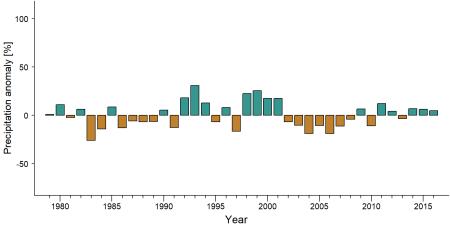
Precipitation anomaly in UFA 10-064_ZIC31 -
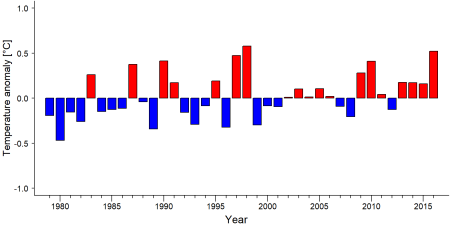
Temperature anomaly in UFA 10-064_ZIC31


External links
References
Beukou, B., Sombambo, M., Nzooh, Z., N'Goran, K. P., Hessana, D., Sebogo, L., & Mengamenya, A. (2019). Dynamique des populations de grands et moyens mammiferes dans le segment Cameroun du paysage Tri-National dela Sangha. WWF Report and MINFOP.
Kiribou, R., Tehoda, P., Chukwu, O., Bempah, G., Kühl, H. S., Ferreira, J., …, & Heinicke, S. (2024). Exposure of African ape sites to climate change impacts. PLOS Climate, 3(2), e0000345. doi:10.1371/journal.pclm.0000345
Page created by: Onella Mundi Date: 2024-11-27 09:30:00