
Taï National Park: Difference between revisions
No edit summary |
No edit summary |
||
| (6 intermediate revisions by the same user not shown) | |||
| Line 14: | Line 14: | ||
* A range of conservation activities are implemented, including permanent presence of researchers and tourists, anti-poaching patrols, environmental education and measures to prevent disease transmission to chimpanzees. | * A range of conservation activities are implemented, including permanent presence of researchers and tourists, anti-poaching patrols, environmental education and measures to prevent disease transmission to chimpanzees. | ||
* Taï National Park is the largest remaining forest block in the Upper Guinea Region and is home to one of the longest-running chimpanzee research sites. | * Taï National Park is the largest remaining forest block in the Upper Guinea Region and is home to one of the longest-running chimpanzee research sites. | ||
[[File: CIV_Tai_chimpanzee_Sonja_Metzger_WCF.jpg | 400px | thumb| none | Chimpanzees, Taï National Park (Côte d’Ivoire) © Sonja Metzger/WCF]] | [[File: CIV_Tai_chimpanzee_Sonja_Metzger_WCF.jpg | 400px | thumb| none | Chimpanzees, Taï National Park (Côte d’Ivoire) © Sonja Metzger/WCF]] | ||
= Site characteristics = | = Site characteristics = | ||
Taï National Park (IUCN category: II) was created in 1972 and proclaimed a UNESCO world heritage site in 1982 (Criteria iii, iv, [http://whc.unesco.org/en/list/195 UNESCO 2019a]). The park is located in south-western Côte d'Ivoire (5°15'-6°07'N, 7°25'-7°54'W), approximately 200 km south of Man and 100 km from the coast. With a size of 5,0812 km², it is the largest protected forest block in Côte d’Ivoire and one of the last tropical lowland forests in the Upper Guinea Region. The topography is mostly flat, but some Inselbergs occur. The majority of the forest in the park has never been logged and this mature, old-growth forest supports a rich diversity of species. It has been estimated that around 1,300 plant species occur in the park, 80-150 are endemic to the Upper Guinea region (BirdLife International 2019). Because of its diversity of bird species, notably white-breasted guinea fowl (''Agelastes meleagrides'') and large hornbill species, it is considered an Important Bird Area (BirdLife International 2019). Primate species recorded in the park include olive colobus (''Procolobus verus''), western red colobus (''Piliocolobus badius''), king colobus (''Colobus polykomos''), and Diana monkey (''Cercopithecus diana''). Other mammal species include the Pel's flying squirrel (''Anomalurus peli''), forest elephant (''Loxodonta africana ''), pygmy hippopotamus (''Choeropsis liberiensis''), Water chevrotain (''Hyemoschus aquaticus''), African buffalo (''Syncerus caffer''), and a range of duikers, including Maxwell's duiker (''Philantomba maxwellii''), black duiker (''Cephalophus niger''), zebra duiker (''Cephalophus zebra''), and Jentink's duiker (''Cephalophus jentinki''). Reptile species include (''Crocodylus cataphractus'') and African dwarf crocodile (''Osteolaemus tetraspis''), Home's hinge-back tortoise (''Kinixys homeana''). | Taï National Park (IUCN category: II) was created in 1972 and proclaimed a UNESCO world heritage site in 1982 (Criteria iii, iv, [http://whc.unesco.org/en/list/195 UNESCO 2019a]). The park is located in south-western Côte d'Ivoire (5°15'-6°07'N, 7°25'-7°54'W), approximately 200 km south of Man and 100 km from the coast. With a size of 5,0812 km², it is the largest protected forest block in Côte d’Ivoire and one of the last tropical lowland forests in the Upper Guinea Region. The topography is mostly flat, but some Inselbergs occur. The majority of the forest in the park has never been logged and this mature, old-growth forest supports a rich diversity of species. It has been estimated that around 1,300 plant species occur in the park, 80-150 are endemic to the Upper Guinea region ([[#R01748|BirdLife International 2019]]). Because of its diversity of bird species, notably white-breasted guinea fowl (''Agelastes meleagrides'') and large hornbill species, it is considered an Important Bird Area ([[#R01748|BirdLife International 2019]]). Primate species recorded in the park include olive colobus (''Procolobus verus''), western red colobus (''Piliocolobus badius''), king colobus (''Colobus polykomos''), and Diana monkey (''Cercopithecus diana''). Other mammal species include the Pel's flying squirrel (''Anomalurus peli''), forest elephant (''Loxodonta africana ''), pygmy hippopotamus (''Choeropsis liberiensis''), Water chevrotain (''Hyemoschus aquaticus''), African buffalo (''Syncerus caffer''), and a range of duikers, including Maxwell's duiker (''Philantomba maxwellii''), black duiker (''Cephalophus niger''), zebra duiker (''Cephalophus zebra''), and Jentink's duiker (''Cephalophus jentinki''). Reptile species include (''Crocodylus cataphractus'') and African dwarf crocodile (''Osteolaemus tetraspis''), Home's hinge-back tortoise (''Kinixys homeana''). | ||
Taï National Park is home to one of the longest-running chimpanzee research sites. Since 1979, the behavior and ecology of chimpanzees has been studied by the [https://www.eva.mpg.de/primat/research-groups/chimpanzees/field-sites/tai-chimpanzee-project.html Taï Chimpanzee Project]. Research has also been ongoing for several decades at the [https://www.taimonkeys.org/#! Taï Monkey Project]. Taï National Park is managed by the Office Ivoirien des Parcs et Réserves (OIPR). There are two eco-tourism sites, one near the town of Taï (managed by WCF, www.ecotourismetai.com) and one near Djouroutou Ecotel Touraco (managed by a private manager, Mr. Louis DIAKITE). | Taï National Park is home to one of the longest-running chimpanzee research sites. Since 1979, the behavior and ecology of chimpanzees has been studied by the [https://www.eva.mpg.de/primat/research-groups/chimpanzees/field-sites/tai-chimpanzee-project.html Taï Chimpanzee Project]. Research has also been ongoing for several decades at the [https://www.taimonkeys.org/#! Taï Monkey Project]. Taï National Park is managed by the Office Ivoirien des Parcs et Réserves (OIPR). There are two eco-tourism sites, one near the town of Taï (managed by WCF, www.ecotourismetai.com) and one near Djouroutou Ecotel Touraco (managed by a private manager, Mr. Louis DIAKITE). | ||
| Line 50: | Line 46: | ||
= Ape status = | = Ape status = | ||
Since 2005 annual surveys on western chimpanzees have been implemented by OIPR and the [https://www.wildchimps.org/index.html Wild Chimpanzee Foundation (WCF)]. Estimated chimpanzee abundance ranges between 300-800 individuals and the population seems to be stable (Campbell et al. 2008). Since 2016, the WCF has used camera traps to systematically monitor biodiversity in 200 km² in the Taï National Park (Cappelle et al. 2019). | Since 2005 annual surveys on western chimpanzees have been implemented by OIPR and the [https://www.wildchimps.org/index.html Wild Chimpanzee Foundation (WCF)]. Estimated chimpanzee abundance ranges between 300-800 individuals and the population seems to be stable ([[#R01751|Campbell et al. 2008]]). Since 2016, the WCF has used camera traps to systematically monitor biodiversity in 200 km² in the Taï National Park ([[#R01752|Cappelle et al. 2019]]). | ||
'''Table 2. Ape population estimates reported for Taï National Park''' | '''Table 2. Ape population estimates reported for Taï National Park''' | ||
| Line 66: | Line 62: | ||
!Comments | !Comments | ||
!A.P.E.S. database ID | !A.P.E.S. database ID | ||
|- | |||
|''Pan troglodytes verus'' | |||
|2008 | |||
| | |||
|0.91 | |||
|0.10 (0.06-0.16) | |||
|516 (314-847) | |||
|Taï National Park | |||
|Line transects | |||
| | |||
|[[#R01770|N'Goran et al. 2008]] | |||
| | |||
|CIV0062 | |||
|- | |- | ||
|''Pan troglodytes verus'' | |''Pan troglodytes verus'' | ||
| Line 76: | Line 85: | ||
|Informed guess | |Informed guess | ||
| | | | ||
|Soiret et al. 2015, Luncz et al. 2019, Proffitt et al. 2022 | |[[#R01775|Soiret et al. 2015]], [[#R01765|Luncz et al. 2019]], [[#R01782|Proffitt et al. 2022]] | ||
| | | | ||
| | | | ||
| Line 89: | Line 98: | ||
|Line transects | |Line transects | ||
| | | | ||
|Tiédoué et al. 2016 | |[[#R01778|Tiédoué et al. 2016]] | ||
| | | | ||
|CIV0062, CIV0065 | |||
|- | |- | ||
|''Pan troglodytes verus'' | |''Pan troglodytes verus'' | ||
| Line 102: | Line 111: | ||
|Line transects | |Line transects | ||
| | | | ||
|Tiédoué et al. 2015 | |[[#R01780|Tiédoué et al. 2015]] | ||
| | | | ||
|CIV0062 | |||
|- | |- | ||
|''Pan troglodytes verus'' | |''Pan troglodytes verus'' | ||
| Line 115: | Line 124: | ||
|Line transects | |Line transects | ||
| | | | ||
|Tiédoué et al. 2014 | |[[#R01779|Tiédoué et al. 2014]] | ||
| | | | ||
|CIV0062 | |||
|- | |- | ||
|''Pan troglodytes verus'' | |''Pan troglodytes verus'' | ||
| Line 128: | Line 137: | ||
|Line transects | |Line transects | ||
| | | | ||
|Tiédoué et al. 2013 | |[[#R01781|Tiédoué et al. 2013]] | ||
| | | | ||
|CIV0062 | |||
|- | |- | ||
|''Pan troglodytes verus'' | |''Pan troglodytes verus'' | ||
| Line 141: | Line 150: | ||
|Line transects | |Line transects | ||
| | | | ||
|Yapi et al. 2012 | |[[#R01793|Yapi et al. 2012]] | ||
| | | | ||
|CIV0062 | |||
|- | |- | ||
|''Pan troglodytes verus'' | |''Pan troglodytes verus'' | ||
| Line 154: | Line 163: | ||
|Line transects | |Line transects | ||
| | | | ||
|N'Goran et al. 2011 | |[[#R01773|N'Goran et al. 2011]] | ||
| | | | ||
|CIV0062 | |||
|- | |- | ||
|''Pan troglodytes verus'' | |''Pan troglodytes verus'' | ||
| Line 167: | Line 176: | ||
|Line transects | |Line transects | ||
| | | | ||
|N'Goran et al. 2010 | |[[#R02087|N'Goran et al. 2010]] | ||
| | | | ||
|LBR0041 | |||
|- | |- | ||
|''Pan troglodytes verus'' | |''Pan troglodytes verus'' | ||
| Line 180: | Line 189: | ||
|Line transects | |Line transects | ||
| | | | ||
| | |[[#R01771|N'Goran et al. 2009a]] | ||
|N'Goran et al. | |||
| | | | ||
| | | | ||
| Line 206: | Line 202: | ||
|Line transects | |Line transects | ||
| | | | ||
|N'Goran et al. | |[[#R01769|N'Goran et al. 2007b]] | ||
| | | | ||
|CIV0062 | |||
|- | |- | ||
|''Pan troglodytes verus'' | |''Pan troglodytes verus'' | ||
| Line 228: | Line 224: | ||
= Threats = | = Threats = | ||
Illegal poaching represents the major threat to the chimpanzee population in the park. Habitat destruction by agriculture, illegal logging and gold mining in some areas of the park also threatens the long-term existence of chimpanzees. Furthermore, long-term research by the Taï Chimpanzee Project and the Robert Koch Institute in Berlin confirmed that Ebola virus (Formenti et al., 1999), Anthrax (Leendertz et al. 2004) and respiratory diseases of human origin (Köndgen et al., 2008) killed a considerable number of chimpanzees. | Illegal poaching represents the major threat to the chimpanzee population in the park. Habitat destruction by agriculture, illegal logging and gold mining in some areas of the park also threatens the long-term existence of chimpanzees. Furthermore, long-term research by the Taï Chimpanzee Project and the Robert Koch Institute in Berlin confirmed that Ebola virus (Formenti et al., 1999), Anthrax ([[#R01763|Leendertz et al. 2004]]) and respiratory diseases of human origin ([[#R01759|Köndgen et al., 2008]]) killed a considerable number of chimpanzees. | ||
While human population density was low in the 1970s when the park was created it has grown considerably afterwards, resulting in increasing pressure on the park, especially since the arrival of refugees from Liberia during the civil war (BirdLife International 2019). All forest around Taï has been cleared. | While human population density was low in the 1970s when the park was created it has grown considerably afterwards, resulting in increasing pressure on the park, especially since the arrival of refugees from Liberia during the civil war ([[#R01748|BirdLife International 2019]]). All forest around Taï has been cleared. | ||
'''Table 3. Threats to apes reported for Taï National Park''' | '''Table 3. Threats to apes reported for Taï National Park''' | ||
| Line 239: | Line 235: | ||
!Description | !Description | ||
!Year of threat | !Year of threat | ||
|- | |||
|2 Agriculture & aquaculture | |||
|2.1 Annual & perennial non-timber crops | |||
|Low (up to 30% of population affected) | |||
|Cocoa and rice field in the eastern side of the park ([[#R01778|Tiédoué et al. 2016]]). | |||
|Ongoing (2016) | |||
|- | |||
|3 Energy production & mining | |||
|3.2 Mining & quarrying | |||
|Medium (30-70% of population affected) | |||
|Artisanal gold mining ([[#R01778|Tiédoué et al. 2016]], [[#R01785|UNESCO 2019b]]). The proliferation of gold panning activities in localities surrounding the park is endangering the chimpanzee community in the Djouroutou sector (Soiret pers. obs. 2022). | |||
|2016-Ongoing (2023) | |||
|- | |||
|4 Transportation & service corridors | |||
|4.1 Roads & railroads | |||
|Medium (30-70% of population affected) | |||
|Trails used by poachers ([[#R01778|Tiédoué et al. 2016]]). | |||
|Ongoing (2016) | |||
|- | |||
|5 Biological resource use | |||
|5.1 Hunting & collecting terrestrial animals | |||
|High (more than 70% of population affected) | |||
|Poaching is widespread throughout the park ([[#R01778|Tiédoué et al. 2016]], [[#R01785|UNESCO 2019b]]). | |||
|2016-Ongoing (2019) | |||
|- | |- | ||
|8 Invasive & other problematic species, genes & diseases | |8 Invasive & other problematic species, genes & diseases | ||
|8.4 Pathogens | |8.4 Pathogens | ||
|High (more than 70% of population affected) | |High (more than 70% of population affected) | ||
|Several chimpanzees died due to an Ebola Virus Disease (Taï Forest Ebolavirus) outbreak in the park in 1994 (Formenti et al. 1999). | |Several chimpanzees died due to an Ebola Virus Disease (Taï Forest Ebolavirus) outbreak in the park in 1994 ([[#R01753|Formenti et al. 1999]]). | ||
|1994 | |1994 | ||
|- | |- | ||
| Line 249: | Line 269: | ||
|8.4 Pathogens | |8.4 Pathogens | ||
|High (more than 70% of population affected) | |High (more than 70% of population affected) | ||
|Anthrax is present at the site and has led to several chimpanzee deaths, first detected in 1996 (Leendertz et al. 2004, Hoffmann et al. 2017). | |Anthrax is present at the site and has led to several chimpanzee deaths, first detected in 1996 ([[#R01763|Leendertz et al. 2004]], [[#R01755|Hoffmann et al. 2017]]). | ||
|1996-Ongoing (2017) | |1996-Ongoing (2017) | ||
|- | |- | ||
|8 Invasive & other problematic species, genes & diseases | |8 Invasive & other problematic species, genes & diseases | ||
|8.4 Pathogens | |8.4 Pathogens | ||
|High (more than 70% of population affected) | |High (more than 70% of population affected) | ||
|Chimpanzees died of respiratory diseases of human origin (Köndgen et al. 2008). | |Chimpanzees died of respiratory diseases of human origin ([[#R01759|Köndgen et al. 2008]]). | ||
|Ongoing (2008) | |Ongoing (2008) | ||
|} | |} | ||
| Line 287: | Line 283: | ||
= Conservation activities = | = Conservation activities = | ||
In the 1970's the first research station was built in Taï National Park and since then several research projects have been conducted on different species. In particular, long-term studies by the Taï Chimpanzee Project (TCP) established in 1979 and the Taï Monkey Project (TMP) established in 1989 ensured and continue to ensure the presence of researchers at the research sites, which have been shown to have a positive influence on local chimpanzee densities (Campbell et al. 2011). Office Ivoirien des Parcs et Reserves (OIPR) does an annual bio-monitoring survey over the entire park and, in addition, the Wild Chimpanzee Foundation (WCF) also does an annual bio-monitoring survey over the research area in collaboration with the TCP. OIPR and WCF also conduct regular patrols across the entire park to control for illegal human activities. A range of environmental awareness activities have been implemented, including an eco-museum in Taï, theater plays, movie presentations, newsletters, Club P.A.N., radio shows (WCF 2015, 2018). Two Eco-tourism projects have been developed in the Taï and Djouroutou area. Finally, the Taï Chimpanzee Project is implementing a set of measures to prevent the transmission of human diseases to the chimpanzees (Grützmacher et al. 2018). | In the 1970's the first research station was built in Taï National Park and since then several research projects have been conducted on different species. In particular, long-term studies by the Taï Chimpanzee Project (TCP) established in 1979 and the Taï Monkey Project (TMP) established in 1989 ensured and continue to ensure the presence of researchers at the research sites, which have been shown to have a positive influence on local chimpanzee densities ([[#R01750|Campbell et al. 2011]]). Office Ivoirien des Parcs et Reserves (OIPR) does an annual bio-monitoring survey over the entire park and, in addition, the Wild Chimpanzee Foundation (WCF) also does an annual bio-monitoring survey over the research area in collaboration with the TCP. OIPR and WCF also conduct regular patrols across the entire park to control for illegal human activities. A range of environmental awareness activities have been implemented, including an eco-museum in Taï, theater plays, movie presentations, newsletters, Club P.A.N., radio shows ([[#R01786|WCF 2015]], 2018). Two Eco-tourism projects have been developed in the Taï and Djouroutou area. Finally, the Taï Chimpanzee Project is implementing a set of measures to prevent the transmission of human diseases to the chimpanzees ([[#R01754|Grützmacher et al. 2018]]). | ||
'''Table 4. Conservation activities reported for Taï National Park''' | '''Table 4. Conservation activities reported for Taï National Park''' | ||
| Line 299: | Line 295: | ||
|1 Development impact mitigation | |1 Development impact mitigation | ||
|1.15 Certify products from agriculture, mining or logging and market them as ape friendly | |1.15 Certify products from agriculture, mining or logging and market them as ape friendly | ||
|Support unions of female farmers in the commercialization and promotion of ‘zero deforestation’ agricultural products, including honey from bee-keeping, makore butter, and cacao (WCF 2018). | |Support unions of female farmers in the commercialization and promotion of ‘zero deforestation’ agricultural products, including honey from bee-keeping, makore butter, and cacao ([[#R01788|WCF 2018]]). | ||
| | | | ||
|Ongoing (2018) | |Ongoing (2018) | ||
| Line 305: | Line 301: | ||
|2 Counter-wildlife crime | |2 Counter-wildlife crime | ||
|2.11 Implement monitoring surveillance strategies (e.g., SMART) or use monitoring data to improve effectiveness of patrols | |2.11 Implement monitoring surveillance strategies (e.g., SMART) or use monitoring data to improve effectiveness of patrols | ||
|Anti-poaching patrols use SMART (WCF 2018). | |Anti-poaching patrols use SMART ([[#R01788|WCF 2018]]). | ||
| | | | ||
|Ongoing (2018) | |Ongoing (2018) | ||
| Line 311: | Line 307: | ||
|2 Counter-wildlife crime | |2 Counter-wildlife crime | ||
|2.3 Conduct regular anti-poaching patrols | |2.3 Conduct regular anti-poaching patrols | ||
|Anti-poaching patrols conducted by OIPR and WCF (WCF 2018). | |Anti-poaching patrols conducted by OIPR and WCF ([[#R01788|WCF 2018]]). | ||
|OIPR, Wild Chimpanzee Foundation | |OIPR, Wild Chimpanzee Foundation | ||
|Ongoing (2018) | |Ongoing (2018) | ||
| Line 317: | Line 313: | ||
|3 Species health | |3 Species health | ||
|3.1 Wear face-masks to avoid transmission of viral and bacterial diseases to primates | |3.1 Wear face-masks to avoid transmission of viral and bacterial diseases to primates | ||
|Mandatory to wear face-masks (Grützmacher et al. 2018). | |Mandatory to wear face-masks ([[#R01754|Grützmacher et al. 2018]]). | ||
| | | | ||
|2004-Ongoing (2018) | |2004-Ongoing (2018) | ||
| Line 323: | Line 319: | ||
|3 Species health | |3 Species health | ||
|3.11 Implement continuous health monitoring/permanent vet on site | |3.11 Implement continuous health monitoring/permanent vet on site | ||
|Veterinary at research site since 2000 (Grützmacher et al. 2018). | |Veterinary at research site since 2000 ([[#R01754|Grützmacher et al. 2018]]). | ||
| | | | ||
|2000-Ongoing (2018) | |2000-Ongoing (2018) | ||
| Line 329: | Line 325: | ||
|3 Species health | |3 Species health | ||
|3.12 Detect & report dead apes and clinically determine their cause of death to avoid disease transmission | |3.12 Detect & report dead apes and clinically determine their cause of death to avoid disease transmission | ||
|Done by the veterinary (Grützmacher et al. 2018). | |Done by the veterinary ([[#R01754|Grützmacher et al. 2018]]). | ||
| | | | ||
|2000-Ongoing (2018) | |2000-Ongoing (2018) | ||
| Line 335: | Line 331: | ||
|3 Species health | |3 Species health | ||
|3.2 Keep safety distance to habituated apes | |3.2 Keep safety distance to habituated apes | ||
|Minimum viewing distance of 7 m (Grützmacher et al. 2018). | |Minimum viewing distance of 7 m ([[#R01754|Grützmacher et al. 2018]]). | ||
| | | | ||
|1999-Ongoing (2018) | |1999-Ongoing (2018) | ||
| Line 341: | Line 337: | ||
|3 Species health | |3 Species health | ||
|3.4 Implement quarantine for people arriving at, and leaving the site | |3.4 Implement quarantine for people arriving at, and leaving the site | ||
|Quarantine in a separate quarantine camp (Grützmacher et al. 2018) | |Quarantine in a separate quarantine camp ([[#R01754|Grützmacher et al. 2018]]) | ||
| | | | ||
|2008-Ongoing (2018) | |2008-Ongoing (2018) | ||
| Line 347: | Line 343: | ||
|3 Species health | |3 Species health | ||
|3.6 Ensure that researchers/tourists are up-to-date with vaccinations and healthy | |3.6 Ensure that researchers/tourists are up-to-date with vaccinations and healthy | ||
|Visitors have to be vaccinated against measles, all researchers have to be up-to-date with vaccines (Grützmacher et al. 2018). | |Visitors have to be vaccinated against measles, all researchers have to be up-to-date with vaccines ([[#R01754|Grützmacher et al. 2018]]). | ||
| | | | ||
|2008-Ongoing (2018) | |2008-Ongoing (2018) | ||
| Line 353: | Line 349: | ||
|3 Species health | |3 Species health | ||
|3.7 Regularly disinfect clothes, boots etc. | |3.7 Regularly disinfect clothes, boots etc. | ||
|‘Hygiene barrier’ implemented mandating changing clothes and disinfecting boots (Grützmacher et al. 2018). | |‘Hygiene barrier’ implemented mandating changing clothes and disinfecting boots ([[#R01754|Grützmacher et al. 2018]]). | ||
| | | | ||
|2002-Ongoing (2018) | |2002-Ongoing (2018) | ||
| Line 359: | Line 355: | ||
|4 Education & awareness | |4 Education & awareness | ||
|4.1 Educate local communities about apes and sustainable use | |4.1 Educate local communities about apes and sustainable use | ||
|Environmental awareness raising activities include eco-museum, community meetings, extra-curricular activities in schools Club P.A.N., radio shows, newsletters, theater plays with discussion rounds and movie presentations (WCF 2015, WCF 2018). | |Environmental awareness raising activities include eco-museum, community meetings, extra-curricular activities in schools Club P.A.N., radio shows, newsletters, theater plays with discussion rounds and movie presentations ([[#R01786|WCF 2015]], [[#R01788|WCF 2018]]). | ||
|Wild Chimpanzee Foundation | |Wild Chimpanzee Foundation | ||
|2015-Ongoing (2018) | |2015-Ongoing (2018) | ||
| Line 365: | Line 361: | ||
|4 Education & awareness | |4 Education & awareness | ||
|4.2 Involve local community in ape research and conservation management | |4.2 Involve local community in ape research and conservation management | ||
|People hired and trained by research and conservation projects (Taï Chimpanzee Project 2019, Taï Monkey Project 2019, WCF 2018). | |People hired and trained by research and conservation projects ([[#R01776|Taï Chimpanzee Project 2019]], [[#R01777|Taï Monkey Project 2019]], [[#R01788|WCF 2018]]). | ||
| | | | ||
|Ongoing (2019) | |Ongoing (2019) | ||
| Line 371: | Line 367: | ||
|4 Education & awareness | |4 Education & awareness | ||
|4.4 Regularly play TV and radio announcements to raise ape conservation awareness | |4.4 Regularly play TV and radio announcements to raise ape conservation awareness | ||
|Several sets of radio programs played regularly (WCF 2018) | |Several sets of radio programs played regularly ([[#R01788|WCF 2018]]) | ||
| | | | ||
|Ongoing (2018) | |Ongoing (2018) | ||
| Line 377: | Line 373: | ||
|4 Education & awareness | |4 Education & awareness | ||
|4.5 Implement multimedia campaigns using theatre, film, print media, discussions | |4.5 Implement multimedia campaigns using theatre, film, print media, discussions | ||
|Theater tour, community discussions, radio, environmental days, eco-museum (WCF 2015, WCF 2018) | |Theater tour, community discussions, radio, environmental days, eco-museum ([[#R01786|WCF 2015]], [[#R01788|WCF 2018]]) | ||
|Wild Chimpanzee Foundation | |Wild Chimpanzee Foundation | ||
|2015-Ongoing (2018) | |2015-Ongoing (2018) | ||
| Line 383: | Line 379: | ||
|5 Protection & restoration | |5 Protection & restoration | ||
|5.2 Legally protect ape habitat | |5.2 Legally protect ape habitat | ||
|Designated as National Park in 1972 (UNEP-WCMC and IUCN 2019) | |Designated as National Park in 1972 ([[#R01783|UNEP-WCMC and IUCN 2019]]) | ||
| | | | ||
|1972-Ongoing (2026) | |1972-Ongoing (2026) | ||
| Line 395: | Line 391: | ||
|8 Permanent presence | |8 Permanent presence | ||
|8.1 Run research project and ensure permanent human presence at site | |8.1 Run research project and ensure permanent human presence at site | ||
|3 long-term research projects: Tai Chimpanzee Project (since 1979, Boesch & Boesch-Achermann 2000, Wittig 2018), Tai Monkey Project (since 1989, McGraw et al. 2007) and Tai Hippo Project (since 2013, IBREAM 2018). | |3 long-term research projects: Tai Chimpanzee Project (since 1979, [[#R01749|Boesch & Boesch-Achermann 2000]], [[#R01791|Wittig 2018]]), Tai Monkey Project (since 1989, [[#R01767|McGraw et al. 2007]]) and Tai Hippo Project (since 2013, [[#R01757|IBREAM 2018]]). | ||
| | | | ||
|1979-Ongoing (2023) | |1979-Ongoing (2023) | ||
| Line 401: | Line 397: | ||
|8 Permanent presence | |8 Permanent presence | ||
|8.2 Run tourist projects and ensure permanent human presence at site | |8.2 Run tourist projects and ensure permanent human presence at site | ||
|2 ecotourism sites (Taï and Djouroutou, initiated in 2013, WCF 2015, WCF 2018). The Ecoguides in the Djouroutou sector, despite their insufficient numbers, follow the chimpanzees every day (Soiret pers. obs. 2023). | |2 ecotourism sites (Taï and Djouroutou, initiated in 2013, [[#R01786|WCF 2015]], [[#R01788|WCF 2018]]). The Ecoguides in the Djouroutou sector, despite their insufficient numbers, follow the chimpanzees every day (Soiret pers. obs. 2023). | ||
|Wild Chimpanzee Foundation | |Wild Chimpanzee Foundation | ||
|2013-Ongoing (2023) | |2013-Ongoing (2023) | ||
| Line 407: | Line 403: | ||
|8 Permanent presence | |8 Permanent presence | ||
|8.3 Permanent presence of staff/manager | |8.3 Permanent presence of staff/manager | ||
|Boesch & Boesch-Achermann 2000, McGraw et al. 2007, Wittig 2018 | |[[#R01749|Boesch & Boesch-Achermann 2000]], [[#R01767|McGraw et al. 2007]], [[#R01791|Wittig 2018]] | ||
| | | | ||
|1979-Ongoing (2023) | |1979-Ongoing (2023) | ||
| Line 479: | Line 475: | ||
= Research activities = | = Research activities = | ||
Since 1979 chimpanzees have been studied in Taï National Park by the Taï Chimpanzee Project (Tai Chimpanzee Project 2019), while the Taï Monkey Project studies different monkey species since 1989 (Tai Monkey Project 2019). A wide range of topics have been studied including behavior, culture, feeding ecology, sociality, health, biomonitoring methods, and conservation interventions. Since 2013, research is also ongoing on the pygmy hippo (IBREAM 2018). In the Djouroutou sector, MPI's Technological Primates Research Group is conducting ethological and archaeological studies on chimpanzees. This study is the first of its kind since the discovery of this group of chimpanzees. Thanks to this research, new data on the behavior of the Djouroutou chimpanzees will be uncovered (Soiret pers. obs. 2022). | Since 1979 chimpanzees have been studied in Taï National Park by the Taï Chimpanzee Project (Tai Chimpanzee Project 2019), while the Taï Monkey Project studies different monkey species since 1989 (Tai Monkey Project 2019). A wide range of topics have been studied including behavior, culture, feeding ecology, sociality, health, biomonitoring methods, and conservation interventions. Since 2013, research is also ongoing on the pygmy hippo ([[#R01757|IBREAM 2018]]). In the Djouroutou sector, MPI's Technological Primates Research Group is conducting ethological and archaeological studies on chimpanzees. This study is the first of its kind since the discovery of this group of chimpanzees. Thanks to this research, new data on the behavior of the Djouroutou chimpanzees will be uncovered (Soiret pers. obs. 2022). | ||
| Line 503: | Line 499: | ||
| | | | ||
| | | | ||
|Luncz and Boesch 2015, Kühl et al. 2019, Taï Chimpanzee Project 2019 | |[[#R01764|Luncz and Boesch 2015]], [[#R01762|Kühl et al. 2019]], [[#R01776|Taï Chimpanzee Project 2019]] | ||
| | | | ||
| | | | ||
| Line 513: | Line 509: | ||
| | | | ||
| | | | ||
|Luncz and Boesch 2015, Kühl et al. 2019, Taï Chimpanzee Project 2019 | |[[#R01764|Luncz and Boesch 2015]], [[#R01762|Kühl et al. 2019]], [[#R01776|Taï Chimpanzee Project 2019]] | ||
| | | | ||
| | | | ||
| Line 523: | Line 519: | ||
| | | | ||
| | | | ||
|Luncz and Boesch 2015, Kühl et al. 2019, Taï Chimpanzee Project 2019 | |[[#R01764|Luncz and Boesch 2015]], [[#R01762|Kühl et al. 2019]], [[#R01776|Taï Chimpanzee Project 2019]] | ||
| | | | ||
| | | | ||
| Line 533: | Line 529: | ||
| | | | ||
| | | | ||
|Whiten et al. 1999 | |[[#R01790|Whiten et al. 1999]] | ||
| | | | ||
| | | | ||
| Line 543: | Line 539: | ||
| | | | ||
| | | | ||
|Whiten et al. 1999 | |[[#R01790|Whiten et al. 1999]] | ||
| | | | ||
| | | | ||
| Line 553: | Line 549: | ||
| | | | ||
| | | | ||
|Whiten et al. 1999 | |[[#R01790|Whiten et al. 1999]] | ||
| | | | ||
| | | | ||
| Line 563: | Line 559: | ||
| | | | ||
| | | | ||
|Whiten et al. 1999 | |[[#R01790|Whiten et al. 1999]] | ||
| | | | ||
| | | | ||
| Line 573: | Line 569: | ||
| | | | ||
| | | | ||
|Whiten et al. 1999 | |[[#R01790|Whiten et al. 1999]] | ||
| | | | ||
| | | | ||
| Line 583: | Line 579: | ||
| | | | ||
| | | | ||
|Luncz and Boesch 2015, Kühl et al. 2019, Taï Chimpanzee Project 2019 | |[[#R01764|Luncz and Boesch 2015]], [[#R01762|Kühl et al. 2019]], [[#R01776|Taï Chimpanzee Project 2019]] | ||
| | | | ||
| | | | ||
| Line 593: | Line 589: | ||
| | | | ||
| | | | ||
|Luncz and Boesch 2015, Kühl et al. 2019, Taï Chimpanzee Project 2019 | |[[#R01764|Luncz and Boesch 2015]], [[#R01762|Kühl et al. 2019]], [[#R01776|Taï Chimpanzee Project 2019]] | ||
| | | | ||
| | | | ||
| Line 603: | Line 599: | ||
| | | | ||
| | | | ||
|Luncz and Boesch 2015, Kühl et al. 2019, Taï Chimpanzee Project 2019 | |[[#R01764|Luncz and Boesch 2015]], [[#R01762|Kühl et al. 2019]], [[#R01776|Taï Chimpanzee Project 2019]] | ||
| | | | ||
| | | | ||
| Line 613: | Line 609: | ||
| | | | ||
| | | | ||
|Whiten et al. 1999 | |[[#R01790|Whiten et al. 1999]] | ||
| | | | ||
| | | | ||
| Line 623: | Line 619: | ||
| | | | ||
| | | | ||
|Luncz and Boesch 2015, Kühl et al. 2019, Taï Chimpanzee Project 2019 | |[[#R01764|Luncz and Boesch 2015]], [[#R01762|Kühl et al. 2019]], [[#R01776|Taï Chimpanzee Project 2019]] | ||
| | | | ||
| | | | ||
| Line 633: | Line 629: | ||
| | | | ||
| | | | ||
|Luncz and Boesch 2015, Kühl et al. 2019, Taï Chimpanzee Project 2019 | |[[#R01764|Luncz and Boesch 2015]], [[#R01762|Kühl et al. 2019]], [[#R01776|Taï Chimpanzee Project 2019]] | ||
| | | | ||
| | | | ||
| Line 643: | Line 639: | ||
| | | | ||
| | | | ||
|Luncz and Boesch 2015, Kühl et al. 2019, Taï Chimpanzee Project 2019 | |[[#R01764|Luncz and Boesch 2015]], [[#R01762|Kühl et al. 2019]], [[#R01776|Taï Chimpanzee Project 2019]] | ||
| | | | ||
| | | | ||
| Line 653: | Line 649: | ||
| | | | ||
| | | | ||
|Luncz and Boesch 2015, Kühl et al. 2019, Taï Chimpanzee Project 2019 | |[[#R01764|Luncz and Boesch 2015]], [[#R01762|Kühl et al. 2019]], [[#R01776|Taï Chimpanzee Project 2019]] | ||
| | | | ||
| | | | ||
| Line 663: | Line 659: | ||
| | | | ||
| | | | ||
|Luncz and Boesch 2015, Kühl et al. 2019, Taï Chimpanzee Project 2019 | |[[#R01764|Luncz and Boesch 2015]], [[#R01762|Kühl et al. 2019]], [[#R01776|Taï Chimpanzee Project 2019]] | ||
| | | | ||
| | | | ||
| Line 673: | Line 669: | ||
| | | | ||
| | | | ||
|Luncz and Boesch 2015, Kühl et al. 2019, Taï Chimpanzee Project 2019 | |[[#R01764|Luncz and Boesch 2015]], [[#R01762|Kühl et al. 2019]], [[#R01776|Taï Chimpanzee Project 2019]] | ||
| | | | ||
| | | | ||
| Line 683: | Line 679: | ||
| | | | ||
| | | | ||
|Luncz and Boesch 2015, Kühl et al. 2019, Taï Chimpanzee Project 2019 | |[[#R01764|Luncz and Boesch 2015]], [[#R01762|Kühl et al. 2019]], [[#R01776|Taï Chimpanzee Project 2019]] | ||
| | | | ||
| | | | ||
| Line 693: | Line 689: | ||
| | | | ||
| | | | ||
|Luncz and Boesch 2015, Kühl et al. 2019, Taï Chimpanzee Project 2019 | |[[#R01764|Luncz and Boesch 2015]], [[#R01762|Kühl et al. 2019]], [[#R01776|Taï Chimpanzee Project 2019]] | ||
| | | | ||
| | | | ||
| Line 703: | Line 699: | ||
| | | | ||
| | | | ||
|Whiten et al. 1999 | |[[#R01790|Whiten et al. 1999]] | ||
| | | | ||
| | | | ||
| Line 713: | Line 709: | ||
= Exposure to climate change impacts = | = Exposure to climate change impacts = | ||
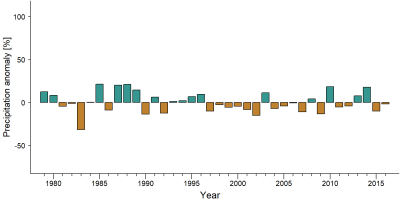
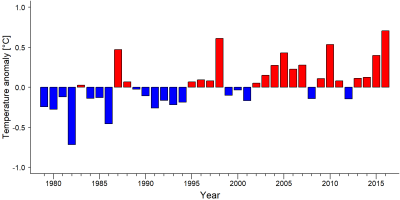
As part of a study on the exposure of African great ape sites to climate change impacts, Kiribou et al. (2024) extracted climate data and data on projected extreme climate impact events for the site. Climatological characteristics were derived from observation-based climate data provided by the Inter-Sectoral Impact Model Intercomparison Project ([ISIMIP www.isimip.org]). Parameters were calculated as the average across each 30-year period. | As part of a study on the exposure of African great ape sites to climate change impacts, [[#R01760|Kiribou et al. (2024)]] extracted climate data and data on projected extreme climate impact events for the site. Climatological characteristics were derived from observation-based climate data provided by the Inter-Sectoral Impact Model Intercomparison Project ([ISIMIP www.isimip.org]). Parameters were calculated as the average across each 30-year period. | ||
For future projections, two Representative Concentration Pathways (RCP) were used. RCP 2.6 is a scenario with strong mitigation measures in which global temperatures would likely rise below 2°C. RCP 6.0 is a scenario with medium emissions in which global temperatures would likely rise up to 3°C by 2100. For the number of days with heavy precipitation events, the 98th percentile of all precipitation days (>1mm/d) was calculated for the 1979-2013 reference period as a threshold for a heavy precipitation event. Then, for each year, the number of days above that threshold was derived. The figures on temperature and precipitation anomaly show the deviation from the mean temperature and mean precipitation for the 1979-2013 reference period. The estimated exposure to future extreme climate impact events (crop failure, drought, river flood, wildfire, tropical cyclone, and heatwave) is based on a published dataset by Lange et al. 2020 derived from ISIMIP2b data. The same global climate models and RCPs as described above were used. Within each 30-year period, the number of years with an extreme event and the average proportion of the site affected were calculated (Kiribou et al. 2024). | For future projections, two Representative Concentration Pathways (RCP) were used. RCP 2.6 is a scenario with strong mitigation measures in which global temperatures would likely rise below 2°C. RCP 6.0 is a scenario with medium emissions in which global temperatures would likely rise up to 3°C by 2100. For the number of days with heavy precipitation events, the 98th percentile of all precipitation days (>1mm/d) was calculated for the 1979-2013 reference period as a threshold for a heavy precipitation event. Then, for each year, the number of days above that threshold was derived. The figures on temperature and precipitation anomaly show the deviation from the mean temperature and mean precipitation for the 1979-2013 reference period. The estimated exposure to future extreme climate impact events (crop failure, drought, river flood, wildfire, tropical cyclone, and heatwave) is based on a published dataset by Lange et al. 2020 derived from ISIMIP2b data. The same global climate models and RCPs as described above were used. Within each 30-year period, the number of years with an extreme event and the average proportion of the site affected were calculated ([[#R01760|Kiribou et al. 2024]]). | ||
'''Table 8. Estimated past and projected climatological characteristics in Taï National Park''' | '''Table 8. Estimated past and projected climatological characteristics in Taï National Park''' | ||
| Line 838: | Line 834: | ||
= References = | = References = | ||
BirdLife International. 2019 Important Bird Areas factsheet: Parc National de Taï et Réserve de faune du | <span id="R01748"></span>BirdLife International. (2019). Important Bird Areas factsheet: Parc National de Taï et Réserve de faune du N’Zo. http://datazone.birdlife.org/site/factsheet/parc-national-de-ta%C3%AF-et-r%C3%A9serve-de-faune-du-nzo-iba-c%C3%B4te-divoire/text | ||
Boesch C & Boesch-Achermann H. 2000. The | <span id="R01749"></span>Boesch, C., & Boesch-Achermann, H. (2000). The Chimpanzees of the Taï Forest. Oxford University PressOxford. [https://doi.org/10.1093/oso/9780198505082.001.0001 doi:10.1093/oso/9780198505082.001.0001] | ||
Campbell, G., Kuehl, H., | <span id="R01750"></span>Campbell, G., Kuehl, H., Diarrassouba, A., N'Goran, P. K., & Boesch, C. (2011). Long-term research sites as refugia for threatened and over-harvested species. ''Biology Letters'', 7(5), 723-726. [https://doi.org/10.1098/rsbl.2011.0155 doi:10.1098/rsbl.2011.0155] | ||
Campbell, G., Kuehl, H., | <span id="R01751"></span>Campbell, G., Kuehl, H., N'Goran Kouamé, P., & Boesch, C. (2008). Alarming decline of West African chimpanzees in Côte d'Ivoire. ''Current Biology'', 18(19), R903-R904. [https://doi.org/10.1016/j.cub.2008.08.015 doi:10.1016/j.cub.2008.08.015] | ||
Cappelle N | <span id="R01752"></span>Cappelle, N., Després‐Einspenner, M., Howe, E. J., Boesch, C., & Kühl, H. S. (2019). Validating camera trap distance sampling for chimpanzees. ''American Journal of Primatology'', 81(3), e22962. [https://doi.org/10.1002/ajp.22962 doi:10.1002/ajp.22962] | ||
Formenty, P., Boesch, C., Wyers, M., Steiner, C., Donati, F., Dind, F., | <span id="R01753"></span>Formenty, P., Boesch, C., Wyers, M., Steiner, C., Donati, F., Dind, F., …, & Le Guenno, B. (1999). Ebola Virus Outbreak among Wild Chimpanzees Living in a Rain Forest of Cote d'Ivoire. ''The Journal of Infectious Diseases'', 179(s1), S120-S126. [https://doi.org/10.1086/514296 doi:10.1086/514296] | ||
Grützmacher K et al. 2018. Human quarantine: Toward reducing infectious pressure on chimpanzees at the Taï Chimpanzee Project, Côte d’Ivoire. American Journal of Primatology 80: | <span id="R01754"></span>Grützmacher, K., et al. (2018). Human quarantine: Toward reducing infectious pressure on chimpanzees at the Taï Chimpanzee Project, Côte d’Ivoire. American Journal of Primatology, 80, e22619. [https://doi.org/10.1002/ajp.22619 doi:10.1002/ajp.22619] | ||
Hoffmann, C., Zimmermann, F., Biek, R., Kuehl, H., Nowak, K., Mundry, R., | <span id="R01755"></span>Hoffmann, C., Zimmermann, F., Biek, R., Kuehl, H., Nowak, K., Mundry, R., …, & Leendertz, F. H. (2017). Persistent anthrax as a major driver of wildlife mortality in a tropical rainforest. ''Nature'', 548(7665), 82-86. [https://doi.org/10.1038/nature23309 doi:10.1038/nature23309] | ||
Hoppe-Dominik, B. (1991) Distribution and status of chimpanzees | <span id="R01756"></span>Hoppe-Dominik, B. (1991). Distribution and status of chimpanzees (Pan troglodytes verus) on the Ivory Coast. Primate Report, 31, 45–75. | ||
IBREAM. 2018. Pygmy | <span id="R01757"></span>IBREAM. (2018). Pygmy hippo PhD 2017 summary. https://ibream.org/updates/pygmy-hippo-phd-2017-summary/ | ||
Klee, S.R., | <span id="R01758"></span>Klee, S. R., Özel, M., Appel, B., Boesch, C., Ellerbrok, H., Jacob, D., …, & Nattermann, H. (2006). Characterization ofBacillus anthracis-Like Bacteria Isolated from Wild Great Apes from Côte d'Ivoire and Cameroon. ''Journal of Bacteriology'', 188(15), 5333-5344. [https://doi.org/10.1128/jb.00303-06 doi:10.1128/jb.00303-06] | ||
Köndgen, S., | <span id="R01759"></span>Köndgen, S., Kühl, H., N'Goran, P. K., Walsh, P. D., Schenk, S., Ernst, N., …, & Leendertz, F. H. (2008). Pandemic Human Viruses Cause Decline of Endangered Great Apes. ''Current Biology'', 18(4), 260-264. [https://doi.org/10.1016/j.cub.2008.01.012 doi:10.1016/j.cub.2008.01.012] | ||
Kiribou, R., Tehoda, P., Chukwu, O., Bempah, G., Kühl, H. S., Ferreira, J., | <span id="R01760"></span>Kiribou, R., Tehoda, P., Chukwu, O., Bempah, G., Kühl, H. S., Ferreira, J., …, & Heinicke, S. (2024). Exposure of African ape sites to climate change impacts. ''PLOS Climate'', 3(2), e0000345. [https://doi.org/10.1371/journal.pclm.0000345 doi:10.1371/journal.pclm.0000345] | ||
Kouakou | <span id="R01761"></span>Kouakou, C. Y., Boesch, C., & Kuehl, H. (2009). Estimating chimpanzee population size with nest counts: validating methods in Taï National Park. ''American Journal of Primatology'', 71(6), 447-457. [https://doi.org/10.1002/ajp.20673 doi:10.1002/ajp.20673] | ||
Kühl | <span id="R01762"></span>Kühl, H. S., Boesch, C., Kulik, L., Haas, F., Arandjelovic, M., Dieguez, P., …, & Kalan, A. K. (2019). Human impact erodes chimpanzee behavioral diversity. ''Science'', 363(6434), 1453-1455. [https://doi.org/10.1126/science.aau4532 doi:10.1126/science.aau4532] | ||
Leendertz, F.H., Ellerbrok, H., Boesch, C., Couacy-Hymann, E., Mätz-Rensing, K., Hakenbeck, R., | <span id="R01763"></span>Leendertz, F. H., Ellerbrok, H., Boesch, C., Couacy-Hymann, E., Mätz-Rensing, K., Hakenbeck, R., …, & Pauli, G. (2004). Anthrax kills wild chimpanzees in a tropical rainforest. ''Nature'', 430(6998), 451-452. [https://doi.org/10.1038/nature02722 doi:10.1038/nature02722] | ||
Luncz L. | <span id="R01764"></span>Luncz, L. V., & Boesch, C. (2015). The extent of cultural variation between adjacent chimpanzee (Pan troglodytes verus) communities: A microecological approach. American Journal of Physical Anthropology, 156, 67–75. [https://doi.org/10.1002/ajpa.22628 doi:10.1002/ajpa.22628] | ||
<span id="R01765"></span>Luncz, L. V., Mundry, R., Soiret, S., & Boesch, C. (2019). Cultural diversity of nut-cracking behaviour between two populations of wild chimpanzees (Pan troglodytes verus) in the Côte d’Ivoire. In ''The Chimpanzees of the Taï Forest'' (pp. 194-220). Cambridge University Press. [https://doi.org/10.1017/9781108674218.014 doi:10.1017/9781108674218.014] | |||
<span id="R01766"></span>Marchesi, P., Marchesi, N., Fruth, B., & Boesch, C. (1995). Census and distribution of chimpanzees in Côte D’Ivoire. ''Primates'', 36(4), 591-607. [https://doi.org/10.1007/bf02382880 doi:10.1007/bf02382880] | |||
<span id="R01767"></span>McGraw, W. S., et al. (2007). Monkeys of the Taï Forest: An African primate community. Cambridge University Press. | |||
N’Goran, K.P., | <span id="R01768"></span>N’Goran, K. P., Herbinger, I., Boesch, C., & Tondossama, A. (2007a). Quelques résultats de la première phase du biomonitoring au Parc National de Taï (août 2005–mars 2006) [Unpublished report]. WCF/OIPR. | ||
N’Goran, K.P., Yapi, F. Herbinger, I., | <span id="R01769"></span>N’Goran, K. P., Yapi, A. F., Herbinger, I., & Tondossama, A. (2007b). État du Parc National de Taï: Rapport de résultats de biomonitoring, phase II (septembre 2006–avril 2007) [Unpublished report]. WCF/OIPR. | ||
N’Goran, K. P., Yapi, A. F., Herbinger, I., Tondossama, A | <span id="R01770"></span>N’Goran, K. P., Yapi, A. F., Herbinger, I., & Tondossama, A. (2008). État du Parc National de Taï: Rapport de résultats de biomonitoring, phase III (août 2007–mars 2008) [Unpublished report]. WCF/OIPR. | ||
N’Goran K. P., Yapi A. F., Herbinger I., Tondossama A. | <span id="R01771"></span>N’Goran, K. P., Yapi, A. F., Herbinger, I., Tondossama, A., & Boesch, C. (2009a). État du Parc National de Taï: Rapport de résultats de biomonitoring, phase IV (août 2008–février 2009) [Unpublished report]. WCF/OIPR, Abidjan. | ||
N’Goran K. P., Yapi A. F., | <span id="R01772"></span>N’Goran, K. P., Yapi, A. F., Herbinger, I., Tondossama, A., & Boesch, C. (2009b). État du Parc National de Taï: Rapport de résultats de biomonitoring, phase V (septembre 2009–mars 2010) [Unpublished report]. WCF/OIPR, Abidjan. | ||
<span id="R01773"></span>N’Goran, K. P., Yapi, A. F., Normand, E., Herbinger, I., Diarrassouba, A., Tondossama, A., & Boesch, C. (2011). État du Parc National de Taï: Rapport de résultats de biomonitoring, phase VI (octobre 2010–mars 2011) [Unpublished report]. WCF/OIPR, Abidjan. | |||
<span id="R01774"></span>Radl, G. (2004). Le système de surveillance et le développement des densités des animaux braconnés du Parc National de Taï. Deutschen Gesellschaft für Technische Zusammenarbeit (GTZ) GmbH. PN: 02.2279.4-001.00. | |||
<span id="R01775"></span>Soiret, S. P., Kadjo, B., Assi, B. D., & Kouassi, K. P. (2015). New observations in nut cracking behavior of chimpanzees (Pan troglodytes verus) in Djouroutou, Taï National Park. International Journal of Innovation and Applied Studies, 11(1), 15–25. [https://www.semanticscholar.org/paper/32f89a2eb67b6f75291603153ba146118e3ad8f6 link] | |||
<span id="R01776"></span>Taï Chimpanzee Project. (2019). Taï Chimpanzee Project. https://www.eva.mpg.de/primat/research-groups/chimpanzees/field-sites/tai-chimpanzee-project.html [https://web.archive.org/web/20210420021226/https://www.eva.mpg.de/primat/research-groups/chimpanzees/field-sites/tai-chimpanzee-project.html link] | |||
<span id="R01777"></span>Taï Monkey Project. (2019). Taï Monkey Project. https://www.taimonkeys.org [https://web.archive.org/web/20230608042326/https://www.taimonkeys.org/ link] | |||
Tiédoué R., Diarrassouba A. | <span id="R01778"></span>Tiédoué, R., Diarrassouba, A., & Tondossama, A. (2016). État de conservation du Parc National de Taï: Résultats du suivi écologique, phase 11 [Unpublished report]. Office Ivoirien des Parcs et Réserves, Direction de Zone Sud-Ouest. | ||
<span id="R01779"></span>Tiédoué, R., Kouakou, Y. C., Normand, E., Vergnes, V., Ouattara, M., Diarrassouba, A., Tondossama, A., & Boesch, C. (2014). État de conservation du Parc National de Taï: Rapport de résultats de suivi-écologique, phase 9 (octobre 2013–avril 2014) [Unpublished report]. OIPR/WCF, Abidjan. | |||
<span id="R01780"></span>Tiédoué, M. R., Normand, E., Diarrassouba, A., Tondossama, A., & Boesch, C. (2015). Etat de conservation du Parc National de Taï : Rapport de suivi-écologique - phase 10 (novembre 2014 - mai 2015). Soubré, Côte d’Ivoire: OIPR; WCF. | |||
<span id="R01781"></span>Tiédoué, R., Vergnes, V., Kouakou, Y. C., Normand, E., Ouattara, M., Diarrassouba, A., Tondossama, A., & Boesch, C. (2013). État de conservation du Parc National de Taï: Rapport de résultats de suivi-écologique, phase 8 (janvier 2013–juin 2013) [Unpublished report]. OIPR/WCF, Abidjan. | |||
<span id="R01782"></span>Tomos Proffitt, J. S., Reeves, J. S., Pacome, S., & Luncz, L. V. (2022). Identifying functional and regional differences in chimpanzee stone tool technology. Royal Society Open Science, 9, 220826. https://doi.org/10.1098/rsos.220826 | |||
<span id="R01783"></span>UNEP-WCMC, & IUCN. (2019). Protected Planet: The World Database on Protected Areas (WDPA). https://www.protectedplanet.net/tai-national-park-national-park [https://web.archive.org/web/20200930170440/https://www.protectedplanet.net/country/GN link] | |||
<span id="R01784"></span>UNESCO. (2019a). Taï National Park. https://whc.unesco.org/en/list/195/ | |||
<span id="R01785"></span>UNESCO. (2019b). State of Conservation: Taï National Park. https://whc.unesco.org/en/soc/3920 | |||
WCF. | <span id="R01786"></span>WCF. (2015). Annual report 2015: Activities of the Wild Chimpanzee Foundation for improved conservation of chimpanzees and their habitat in West Africa. https://www.wildchimps.org/reports/reports.html [https://web.archive.org/web/20241112052804/https://www.wildchimps.org/reports/reports.html link] | ||
WCF | <span id="R01787"></span>WCF. (2017). Annual report 2017: Activities of the Wild Chimpanzee Foundation for improved conservation of chimpanzees and their habitat in West Africa. https://www.wildchimps.org/reports/reports.html | ||
<span id="R01788"></span>WCF. (2018). Annual report 2018: Activities of the Wild Chimpanzee Foundation for improved conservation of chimpanzees and their habitat in West Africa. https://www.wildchimps.org/reports/reports.html [https://web.archive.org/web/20241112052804/https://www.wildchimps.org/reports/reports.html link] | |||
<span id="R01789"></span>WCF, OIPR-PNT, WWF, CSRS, KFW, EU, UNEP, GRASP, & GTZ. (2008). État du Parc National de Taï: Rapport de résultats de biomonitoring, phase III (août 2007–mars 2008) [Report]. | |||
<span id="R01790"></span>Whiten, A., Goodall, J., McGrew, W. C., Nishida, T., Reynolds, V., Sugiyama, Y., …, & Boesch, C. (1999). Cultures in chimpanzees. ''Nature'', 399(6737), 682-685. [https://doi.org/10.1038/21415 doi:10.1038/21415] | |||
<span id="R01791"></span>Wittig, R. M. (2018). 40 years of research at the Taï Chimpanzee Project. ''Pan Africa News'', 25(2), 16-18. [https://doi.org/10.5134/236289 doi:10.5134/236289] | |||
<span id="R01792"></span>Yao, C. Y. A., & Roussel, B. (2007). Forest Management, Farmers' Practices and Biodiversity Conservation in the Monogaga Protected Coastal Forest in Southwest Côte D'ivoire. ''Africa'', 77(1), 63-85. [https://doi.org/10.3366/afr.2007.77.1.63 doi:10.3366/afr.2007.77.1.63] | |||
<span id="R01793"></span>Yapi, A. F., Vergnes, V., Normand, E., N’Goran, K. P., Diarrassouba, A., Tondossama, A., & Boesch, C. (2012). État de conservation du Parc National de Taï: Rapport de résultats de biomonitoring, phase 7 (janvier 2012–juillet 2012) [Unpublished report]. WCF/OIPR, Abidjan. | |||
<span id="R02087"></span>N’Goran, K. P., Kouakou, C. Y., & Herbinger, I. (2010). Report on the population survey and monitoring of chimpanzee in Sapo National Park, Liberia (June–December 2009) [Report]. Wild Chimpanzee Foundation. | |||
'''Page created by: '''Julia Riedel & Serge Soiret''' Date:''' 2023-11-08 | '''Page created by: '''Julia Riedel & Serge Soiret''' Date:''' 2023-11-08 | ||
Latest revision as of 17:54, 15 October 2026
West Africa > Côte d'Ivoire > Taï National Park
Français | Português | Español | Bahasa Indonesia | Melayu
Summary
- Western chimpanzees (Pan troglodytes verus) are present in Taï National Park.
- It has been estimated that 406 (CI: 265-623) individuals occur at the site.
- The chimpanzee population trend is stable.
- This site has a total size of 5,081.2 km².
- Key threats to chimpanzees are poaching and diseases.
- A range of conservation activities are implemented, including permanent presence of researchers and tourists, anti-poaching patrols, environmental education and measures to prevent disease transmission to chimpanzees.
- Taï National Park is the largest remaining forest block in the Upper Guinea Region and is home to one of the longest-running chimpanzee research sites.

Site characteristics
Taï National Park (IUCN category: II) was created in 1972 and proclaimed a UNESCO world heritage site in 1982 (Criteria iii, iv, UNESCO 2019a). The park is located in south-western Côte d'Ivoire (5°15'-6°07'N, 7°25'-7°54'W), approximately 200 km south of Man and 100 km from the coast. With a size of 5,0812 km², it is the largest protected forest block in Côte d’Ivoire and one of the last tropical lowland forests in the Upper Guinea Region. The topography is mostly flat, but some Inselbergs occur. The majority of the forest in the park has never been logged and this mature, old-growth forest supports a rich diversity of species. It has been estimated that around 1,300 plant species occur in the park, 80-150 are endemic to the Upper Guinea region (BirdLife International 2019). Because of its diversity of bird species, notably white-breasted guinea fowl (Agelastes meleagrides) and large hornbill species, it is considered an Important Bird Area (BirdLife International 2019). Primate species recorded in the park include olive colobus (Procolobus verus), western red colobus (Piliocolobus badius), king colobus (Colobus polykomos), and Diana monkey (Cercopithecus diana). Other mammal species include the Pel's flying squirrel (Anomalurus peli), forest elephant (Loxodonta africana ), pygmy hippopotamus (Choeropsis liberiensis), Water chevrotain (Hyemoschus aquaticus), African buffalo (Syncerus caffer), and a range of duikers, including Maxwell's duiker (Philantomba maxwellii), black duiker (Cephalophus niger), zebra duiker (Cephalophus zebra), and Jentink's duiker (Cephalophus jentinki). Reptile species include (Crocodylus cataphractus) and African dwarf crocodile (Osteolaemus tetraspis), Home's hinge-back tortoise (Kinixys homeana).
Taï National Park is home to one of the longest-running chimpanzee research sites. Since 1979, the behavior and ecology of chimpanzees has been studied by the Taï Chimpanzee Project. Research has also been ongoing for several decades at the Taï Monkey Project. Taï National Park is managed by the Office Ivoirien des Parcs et Réserves (OIPR). There are two eco-tourism sites, one near the town of Taï (managed by WCF, www.ecotourismetai.com) and one near Djouroutou Ecotel Touraco (managed by a private manager, Mr. Louis DIAKITE).
Table 1. Basic site information for Taï National Park
| Species | Pan troglodytes verus |
| Area | 5,081.2 km² |
| Coordinates | Lat: 5.77 , Lon: -7.12 |
| Type of site | Protected area (National Park) |
| Habitat types | Subtropical/tropical moist lowland forest, Agricultural land |
| Type of governance |
Types of sites Governance types Habitat types
Ape status
Since 2005 annual surveys on western chimpanzees have been implemented by OIPR and the Wild Chimpanzee Foundation (WCF). Estimated chimpanzee abundance ranges between 300-800 individuals and the population seems to be stable (Campbell et al. 2008). Since 2016, the WCF has used camera traps to systematically monitor biodiversity in 200 km² in the Taï National Park (Cappelle et al. 2019).
Table 2. Ape population estimates reported for Taï National Park
| Species | Year | Occurrence | Encounter or vistation rate (nests/km; ind/day) | Density estimate [ind./ km²] (95% CI) | Abundance estimate (95% CI) | Survey area | Sampling method | Analytical framework | Source | Comments | A.P.E.S. database ID |
|---|---|---|---|---|---|---|---|---|---|---|---|
| Pan troglodytes verus | 2008 | 0.91 | 0.10 (0.06-0.16) | 516 (314-847) | Taï National Park | Line transects | N'Goran et al. 2008 | CIV0062 | |||
| Pan troglodytes verus | 2022 | 60.0 | Taï National Park, Djouroutou sector (25 km²) | Informed guess | Soiret et al. 2015, Luncz et al. 2019, Proffitt et al. 2022 | ||||||
| Pan troglodytes verus | 2016 | 0.265 | 0.07 (0.05-0.11) | 406 (265-623) | Taï National Park | Line transects | Tiédoué et al. 2016 | CIV0062, CIV0065 | |||
| Pan troglodytes verus | 2015 | 0.57 | 0.099 (0.060-0.169) | 540 (321-909) | Taï National Park | Line transects | Tiédoué et al. 2015 | CIV0062 | |||
| Pan troglodytes verus | 2014 | 0.67 | 0.044 (0.022-0.091) | 238 (116-487) | Taï National Park | Line transects | Tiédoué et al. 2014 | CIV0062 | |||
| Pan troglodytes verus | 2013 | 0.49 | 0.055 (0.032-0.093) | 294 (173-500) | Taï National Park | Line transects | Tiédoué et al. 2013 | CIV0062 | |||
| Pan troglodytes verus | 2012 | 0.39 | 0.0493 (0.0252-0.0966) | 264 (135-518) | Taï National Park | Line transects | Yapi et al. 2012 | CIV0062 | |||
| Pan troglodytes verus | 2011 | 0.58 | 0.09 (0.05-0.16) | 497 (287-868) | Taï National Park | Line transects | N'Goran et al. 2011 | CIV0062 | |||
| Pan troglodytes verus | 2010 | 0.89 | 0.08 (0.05-0.14) | 441 (264-735) | Taï National Park | Line transects | N'Goran et al. 2010 | LBR0041 | |||
| Pan troglodytes verus | 2009 | 1.22 | 0.077 (0.040-0.147) | 361 (230-568) | Taï National Park | Line transects | N'Goran et al. 2009a | ||||
| Pan troglodytes verus | 2007 | 0.54 | 0.09 (0.06-0.14) | 479 (299-767) | Taï National Park | Line transects | N'Goran et al. 2007b | CIV0062 | |||
| Pan troglodytes verus | 2006 | 0.54 | 0.089 (0.052-0.155) | 480 (280-830) | Taï National Park | Line transects | N'Goran et al. 2006 |
Sampling methods Analytical frameworks
Threats
Illegal poaching represents the major threat to the chimpanzee population in the park. Habitat destruction by agriculture, illegal logging and gold mining in some areas of the park also threatens the long-term existence of chimpanzees. Furthermore, long-term research by the Taï Chimpanzee Project and the Robert Koch Institute in Berlin confirmed that Ebola virus (Formenti et al., 1999), Anthrax (Leendertz et al. 2004) and respiratory diseases of human origin (Köndgen et al., 2008) killed a considerable number of chimpanzees.
While human population density was low in the 1970s when the park was created it has grown considerably afterwards, resulting in increasing pressure on the park, especially since the arrival of refugees from Liberia during the civil war (BirdLife International 2019). All forest around Taï has been cleared.
Table 3. Threats to apes reported for Taï National Park
| Category | Specific threats | Threat level | Description | Year of threat |
|---|---|---|---|---|
| 2 Agriculture & aquaculture | 2.1 Annual & perennial non-timber crops | Low (up to 30% of population affected) | Cocoa and rice field in the eastern side of the park (Tiédoué et al. 2016). | Ongoing (2016) |
| 3 Energy production & mining | 3.2 Mining & quarrying | Medium (30-70% of population affected) | Artisanal gold mining (Tiédoué et al. 2016, UNESCO 2019b). The proliferation of gold panning activities in localities surrounding the park is endangering the chimpanzee community in the Djouroutou sector (Soiret pers. obs. 2022). | 2016-Ongoing (2023) |
| 4 Transportation & service corridors | 4.1 Roads & railroads | Medium (30-70% of population affected) | Trails used by poachers (Tiédoué et al. 2016). | Ongoing (2016) |
| 5 Biological resource use | 5.1 Hunting & collecting terrestrial animals | High (more than 70% of population affected) | Poaching is widespread throughout the park (Tiédoué et al. 2016, UNESCO 2019b). | 2016-Ongoing (2019) |
| 8 Invasive & other problematic species, genes & diseases | 8.4 Pathogens | High (more than 70% of population affected) | Several chimpanzees died due to an Ebola Virus Disease (Taï Forest Ebolavirus) outbreak in the park in 1994 (Formenti et al. 1999). | 1994 |
| 8 Invasive & other problematic species, genes & diseases | 8.4 Pathogens | High (more than 70% of population affected) | Anthrax is present at the site and has led to several chimpanzee deaths, first detected in 1996 (Leendertz et al. 2004, Hoffmann et al. 2017). | 1996-Ongoing (2017) |
| 8 Invasive & other problematic species, genes & diseases | 8.4 Pathogens | High (more than 70% of population affected) | Chimpanzees died of respiratory diseases of human origin (Köndgen et al. 2008). | Ongoing (2008) |
Conservation activities
In the 1970's the first research station was built in Taï National Park and since then several research projects have been conducted on different species. In particular, long-term studies by the Taï Chimpanzee Project (TCP) established in 1979 and the Taï Monkey Project (TMP) established in 1989 ensured and continue to ensure the presence of researchers at the research sites, which have been shown to have a positive influence on local chimpanzee densities (Campbell et al. 2011). Office Ivoirien des Parcs et Reserves (OIPR) does an annual bio-monitoring survey over the entire park and, in addition, the Wild Chimpanzee Foundation (WCF) also does an annual bio-monitoring survey over the research area in collaboration with the TCP. OIPR and WCF also conduct regular patrols across the entire park to control for illegal human activities. A range of environmental awareness activities have been implemented, including an eco-museum in Taï, theater plays, movie presentations, newsletters, Club P.A.N., radio shows (WCF 2015, 2018). Two Eco-tourism projects have been developed in the Taï and Djouroutou area. Finally, the Taï Chimpanzee Project is implementing a set of measures to prevent the transmission of human diseases to the chimpanzees (Grützmacher et al. 2018).
Table 4. Conservation activities reported for Taï National Park
| Category | Specific activity | Description | Implementing organization(s) | Year of activity |
|---|---|---|---|---|
| 1 Development impact mitigation | 1.15 Certify products from agriculture, mining or logging and market them as ape friendly | Support unions of female farmers in the commercialization and promotion of ‘zero deforestation’ agricultural products, including honey from bee-keeping, makore butter, and cacao (WCF 2018). | Ongoing (2018) | |
| 2 Counter-wildlife crime | 2.11 Implement monitoring surveillance strategies (e.g., SMART) or use monitoring data to improve effectiveness of patrols | Anti-poaching patrols use SMART (WCF 2018). | Ongoing (2018) | |
| 2 Counter-wildlife crime | 2.3 Conduct regular anti-poaching patrols | Anti-poaching patrols conducted by OIPR and WCF (WCF 2018). | OIPR, Wild Chimpanzee Foundation | Ongoing (2018) |
| 3 Species health | 3.1 Wear face-masks to avoid transmission of viral and bacterial diseases to primates | Mandatory to wear face-masks (Grützmacher et al. 2018). | 2004-Ongoing (2018) | |
| 3 Species health | 3.11 Implement continuous health monitoring/permanent vet on site | Veterinary at research site since 2000 (Grützmacher et al. 2018). | 2000-Ongoing (2018) | |
| 3 Species health | 3.12 Detect & report dead apes and clinically determine their cause of death to avoid disease transmission | Done by the veterinary (Grützmacher et al. 2018). | 2000-Ongoing (2018) | |
| 3 Species health | 3.2 Keep safety distance to habituated apes | Minimum viewing distance of 7 m (Grützmacher et al. 2018). | 1999-Ongoing (2018) | |
| 3 Species health | 3.4 Implement quarantine for people arriving at, and leaving the site | Quarantine in a separate quarantine camp (Grützmacher et al. 2018) | 2008-Ongoing (2018) | |
| 3 Species health | 3.6 Ensure that researchers/tourists are up-to-date with vaccinations and healthy | Visitors have to be vaccinated against measles, all researchers have to be up-to-date with vaccines (Grützmacher et al. 2018). | 2008-Ongoing (2018) | |
| 3 Species health | 3.7 Regularly disinfect clothes, boots etc. | ‘Hygiene barrier’ implemented mandating changing clothes and disinfecting boots (Grützmacher et al. 2018). | 2002-Ongoing (2018) | |
| 4 Education & awareness | 4.1 Educate local communities about apes and sustainable use | Environmental awareness raising activities include eco-museum, community meetings, extra-curricular activities in schools Club P.A.N., radio shows, newsletters, theater plays with discussion rounds and movie presentations (WCF 2015, WCF 2018). | Wild Chimpanzee Foundation | 2015-Ongoing (2018) |
| 4 Education & awareness | 4.2 Involve local community in ape research and conservation management | People hired and trained by research and conservation projects (Taï Chimpanzee Project 2019, Taï Monkey Project 2019, WCF 2018). | Ongoing (2019) | |
| 4 Education & awareness | 4.4 Regularly play TV and radio announcements to raise ape conservation awareness | Several sets of radio programs played regularly (WCF 2018) | Ongoing (2018) | |
| 4 Education & awareness | 4.5 Implement multimedia campaigns using theatre, film, print media, discussions | Theater tour, community discussions, radio, environmental days, eco-museum (WCF 2015, WCF 2018) | Wild Chimpanzee Foundation | 2015-Ongoing (2018) |
| 5 Protection & restoration | 5.2 Legally protect ape habitat | Designated as National Park in 1972 (UNEP-WCMC and IUCN 2019) | 1972-Ongoing (2026) | |
| 6 Species management | 6.1 Habituate primates to human presence to reduce stress from tourists/researchers | Habituation process of chimpanzees in the Djouroutou area (Soiret pers. obs. 2023). | Ongoing (2023) | |
| 8 Permanent presence | 8.1 Run research project and ensure permanent human presence at site | 3 long-term research projects: Tai Chimpanzee Project (since 1979, Boesch & Boesch-Achermann 2000, Wittig 2018), Tai Monkey Project (since 1989, McGraw et al. 2007) and Tai Hippo Project (since 2013, IBREAM 2018). | 1979-Ongoing (2023) | |
| 8 Permanent presence | 8.2 Run tourist projects and ensure permanent human presence at site | 2 ecotourism sites (Taï and Djouroutou, initiated in 2013, WCF 2015, WCF 2018). The Ecoguides in the Djouroutou sector, despite their insufficient numbers, follow the chimpanzees every day (Soiret pers. obs. 2023). | Wild Chimpanzee Foundation | 2013-Ongoing (2023) |
| 8 Permanent presence | 8.3 Permanent presence of staff/manager | Boesch & Boesch-Achermann 2000, McGraw et al. 2007, Wittig 2018 | 1979-Ongoing (2023) |
Challenges
Table 5. Challenges reported for Taï National Park
| Challenges | Specific challenges | Source | Year(s) |
|---|---|---|---|
| Not reported |
Enablers
Table 6. Enablers reported for Taï National Park
| Enablers | Specific enablers | Source | Year(s) |
|---|---|---|---|
| 1 Site management | |||
| 2 Resources and capacity | |||
| 3 Engaged community | |||
| 4 Institutional support | |||
| 5 Ecological context | |||
| 6 Safety and stability |
Research activities
Since 1979 chimpanzees have been studied in Taï National Park by the Taï Chimpanzee Project (Tai Chimpanzee Project 2019), while the Taï Monkey Project studies different monkey species since 1989 (Tai Monkey Project 2019). A wide range of topics have been studied including behavior, culture, feeding ecology, sociality, health, biomonitoring methods, and conservation interventions. Since 2013, research is also ongoing on the pygmy hippo (IBREAM 2018). In the Djouroutou sector, MPI's Technological Primates Research Group is conducting ethological and archaeological studies on chimpanzees. This study is the first of its kind since the discovery of this group of chimpanzees. Thanks to this research, new data on the behavior of the Djouroutou chimpanzees will be uncovered (Soiret pers. obs. 2022).
Documented behaviours
Table 7. Behaviours documented for Taï National Park
Exposure to climate change impacts
As part of a study on the exposure of African great ape sites to climate change impacts, Kiribou et al. (2024) extracted climate data and data on projected extreme climate impact events for the site. Climatological characteristics were derived from observation-based climate data provided by the Inter-Sectoral Impact Model Intercomparison Project ([ISIMIP www.isimip.org]). Parameters were calculated as the average across each 30-year period.
For future projections, two Representative Concentration Pathways (RCP) were used. RCP 2.6 is a scenario with strong mitigation measures in which global temperatures would likely rise below 2°C. RCP 6.0 is a scenario with medium emissions in which global temperatures would likely rise up to 3°C by 2100. For the number of days with heavy precipitation events, the 98th percentile of all precipitation days (>1mm/d) was calculated for the 1979-2013 reference period as a threshold for a heavy precipitation event. Then, for each year, the number of days above that threshold was derived. The figures on temperature and precipitation anomaly show the deviation from the mean temperature and mean precipitation for the 1979-2013 reference period. The estimated exposure to future extreme climate impact events (crop failure, drought, river flood, wildfire, tropical cyclone, and heatwave) is based on a published dataset by Lange et al. 2020 derived from ISIMIP2b data. The same global climate models and RCPs as described above were used. Within each 30-year period, the number of years with an extreme event and the average proportion of the site affected were calculated (Kiribou et al. 2024).
Table 8. Estimated past and projected climatological characteristics in Taï National Park
| Value | 1981-2010 | 2021-2050, RCP 2.6 | 2021-2050, RCP 6.0 | 2071-2099, RCP 2.6 | 2071-2099, RCP 6.0 |
|---|---|---|---|---|---|
| Mean temperature [°C] | 25.7 | 26.8 | 26.7 | 26.9 | 28 |
| Annual precipitation [mm] | 1828 | 1822 | 1894 | 1869 | 1947 |
| Max no. consecutive dry days (per year) | 24 | 23.3 | 22.7 | 24.9 | 24.2 |
| No. days with heavy precipitation (per year) | 6.4 | 7.8 | 7.5 | 9.5 | 10.3 |
Table 9. Projected exposure of apes to extreme climate impact events in Taï National Park
| Type | No. of years with event (2021-2050, RCP 2.6) | % of site exposed (2021-2050, RCP 2.6) | No. of years with event (2021-2050, RCP 6.0) | % of site exposed (2021-2050, RCP 6.0) | No. of years with event (2070-2099, RCP 2.6) | % of site exposed (2070-2099, RCP 2.6) | No. of years with event (2070-2099, RCP 6.0) | % of site exposed (2070-2099, RCP 6.0) |
|---|---|---|---|---|---|---|---|---|
| Crop failure | 3 | 1.11 | 2.5 | 0.83 | 4 | 0.62 | 4 | 1.27 |
| Drought | 0.5 | 12.5 | 0 | 0 | 0 | 0 | 0.25 | 12.5 |
| Heatwave | 13.5 | 77.15 | 11.5 | 87.19 | 15.5 | 85.94 | 17.5 | 81.94 |
| River flood | 1.25 | 1.46 | 4 | 3.22 | 4.25 | 2.57 | 5.25 | 4.16 |
| Tropical cyclone | 0 | 0 | 0 | 0 | 0 | 0 | 0 | 0 |
| Wildfire | 30 | 0.51 | 30 | 0.5 | 29 | 0.54 | 29 | 0.54 |
-
Precipitation anomaly in Taï National Park -
Temperature anomaly in Taï National Park


External links
References
BirdLife International. (2019). Important Bird Areas factsheet: Parc National de Taï et Réserve de faune du N’Zo. http://datazone.birdlife.org/site/factsheet/parc-national-de-ta%C3%AF-et-r%C3%A9serve-de-faune-du-nzo-iba-c%C3%B4te-divoire/text
Boesch, C., & Boesch-Achermann, H. (2000). The Chimpanzees of the Taï Forest. Oxford University PressOxford. doi:10.1093/oso/9780198505082.001.0001
Campbell, G., Kuehl, H., Diarrassouba, A., N'Goran, P. K., & Boesch, C. (2011). Long-term research sites as refugia for threatened and over-harvested species. Biology Letters, 7(5), 723-726. doi:10.1098/rsbl.2011.0155
Campbell, G., Kuehl, H., N'Goran Kouamé, P., & Boesch, C. (2008). Alarming decline of West African chimpanzees in Côte d'Ivoire. Current Biology, 18(19), R903-R904. doi:10.1016/j.cub.2008.08.015
Cappelle, N., Després‐Einspenner, M., Howe, E. J., Boesch, C., & Kühl, H. S. (2019). Validating camera trap distance sampling for chimpanzees. American Journal of Primatology, 81(3), e22962. doi:10.1002/ajp.22962
Formenty, P., Boesch, C., Wyers, M., Steiner, C., Donati, F., Dind, F., …, & Le Guenno, B. (1999). Ebola Virus Outbreak among Wild Chimpanzees Living in a Rain Forest of Cote d'Ivoire. The Journal of Infectious Diseases, 179(s1), S120-S126. doi:10.1086/514296
Grützmacher, K., et al. (2018). Human quarantine: Toward reducing infectious pressure on chimpanzees at the Taï Chimpanzee Project, Côte d’Ivoire. American Journal of Primatology, 80, e22619. doi:10.1002/ajp.22619
Hoffmann, C., Zimmermann, F., Biek, R., Kuehl, H., Nowak, K., Mundry, R., …, & Leendertz, F. H. (2017). Persistent anthrax as a major driver of wildlife mortality in a tropical rainforest. Nature, 548(7665), 82-86. doi:10.1038/nature23309
Hoppe-Dominik, B. (1991). Distribution and status of chimpanzees (Pan troglodytes verus) on the Ivory Coast. Primate Report, 31, 45–75.
IBREAM. (2018). Pygmy hippo PhD 2017 summary. https://ibream.org/updates/pygmy-hippo-phd-2017-summary/
Klee, S. R., Özel, M., Appel, B., Boesch, C., Ellerbrok, H., Jacob, D., …, & Nattermann, H. (2006). Characterization ofBacillus anthracis-Like Bacteria Isolated from Wild Great Apes from Côte d'Ivoire and Cameroon. Journal of Bacteriology, 188(15), 5333-5344. doi:10.1128/jb.00303-06
Köndgen, S., Kühl, H., N'Goran, P. K., Walsh, P. D., Schenk, S., Ernst, N., …, & Leendertz, F. H. (2008). Pandemic Human Viruses Cause Decline of Endangered Great Apes. Current Biology, 18(4), 260-264. doi:10.1016/j.cub.2008.01.012
Kiribou, R., Tehoda, P., Chukwu, O., Bempah, G., Kühl, H. S., Ferreira, J., …, & Heinicke, S. (2024). Exposure of African ape sites to climate change impacts. PLOS Climate, 3(2), e0000345. doi:10.1371/journal.pclm.0000345
Kouakou, C. Y., Boesch, C., & Kuehl, H. (2009). Estimating chimpanzee population size with nest counts: validating methods in Taï National Park. American Journal of Primatology, 71(6), 447-457. doi:10.1002/ajp.20673
Kühl, H. S., Boesch, C., Kulik, L., Haas, F., Arandjelovic, M., Dieguez, P., …, & Kalan, A. K. (2019). Human impact erodes chimpanzee behavioral diversity. Science, 363(6434), 1453-1455. doi:10.1126/science.aau4532
Leendertz, F. H., Ellerbrok, H., Boesch, C., Couacy-Hymann, E., Mätz-Rensing, K., Hakenbeck, R., …, & Pauli, G. (2004). Anthrax kills wild chimpanzees in a tropical rainforest. Nature, 430(6998), 451-452. doi:10.1038/nature02722
Luncz, L. V., & Boesch, C. (2015). The extent of cultural variation between adjacent chimpanzee (Pan troglodytes verus) communities: A microecological approach. American Journal of Physical Anthropology, 156, 67–75. doi:10.1002/ajpa.22628
Luncz, L. V., Mundry, R., Soiret, S., & Boesch, C. (2019). Cultural diversity of nut-cracking behaviour between two populations of wild chimpanzees (Pan troglodytes verus) in the Côte d’Ivoire. In The Chimpanzees of the Taï Forest (pp. 194-220). Cambridge University Press. doi:10.1017/9781108674218.014
Marchesi, P., Marchesi, N., Fruth, B., & Boesch, C. (1995). Census and distribution of chimpanzees in Côte D’Ivoire. Primates, 36(4), 591-607. doi:10.1007/bf02382880
McGraw, W. S., et al. (2007). Monkeys of the Taï Forest: An African primate community. Cambridge University Press.
N’Goran, K. P., Herbinger, I., Boesch, C., & Tondossama, A. (2007a). Quelques résultats de la première phase du biomonitoring au Parc National de Taï (août 2005–mars 2006) [Unpublished report]. WCF/OIPR.
N’Goran, K. P., Yapi, A. F., Herbinger, I., & Tondossama, A. (2007b). État du Parc National de Taï: Rapport de résultats de biomonitoring, phase II (septembre 2006–avril 2007) [Unpublished report]. WCF/OIPR.
N’Goran, K. P., Yapi, A. F., Herbinger, I., & Tondossama, A. (2008). État du Parc National de Taï: Rapport de résultats de biomonitoring, phase III (août 2007–mars 2008) [Unpublished report]. WCF/OIPR.
N’Goran, K. P., Yapi, A. F., Herbinger, I., Tondossama, A., & Boesch, C. (2009a). État du Parc National de Taï: Rapport de résultats de biomonitoring, phase IV (août 2008–février 2009) [Unpublished report]. WCF/OIPR, Abidjan.
N’Goran, K. P., Yapi, A. F., Herbinger, I., Tondossama, A., & Boesch, C. (2009b). État du Parc National de Taï: Rapport de résultats de biomonitoring, phase V (septembre 2009–mars 2010) [Unpublished report]. WCF/OIPR, Abidjan.
N’Goran, K. P., Yapi, A. F., Normand, E., Herbinger, I., Diarrassouba, A., Tondossama, A., & Boesch, C. (2011). État du Parc National de Taï: Rapport de résultats de biomonitoring, phase VI (octobre 2010–mars 2011) [Unpublished report]. WCF/OIPR, Abidjan.
Radl, G. (2004). Le système de surveillance et le développement des densités des animaux braconnés du Parc National de Taï. Deutschen Gesellschaft für Technische Zusammenarbeit (GTZ) GmbH. PN: 02.2279.4-001.00.
Soiret, S. P., Kadjo, B., Assi, B. D., & Kouassi, K. P. (2015). New observations in nut cracking behavior of chimpanzees (Pan troglodytes verus) in Djouroutou, Taï National Park. International Journal of Innovation and Applied Studies, 11(1), 15–25. link
Taï Chimpanzee Project. (2019). Taï Chimpanzee Project. https://www.eva.mpg.de/primat/research-groups/chimpanzees/field-sites/tai-chimpanzee-project.html link
Taï Monkey Project. (2019). Taï Monkey Project. https://www.taimonkeys.org link
Tiédoué, R., Diarrassouba, A., & Tondossama, A. (2016). État de conservation du Parc National de Taï: Résultats du suivi écologique, phase 11 [Unpublished report]. Office Ivoirien des Parcs et Réserves, Direction de Zone Sud-Ouest.
Tiédoué, R., Kouakou, Y. C., Normand, E., Vergnes, V., Ouattara, M., Diarrassouba, A., Tondossama, A., & Boesch, C. (2014). État de conservation du Parc National de Taï: Rapport de résultats de suivi-écologique, phase 9 (octobre 2013–avril 2014) [Unpublished report]. OIPR/WCF, Abidjan.
Tiédoué, M. R., Normand, E., Diarrassouba, A., Tondossama, A., & Boesch, C. (2015). Etat de conservation du Parc National de Taï : Rapport de suivi-écologique - phase 10 (novembre 2014 - mai 2015). Soubré, Côte d’Ivoire: OIPR; WCF.
Tiédoué, R., Vergnes, V., Kouakou, Y. C., Normand, E., Ouattara, M., Diarrassouba, A., Tondossama, A., & Boesch, C. (2013). État de conservation du Parc National de Taï: Rapport de résultats de suivi-écologique, phase 8 (janvier 2013–juin 2013) [Unpublished report]. OIPR/WCF, Abidjan.
Tomos Proffitt, J. S., Reeves, J. S., Pacome, S., & Luncz, L. V. (2022). Identifying functional and regional differences in chimpanzee stone tool technology. Royal Society Open Science, 9, 220826. https://doi.org/10.1098/rsos.220826
UNEP-WCMC, & IUCN. (2019). Protected Planet: The World Database on Protected Areas (WDPA). https://www.protectedplanet.net/tai-national-park-national-park link
UNESCO. (2019a). Taï National Park. https://whc.unesco.org/en/list/195/
UNESCO. (2019b). State of Conservation: Taï National Park. https://whc.unesco.org/en/soc/3920
WCF. (2015). Annual report 2015: Activities of the Wild Chimpanzee Foundation for improved conservation of chimpanzees and their habitat in West Africa. https://www.wildchimps.org/reports/reports.html link
WCF. (2017). Annual report 2017: Activities of the Wild Chimpanzee Foundation for improved conservation of chimpanzees and their habitat in West Africa. https://www.wildchimps.org/reports/reports.html
WCF. (2018). Annual report 2018: Activities of the Wild Chimpanzee Foundation for improved conservation of chimpanzees and their habitat in West Africa. https://www.wildchimps.org/reports/reports.html link
WCF, OIPR-PNT, WWF, CSRS, KFW, EU, UNEP, GRASP, & GTZ. (2008). État du Parc National de Taï: Rapport de résultats de biomonitoring, phase III (août 2007–mars 2008) [Report].
Whiten, A., Goodall, J., McGrew, W. C., Nishida, T., Reynolds, V., Sugiyama, Y., …, & Boesch, C. (1999). Cultures in chimpanzees. Nature, 399(6737), 682-685. doi:10.1038/21415
Wittig, R. M. (2018). 40 years of research at the Taï Chimpanzee Project. Pan Africa News, 25(2), 16-18. doi:10.5134/236289
Yao, C. Y. A., & Roussel, B. (2007). Forest Management, Farmers' Practices and Biodiversity Conservation in the Monogaga Protected Coastal Forest in Southwest Côte D'ivoire. Africa, 77(1), 63-85. doi:10.3366/afr.2007.77.1.63
Yapi, A. F., Vergnes, V., Normand, E., N’Goran, K. P., Diarrassouba, A., Tondossama, A., & Boesch, C. (2012). État de conservation du Parc National de Taï: Rapport de résultats de biomonitoring, phase 7 (janvier 2012–juillet 2012) [Unpublished report]. WCF/OIPR, Abidjan.
N’Goran, K. P., Kouakou, C. Y., & Herbinger, I. (2010). Report on the population survey and monitoring of chimpanzee in Sapo National Park, Liberia (June–December 2009) [Report]. Wild Chimpanzee Foundation.
Page created by: Julia Riedel & Serge Soiret Date: 2023-11-08