
Lopé National Park: Difference between revisions
No edit summary |
No edit summary Tag: Manual revert |
||
| (11 intermediate revisions by the same user not shown) | |||
| Line 14: | Line 14: | ||
* The main conservation interventions include law enforcement and anti-poaching patrols, awareness-raising and outreach, epidemiological surveillance programs and non-monetary support. | * The main conservation interventions include law enforcement and anti-poaching patrols, awareness-raising and outreach, epidemiological surveillance programs and non-monetary support. | ||
* The site is part of the Ecosystem and Relic Cultural Landscape of Lopé-Okanda, a UNESCO World Heritage site. | * The site is part of the Ecosystem and Relic Cultural Landscape of Lopé-Okanda, a UNESCO World Heritage site. | ||
= Site characteristics = | = Site characteristics = | ||
| Line 105: | Line 101: | ||
!Description | !Description | ||
!Year of threat | !Year of threat | ||
|- | |||
|1 Residential & commercial development | |||
|1.1 Residential areas | |||
|Present (unknown severity) | |||
|Expansion of settlements along national roads leading to habitat degradation and disturbance ([[#R01112|IUCN/SSC 2014]]). | |||
|Ongoing (2014) | |||
|- | |||
|4 Transportation & service corridors | |||
|4.1 Roads & railroads | |||
|Present (unknown severity) | |||
|The increase in transport infrastructure projects is leading to greater access to wildlife habitats, opening new areas to hunters ([[#R01112|IUCN/SSC 2014]]). | |||
|Ongoing (2014) | |||
|- | |- | ||
|5 Biological resource use | |5 Biological resource use | ||
|5.1.3 Commercial bushmeat trade | |5.1.3 Commercial bushmeat trade | ||
|Present (unknown severity) | |Present (unknown severity) | ||
|Illegal hunting for bushmeat and ivory, opportunistic killing of apes, facilitated by roads and settlement access (IUCN/SSC 2014, UNESCO SOC 2016). | |Illegal hunting for bushmeat and ivory, opportunistic killing of apes, facilitated by roads and settlement access ([[#R01112|IUCN/SSC 2014]], UNESCO SOC 2016). | ||
|1980-Ongoing (2016) | |1980-Ongoing (2016) | ||
|- | |- | ||
|5 Biological resource use | |5 Biological resource use | ||
|5.3.2 Commercial logging | |5.3.2 Commercial logging | ||
|Present (unknown severity) | |Present (unknown severity) | ||
|Uncertified logging concessions which leads to opening new areas to hunters (IUCN/SSC 2014). Habitat loss and fragmentation driven by heavy logging activities (White 1994). | |Uncertified logging concessions which leads to opening new areas to hunters ([[#R01112|IUCN/SSC 2014]]). Habitat loss and fragmentation driven by heavy logging activities ([[#R01120|White 1994]]). | ||
|1994-Ongoing (2014) | |1994-Ongoing (2014) | ||
|- | |- | ||
| | |8 Invasive & other problematic species, genes & diseases | ||
| | |8.4 Pathogens | ||
|Present (unknown severity) | |Present (unknown severity) | ||
| | |Historic Ebola outbreak in the 1990s caused local ape population declines; other zoonotic risks persist ([[#R01112|IUCN/SSC 2014]], [[#R01116|Bermejo et al. 2006]], Frontiers 2022). | ||
|1994-1996 | |||
| | |||
| | |||
|- | |- | ||
|11 Climate change & severe weather | |11 Climate change & severe weather | ||
|Other | |Other | ||
|Present (unknown severity) | |Present (unknown severity) | ||
|Less fruits in the ecosystem due to climate change will affect gorilla and chimpanzee populations (Bush et al. 2020). | |Less fruits in the ecosystem due to climate change will affect gorilla and chimpanzee populations ([[#R01108|Bush et al. 2020]]). | ||
|Ongoing (2020) | |Ongoing (2020) | ||
|} | |} | ||
| Line 159: | Line 155: | ||
|2 Counter-wildlife crime | |2 Counter-wildlife crime | ||
|2.11 Implement monitoring surveillance strategies (e.g., SMART) or use monitoring data to improve effectiveness of patrols | |2.11 Implement monitoring surveillance strategies (e.g., SMART) or use monitoring data to improve effectiveness of patrols | ||
|Ecological monitoring activities are enhanced through research and long-term field data collection (White 1994, Tutin et al. 1997). | |Ecological monitoring activities are enhanced through research and long-term field data collection ([[#R01120|White 1994]], [[#R01121|Tutin et al. 1997]]). | ||
| | | | ||
|1994-Ongoing (1997) | |1994-Ongoing (1997) | ||
|- | |- | ||
| | |2 Counter-wildlife crime | ||
| | |2.3 Conduct regular anti-poaching patrols | ||
| | |Recruitment, training, and deployment of ecoguards; reinforcement of anti-poaching patrols; judicial follow-up ([[#R01112|IUCN/SSC 2014]], UNESCO SOC 2016). | ||
| | |Agence Nationale des Parcs Nationaux, WWF, USFWS, UNESCO, and local partners | ||
|Ongoing (2014) | |||
| | |||
| | |||
|- | |- | ||
|3 Species health | |3 Species health | ||
|3.11 Implement continuous health monitoring/permanent vet on site | |3.11 Implement continuous health monitoring/permanent vet on site | ||
|Protocols for health monitoring, prevention of human–ape disease transmission, and rapid response capacity (IUCN/SSC, 2014; CIRMF, 2020). | |Protocols for health monitoring, prevention of human–ape disease transmission, and rapid response capacity ([[#R01112|IUCN/SSC, 2014]]; [[#R01118|CIRMF, 2020]]). | ||
| | | | ||
|2014-Ongoing (2020) | |2014-Ongoing (2020) | ||
| Line 189: | Line 173: | ||
|3 Species health | |3 Species health | ||
|3.13 Implement a health programme for local communities | |3.13 Implement a health programme for local communities | ||
|Epidemiological surveillance in local communities and One Health programs (IUCN/SSC, 2014; CIRMF, 2020). | |Epidemiological surveillance in local communities and One Health programs ([[#R01112|IUCN/SSC, 2014]]; [[#R01118|CIRMF, 2020]]). | ||
|Agence Nationale des Parcs Nationaux, CIRMF (Centre International de Recherches Médicales de Franceville) | |Agence Nationale des Parcs Nationaux, CIRMF (Centre International de Recherches Médicales de Franceville) | ||
|2014-Ongoing (2020) | |2014-Ongoing (2020) | ||
|- | |- | ||
|4 Education & awareness | |4 Education & awareness | ||
|4.1 Educate local communities about apes and sustainable use | |4.1 Educate local communities about apes and sustainable use | ||
|Awareness programs and outreach to teach local people about apes and wildlife (IUCN/SSC 2014, WWF 2015). | |Awareness programs and outreach to teach local people about apes and wildlife ([[#R01112|IUCN/SSC 2014]], [[#R01119|WWF 2015]]). | ||
| | | | ||
|Ongoing (2014) | |Ongoing (2014) | ||
| Line 207: | Line 185: | ||
|5 Protection & restoration | |5 Protection & restoration | ||
|5.10 Use prescribed burning within the context of home range size and use | |5.10 Use prescribed burning within the context of home range size and use | ||
|Fire management programme to maintain the diversity of forest/savanna habitats in the park (Jeffrey et al. 2014). | |Fire management programme to maintain the diversity of forest/savanna habitats in the park ([[#R01109|Jeffrey et al. 2014]]). | ||
| | | | ||
|Ongoing (2014) | |Ongoing (2014) | ||
|- | |||
|5 Protection & restoration | |||
|5.2 Legally protect ape habitat | |||
|Officially designated a national park on 30 August 2002. | |||
| | |||
|2002-Ongoing (2026) | |||
|- | |||
|5 Protection & restoration | |||
|5.6 Habitat restoration | |||
|Forest and habitat rehabilitation through maintaining forest heterogeneity and restoring key food sources ([[#R01121|Tutin et al. 1997]]). | |||
| | |||
|1994-Ongoing (1997) | |||
|- | |- | ||
|7 Economic & other incentives | |7 Economic & other incentives | ||
|7.2 Provide non-monetary benefits to local communities for sustainably managing their forest and its wildlife (e.g., better education, infrastructure development) | |7.2 Provide non-monetary benefits to local communities for sustainably managing their forest and its wildlife (e.g., better education, infrastructure development) | ||
|Supporting local people in development of alternative livelihoods to reduce hunting pressure (IUCN/SSC, 2014, WWF, 2015). | |Supporting local people in development of alternative livelihoods to reduce hunting pressure ([[#R01112|IUCN/SSC, 2014]], [[#R01119|WWF, 2015]]). | ||
| | | | ||
|Ongoing (2014) | |Ongoing (2014) | ||
|- | |||
|8 Permanent presence | |||
|8.1 Run research project and ensure permanent human presence at site | |||
|Feeding Ecology Research of gorilla diet, which imply a structured, long-term scientific research effort, focus on identifying keystone food species and will also help guide conservation priorities ([[#R01120|White 1994]], [[#R01121|Tutin et al. 1997]]). | |||
| | |||
|1994-Ongoing (1997) | |||
|} | |} | ||
| Line 249: | Line 245: | ||
!Source | !Source | ||
!Year(s) | !Year(s) | ||
|- | |||
|2 Resources and capacity | |||
|2.6 External partnerships that add expertise or resources | |||
|UNESCO SOC 2016 | |||
|Ongoing 2025 | |||
|- | |- | ||
|1 Site management | |1 Site management | ||
| Line 254: | Line 255: | ||
| | | | ||
| | | | ||
|- | |- | ||
|3 Engaged community | |3 Engaged community | ||
| Line 309: | Line 305: | ||
| | | | ||
| | | | ||
|University of Stirling 2020 | |[[#R01110|University of Stirling 2020]] | ||
| | | | ||
| | | | ||
| Line 319: | Line 315: | ||
| | | | ||
| | | | ||
|University of Stirling 2020 | |[[#R01110|University of Stirling 2020]] | ||
| | | | ||
| | | | ||
| Line 329: | Line 325: | ||
= Exposure to climate change impacts = | = Exposure to climate change impacts = | ||
As part of a study on the exposure of African great ape sites to climate change impacts, Kiribou et al. | As part of a study on the exposure of African great ape sites to climate change impacts, [[#R02250|Kiribou et al. (2024)]] extracted climate data and data on projected extreme climate impact events for the site. Climatological characteristics were derived from observation-based climate data provided by the Inter-Sectoral Impact Model Intercomparison Project (ISIMIP, www.isimip.org). Parameters were calculated as the average across each 30-year period. For 1981-2010, the EWEMBI dataset from ISIMIP2a was used. For the two future periods (2021-2050 and 2071-2099) ISIMIP2b climate data based on four CMIP5 global climate models were used. For future projections, two Representative Concentration Pathways (RCP) were used. RCP 2.6 is a scenario with strong mitigation measures in which global temperatures would likely rise below 2C. RCP 6.0 is a scenario with medium emissions in which global temperatures would likely rise up to 3C by 2100. For the number of days with heavy precipitation events, the 98th percentile of all precipitation days (>1mm/d) was calculated for the 1979-2013 reference period as a threshold for a heavy precipitation event. Then, for each year, the number of days above that threshold was derived. The figures on temperature and precipitation anomaly show the deviation from the mean temperature and mean precipitation for the 1979-2013 reference period. | ||
The estimated exposure to future extreme climate impact events (crop failure, drought, river flood, wildfire, tropical cyclone, and heatwave) is based on a published dataset by Lange et al. 2020 derived from ISIMIP2b data. The same global climate models and RCPs as described above were used. Within each 30-year period, the number of years with an extreme event and the average proportion of the site affected were calculated ( | The estimated exposure to future extreme climate impact events (crop failure, drought, river flood, wildfire, tropical cyclone, and heatwave) is based on a published dataset by Lange et al. 2020 derived from ISIMIP2b data. The same global climate models and RCPs as described above were used. Within each 30-year period, the number of years with an extreme event and the average proportion of the site affected were calculated ([[#R02250|Kiribou et al. 2024]]). | ||
'''Table 8. Estimated past and projected climatological characteristics in Lopé National Park''' | '''Table 8. Estimated past and projected climatological characteristics in Lopé National Park''' | ||
| Line 446: | Line 442: | ||
<div><ul><li style="display: inline-block; vertical-align: top;"> [[File:PrecipAnomaly_Lope_NP.png| 450px | thumb| none | Precipitation anomaly | <div><ul><li style="display: inline-block; vertical-align: top;"> [[File:PrecipAnomaly_Lope_NP.png| 450px | thumb| none | Precipitation anomaly in Lopé National Park]] </li><li style="display: inline-block; vertical-align: top;"> [[File:TempAnomaly_Lope_NP.png | 450px | thumb| none | Temperature anomaly in Lopé National Park]] </li></ul></div> | ||
= External links = | = External links = | ||
| Line 460: | Line 456: | ||
= References = | = References = | ||
Bush, E. R., Whytock, R. C., Bahaa-el-din, L., Bourgeois, S., Bunnefeld, N., Cardoso, A. W., | <span id="R01108"></span>Bush, E. R., Whytock, R. C., Bahaa-el-din, L., Bourgeois, S., Bunnefeld, N., Cardoso, A. W., …, & Abernethy, K. (2020). Long-term collapse in fruit availability threatens Central African forest megafauna. ''Science'', 370(6521), 1219-1222. [https://doi.org/10.1126/science.abc7791 doi:10.1126/science.abc7791] | ||
<span id="R01109"></span>Jeffery, K. J., Korte, L., Palla, F., Walters, G., White, L. J. T., & Abernethy, K. A. (2014). Fire management in a changing landscape: a case study from Lopé National Park, Gabon. ''PARKS'', 20(1), 39-52. [https://doi.org/10.2305/iucn.ch.2014.parks-20-1.kjj.en doi:10.2305/iucn.ch.2014.parks-20-1.kjj.en] | |||
<span id="R01110"></span>University of Stirling. (2020). Stirling expert informs new study on chimpanzee behaviour. Retrieved from: https://www.stir.ac.uk/news/2020/09/stirling-expert-informs-new-study-on-chimpanzee-behaviour/ | |||
<span id="R01111"></span>UNESCO. (n.d.). Ecosystem and Relict Cultural Landscape of Lopé-Okanda. Retrieved from: https://whc.unesco.org/en/list/1147/ | |||
<span id="R01112"></span>IUCN - International Union for Conservation of Nature (2014). Regional Action Plan for the Conservation of Western Lowland Gorillas and Central Chimpanzees 2015–2025. International Union for Conservation of Nature. [https://doi.org/10.2305/iucn.ch.2005.ssc-rap.1.en doi:10.2305/iucn.ch.2005.ssc-rap.1.en] | |||
<span id="R01113"></span>UNESCO World Heritage Committee. (2016–2018). State of Conservation reports for Ecosystem and Relict Cultural Landscape of Lopé-Okanda (Gabon). Paris: UNESCO. [https://whc.unesco.org/en/list/1147/documents/ link] | |||
<span id="R01114"></span>UNEP-WCMC. (2007). Lopé-Okanda World Heritage Site Datasheet. Cambridge: UNEP-WCMC. [https://worldheritageoutlook.iucn.org/ link] | |||
<span id="R01115"></span>Station d’Études des Gorilles et Chimpanzés (SEGC) (2010). Research and Monitoring Reports for Lopé National Park. | |||
<span id="R01116"></span>Bermejo, M., Rodríguez-Teijeiro, J. D., Illera, G., Barroso, A., Vilà, C., & Walsh, P. D. (2006). Ebola Outbreak Killed 5000 Gorillas. ''Science'', 314(5805), 1564-1564. [https://doi.org/10.1126/science.1133105 doi:10.1126/science.1133105] | |||
<span id="R01117"></span>Kiyang, J. A., et al. (2022). Pathogen spillover risks to great apes in Gabon. Frontiers in Public Health, 10: 866723. | |||
<span id="R01118"></span>Centre International de Recherches Médicales de Franceville (CIRMF) (2020). Annual Report on Zoonotic Surveillance in Gabon. | |||
<span id="R01119"></span>WWF. (2015). Community-based conservation initiatives in Gabon. Libreville: WWF-Gabon. | |||
<span id="R01120"></span>White, L. J. T. (1994). Biomass of Rain Forest Mammals in the Lope Reserve, Gabon. ''The Journal of Animal Ecology'', 63(3), 499. [https://doi.org/10.2307/5217 doi:10.2307/5217] | |||
<span id="R01121"></span>Tutin, C. E. G., White, L. J. T., & Mackanga‐Missandzou, A. (1997). The Use by Rain Forest Mammals of Natural Forest Fragments in an Equatorial African Savanna. ''Conservation Biology'', 11(5), 1190-1203. [https://doi.org/10.1046/j.1523-1739.1997.96211.x doi:10.1046/j.1523-1739.1997.96211.x] | |||
Tutin, C. E. G., White, L. J. T., & | |||
<span id="R02250"></span>Kiribou, R., Tehoda, P., Chukwu, O., Bempah, G., Kühl, H. S., Ferreira, J., …, & Heinicke, S. (2024). Exposure of African ape sites to climate change impacts. ''PLOS Climate'', 3(2), e0000345. [https://doi.org/10.1371/journal.pclm.0000345 doi:10.1371/journal.pclm.0000345] | |||
Latest revision as of 17:53, 15 October 2026
Central Africa > Gabon > Lopé National Park
Français | Português | Español | Bahasa Indonesia | Melayu
Summary
- Central chimpanzees (Pan troglodytes troglodytes) & Western lowland gorillas (Gorilla gorilla gorilla) are present in Lopé National Park.
- The population sizes are unknown.
- The population trends are unknown.
- The site has a total size of 4,910 km².
- The main reported threats include commercial bushmeat hunting, logging, diseases, and residential encroachment.
- The main conservation interventions include law enforcement and anti-poaching patrols, awareness-raising and outreach, epidemiological surveillance programs and non-monetary support.
- The site is part of the Ecosystem and Relic Cultural Landscape of Lopé-Okanda, a UNESCO World Heritage site.
Site characteristics
Situated in central Gabon, Lopé National Park is part of the Ecosystem and Relic Cultural Landscape of Lopé-Okanda, a UNESCO World Heritage site. The site contains a special interface between dense tropical rainforest and relict savanna. The diversity of habitat types present at the park has contributed to the high floral diversity; over 1,550 plant species have been documented, including 40 never recorded before in Gabon. It is thought that, with the completion of all the floristic surveys and research, the number of plant species could reach over 3,000 (UNESCO). Well-preserved rock carvings and evidence of iron-working have been discovered in the area; these and other archaeological findings reflect a major migration route of Bantu and other peoples along the River Ogooué valley (UNESCO).
Table 1. Basic site information for Lopé National Park
| Species | Pan troglodytes troglodytes, Gorilla gorilla gorilla |
| Area | 4,910 km² |
| Coordinates | Lat: -0.442447 , Lon: 11.524291 |
| Type of site | Protected area (National Park) |
| Habitat types | Subtropical/tropical dry forest, Savanna |
| Type of governance | Governance by government |
Types of sites Governance types Habitat types
Ape status
Table 2. Ape population estimates reported for Lopé National Park
| Species | Year | Occurrence | Encounter or vistation rate (nests/km; ind/day) | Density estimate [ind./ km²] (95% CI) | Abundance estimate (95% CI) | Survey area | Sampling method | Analytical framework | Source | Comments | A.P.E.S. database ID |
|---|---|---|---|---|---|---|---|---|---|---|---|
| Gorilla gorilla gorilla | Lopé National Park | ||||||||||
| Pan troglodytes troglodytes | Lopé National Park |
Sampling methods Analytical frameworks
Threats
Table 3. Threats to apes reported for Lopé National Park
| Category | Specific threats | Threat level | Description | Year of threat |
|---|---|---|---|---|
| 1 Residential & commercial development | 1.1 Residential areas | Present (unknown severity) | Expansion of settlements along national roads leading to habitat degradation and disturbance (IUCN/SSC 2014). | Ongoing (2014) |
| 4 Transportation & service corridors | 4.1 Roads & railroads | Present (unknown severity) | The increase in transport infrastructure projects is leading to greater access to wildlife habitats, opening new areas to hunters (IUCN/SSC 2014). | Ongoing (2014) |
| 5 Biological resource use | 5.1.3 Commercial bushmeat trade | Present (unknown severity) | Illegal hunting for bushmeat and ivory, opportunistic killing of apes, facilitated by roads and settlement access (IUCN/SSC 2014, UNESCO SOC 2016). | 1980-Ongoing (2016) |
| 5 Biological resource use | 5.3.2 Commercial logging | Present (unknown severity) | Uncertified logging concessions which leads to opening new areas to hunters (IUCN/SSC 2014). Habitat loss and fragmentation driven by heavy logging activities (White 1994). | 1994-Ongoing (2014) |
| 8 Invasive & other problematic species, genes & diseases | 8.4 Pathogens | Present (unknown severity) | Historic Ebola outbreak in the 1990s caused local ape population declines; other zoonotic risks persist (IUCN/SSC 2014, Bermejo et al. 2006, Frontiers 2022). | 1994-1996 |
| 11 Climate change & severe weather | Other | Present (unknown severity) | Less fruits in the ecosystem due to climate change will affect gorilla and chimpanzee populations (Bush et al. 2020). | Ongoing (2020) |
Conservation activities
Table 4. Conservation activities reported for Lopé National Park
| Category | Specific activity | Description | Implementing organization(s) | Year of activity |
|---|---|---|---|---|
| 2 Counter-wildlife crime | 2.11 Implement monitoring surveillance strategies (e.g., SMART) or use monitoring data to improve effectiveness of patrols | Ecological monitoring activities are enhanced through research and long-term field data collection (White 1994, Tutin et al. 1997). | 1994-Ongoing (1997) | |
| 2 Counter-wildlife crime | 2.3 Conduct regular anti-poaching patrols | Recruitment, training, and deployment of ecoguards; reinforcement of anti-poaching patrols; judicial follow-up (IUCN/SSC 2014, UNESCO SOC 2016). | Agence Nationale des Parcs Nationaux, WWF, USFWS, UNESCO, and local partners | Ongoing (2014) |
| 3 Species health | 3.11 Implement continuous health monitoring/permanent vet on site | Protocols for health monitoring, prevention of human–ape disease transmission, and rapid response capacity (IUCN/SSC, 2014; CIRMF, 2020). | 2014-Ongoing (2020) | |
| 3 Species health | 3.13 Implement a health programme for local communities | Epidemiological surveillance in local communities and One Health programs (IUCN/SSC, 2014; CIRMF, 2020). | Agence Nationale des Parcs Nationaux, CIRMF (Centre International de Recherches Médicales de Franceville) | 2014-Ongoing (2020) |
| 4 Education & awareness | 4.1 Educate local communities about apes and sustainable use | Awareness programs and outreach to teach local people about apes and wildlife (IUCN/SSC 2014, WWF 2015). | Ongoing (2014) | |
| 5 Protection & restoration | 5.10 Use prescribed burning within the context of home range size and use | Fire management programme to maintain the diversity of forest/savanna habitats in the park (Jeffrey et al. 2014). | Ongoing (2014) | |
| 5 Protection & restoration | 5.2 Legally protect ape habitat | Officially designated a national park on 30 August 2002. | 2002-Ongoing (2026) | |
| 5 Protection & restoration | 5.6 Habitat restoration | Forest and habitat rehabilitation through maintaining forest heterogeneity and restoring key food sources (Tutin et al. 1997). | 1994-Ongoing (1997) | |
| 7 Economic & other incentives | 7.2 Provide non-monetary benefits to local communities for sustainably managing their forest and its wildlife (e.g., better education, infrastructure development) | Supporting local people in development of alternative livelihoods to reduce hunting pressure (IUCN/SSC, 2014, WWF, 2015). | Ongoing (2014) | |
| 8 Permanent presence | 8.1 Run research project and ensure permanent human presence at site | Feeding Ecology Research of gorilla diet, which imply a structured, long-term scientific research effort, focus on identifying keystone food species and will also help guide conservation priorities (White 1994, Tutin et al. 1997). | 1994-Ongoing (1997) |
Challenges
Table 5. Challenges reported for Lopé National Park
| Challenges | Specific challenges | Source | Year(s) |
|---|---|---|---|
| Not reported |
Enablers
Table 6. Enablers reported for Lopé National Park
| Enablers | Specific enablers | Source | Year(s) |
|---|---|---|---|
| 2 Resources and capacity | 2.6 External partnerships that add expertise or resources | UNESCO SOC 2016 | Ongoing 2025 |
| 1 Site management | |||
| 3 Engaged community | |||
| 4 Institutional support | |||
| 5 Ecological context | |||
| 6 Safety and stability |
Research activities
The Station d’Etudes des Gorilles et Chimpanzes (SEGC) was established in 1983. In collaboration with the University of Stirling and Wildlife Conservation Society (WCS), the field site has developed one of the most valuable long-term ecological databases in the region. SEGC also supports the park management and guides conservation policy.The WCS also has a long-term project at the park doing mandrill research.
Documented behaviours
Table 7. Behaviours documented for Lopé National Park
| Category | Behavior | Observation type | Prevalence | Observation dates | Source | Habituation | Species | Comment |
|---|---|---|---|---|---|---|---|---|
| Ant fishing | University of Stirling 2020 | |||||||
| Honey extraction with tools | University of Stirling 2020 |
Exposure to climate change impacts
As part of a study on the exposure of African great ape sites to climate change impacts, Kiribou et al. (2024) extracted climate data and data on projected extreme climate impact events for the site. Climatological characteristics were derived from observation-based climate data provided by the Inter-Sectoral Impact Model Intercomparison Project (ISIMIP, www.isimip.org). Parameters were calculated as the average across each 30-year period. For 1981-2010, the EWEMBI dataset from ISIMIP2a was used. For the two future periods (2021-2050 and 2071-2099) ISIMIP2b climate data based on four CMIP5 global climate models were used. For future projections, two Representative Concentration Pathways (RCP) were used. RCP 2.6 is a scenario with strong mitigation measures in which global temperatures would likely rise below 2C. RCP 6.0 is a scenario with medium emissions in which global temperatures would likely rise up to 3C by 2100. For the number of days with heavy precipitation events, the 98th percentile of all precipitation days (>1mm/d) was calculated for the 1979-2013 reference period as a threshold for a heavy precipitation event. Then, for each year, the number of days above that threshold was derived. The figures on temperature and precipitation anomaly show the deviation from the mean temperature and mean precipitation for the 1979-2013 reference period.
The estimated exposure to future extreme climate impact events (crop failure, drought, river flood, wildfire, tropical cyclone, and heatwave) is based on a published dataset by Lange et al. 2020 derived from ISIMIP2b data. The same global climate models and RCPs as described above were used. Within each 30-year period, the number of years with an extreme event and the average proportion of the site affected were calculated (Kiribou et al. 2024).
Table 8. Estimated past and projected climatological characteristics in Lopé National Park
| Value | 1981-2010 | 2021-2050, RCP 2.6 | 2021-2050, RCP 6.0 | 2071-2099, RCP 2.6 | 2071-2099, RCP 6.0 |
|---|---|---|---|---|---|
| Mean temperature [C] | 26.1 | 27.2 | 27.2 | 27.4 | 28.5 |
| Annual precipitation [mm] | 3579 | 3788 | 3754 | 3859 | 3855 |
| Max no. consecutive dry days (per year) | 42.2 | 24.8 | 22.1 | 23.8 | 20.5 |
| No. days with heavy precipitation (per year) | 6.1 | 8.5 | 7.8 | 7.7 | 9.6 |
Table 9. Projected exposure of apes to extreme climate impact events in Lopé National Park
| Type | No. of years with event (2021-2050, RCP 2.6) | % of site exposed (2021-2050, RCP 2.6) | No. of years with event (2021-2050, RCP 6.0) | % of site exposed (2021-2050, RCP 6.0) | No. of years with event (2070-2099, RCP 2.6) | % of site exposed (2070-2099, RCP 2.6) | No. of years with event (2070-2099, RCP 6.0) | % of site exposed (2070-2099, RCP 6.0) |
|---|---|---|---|---|---|---|---|---|
| Crop failure | 9 | 0.03 | 9 | 0.07 | 7.5 | 0.05 | 26 | 0.04 |
| Drought | 0 | 0 | 0 | 0 | 0 | 0 | 0 | 0 |
| Heatwave | 15.5 | 100 | 16.5 | 100 | 14.5 | 100 | 23.5 | 100 |
| River flood | 1.5 | 0.63 | 3.25 | 1.49 | 1.5 | 2.62 | 3 | 2.37 |
| Tropical cyclone | 0 | 0 | 0 | 0 | 0 | 0 | 0 | 0 |
| Wildfire | 30 | 0.4 | 30 | 0.37 | 29 | 0.39 | 29 | 0.36 |
-
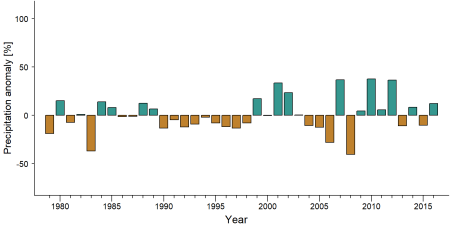
Precipitation anomaly in Lopé National Park -
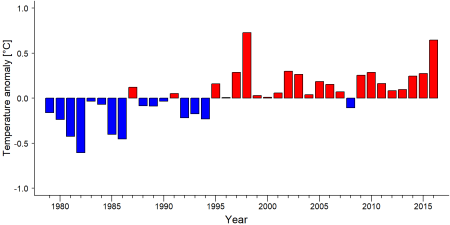
Temperature anomaly in Lopé National Park


External links
Station d’Etudes des Gorilles et Chimpanzes
Foraging profiles of sympatric lowland gorillas and chimpanzees in the Lopé Reserve, Gabon
References
Bush, E. R., Whytock, R. C., Bahaa-el-din, L., Bourgeois, S., Bunnefeld, N., Cardoso, A. W., …, & Abernethy, K. (2020). Long-term collapse in fruit availability threatens Central African forest megafauna. Science, 370(6521), 1219-1222. doi:10.1126/science.abc7791
Jeffery, K. J., Korte, L., Palla, F., Walters, G., White, L. J. T., & Abernethy, K. A. (2014). Fire management in a changing landscape: a case study from Lopé National Park, Gabon. PARKS, 20(1), 39-52. doi:10.2305/iucn.ch.2014.parks-20-1.kjj.en
University of Stirling. (2020). Stirling expert informs new study on chimpanzee behaviour. Retrieved from: https://www.stir.ac.uk/news/2020/09/stirling-expert-informs-new-study-on-chimpanzee-behaviour/
UNESCO. (n.d.). Ecosystem and Relict Cultural Landscape of Lopé-Okanda. Retrieved from: https://whc.unesco.org/en/list/1147/
IUCN - International Union for Conservation of Nature (2014). Regional Action Plan for the Conservation of Western Lowland Gorillas and Central Chimpanzees 2015–2025. International Union for Conservation of Nature. doi:10.2305/iucn.ch.2005.ssc-rap.1.en
UNESCO World Heritage Committee. (2016–2018). State of Conservation reports for Ecosystem and Relict Cultural Landscape of Lopé-Okanda (Gabon). Paris: UNESCO. link
UNEP-WCMC. (2007). Lopé-Okanda World Heritage Site Datasheet. Cambridge: UNEP-WCMC. link
Station d’Études des Gorilles et Chimpanzés (SEGC) (2010). Research and Monitoring Reports for Lopé National Park.
Bermejo, M., Rodríguez-Teijeiro, J. D., Illera, G., Barroso, A., Vilà, C., & Walsh, P. D. (2006). Ebola Outbreak Killed 5000 Gorillas. Science, 314(5805), 1564-1564. doi:10.1126/science.1133105
Kiyang, J. A., et al. (2022). Pathogen spillover risks to great apes in Gabon. Frontiers in Public Health, 10: 866723.
Centre International de Recherches Médicales de Franceville (CIRMF) (2020). Annual Report on Zoonotic Surveillance in Gabon.
WWF. (2015). Community-based conservation initiatives in Gabon. Libreville: WWF-Gabon.
White, L. J. T. (1994). Biomass of Rain Forest Mammals in the Lope Reserve, Gabon. The Journal of Animal Ecology, 63(3), 499. doi:10.2307/5217
Tutin, C. E. G., White, L. J. T., & Mackanga‐Missandzou, A. (1997). The Use by Rain Forest Mammals of Natural Forest Fragments in an Equatorial African Savanna. Conservation Biology, 11(5), 1190-1203. doi:10.1046/j.1523-1739.1997.96211.x
Kiribou, R., Tehoda, P., Chukwu, O., Bempah, G., Kühl, H. S., Ferreira, J., …, & Heinicke, S. (2024). Exposure of African ape sites to climate change impacts. PLOS Climate, 3(2), e0000345. doi:10.1371/journal.pclm.0000345
Page created by: APES Atlas Team Date: 2020-12-05
Page updated by: Aime Mizero Date: 2025-08-15