
Semenggoh Nature Reserve: Difference between revisions
No edit summary |
No edit summary |
||
| (4 intermediate revisions by the same user not shown) | |||
| Line 14: | Line 14: | ||
* Conservation activities have focused on orangutan rehabilitation, ecotourism, raising awareness and education. | * Conservation activities have focused on orangutan rehabilitation, ecotourism, raising awareness and education. | ||
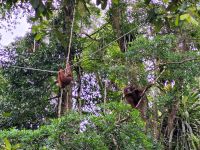
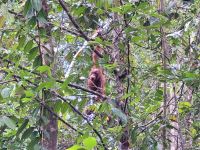
* Semi-wild orangutans inhabit the site. | * Semi-wild orangutans inhabit the site. | ||
<div><ul> <li style="display: inline-block;"> [[File: Orangutan_Semenggoh.jpg | 200px | thumb| none | © Isabel Ordaz-Nemeth]]<li style="display: inline-block;"> [[File: Orangutan2_Semenggoh.jpg | 200px | thumb| none | © Isabel Ordaz-Nemeth]]<li style="display: inline-block;"> [[File: Road_Semenggoh.jpg | 200px | thumb| none | Road to visitor center © Isabel Ordaz-Nemeth]]</ul></div> | <div><ul> <li style="display: inline-block;"> [[File: Orangutan_Semenggoh.jpg | 200px | thumb| none | © Isabel Ordaz-Nemeth]]<li style="display: inline-block;"> [[File: Orangutan2_Semenggoh.jpg | 200px | thumb| none | © Isabel Ordaz-Nemeth]]<li style="display: inline-block;"> [[File: Road_Semenggoh.jpg | 200px | thumb| none | Road to visitor center © Isabel Ordaz-Nemeth]]</ul></div> | ||
= Site characteristics = | = Site characteristics = | ||
| Line 66: | Line 62: | ||
|- | |- | ||
|''Pongo pygmaeus pygmaeus'' | |''Pongo pygmaeus pygmaeus'' | ||
| | |2023 | ||
| | | | ||
| | | | ||
| | | | ||
| | |29.0 | ||
|Semenggoh Nature Reserve | |Semenggoh Nature Reserve | ||
|Full count | |Full count | ||
| | | | ||
| | |Azizi Bin Ahmad Zaini pers. comm. 2023 | ||
| | | | ||
| | | | ||
|- | |- | ||
|''Pongo pygmaeus pygmaeus'' | |''Pongo pygmaeus pygmaeus'' | ||
| | |2016 | ||
| | | | ||
| | | | ||
| | | | ||
| | |27.0 | ||
|Semenggoh Nature Reserve | |Semenggoh Nature Reserve | ||
|Full count | |Full count | ||
| | | | ||
| | |[[#R01687|Tisen & Silang 2016]] | ||
| | | | ||
| | | | ||
| Line 109: | Line 105: | ||
|1.1 Residential areas | |1.1 Residential areas | ||
|High (more than 70% of population affected) | |High (more than 70% of population affected) | ||
|Habitat encroachment due to housing developments around the site, which also increase forest fragmentation (Ali 2021). | |Habitat encroachment due to housing developments around the site, which also increase forest fragmentation ([[#R01684|Ali 2021]]). | ||
|Ongoing (2021) | |Ongoing (2021) | ||
|- | |- | ||
| Line 115: | Line 111: | ||
|5.1 Hunting & collecting terrestrial animals | |5.1 Hunting & collecting terrestrial animals | ||
|Present (unknown severity) | |Present (unknown severity) | ||
|Poaching (Ali 2021). | |Poaching ([[#R01684|Ali 2021]]). | ||
|Ongoing (2021) | |Ongoing (2021) | ||
|- | |- | ||
| Line 121: | Line 117: | ||
|8.4 Pathogens | |8.4 Pathogens | ||
|Present (unknown severity) | |Present (unknown severity) | ||
|Risk of infection due to human presence, including Covid-19 (Ali 2021), and pulmonary diseases (Azizi Bin Ahmad Zaini pers. comm. 2023). | |Risk of infection due to human presence, including Covid-19 ([[#R01684|Ali 2021]]), and pulmonary diseases (Azizi Bin Ahmad Zaini pers. comm. 2023). | ||
|Ongoing (2023) | |Ongoing (2023) | ||
|} | |} | ||
| Line 129: | Line 125: | ||
= Conservation activities = | = Conservation activities = | ||
A rehabilitation program for orangutans was created at the site in 1975. By 1990 there was a growing population of semi-wild orangutans. Due to the small size of the site, the rehabilitation program was moved to Matang Wildlife Centre in 1998. The wildlife centre is active in conservation awareness and education for schools and the public (Tisen & Silang 2016). | A rehabilitation program for orangutans was created at the site in 1975. By 1990 there was a growing population of semi-wild orangutans. Due to the small size of the site, the rehabilitation program was moved to Matang Wildlife Centre in 1998. The wildlife centre is active in conservation awareness and education for schools and the public ([[#R01687|Tisen & Silang 2016]]). | ||
'''Table 4. Conservation activities reported for Semenggoh Nature Reserve''' | '''Table 4. Conservation activities reported for Semenggoh Nature Reserve''' | ||
| Line 159: | Line 155: | ||
|4 Education & awareness | |4 Education & awareness | ||
|4.1 Educate local communities about apes and sustainable use | |4.1 Educate local communities about apes and sustainable use | ||
|The wildlife centre is active in nature and wildlife awareness programs for schools and the public ([ | |The wildlife centre is active in nature and wildlife awareness programs for schools and the public ([[#R01686|SFC]]). | ||
| | | | ||
|1975-Ongoing (2023) | |1975-Ongoing (2023) | ||
| Line 167: | Line 163: | ||
|The site is a nature reserve. | |The site is a nature reserve. | ||
| | | | ||
|1975-Ongoing ( | |1975-Ongoing (2026) | ||
|- | |- | ||
|6 Species management | |6 Species management | ||
| Line 177: | Line 173: | ||
|6 Species management | |6 Species management | ||
|6.9 Rehabilitate injured/orphaned apes | |6.9 Rehabilitate injured/orphaned apes | ||
|Care of orangutans that have been injured in the forests, orphaned or kept illegally as pets. After rehabilitation, the animals would eventually be released back into the wild ([ | |Care of orangutans that have been injured in the forests, orphaned or kept illegally as pets. After rehabilitation, the animals would eventually be released back into the wild ([[#R01686|SFC]]). | ||
| | | | ||
|1975-2000 | |1975-2000 | ||
| Line 183: | Line 179: | ||
|8 Permanent presence | |8 Permanent presence | ||
|8.2 Run tourist projects and ensure permanent human presence at site | |8.2 Run tourist projects and ensure permanent human presence at site | ||
|The site is open to tourists and offers ecotourism activities ([ | |The site is open to tourists and offers ecotourism activities ([[#R01686|SFC]]). | ||
| | | | ||
|Ongoing (2023) | |Ongoing (2023) | ||
| Line 255: | Line 251: | ||
= Research activities = | = Research activities = | ||
A few studies have been conducted on the ecology and behavior of orangutans at Semenggoh, e.g., Wesley (2001) on the activity budget on orangutans, and Mohd-Rahmantullah (2001) on nesting ecology. | A few studies have been conducted on the ecology and behavior of orangutans at Semenggoh, e.g., [[#R01688|Wesley (2001)]] on the activity budget on orangutans, and [[#R01685|Mohd-Rahmantullah (2001)]] on nesting ecology. | ||
| Line 299: | Line 295: | ||
= References = | = References = | ||
<span id="R01684"></span>Ali, N. S. (2021, October 2). Not just survival of the fittest for orangutans in Sarawak reserve. Malaysia Now. https://www.malaysianow.com/news/2021/10/02/not-just-survival-of-the-fittest-for-orangutans-in-sarawak-reserve/ | |||
<span id="R01685"></span>Mohd-Rahmatullah, M. H. (2001). Nesting ecology of semi-wild orangutans at Semenggoh Wildlife Rehabilitation Centre, Sarawak [Undergraduate thesis]. Universiti Malaysia Sarawak. | |||
<span id="R01686"></span>Sarawak Forestry Corporation. (n.d.). Semenggoh Nature Reserve. https://semenggoh.my/about-us/ | |||
<span id="R01687"></span>Tisen, O. B., & Silang, S. (2016). Orangutan conservation in Sarawak, Malaysia [Conference abstract]. 15th National Peat Congress, Sarawak Forestry Corporation, Sarawak, Malaysia (Abstract No. A-394). | |||
<span id="R01688"></span>Wesley, M. N. (2001). Activity budget of mother-infant pairs of semi-wild orangutans at Semenggoh Wildlife Rehabilitation Centre [Undergraduate thesis]. Universiti Malaysia Sarawak. | |||
'''Page created by: '''Muhammad Azizi Bin Ahmad Zaini & APES Atlas Team''' Date:''' 2023-09-14 | '''Page created by: '''Muhammad Azizi Bin Ahmad Zaini & APES Atlas Team''' Date:''' 2023-09-14 | ||
Latest revision as of 20:10, 14 October 2026
Asia > Malaysia > Semenggoh Nature Reserve
Français | Português | Español | Bahasa Indonesia | Melayu
Summary
- Northwest Bornean orangutans (Pongo pygmaeus pygmaeus) are present in Semenggoh Nature Reserve.
- 27 individuals occur in the site.
- The orangutan population trend is stable.
- The site has a total size of 6.53 km².
- Key threats to orangutans are habitat encroachment and hunting.
- Conservation activities have focused on orangutan rehabilitation, ecotourism, raising awareness and education.
- Semi-wild orangutans inhabit the site.
-
© Isabel Ordaz-Nemeth -
© Isabel Ordaz-Nemeth -
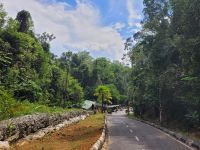
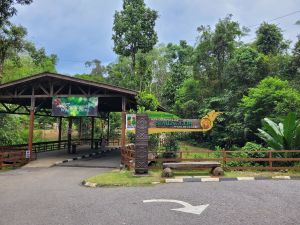
Road to visitor center © Isabel Ordaz-Nemeth


Site characteristics
The nature reserve is located in the Malaysian state of Sarawak, in the northwest of Borneo. The site was first designated as a Forest Reserve in 1920 and subsequently used as a botanical research plot (SFC). In 1975 the Semenggoh Wildlife Rehabilitation Centre was established as part of the reserve, with the aim of rehabilitating orangutans and other wildlife species in Sarawak (SFC). Semenggoh Forest Reserve was declared as Semenggoh Nature Reserve in 2000. In the same year, the Wildlife Rehabilitation Centre was renamed as the Semenggoh Wildlife Centre. The name is derived from the Semenggoh river, which runs through the reserve. Semi-wild orangutans inhabit the site; they spend most of the time roaming freely in the forest, but occasionally visit feeding platforms that are provisioned daily. In addition to orangutans, the site is also home to giant squirrels, pygmy squirrels, gibbons and a wide variety of birds (SFC).
Table 1. Basic site information for Semenggoh Nature Reserve
| Species | Pongo pygmaeus pygmaeus |
| Area | 6.53 km² |
| Coordinates | Lat: 1.392031 , Lon: 110.299506 |
| Type of site | Protected area (Nature Reserve) |
| Habitat types | Subtropical/tropical moist lowland forest |
| Type of governance |
Types of sites Governance types Habitat types

Ape status
Table 2. Ape population estimates reported for Semenggoh Nature Reserve
| Species | Year | Occurrence | Encounter or vistation rate (nests/km; ind/day) | Density estimate [ind./ km²] (95% CI) | Abundance estimate (95% CI) | Survey area | Sampling method | Analytical framework | Source | Comments | A.P.E.S. database ID |
|---|---|---|---|---|---|---|---|---|---|---|---|
| Pongo pygmaeus pygmaeus | 2023 | 29.0 | Semenggoh Nature Reserve | Full count | Azizi Bin Ahmad Zaini pers. comm. 2023 | ||||||
| Pongo pygmaeus pygmaeus | 2016 | 27.0 | Semenggoh Nature Reserve | Full count | Tisen & Silang 2016 |
Sampling methods Analytical frameworks
Threats
Table 3. Threats to apes reported for Semenggoh Nature Reserve
| Category | Specific threats | Threat level | Description | Year of threat |
|---|---|---|---|---|
| 1 Residential & commercial development | 1.1 Residential areas | High (more than 70% of population affected) | Habitat encroachment due to housing developments around the site, which also increase forest fragmentation (Ali 2021). | Ongoing (2021) |
| 5 Biological resource use | 5.1 Hunting & collecting terrestrial animals | Present (unknown severity) | Poaching (Ali 2021). | Ongoing (2021) |
| 8 Invasive & other problematic species, genes & diseases | 8.4 Pathogens | Present (unknown severity) | Risk of infection due to human presence, including Covid-19 (Ali 2021), and pulmonary diseases (Azizi Bin Ahmad Zaini pers. comm. 2023). | Ongoing (2023) |
Conservation activities
A rehabilitation program for orangutans was created at the site in 1975. By 1990 there was a growing population of semi-wild orangutans. Due to the small size of the site, the rehabilitation program was moved to Matang Wildlife Centre in 1998. The wildlife centre is active in conservation awareness and education for schools and the public (Tisen & Silang 2016).
Table 4. Conservation activities reported for Semenggoh Nature Reserve
| Category | Specific activity | Description | Implementing organization(s) | Year of activity |
|---|---|---|---|---|
| 2 Counter-wildlife crime | 2.3 Conduct regular anti-poaching patrols | Regular patrols to monitor orangutans, secure the reserve from trespassing and poaching (Azizi Bin Ahmad Zaini pers. comm. 2023). | Ongoing (2023) | |
| 3 Species health | 3.10 Treat sick/injured apes | In case of illness/injury, a veterinarian is available (Azizi Bin Ahmad Zaini pers. comm. 2023). | Ongoing (2023) | |
| 3 Species health | 3.3 Limit time that researchers/tourists are allowed to spend with habituated apes | Tourists are only allowed to watch orangutans twice a day for two hours each time (Azizi Bin Ahmad Zaini pers. comm. 2023). | Ongoing (2023) | |
| 4 Education & awareness | 4.1 Educate local communities about apes and sustainable use | The wildlife centre is active in nature and wildlife awareness programs for schools and the public (SFC). | 1975-Ongoing (2023) | |
| 5 Protection & restoration | 5.2 Legally protect ape habitat | The site is a nature reserve. | 1975-Ongoing (2026) | |
| 6 Species management | 6.4 Provide supplementary food for apes | Supplementary food is provided everyday twice a day (Azizi Bin Ahmad Zaini pers. comm. 2023). | Ongoing (2023) | |
| 6 Species management | 6.9 Rehabilitate injured/orphaned apes | Care of orangutans that have been injured in the forests, orphaned or kept illegally as pets. After rehabilitation, the animals would eventually be released back into the wild (SFC). | 1975-2000 | |
| 8 Permanent presence | 8.2 Run tourist projects and ensure permanent human presence at site | The site is open to tourists and offers ecotourism activities (SFC). | Ongoing (2023) |
-
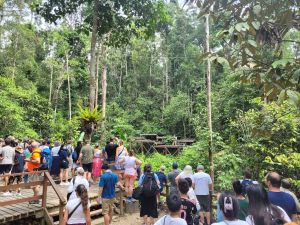
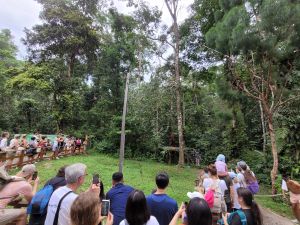
View to feeding platforms © Isabel Ordaz-Nemeth -
© Isabel Ordaz-Nemeth -
© Isabel Ordaz-Nemeth


Challenges
Ecotourism at the site brings both benefits and challenges; the main challenge is to ensure large numbers of tourists stay at the permitted distance from orangutans in the occasions when orangutans appear by the road in the reserve and not on the feeding platforms (Azizi Bin Ahmad Zaini pers. comm. 2023).
Table 5. Challenges reported for Semenggoh Nature Reserve
| Challenges | Specific challenges | Source | Year(s) |
|---|---|---|---|
| 4 Institutional support | 4.1 Lack of law enforcement | Azizi Bin Ahmad Zaini pers. comm. 2023 |

Enablers
Table 6. Enablers reported for Semenggoh Nature Reserve
| Enablers | Specific enablers | Source | Year(s) |
|---|---|---|---|
| 1 Site management | |||
| 2 Resources and capacity | |||
| 3 Engaged community | |||
| 4 Institutional support | |||
| 5 Ecological context | |||
| 6 Safety and stability |
Research activities
A few studies have been conducted on the ecology and behavior of orangutans at Semenggoh, e.g., Wesley (2001) on the activity budget on orangutans, and Mohd-Rahmantullah (2001) on nesting ecology.
Documented behaviours
Table 7. Behaviours documented for Semenggoh Nature Reserve
| Category | Behavior | Observation type | Prevalence | Observation dates | Source | Habituation | Species | Comment |
|---|---|---|---|---|---|---|---|---|
| Not reported |
Exposure to climate change impacts
External links
References
Ali, N. S. (2021, October 2). Not just survival of the fittest for orangutans in Sarawak reserve. Malaysia Now. https://www.malaysianow.com/news/2021/10/02/not-just-survival-of-the-fittest-for-orangutans-in-sarawak-reserve/
Mohd-Rahmatullah, M. H. (2001). Nesting ecology of semi-wild orangutans at Semenggoh Wildlife Rehabilitation Centre, Sarawak [Undergraduate thesis]. Universiti Malaysia Sarawak.
Sarawak Forestry Corporation. (n.d.). Semenggoh Nature Reserve. https://semenggoh.my/about-us/
Tisen, O. B., & Silang, S. (2016). Orangutan conservation in Sarawak, Malaysia [Conference abstract]. 15th National Peat Congress, Sarawak Forestry Corporation, Sarawak, Malaysia (Abstract No. A-394).
Wesley, M. N. (2001). Activity budget of mother-infant pairs of semi-wild orangutans at Semenggoh Wildlife Rehabilitation Centre [Undergraduate thesis]. Universiti Malaysia Sarawak.
Page created by: Muhammad Azizi Bin Ahmad Zaini & APES Atlas Team Date: 2023-09-14